
UNITED STATES
SECURITIES AND EXCHANGE COMMISSION
WASHINGTON, D.C. 20549
FORM
(Mark One)
OR
For the fiscal year ended
OR
OR
Date of event requiring this shell company report
For the transition period from to
Commission file number:
(Exact name of Registrant as specified in its charter)
N/A
(Translation of Registrant’s name into English)
(Jurisdiction of incorporation or organization)
(Address of principal executive offices)
E-mail:
Telephone:
(Name, Telephone, Email and/or Facsimile number and Address of Company Contact Person)
Securities registered or to be registered pursuant to Section 12(b) of the Act.
| Title of each class | Trading Symbol | Name of each exchange | ||
Securities registered or to be registered pursuant to Section 12(g) of the Act.
None
(Title of Class)
Securities for which there is a reporting obligation pursuant to Section 15(d) of the Act.
None
(Title of Class)
Indicate the number of outstanding shares of each of the issuer’s classes of capital or common stock as of the close of the period covered by the annual report:
As of December 31, 2025, there were
Indicate by check mark if the registrant is a
well-known seasoned issuer, as defined in Rule 405 of the Securities Act. ☐
Yes ☒
If this report is an annual or transition report,
indicate by check mark if the registrant is not required to file reports pursuant to Section 13 or 15(d) of the Securities Exchange Act
of 1934. ☐ Yes ☒
Note – Checking the box above will not relieve any registrant required to file reports pursuant to Section 13 or 15(d) of the Securities Exchange Act of 1934 from their obligations under those Sections.
Indicate by check mark whether the registrant
(1) has filed all reports required to be filed by Section 13 or 15(d) of the Securities Exchange Act of 1934 during the preceding 12 months
(or for such shorter period that the registrant was required to file such reports), and (2) has been subject to such filing requirements
for the past 90 days. ☒
Indicate by check mark whether the registrant
has submitted electronically every Interactive Data File required to be submitted pursuant to Rule 405 of Regulation S-T (§232.405
of this chapter) during the preceding 12 months (or for such shorter period that the registrant was required to submit such files). ☒
Indicate by check mark whether the registrant is a large accelerated filer, an accelerated filer, a non-accelerated filer, or an emerging growth company. See definition of “large accelerated filer,” “accelerated filer,” and “emerging growth company” in Rule 12b-2 of the Exchange Act.
| Large accelerated filer | ☐ | Accelerated filer | ☐ | |
| ☒ | Emerging growth company |
If an emerging growth company that prepares its
financial statements in accordance with U.S. GAAP, indicate by check mark if the registrant has elected not to use the extended transition
period for complying with any new or revised financial accounting standards provided pursuant to Section 13(a) of the Exchange Act.
| † | The term “new or revised financial accounting standard” refers to any update issued by the Financial Accounting Standards Board to its Accounting Standards Codification after April 5, 2012. |
Indicate by check mark whether the registrant
has filed a report on and attestation to its management’s assessment of the effectiveness of its internal control over financial
reporting under Section 404(b) of the Sarbanes-Oxley Act (15 U.S.C. 7262(b)) by the registered public accounting firm that prepared or
issued its audit report.
If securities are registered pursuant to Section
12(b) of the Act, indicate by check mark whether the financial statements of the registrant included in the filing reflect the correction
of an error to previously issued financial statements.
Indicate by check mark whether any of those error corrections are restatements that required a recovery analysis of incentive-based compensation received by any of the registrant’s executive officers during the relevant recovery period pursuant to §240.10D-1(b). ☐
Indicate by check mark which basis of accounting the registrant has used to prepare the financial statements included in this filing:
| | International Financial Reporting Standards as issued by the International Accounting Standards Board ☐ | Other ☐ |
If “Other” has been checked in response to the previous question, indicate by check mark which financial statement item the registrant has elected to follow. Item 17 ☐ Item 18 ☐
If this is an annual report, indicate by check
mark whether the registrant is a shell company (as defined in Rule 12b-2 of the Exchange Act). ☐
Yes
(APPLICABLE ONLY TO ISSUERS INVOLVED IN BANKRUPTCY PROCEEDINGS DURING THE PAST FIVE YEARS)
Indicate by check mark whether the registrant has filed all documents and reports required to be filed by Sections 12, 13 or 15(d) of the Securities Exchange Act of 1934 subsequent to the distribution of securities under a plan confirmed by a court. ☐ Yes ☐ No
TABLE OF CONTENTS
i
INTRODUCTION
Unless otherwise indicated or the context otherwise requires, references in this annual report on Form 20-F to:
| ● | “Antalpha,” “we,” “us,” “our company” and “our” are to Antalpha Platform Holding Company, our Cayman Islands holding company and its subsidiaries; |
| ● | “Bitmain” are to Bitmain Technologies, Ltd., a world-leading cryptocurrency mining hardware manufacturer; |
| ● | “Northstar” are to Northstar Digital (HK) Limited, a company incorporated under the laws of Hong Kong and its affiliates; |
| ● | “Parent Company” are to our parent company, Antalpha Holding Company, a company incorporated under the laws of the Cayman Islands; |
| ● | “shares” or “ordinary shares” are to our Class A and Class B ordinary shares, par value $0.001 per share; |
| ● | “USD,” “US$,” “U.S. dollars,” “$,” and “dollars” are to the legal currency of the United States; |
| ● | “USDC” are to USD Coin, a stablecoin issued by Circle Internet Financial Limited; |
| ● | “USDT” are to Tether, a stablecoin issued by Tether Operations Limited, a member of the Tether Group; and |
| ● | “XAUt” or “Tether Gold” are to Tether Gold, a digital token issued by TG Commodities Limited, a member of the Tether Group. |
Due to rounding, numbers presented throughout this annual report may not add up precisely to the totals provided and percentages may not precisely reflect the absolute figures.
ii
FORWARD-LOOKING INFORMATION
This annual report on Form 20-F contains forward-looking statements that reflect our current expectations and views of future events. All statements other than statements of current or historical facts are forward-looking statements. These statements involve known and unknown risks, uncertainties and other factors that may cause our actual results, performance or achievements to be materially different from those expressed or implied by the forward-looking statements.
You can identify some of these forward-looking statements by words or phrases such as “may,” “might,” “will,” “would,” “expect,” “anticipate,” “aim,” “estimate,” “intend,” “plan,” “believe,” “is/are likely to,” “potential,” “continue” or other similar expressions. We have based these forward-looking statements largely on our current expectations and projections about future events that we believe may affect our financial condition, results of operations, business strategy and financial needs. These forward-looking statements include statements relating to:
| ● | our mission, goals and strategies; |
| ● | our future business development, financial condition and results of operations; |
| ● | the expected growth of our industry; |
| ● | our expectations regarding demand for and market acceptance of our services and solutions; |
| ● | competition in our industry; |
| ● | our proposed use of proceeds from our initial public offering; |
| ● | relevant government policies and regulations relating to our business and industry; |
| ● | general economic and business conditions globally and in jurisdictions where we operate; and |
| ● | assumptions underlying or related to any of the foregoing. |
These forward-looking statements involve various risks and uncertainties. Although we believe that our expectations expressed in these forward-looking statements are reasonable, our expectations may later be found to be incorrect. Our actual results could be materially different from our expectations. Important risks and factors that could cause our actual results to be materially different from our expectations are generally set forth in “Item 3. Key Information—D. Risk Factors,” “Item 4. Information on the Company—B. Business Overview,” “Item 5. Operating and Financial Review and Prospects,” and other sections in this annual report. You should read this annual report and the documents that we refer to thoroughly with the understanding that our actual future results may be materially different from and worse than what we expect. We qualify all of our forward-looking statements by these cautionary statements.
The forward-looking statements made in this annual report relate only to events or information as of the date on which the statements are made in this annual report. Except as required by law, we undertake no obligation to update or revise publicly any forward-looking statements, whether as a result of new information, future events or otherwise, after the date on which the statements are made or to reflect the occurrence of unanticipated events. You should read this annual report and the documents that we refer to in this annual report and have filed as exhibits to this annual report completely and with the understanding that our actual future results may be materially different from what we expect.
iii
Part I
ITEM 1. IDENTITY OF DIRECTORS, SENIOR MANAGEMENT AND ADVISERS
Not applicable.
ITEM 2. OFFER STATISTICS AND EXPECTED TIMETABLE
Not applicable.
ITEM 3. KEY INFORMATION
A. [RESERVED]
B. CAPITALIZATION AND INDEBTEDNESS
Not applicable.
C. REASONS FOR THE OFFER AND USE OF PROCEEDS
Not applicable.
D. RISK FACTORS
Summary of Risk Factors
Risks Related to Our Business
We are subject to risks and uncertainties related to our business, including, but not limited to, the following:
| ● | We have a limited operating history. Our business lines are nascent, not fully proven and subject to material legal, regulatory, operational, reputational, tax and other risks in every jurisdiction we operate and are not assured to be profitable. |
| ● | Our operating results have and will continue to significantly fluctuate, including due to the highly volatile nature of the digital asset economy. |
| ● | Our results of operations have been and are expected to continue to be significantly impacted by the expected economic returns of Bitcoin mining, which in turn are significantly affected by the prices of Bitcoin and the macroeconomic condition of the cryptoeconomy. |
| ● | We derive a significant portion of our revenues from financing activities relating to the purchase of Bitcoin mining machines. If the market for Bitcoin mining machines ceases to exist or diminishes significantly, our business and results of operations would be materially harmed. |
| ● | We may experience variability in our future earnings as a result of our digital gold holdings. |
| ● | Our business is closely tied to the development of the Bitcoin mining industry, and the operations and financial condition of Bitmain, whose machines make up the subjects of all of our machine financing; if the Bitcoin mining industry and/or Bitmain confronts a slowdown or downturn, our business may also slow down or face a downturn. |
1
| ● | If we are unable to maintain or increase the amount of loans we enable or if we are unable to retain existing borrowers or attract new borrowers, our business, financial condition and results of operations will be adversely affected. |
| ● | Our existing portfolio is, and our future portfolio may be, concentrated in a limited number of customers and loans, which subjects us to an increased risk of significant loss if any asset held as collateral declines in value or if a particular borrower or loan fails to perform as expected. |
| ● | Our success and future growth depend significantly on our marketing efforts and we have benefited significantly from our partnership with Bitmain in marketing our services. If we are unable to maintain our relationship and partnership with Bitmain, or otherwise unable to acquire customers or promote or maintain our brands in an effective and cost-efficient way, our business and financial results may be harmed. |
| ● | Our sources of funding are highly concentrated. Our primary funding partner, Northstar, has historically provided almost all of the funding for the loans we originated. We cannot guarantee that we will have continued access to sufficient and sustainable funding at commercially attractive costs. |
| ● | In addition to our headquarters in Singapore, we have operations in Hong Kong. The regulatory environment in mainland China and Hong Kong is complex and evolving, and changes in the economic, political or social conditions or government policies of mainland China or Hong Kong could have a material adverse effect on our business and operations. Moreover, our business is closely tied to the operations and financial condition of Bitmain, and Northstar is our primary funding partner. To the extent Bitmain or Northstar are perceived or deemed to be China-based companies, they could face significant risks and uncertainties that are inherent in operating in China. If these risks or uncertainties were to materialize, our business, results of operations, financial condition, and future prospects could be materially and adversely affected. |
Risks Related to Digital Assets
We are subject to risks and uncertainties related to our digital assets, including, but not limited to, the following:
| ● | The future development and growth of the digital asset industry is subject to a variety of factors that are difficult to predict and evaluate. If the digital asset industry does not grow as we expect, our business, operating results, and financial condition could be adversely affected. |
| ● | We are subject to risks related to stablecoins and digital tokens. |
| ● | Many digital asset transactions are irrevocable, and stolen or incorrectly transferred digital assets may be irretrievable. |
Risks Related to Regulations
We are subject to risks and uncertainties related to regulations in general, including, but not limited to, the following:
| ● | We are subject to an extensive, rapidly evolving and uncertain regulatory landscape, and any adverse changes to, or our failure to comply with, any laws and regulations could adversely affect our brand, reputation, business, operating results, and financial condition. |
| ● | Our loans are secured by digital assets that are, and will be, subject to extensive regulations, such that if such collateral was foreclosed upon those regulations may result in significant costs and materially and adversely affect our business, financial condition, liquidity and results of operations. |
| ● | A particular digital asset, product or service’s status as a “security” in any relevant jurisdiction is subject to a high degree of uncertainty. |
| ● | A determination that a digital asset is a “security”, or that an activity in which we engage involves a “security” transaction for purposes of the U.S. federal securities laws or the laws of any relevant jurisdiction could have material and adverse regulatory consequences for us. |
2
| ● | If we are unable to properly characterize the status of any digital asset as a “security”, we may be subject to regulatory scrutiny, inquiries, investigations, fines, and other penalties, which may adversely affect our business, operating results, and financial condition. |
| ● | The digital asset economy is still novel. As a result, policymakers are just beginning to consider what a regulatory regime for digital assets would look like and the elements that would serve as the foundation for such a regime. This less-developed consideration of digital assets may harm our ability to effectively react to proposed legislation and regulation of digital assets or digital asset platforms adverse to our business. |
| ● | Current and future legislation and rulemaking regarding digital assets may result in extraordinary, non-recurring expenses and could have a material adverse effect on our business, financial condition and results of operations. |
Risks Related to Ownership of Our Class A Ordinary Shares
We are subject to risks and uncertainties related to our ordinary shares, including, but not limited to, the following:
| ● | The market price of our Class A ordinary shares may be volatile, and could decline significantly and rapidly. Market volatility may affect the value of an investment in our Class A ordinary shares and could subject us to litigation. |
| ● | We are and will remain a holding company. Our sole material asset is and will be our equity interest in our operating subsidiaries, and as such, we depend and will depend on our subsidiaries for cash to fund all of our expenses and to pay dividends, if any. |
| ● | If we are deemed an “investment company” under the Investment Company Act of 1940, it could adversely affect the price of the Class A ordinary shares and could materially and adversely affect our business, results of operations, and financial condition. |
| ● | We are not subject to legal and regulatory obligations that apply to investment companies such as mutual funds and exchange-traded funds, or to obligations applicable to investment advisers. |
| ● | There is a significant risk that we will be classified as a passive foreign investment company for U.S. federal income tax purposes, which could result in adverse U.S. federal income tax consequences to U.S. Holders of our ordinary shares. |
Risks Related to Our Business
We have a limited operating history. Our business lines are nascent, not fully proven and subject to material legal, regulatory, operational, reputational, tax and other risks in every jurisdiction we operate and are not assured to be profitable.
We commenced our operations in 2022, and we and our subsidiaries have a limited operating history on which an investor might evaluate our performance. For example, our mining machine loans, as well as hashrate loans that are bundled with mining machine loans, generally have a term of two years. As of the date of this annual report, a significant number of these loans have not yet reached their respective maturity dates and the borrowers have the option to make early loan repayment without penalty. As a result, we are subject to many of the risks common to early-stage enterprises, including under-capitalization, cash shortages, limitations with respect to personnel, financial and other resources and lack of revenues, any of which could have a material adverse effect on us and may force us to reduce or curtail operations. Due to our limited operating history, our business model has not been fully proven and we have limited financial data that can be used to evaluate our current business and future prospects, which subjects us to a number of uncertainties, including our ability to plan for, model and manage future growth and risks. Our historical revenue growth should not be considered indicative of our future performance. There is no assurance that we will be successful in achieving a return on shareholders’ investment and the likelihood of success must be considered in light of the early stage of operations. Even if we accomplish these objectives, we may not generate the anticipated positive cash flows or profits. No assurance can be given that we will ever be successful in our operations and operate profitably.
3
Furthermore, our business lines, which are limited to supply chain financing in connection with Bitcoin mining and other technology platform services, are nascent, not fully proven and subject to material legal, regulatory, operational, reputational, tax and other risks in every jurisdiction in which we operate and are not assured to be profitable. We may fail to implement our business strategies, achieve our business objectives, effectively operate or develop our business lines or produce a return for our investors.
In addition, our revenues and costs may fluctuate due to start-up costs associated with new businesses or products and services while revenues may take time to develop, which may adversely impact our results of operations. If we are unable to successfully manage our business while reducing expenses, our ability to continue in business could depend on the ability to raise sufficient additional capital, obtain sufficient financing and monetize assets. The occurrence of any of the foregoing risks would have a material adverse effect on our financial results, business and prospects.
Our operating results have and will continue to significantly fluctuate, including due to the highly volatile nature of the digital asset economy.
Our operating results are, to a significant degree, dependent on the value of digital assets and the broader digital asset economy. We provide financing to participants in the Bitcoin mining industry. Our loans are typically settled in USDT and are secured by Bitcoin and Bitcoin mining machines. Due to the highly volatile nature of the digital asset economy and the prices of digital assets, which have experienced and continue to experience significant volatility, our operating results have, and will continue to, fluctuate significantly from quarter to quarter in accordance with market sentiments and movements in the broader digital asset economy. Our operating results will continue to fluctuate significantly as a result of a variety of factors, many of which are unpredictable and in certain instances are outside of our control, including:
| ● | our dependence on offerings that are dependent on digital asset trading activity, including trading volume and the prevailing trading prices for digital assets, whose trading prices and volume can be highly volatile; |
| ● | changes in the legislative or regulatory environment, or actions by U.S. or foreign governments, authorities or regulators, including fines, orders, or consent decrees; |
| ● | political, legislative or regulatory changes or scrutiny that impact our ability to offer certain products or services; |
| ● | the impact of environmental, social and governance concerns surrounding digital assets; |
| ● | market conditions of, and overall sentiment towards Bitcoin, other crypto and digital assets, and the broader digital asset economy; |
| ● | macroeconomic conditions, including interest rates, inflation, instability in the global banking system and institutions in the digital asset economy, as well as the demand for financial services products generally; |
| ● | our ability to establish and maintain partnerships, collaborations, joint ventures, or strategic alliances with third parties; |
| ● | disputes with our business partners, customers or regulators, adverse legal proceedings or regulatory enforcement actions, judgments, settlements, or other legal proceeding and enforcement-related costs; |
| ● | our ability to attract, maintain, and grow our customer base and engage our customers; |
| ● | investments we make in the development of products and services, international expansion, and sales and marketing; |
4
| ● | the development and introduction of existing and new products and services by us or our competitors; |
| ● | pricing for or temporary suspensions of our products and services; |
| ● | our ability to control costs, including our operating expenses incurred to grow and expand our operations and to remain competitive; |
| ● | system failure or outages, including with respect to third-party crypto asset networks, breaches of security or privacy or any inaccessibility of the third-party crypto asset networks due to our or third-party actions; |
| ● | breaches of security or privacy; |
| ● | changes in the overall tax rate for our business, changes in tax laws or judicial or regulatory interpretations of tax laws; |
| ● | changes in accounting standards, policies, guidance and interpretations or principles; |
| ● | changes in requirements imposed on us by regulators or by our business partners, including any new licensing requirements; |
| ● | our ability to attract and retain talent; and |
| ● | our ability to compete with our competitors. |
As a result of these factors, it is difficult for us to forecast growth trends accurately and our business and future prospects are difficult to evaluate, particularly in the short term. In view of the rapidly evolving nature of our business and the digital asset economy, period-to-period comparisons of our operating results may not be meaningful, and you should not rely upon them as an indication of future performance. Quarterly and annual expenses reflected in our financial statements may be significantly different from historical or projected rates. Our operating results in one or more future quarters may fall below the expectations of securities analysts and investors. As a result, the trading price of our Class A ordinary shares may increase or decrease significantly.
Our results of operations have been and are expected to continue to be significantly impacted by the expected economic returns of Bitcoin mining, which in turn are significantly affected by the prices of Bitcoin and the macroeconomic condition of the cryptoeconomy.
Our revenues are primarily derived from the provision of supply chain financing solutions to institutional and corporate participants in the Bitcoin mining industry, offering loans secured by Bitcoin and Bitcoin mining machines. The loans we offer include mining machine loans to finance the purchase of on-rack mining machines as well as hashrate loans to our customers to finance expenditures on mining-related services, including the hosting services. The demand for Bitcoin mining machines and the incurrence of mining-related expenditures is primarily driven by the expected economic returns of Bitcoin mining. An increase in the price of Bitcoin is one of the significant factors that could increase the expected economic returns generated by Bitcoin mining activities and stimulate the demand for and technology financing fees charged on Bitcoin supply chain financing.
5
The price of crypto assets has fluctuated significantly in the past few years and resulted in corresponding fluctuations on the sale of Bitcoin mining machines and on the demand for related financing. For instance, in 2017 and in 2021, the value of certain crypto assets, including Bitcoin, experienced steep increases in value. These increases were followed by a steep decline in 2018 and again in 2022, before the value of crypto assets began to increase once more towards the end of 2023. Bitcoin reached new all-time highs in late 2024 and continued to trend upward into 2025, albeit with periodic corrections, before entering a phase of heightened volatility and pullbacks in late 2025 and early 2026. Our business mainly involves Bitcoin and stablecoins, and the price and trading volume of crypto assets are subject to significant uncertainty and volatility, depending on a number of factors, including:
| ● | market conditions of, and overall sentiment towards, digital assets and the broader digital asset economy, including, but not limited to, as a result of actions taken by or developments of other companies in the digital asset economy; |
| ● | changes in liquidity, market-making volume, and trading activities; |
| ● | trading activities on crypto platforms worldwide, many of which may be unregulated, and may include manipulative activities; |
| ● | investment and trading activities of highly active consumer and institutional users, speculators, miners, and investors; |
| ● | the speed and rate at which crypto assets are able to gain adoption as a medium of exchange, utility token, store of value, consumptive asset, or other use case worldwide, if at all; |
| ● | decreased user and investor confidence in digital assets and crypto platforms; |
| ● | negative publicity and events relating to the digital asset economy and crypto platforms; |
| ● | unpredictable social media coverage or “trending” of, or other rumors and market speculation regarding, digital assets and the broader digital asset economy; |
| ● | the ability for digital assets to meet user and investor demands; |
| ● | the functionality and utility of digital assets and their associated ecosystems and networks, including digital assets designed for use in various applications; |
| ● | consumer preferences and perceived value of digital assets and digital asset markets; |
| ● | increased competition from other payment services or other digital assets that exhibit better speed, security, scalability, or other characteristics; |
| ● | adverse legal proceedings or regulatory enforcement actions, judgments, or settlements impacting digital asset economy participants; |
| ● | regulatory or legislative changes, scrutiny and updates affecting the digital asset economy; |
| ● | the characterization of digital assets under the laws of various jurisdictions around the world; |
| ● | the adoption of unfavorable taxation policies on digital asset investments by governmental entities; |
| ● | the maintenance, troubleshooting, and development of the blockchain networks underlying digital assets, including by miners, validators, and developers worldwide; |
| ● | the ability for crypto networks to attract and retain miners or validators to secure and confirm transactions accurately and efficiently; |
| ● | legal and regulatory changes affecting the operations of miners and validators of blockchain networks, including limitations and prohibitions on mining activities, or new legislative or regulatory requirements as a result of growing environmental concerns around the use of energy in Bitcoin and other proof-of-work mining activities; |
| ● | the activities of stablecoin issuers, the ability of stablecoin issuers to substitute underlying assets to back the stablecoins or the decline in value of those underlying assets and future actions relating to the regulatory or accounting treatment of stablecoins; |
6
| ● | ongoing technological viability and security of digital assets and their associated smart contracts, applications and networks, including vulnerabilities against hacks and scalability; |
| ● | fees and speed associated with processing digital asset transactions, including on the underlying blockchain networks and on crypto platforms; |
| ● | financial strength of market participants; |
| ● | the availability and cost of funding and capital; |
| ● | liquidity and credit risk of crypto platforms, including crypto exchanges, stablecoin issuers and crypto payment companies; |
| ● | interruptions or temporary suspensions or other compulsory restrictions in products or services from or failures of major crypto platforms; |
| ● | the availability of an active derivatives market for various digital assets; |
| ● | the availability of banking and payment services to support crypto-related projects; |
| ● | instability in the global banking system; |
| ● | the level of interest rates and inflation; |
| ● | monetary policies of governments, trade restrictions, and fiat currency devaluations; and |
| ● | national and international economic, political and geopolitical conditions. |
There is no assurance that any crypto asset will maintain its value or that there will be sustained volume and liquidity in the trading markets of crypto assets.
Given that crypto assets, including Bitcoin, have historically experienced significant price volatility, and Bitcoin represents a substantial portion of our current collateral position, any significant reductions in the price of Bitcoin or changes in network transaction fees, and/or the maintenance of a lower Bitcoin price for an extended term will likely have a material and adverse effect on our results of operations and financial condition. For example, if the price of Bitcoin or Bitcoin network transaction fees drop and fail to recover, the expected economic return of Bitcoin mining activities will diminish, thereby resulting in a decrease in demand for Bitcoin mining machines and in the need for funding to purchase such machines. At the same time, if transaction fees increase to such an extent as to discourage users from using Bitcoin as a medium of exchange or an asset for storage of value, it may decrease the transaction volume of the Bitcoin network and may affect the demand for Bitcoin mining machines and therefore the need for funding to purchase such machines. A drop in the price of Bitcoin or the value of other crypto assets may also result in a reduction of the value of our collaterals to below the outstanding loan value. We cannot assure you that Bitcoin price will remain high enough to sustain our operations or that the price of Bitcoin will not decline significantly in the future. Further, fluctuations in the price of Bitcoin can have an immediate impact on the trading price of our Class A ordinary shares even before our financial performance is affected, if at all.
In addition to the volatility of the price of Bitcoin, various other factors, mostly beyond our control, could impact the expected economic returns of Bitcoin mining, including, among others, the overall imbalanced supply and demand for mining machines, the supply and availability of mining farm resources, changes in electricity costs or other operating costs, the total network computing power, the cost-efficiency and the depreciation of mining machines, and a variety of special economic, geopolitical and regulatory factors. Additionally, any shortage of power supply due to government control measures or other reasons, and any increase in energy costs, would raise the costs of Bitcoin mining. This in turn could affect our customers’ expected economic return for mining activities and the demand for and pricing of mining machines. A drop in the price of Bitcoin could also cause our customers to be less willing to make repayments.
7
We derive a significant portion of our revenues from financing activities relating to the purchase of Bitcoin mining machines. If the market for Bitcoin mining machines ceases to exist or diminishes significantly, our business and results of operations would be materially harmed.
We generated and expect to continue to generate a significant portion of our revenues from the provision of supply chain financing solutions to institutional and corporate participants in the Bitcoin mining industry. If the market for Bitcoin mining machines ceases to exist or diminishes significantly, we could experience a significant loss. Adverse factors that may affect the market for Bitcoin mining machines include:
| ● | any other crypto asset displaces Bitcoin as the mainstream crypto asset, thereby causing Bitcoin to lose value or become worthless; |
| ● | Bitcoin fails to gain wide market acceptance and fails to become a generally accepted medium of exchange or asset for storage of value in the global economy due to certain inherent limitations to crypto assets or is displaced by another crypto asset as the mainstream, thereby causing Bitcoin to lose value or become worthless, which could adversely affect the sustainability of our business; |
| ● | the reduction in mining rewards of Bitcoin, including block reward halving events, which are events that occur after a specific period of time and reduce the block reward earned by miners. Specifically, the method for creating new Bitcoin is mathematically controlled in a manner so that the supply of Bitcoin grows at a limited rate pursuant to a pre-set schedule. The number of Bitcoin awarded for solving a new block is automatically halved every 210,000 blocks. Thus, the current fixed reward for solving a new block is 3.125 bitcoin per block. The reward decreased from 6.25 bitcoin in May 2020 to 3.125 bitcoin in April 2024; the next estimated halving is expected to occur in 2028. This deliberately controlled rate of Bitcoin creation means that the number of Bitcoin in existence will never exceed 21,000,000, and that Bitcoin cannot be devalued through excessive production unless the Bitcoin Network’s source code (and the underlying protocol for Bitcoin issuance) is altered. As of December 31, 2025, approximately 20.0 million Bitcoin are outstanding. The date when the 21 million Bitcoin limitation will be reached is estimated to be the year 2140; |
| ● | negative public sentiment related to the actual or perceived environmental impact of Bitcoin and related activities, including environmental concerns raised by private individuals and governmental actors related to the energy Bitcoin consumed in the Bitcoin mining process; |
| ● | negative public sentiment related to the actual or perceived value of crypto assets, especially Bitcoin and stablecoins, as a storage of value and digital asset economy participants’ confidence in and expectation of the safety and security of crypto assets; |
| ● | disruptions, hacks, and splits in the underlying networks also known as “forks,” attacks by malicious actors who control a significant portion of the networks’ hash rate such as double spend or 51% attacks, or other similar incidents affecting the Bitcoin blockchain network; |
| ● | hard “forks” resulting in the creation of and divergence into multiple separate networks, such as Bitcoin cash; |
| ● | informal governance led by Bitcoin’s core developers that leads to revisions to the underlying source code or inactions that prevent network scaling, and which evolve over time largely based on self-determined participation, which may result in new changes or updates that affect their speed, security, usability, or value; |
| ● | the reduced ability for Bitcoin blockchain networks to resolve significant scaling challenges and increase the volume and speed of transactions; |
| ● | a slowdown in the iteration of Bitcoin mining machines or reduced ability of future mining machine upgrades to provide significant performance improvement over existing models in the market, resulting in lower or no demand for the purchase of new mining machines; |
8
| ● | the reduced ability to attract and retain developers and customers to use Bitcoin for payment, store of value, unit of accounting, and other intended uses; |
| ● | transaction congestion and fees associated with processing transactions on the Bitcoin network; |
| ● | the identification of Satoshi Nakamoto, the pseudonymous person or persons who developed Bitcoin, or the transfer of Satoshi’s Bitcoin; |
| ● | negative perception of Bitcoin; |
| ● | development in mathematics, technology, including in digital computing, algebraic geometry, and quantum computing that could result in the cryptography being used by Bitcoin becoming insecure or ineffective; |
| ● | adverse legal proceedings or regulatory enforcement actions, judgments, or settlements impacting digital asset economy participants; |
| ● | regulatory, legislative or other compulsory or informal restrictions or limitations on Bitcoin lending, mining or staking activities; |
| ● | liquidity and credit risk issues experienced by other crypto platforms and other participants of the digital asset economy; and |
| ● | laws and regulations affecting the Bitcoin network or access to these networks, including a determination that Bitcoin constitutes a security or other regulated financial instrument under the laws of any jurisdiction. |
If the scale or profitability on the sale of new Bitcoin mining machines, or the economics on the purchase of new machines for miners, cannot be maintained, our business, results of operations and financial condition will materially suffer.
We may experience variability in our future earnings as a result of our digital gold holdings.
We may experience variability in our future earnings as a result of holding or selling substantial amounts of digital gold, including, but not limited to, digital gold tokens such as XAUt. Digital gold tokens, including XAUt, are designed to represent ownership of physical gold; however, their market price may be influenced by factors beyond the price of gold itself, such as liquidity, market sentiment, and regulatory developments.
The price of XAUt has historically been subject to significant price fluctuations and is highly volatile. This volatility may result from various factors, including changes in the global gold market, fluctuations in cryptocurrency markets, macroeconomic conditions, geopolitical events, and shifts in investor demand for digital assets. As a result, the value of our XAUt holdings may fluctuate significantly over short periods of time, which could lead to substantial gains or losses in our reported earnings.
Our XAUt holdings are expected to significantly affect our financial results, and if we continue to increase our overall holdings of XAUt in the future, they will have an even greater impact on our financial results and the market price of our Class A ordinary shares. For example, increases in the price of XAUt may result in unrealized gains, while decreases in the price of XAUt may result in unrealized or realized losses, depending on whether we hold or sell the tokens. These fluctuations may cause our quarterly and annual financial results to vary materially from period to period, making it difficult for investors to accurately assess our underlying business performance.
Furthermore, any significant changes in the value of our digital gold holdings may also affect investor perception of our company and contribute to increased volatility in the market price of our Class A ordinary shares. If we continue to increase our exposure to XAUt or other digital gold tokens, the potential impact of price volatility on our financial results and the market price of our Class A ordinary shares may become even more pronounced.
9
There can be no assurance that the market for XAUt or similar digital gold tokens will remain liquid or that prices will not decline significantly in the future. Any such developments could materially and adversely affect our financial condition, results of operations, and the market price of our Class A ordinary shares.
Our business is closely tied to the development of the Bitcoin mining industry, and the operations and financial condition of Bitmain, whose machines make up the subjects of all of our machine financing; if the Bitcoin mining industry and/or Bitmain confronts a slowdown or downturn, our business may also slow down or face a downturn.
Our services are offered primarily in connection with the Bitcoin mining industry, and a majority of our business is in connection with the purchase of mining machines manufactured and sold by Bitmain.
The Bitcoin mining industry in general is subject to extensive laws, rules, regulations, policies, orders, determinations, directives, treaties, and legal and regulatory interpretations and guidance. The legal and regulatory regimes governing this sector evolve frequently and may be modified, interpreted and applied in an inconsistent manner from one jurisdiction to another, and may conflict with one another. Regulators in various jurisdictions have embarked on efforts to formulate and enforce a framework of regulations that are aimed at monitoring and supervising the Bitcoin industry. In addition, various countries have also implemented, or are considering implementing, moratoriums on mining activity in their jurisdictions.
If the Bitcoin mining industry is affected by adverse regulatory changes or otherwise encounters a slowdown or downturn, it is likely that the demand for mining equipment will decline and our business will consequentially encounter a slowdown or downturn.
In addition, the Bitcoin mining industry has and will continue to see rapid growth and innovation. If Bitmain fails to anticipate market trends, timely upgrade its technologies or adopt new technologies or improve or expand its infrastructure, if its technologies or products become obsolete because of new technologies, or if its products are unable to perform satisfactorily or meet the increasing or evolving demands of its customers or are found to be defective, its mining machines may no longer be attractive to customers. Export controls implemented by the U.S. government in respect of the semiconductor and advanced computing industries could further limit non-U.S. suppliers, such as Bitmain, from sourcing sufficient raw materials for the production of mining machines or selling mining machines into the U.S. or elsewhere. Moreover, if rewards for Bitcoin mining or the transaction fees for recording transactions on the Bitcoin network are not sufficiently high to incentivize miners, miners may cease purchasing or upgrading their mining machines. As a result of the above, the Bitcoin mining industry and/or Bitmain could experience a significant decrease in sales, and our business, results of operations and financial condition could be materially and adversely affected.
We primarily engage with Bitmain’s entities in the U.S. in our business. While we are not certain of the extent of Bitmain’s operations in China, if Bitmain is perceived or deemed to be a China-based company, it could face significant risks and uncertainties that are inherent in operating in China. For example, the PRC government exercises significant oversight and discretion over the conduct of business in China. Changes in laws, regulations, or policies, or the interpretation and enforcement thereof, in China could occur quickly and without prior notice. Moreover, the PRC government may intervene in or influence business operations in China at any time, including through regulatory actions, investigations, or restrictions industry-wide. There may also be other regulatory, legal, political, geopolitical and operational risks and uncertainties as a result of operating in China, such as those relating to trade tensions between the U.S. and China, U.S. export control regulations and sanctions targeting certain Chinese companies and industries, and concerns from the U.S. government about the national security implications of Chinese companies operating in sensitive industries. For example, the U.S. Department of the Treasury has also released a final rule imposing restrictions on U.S. outbound investment in Chinese companies active in developing certain national security technologies, which became effective on January 2, 2025. This is referred to as the Outbound Investment Rule. Moreover, on February 21, 2025, President Donald J. Trump signed a National Security Presidential Memorandum, which encourages an open foreign investment environment while imposing restrictions on foreign investments in proportion to their degree of independence from U.S. foreign adversaries, particularly China. In addition, on December 18, 2025, the Comprehensive Outbound Investment National Security Act of 2025, or the COINS Act, was enacted as part of the National Defense Authorization Act for Fiscal Year 2026. The COINS Act largely preserves the core framework of the Outbound Investment Rule while expanding its scope and coverage in certain respects such as expanding covered activities in high-performance computing and supercomputing and hypersonic systems and including more countries of concern. The COINS Act will not become effective until the U.S. Department of the Treasury issues implementing regulations, which must be promulgated through notice-and-comment rulemaking and no later than March 13, 2027. Accordingly, the Treasury may amend, expand or otherwise modify existing outbound investment prohibitions and restrictions pursuant to the COINS Act. If our ability to raise such capital is significantly and negatively affected, it could be detrimental to our business, financial condition and prospects, and our Class A ordinary shares may significantly decline in value. Moreover, because our business is closely tied to the operations and financial condition of Bitmain, if any of the foregoing risks or uncertainties were to materialize, our business, results of operations and financial condition could also be materially and adversely affected. See “Item 3. Key Information—D. Risk Factors—Risks Related to Our Business—The regulatory environment in mainland China and Hong Kong is complex and evolving, and changes in the economic, political or social conditions or government policies of China or Hong Kong could have a material adverse effect on our business and operations.”
10
If we are unable to maintain or increase the amount of loans we enable or if we are unable to retain existing borrowers or attract new borrowers, our business, financial condition and results of operations will be adversely affected.
The volume of new loans we enable is one of the key metrics for our financial performance. The success of our business depends on whether we can retain existing borrowers, grow their loan balances over time, and continually attract additional borrowers and funding partners.
If there are insufficient qualified loan requests, funding partners may be unwilling to deploy their capital through loans we enable in a timely or efficient manner and may seek other opportunities, including those offered by our competitors. Conversely, if there are insufficient commitments from funding partners, borrowers may not obtain enough capital through loans we enable and may turn to other sources for their needs.
The overall transaction volume may be affected by the following factors:
| ● | our brand recognition and reputation; |
| ● | our ability to maintain the trust of our customers to overcollateralize their financing with us; |
| ● | our efficiency in acquiring and engaging prospective borrowers; |
| ● | the rate of the technology financing fee we offer; |
| ● | our ability to secure sufficient and cost-efficient funding; |
| ● | our funding partners’ ability to offer us competitive market rates and meet our loan capacity requirements; |
| ● | the effectiveness of our credit assessment model and risk management system; |
| ● | the regulatory environment governing our operations; and |
| ● | the macroeconomic environment and the environment of the digital asset economy in general. |
In connection with the introduction of new products or in response to general economic conditions, we may impose more stringent borrower qualifications to ensure the quality of the transactions we enable, which may alter the portfolio of our loans and negatively affect the volume of loans we enable.
We may not be able to attract new borrowers and funding partners in a cost-effective manner, we may lose our existing borrowers to our competitors and we may not be able to convert potential borrowers into active borrowers, if any of the following factors occurs:
| ● | our current borrower-acquisition channels become less effective, |
| ● | our current borrower-acquisition channel partners are no longer able or willing to continue to work with us for regulatory or other reasons, |
| ● | we are unable to continue to use any of our current borrower-acquisition channels, or |
| ● | we are unsuccessful in using new borrower-acquisition channels. |
If any of the above occurs, we may not be able to increase the volume of our loans or our income as we expect, our business, results of operations and financial condition may be adversely and materially affected.
11
Our existing portfolio is, and our future portfolio may be, concentrated in a limited number of customers and loans, which subjects us to an increased risk of significant loss if any asset held as collateral declines in value or if a particular borrower or loan fails to perform as expected.
Our existing portfolio is, and our future loans may be, concentrated in a limited number of loans. As of December 31, 2025, loans receivables from our top 3 borrowers accounted for 74% of the total amount of loans outstanding. Moreover, in the year ended December 31, 2025, 2 customers each accounted for more than 10 percent of our total revenues. If a significant loan to one or more companies fails to perform as expected, such a failure could have a material adverse effect on our business, financial condition and operating results, and the magnitude of such effect could be more significant than if we had further diversified our portfolio. In other words, the aggregate returns we realize may be significantly adversely affected if a small number of loans perform poorly, if we need to write down the value of any one loan, if a loan is repaid prior to maturity and we are not able to promptly redeploy the proceeds, and/or if a borrower is unable to obtain and maintain commercial success.
While we intend to diversify our loan portfolio as we deem prudent, we may not be able to do so and we do not have fixed guidelines for diversification. As a result, our portfolio could be concentrated in a relatively limited number of borrowers and loans.
Our existing portfolio contains loans to Bitcoin mining companies whose operations are geographically concentrated in North America and Asia, and we could be subject to social, political and economic risks of doing business in those locations and any other location in which we in the future have lending exposure.
Our existing portfolio contains loans to borrowers whose operations are geographically concentrated in North America (Texas, Montana, Indiana, North Dakota, Delaware, South Carolina, Arkansas and Arizona) and Asia (Singapore, South Korea, Japan and Hong Kong) with their Bitcoin mining machines situated primarily in North America, Africa and Middle East. Circumstances and developments related to Bitcoin mining operations in these markets that could negatively affect our business, financial condition, liquidity and results of operations include, but are not limited to, the following factors:
| ● | the development and growth of applicable Bitcoin mining markets; |
| ● | unexpected changes in regulatory requirements and other laws with respect to Bitcoin mining, crypto assets and the digital asset economy in general; |
| ● | the responsibility of complying with multiple and likely conflicting state and federal laws, including with respect to Bitcoin mining and digital assets and the digital asset economy in general; |
| ● | difficulties and costs of managing operations in certain locations; |
| ● | potentially adverse tax consequences; |
| ● | the impact of national, regional, state or municipal specific business cycles and economic instability; and |
| ● | access to capital, electricity and data centers may be more restricted, or unavailable on favorable terms or at all in certain locations. |
If we are unable to maintain or enhance our brand recognition, our business, financial condition and results of operations may be materially and adversely affected.
Maintaining and enhancing the recognition, image and acceptance of our brand are important to our ability to differentiate our services from and to compete effectively with our peers. Our brand image, however, could be jeopardized if we fail to maintain high service quality, pioneer and keep pace with evolving technology trends, or timely meet the demand for our services. If we fail to promote our brand or to maintain or enhance our brand recognition and awareness among our customers, or if we become the subject of negative publicity, our business, financial condition and results of operations could be materially and adversely affected.
12
Our success and future growth depend significantly on our marketing efforts and we have benefited significantly from our partnership with Bitmain in marketing our services. If we are unable to maintain our relationship and partnership with Bitmain, or otherwise unable to acquire customers or promote or maintain our brands in an effective and cost-efficient way, our business and financial results may be harmed.
Our brand and reputation are integral to our acquisition of borrowers and institutional partners. Our marketing channels include social media, website posting, attendance of major industry events and referral by our business partners and customers. Negative publicity associated with our customers or business partners could have an adverse impact on the effectiveness of our marketing as well as our reputation and our brand, which would harm our business and our market position. Moreover, if our current marketing efforts and channels are less effective or become inaccessible to us, or if we are unable to operate such channels as effectively with fewer resources or we cannot penetrate the market with new channels, we may not be able to promote and maintain our brands and reputation to maintain or grow our customer base.
Bitmain and we have been referring customers to each other, and together we have entered into a non-binding memorandum of understanding, or the MOU, to reflect each of our intention to continue our mutually beneficial relationship. See “Item 4. Information on the Company—B. Business—Our Key Strategic Partners—Bitmain.” The MOU is not binding on us or on Bitmain with certain exceptions, such as confidentiality. There is no contractual obligation for Bitmain to, and Bitmain could at its discretion refuse to, continue to utilize us as its financing partner, refer customers to us, or provide us with a right of first refusal to serve its customers seeking financing. We have benefited significantly from our partnership with Bitmain in marketing our services and have relied on Bitmain as an important source of customer referral. We also benefit from Bitmain’s strong brand recognition, which has provided us a broad marketing reach and strong customer trust in our brand. All of our mining machine loans serve Bitmain’s customers, and we originate such mining machine loans through our employees’ involvement in Bitmain’s machine sales process. The success of our other financing solutions rely heavily on the success of mining machine loans. If (i) our relationship with Bitmain deteriorates or Bitmain fails to perform the terms of the MOU with us, (ii) Bitmain loses its market position, or (iii) we are no longer as integrated in Bitmain machine’s sales process, our market position in Bitcoin supply chain financing and overall financial results would be materially and adversely affected.
In addition, we are exploring marketing channels outside of Bitmain’s promotional venues. For example, we are attending industry marketing conferences and holding customer events on our own. We are expanding our own customer network and reaching customers outside of Bitmain’s traditional customer pool, such as family offices and corporations who are not traditional Bitcoin mining participants and offering hashrate loans and margin loans to customers who did not take out machine financing with us. Our future marketing efforts may require us to incur significant additional expenses. These efforts may not result in increased income in the immediate future or at all, and, even if they do, any increases in income may not offset the expenses incurred.
If we are unable to promote and maintain our brands in a cost-efficient manner, or maintain our reputation and continue to garner trust from our customers and business partners, we could experience a lower growth rate than we anticipated, which would harm our business, results of operations and financial condition.
Our sources of funding are highly concentrated, and we cannot guarantee that we will have continued access to sufficient and sustainable funding at commercially attractive costs.
The growth and success of our future operations depend on the availability of adequate lending capital to meet borrowers’ demands for loans. To maintain sufficient and sustainable funding to meet borrower demands, we need to keep expanding our funding base and secure a stable stream of funds from our funding partners.
Our primary funding partner, Northstar, has historically provided almost all of the funding for the loans we originated. Additionally, through our partnership with Northstar, we enable our customers to take out margin loans directly funded by Northstar, for which we earn a technology platform fee. We have entered into a Commercial Framework Agreement with the Parent Company and Northstar, under which Northstar undertakes to provide us with a right of first offer for certain funding transactions and not to provide financing to any person or entity at a cost lower than the average cost of financing offered to us.
13
In November 2024, we entered into an amended and restated Loan Agreement with Northstar, or the Financing Agreement. This agreement provides for a credit facility of up to $1.0 billion for our supply chain financing, subject to collateral requirements. The credit facility has an accordion feature that allows us to increase the aggregate commitments to up to $1.15 billion per year, subject to customary conditions. In June 2025, we entered into a further amended loan agreement that updated the collateral provisions to, among other things, expand the types of eligible collateral to include specified digital assets, require the collateral value to be maintained at or above the related client facility amounts, grant Northstar a first-priority security interest in the collateral, and impose related restrictions and return obligations. The foregoing notwithstanding, there is no assurance that Northstar will be able to perform as expected under our existing agreements. See “Item 4. Information on the Company—B. Business—Our Key Strategic Partners—Northstar.” We could in the future have disagreements or disputes with Northstar and Northstar could take actions that are not in line with or detrimental to our interests, which could negatively impact or threaten our relationship with Northstar. If Northstar were to suspend, limit, cut down, or cease its operations, if Northstar’s financing capabilities, which in turn depends on its relationship with its funding partners, were to deteriorate, or if our existing funding arrangements with Northstar are not renewed or replaced or if Northstar becomes unwilling or unable to provide funding to us on terms acceptable to us, or at all, we would need to secure additional sources of funding or reduce our operations significantly. If we need to enter into alternative arrangements with other funding sources to replace our existing arrangements with Northstar, we may not be able to negotiate a comparable alternative arrangement in a timely manner or at all. In addition, where the transitioning of existing loan originations is required, we may not be able to effect such transition promptly or at all and our platform may become inoperable. In the event that our relationship with Northstar were terminated, and we were not able to replace it with another funding source in a timely manner, on comparable or more favorable terms, or at all, our business, results of operations, financial condition, and future prospects would be materially and adversely affected. Prior to the 2024 Reorganization, the Parent Company and its affiliated entities, including Northstar, were involved in a number of business lines including the Antalpha Business and we were affiliated with Northstar by virtue of being its sister company under common ownership of the Parent Company. Under the Commercial Framework Agreement, we agree to indemnify Northstar for, among other things, liabilities that relate to, arise or result from the operation of the business of providing supply chain financing for Bitcoin mining and servicing of Bitcoin collateralized loans before the 2024 Reorganization and we have agreed to release Northstar from all liabilities that existed prior to the 2024 Reorganization. We are therefore exposed to, and have limited recourse in respect of, potential liabilities that may arise from Northstar and its affiliated entities’ businesses, including the Antalpha Business, prior to the 2024 Reorganization, including breaches of contract, intellectual property disputes, regulatory non-compliance, or other legal claims, which liabilities may not be known to us but could result in significant financial penalties, operational challenges, litigation costs, or reputational harm.
Additionally, because Northstar is in the business of offering financing solutions, which currently consist of margin loans to our customers, its business, results of operations and financial condition, and consequently, its capability to continue to fund loans originated from us, are subject to factors affecting the Bitcoin lending market. Borrowers of Northstar’s margin loans may not pay the interest or principal on their loans on time, in full or at all, and Northstar bears the default risk. While these loans are collateralized by Bitcoin, there can be uncertainties with respect to the perfection and enforcement of Bitcoin collaterals. In addition, even if Northstar can successfully foreclose on the collateral securing their margin loans, the liquidation proceeds upon sale of the Bitcoin may not be sufficient to recover their loans, particularly, given the significant fluctuation in the price of Bitcoin. Any of these could have a significant impact on the business of Northstar and a material deterioration in Northstar’s financial condition could cripple its capacity to fund loans originated from us.
Moreover, we primarily engage with Northstar’s entities in Hong Kong in our business. If Northstar is perceived or deemed to be a China-based company, it could face significant risks and uncertainties that are inherent in operating in China. For example, the PRC government exercises significant oversight and discretion over the conduct of business in China. Changes in laws, regulations, or policies, or the interpretation and enforcement thereof, in China could occur quickly and without prior notice. Moreover, the PRC government may intervene in or influence business operations in China at any time, including through regulatory actions, investigations, or restrictions industry-wide. There may also be other regulatory, legal, political, geopolitical and operational risks and uncertainties as a result of operating in China, such as those relating to trade tensions between the U.S. and China, U.S. export control regulations and sanctions targeting certain Chinese companies and industries, and concerns from the U.S. government about the national security implications of Chinese companies operating in sensitive industries. For example, the U.S. Department of the Treasury has also released a final rule imposing restrictions on U.S. outbound investment in Chinese companies active in developing certain national security technologies, which became effective on January 2, 2025. This is referred to as the Outbound Investment Rule. Moreover, on February 21, 2025, President Donald J. Trump signed a National Security Presidential Memorandum, which encourages an open foreign investment environment while imposing restrictions on foreign investments in proportion to their degree of independence from U.S. foreign adversaries, particularly China. In addition, on December 18, 2025, the Comprehensive Outbound Investment National Security Act of 2025, or the COINS Act, was enacted as part of the National Defense Authorization Act for Fiscal Year 2026. The COINS Act largely preserves the core framework of the Outbound Investment Rule while expanding its scope and coverage in certain respects such as expanding covered activities in high-performance computing and supercomputing and hypersonic systems and including more countries of concern. The COINS Act will not become effective until the U.S. Department of the Treasury issues implementing regulations, which must be promulgated through notice-and-comment rulemaking and no later than March 13, 2027. Accordingly, the Treasury may amend, expand or otherwise modify existing outbound investment prohibitions and restrictions pursuant to the COINS Act. Because Northstar is our primary funding partner, if any of the foregoing risks or uncertainties were to materialize, and we were not able to identify other viable funding sources in a timely manner, our business, results of operations, financial condition, and future prospects could be materially and adversely affected. See “Item 3. Key Information—D. Risk Factors—Risks Related to Our Business—The regulatory environment in mainland China and Hong Kong is complex and evolving, and changes in the economic, political or social conditions or government policies of China or Hong Kong could have a material adverse effect on our business and operations.”
14
More generally, the availability of funding from our funding partners, including Northstar, depends on many factors, some of which are out of our control. Changes in the credit environment may impact the funding costs and the terms of our agreements with funding partners, and we may not be able to obtain sufficient and sustainable funding from our funding partners if the funding cost increases significantly. In addition, our competitors may offer better terms to attract institutional funding partners away from us or form exclusive partnerships with them. Initial funding partners to collateralized crypto-mining financing have historically been from the larger crypto institutions, such as crypto exchanges and stablecoin institutions that can accept crypto assets as a form of collateral for the financing. We are exploring a variety of channels of financing, but there can be no assurance that we can make it cost-effective to rely on these channels to sustain or support the growth of our financing business.
We cannot assure you that we will be successful in diversifying our funding sources or funding sources for the loans we enable will remain or become increasingly diversified in the future. If we continue to be dependent on a small number of funding partners and any such funding partners decide not to collaborate with us, change the commercial terms to the extent unacceptable to our borrowers or limit the funding available for loans we enable, such constraints may materially limit our ability to enable loans and adversely affect our user experience. As a result, our business, financial condition, results of operations and cash flow may be materially and adversely affected.
If our XAUt treasury plan fails to achieve its intended strategic objectives or if the value of XAUt declines significantly, our business, financial condition, and results of operations will be adversely affected.
We increased the holdings of XAUt as part of our treasury management strategy, which is subject to substantial risks. While XAUt is intended to provide exposure to gold, its market price can be highly volatile and may not consistently track the price of physical gold due to factors such as cryptocurrency market dynamics, trading volumes, investor sentiment and regulatory developments. There is no guarantee that we will be able to acquire the intended amount of XAUt at favorable market prices or that sufficient liquidity will be available to facilitate such acquisitions or future liquidations without incurring significant price impact.
Furthermore, while we view XAUt as a strategic hedge against macroeconomic volatility and a tool to diversify our institutional collateral base, there is no assurance that XAUt will effectively serve these purposes, particularly during periods of extreme market stress, disruptions in cryptocurrency markets, or unforeseen regulatory changes affecting digital assets. A substantial decline in the value of XAUt could adversely affect our financial condition, the stability of our loan structures, and our ability to scale our financing business as anticipated.
Our XAUt strategy exposes us to counterparty risks, including the risk of non-performance, which could materially and adversely affect our business, financial condition, and results of operations.
Our XAUt strategy increases our exposure to the risk of non-performance by counterparties, whether contractual or otherwise. These risks may arise from factors such as financial deterioration, liquidity constraints, operational failures, or other causes, which could result in the loss of XAUt tokens, missed opportunities to generate funds, or other adverse consequences. XAUt is a gold-backed digital token with its underlying physical gold held in custody by a third-party custodian in a secure Swiss vault. This arrangement introduces custodial risks, as any insolvency, breach, or failure by the custodians could impair our ability to redeem XAUt tokens and undermine the value support of XAUt.
Moreover, the value and stability of XAUt rely on the issuer’s continued operational integrity and financial soundness. There may be limitations in the transparency, frequency, or reliability of third-party audits or public attestations regarding the physical gold backing each XAUt token. Inadequate verification by auditors could create uncertainty about whether the tokens are fully and legitimately supported by the claimed physical gold. Such uncertainty could harm our business credibility and potentially have a material adverse effect on our financial condition and results of operations.
15
The broader digital assets sector inherently includes counterparty risks arising from events such as bankruptcies, liquidations, regulatory enforcement actions, or operational disruptions involving market participants. These events could adversely affect the price, liquidity, and usability of XAUt. In addition, changes in applicable legal, regulatory, or accounting frameworks may increase volatility and compliance burdens. While we continuously monitor these risks and adapt our risk management, there can be no assurance that such measures will fully mitigate these risks or prevent adverse impacts on our business and investors.
Competition for the capital that we provide may reduce the return of our loans, which could adversely affect our business, operating results and financial condition.
While we believe we have no direct competitors, we face competition from various liquidity providers, including digital asset exchanges like Coinbase, Binance, and OKX; cryptocurrency financial institutions such as NYDIG, Luxor, Hidden Road, Anchorage, and Galaxy Digital; stablecoin issuers like Circle and Tether; and commercial banks. We also compete with commercial banks, traditional financing providers and other financial institutions. Initial funding sources to collateralized crypto supply chain financing have historically been from crypto exchanges and other crypto institutions that can accept crypto assets as a form of collateral for the financing. Although Bitcoin supply chain financing is a niche financing market that requires significant mining know how and strong technology and service support, there can be no assurance that larger financial institutions will not decide to enter financing directly to mining industry participants. Our competitors may have greater resources than we do and may be able to compete more effectively as a capital provider and/or new technology provider. In particular, larger financial institutions and new technology entrants may enjoy significant competitive advantages that result from, among other things, a lower cost of capital, enhanced operating efficiencies or better customer service.
Additionally, some of our competitors may have higher risk tolerances or different risk assessments, which could allow them to consider a wider variety of loans, deploy more aggressive pricing and establish more relationships than us. Our competitors may also adopt loan structures similar to ours, which would decrease our competitive advantage in offering flexible loan terms. In addition, participants in the Bitcoin mining industry could also seek equity financings which typically come at a lower cost as compared with debt financings such as the loans we provide. Due to a number of factors, the number of entities and the type and amount of funds competing to provide suitable capital may increase. Any of the foregoing may lead to a decrease in our profitability, and you may experience a lower return on your investment. Increased competition in providing capital may also preclude us from making those loans that would generate attractive returns to us.
Loans to Bitcoin mining companies and companies operating in the digital asset industry generally involve significant risks.
We primarily provide loans to Bitcoin mining companies and other companies operating in the digital asset industry, but because the digital asset industry is relatively new and rapidly evolving, some of these companies may be relatively new and/or small companies. Loans to relatively new and/or small companies operating in the digital asset industry generally involve a number of significant risks, including, but not limited to, the following:
| ● | these companies may have limited financial resources and may be unable to meet their obligations, which may be accompanied by a reduction in the likelihood of us realizing a return on our loan; |
| ● | they typically have shorter operating histories, narrower product lines and smaller market shares than larger and more established businesses, which tend to render them more vulnerable to competitors’ actions and market conditions, as well as general economic downturns; |
| ● | there is generally less public information about these companies. Unless publicly traded, these companies and their financial information are generally not subject to the regulations that govern public companies, and we may be unable to uncover all material information about these companies, which may prevent us from making a fully informed lending decision and cause us to lose money on our loans; |
16
| ● | they generally have less predictable operating results and may require substantial additional capital to support their operations, finance expansion or maintain their competitive position; |
| ● | they may fail to comply with applicable anti-money laundering requirements; |
| ● | changes in laws and regulations and their interpretations, as well as other changes in the general political, economic and social environmental may have a disproportionate adverse effect on their business, financial structure or prospects compared to those of larger and more established companies or companies operating in other industries; and |
| ● | they may have difficulty accessing capital from other providers on favorable terms or at all. |
Loss rates on loans may increase due to factors such as prevailing market conditions in the digital asset economy, the price of Bitcoin and other crypto assets, the amount of liquidity in the markets, and other factors. Borrowers may seek protection under federal bankruptcy law or similar laws. If a borrower files for bankruptcy (or becomes the subject of an involuntary petition), a stay will go into effect that will automatically put any pending collection actions on the loan on hold and prevent further collection action absent bankruptcy court approval.
While we require our lenders to grant us security for the loans we extend to them, such security does not guarantee that (i) we will receive principal and technology financing fees according to the terms of the loan, (ii) we will be able to liquidate and apply the collateral to the borrower’s obligations, (iii) the collateral will remain liquid, or (iv) the value of the collateral will remain sufficient to allow us to recover all or a portion of the outstanding amount of such loan should we be forced to enforce our remedies. We could lose all or part of our loans and accounts receivable. Our security interest may not be enforceable against the borrower or third parties under various laws that could be applicable if a borrower defaults and therefore we may be exposed to loss in the event of a customer default, even if we appear to be secured against such default.
Our mining machine loans and bundled hashrate loans generally have a term of two years. Though we did not experience any losses of principal in 2023 or 2024, we recognized an allowance for expected credit losses of $0.3 million for the year ended December 31, 2025. Management determined that an allowance for expected credit losses was necessary based on its CECL assessment, which incorporates historical loss data, current collateral levels, and forward-looking macroeconomic conditions. If the actual default risk exceeds our estimations or if we are otherwise unable to collect amounts due under these loans, our reputation and relationships with borrowers, and our financial results, could be harmed.
We may need to foreclose on loans that are in default, which could result in losses.
We may find it necessary to foreclose on loans that are in default. Foreclosure processes are often lengthy and expensive. Results of foreclosure processes may be uncertain, as claims may be asserted by the relevant borrower or by other creditors or investors in such borrower that interfere with enforcement of our rights, such as claims that challenge the validity or enforceability of our loan or the priority or perfection of our security interests. Our borrowers may resist foreclosure actions by asserting numerous claims, counterclaims and defenses against us, including, without limitation, lender liability claims and defenses, even when the assertions may have no merit, in an effort to prolong the foreclosure action and seek to force us into a modification or buy-out of our loan for less than we are owed. Additionally, the transfer of certain collateral to us may be limited or prohibited by applicable laws and regulations. See “Item 3. Key Information—D. Risk Factors—Risks Related to Regulations—Our loans are secured by digital assets that are, and will be, subject to extensive regulations, such that if such collateral was foreclosed upon those regulations may result in significant costs and materially and adversely affect our business, financial condition, liquidity and results of operations.”
Applicable law may provide that a security interest in certain tangible and intangible assets can only be properly perfected and its priority retained through certain actions undertaken by the secured party, such as filing of a registration or financing statement. We may not have performed all such actions as may be necessary to ensure the enforceability of our security interest vis-a-vis third parties (or even the borrower in a bankruptcy or insolvency). Our right to the collateral will be subject to any and all exceptions, defects, encumbrances, liens and other imperfections that may exist in respect of the security interests thereon. The existence of any such exceptions, defects, encumbrances, liens and other imperfections or lack of filings could adversely affect the value of our collateral as well as our ability to realize or foreclose on our collateral. In addition, the law governing the perfection of the security interest over our collateral may not be enforceable or recognized in the jurisdictions in which we seek enforcement of such security.
17
Foreclosure or other remedies available may also be subject to procedures and impediments under applicable laws and regulations. For example, the applicable borrower could file for bankruptcy, which would have the effect of staying the foreclosure actions and delaying the foreclosure processes and potentially result in reductions or discharges of debt owed to us. Any costs or delays involved in the foreclosure or a liquidation of the collateral will reduce the net proceeds realized and, thus, increase the potential for loss.
Even if we are successful in foreclosing on the collateral securing our loan, the liquidation proceeds upon sale of the underlying digital assets may not be sufficient to recover our loan. Particularly, given the significant fluctuation in the price of crypto assets, we could experience a significant decline in the value of the collateral. This would cause the value of, and return on, our loans to significantly decline and could materially and adversely affect our results of operations and financial condition. A decline in the value of crypto assets, especially in Bitcoin and stablecoins, will lead to a decrease in the expected economic returns of Bitcoin miners; if this happens, there could be abandonment by the borrower of the collateral for the loan. Additionally, there could be theft, loss, or destruction of Bitcoin that are collateralized for our loans. Furthermore, there could also be theft, loss, or destruction of Bitcoin mining machines that are collateralized for our loans. Moreover, mining machines are not as liquid as Bitcoin and market data on the fair market value of mining machines is very limited. Mining machine prices fluctuate with the price of Bitcoin and other factors impacting the digital asset economy, and their value could be further impacted by factors such as mining machine model, operating efficiency relative to other mining machines in the market, operating duration, disposal scale and disposal urgency. The Company estimates the value of mining machines for the calculation of loan-to-value (LTV), which is subject to significant management judgment. We cannot assure you that we would be able to dispose of the mining machines pledged to us as collateral, if needed, for an amount equal to the estimated value that we used to calculate the LTV on the mining machine collateral. If the price of Bitcoin falls, the value of the collateralized Bitcoin machines would likely also decrease. If this occurs, we could be prevented from foreclosing on our loans and be subject to material litigations and financial losses.
The rehypothecation of collateral to Northstar exposes us to significant risks and uncertainties.
We rehypothecate the secured Bitcoin from our customers to Northstar as our funding partner and, as such, we do not have direct control over the rehypothecated collateral and we may face challenges in reclaiming the collateral. While we have visibility over the collateral that we pledge to Northstar through the crypto account addresses at which such collateral is held, our ability to monitor the credit quality and default risk of Northstar is limited. Our ability to recover such collateral could be impacted by Northstar’s financial health and operational stability and, if Northstar experiences financial distress, insolvency or bankruptcy, we may be unable to recover the Bitcoin collateral rehypothecated to them, and in which event, our recourse may be limited to legal proceedings, which could be time-consuming, costly and uncertain in outcome. The legal treatment of rehypothecated Bitcoin collateral in the event of Northstar’s insolvency or bankruptcy involves significant complexity, particularly given the unique characteristics of digital assets. This uncertainty increases the risk that we may not be able to recover the collateral. The loss of rehypothecated Bitcoin collateral could materially strain our liquidity, particularly if we are required to return collateral to our borrowers or meet other obligations. This could force us to seek alternative funding sources or liquidate other assets on unfavorable terms. The rehypothecation of collateral to Northstar therefore exposes us to significant counterparty risks and, if Northstar’s business is materially and adversely affected, it could have a material adverse effect on our operations and financial condition.
If our credit assessment and risk management model is flawed or ineffective, or if the data that we collect for credit analysis inaccurately reflects borrowers’ creditworthiness, or if we fail or are perceived to fail to effectively manage the default risks of loans we enable for any other reason, our business and results of operations may be adversely affected.
Our ability to attract borrowers and funding partners and build trust in our capabilities is significantly dependent on our ability to adhere to a disciplined process to originate and underwrite potential loans. Our underwriting process relies on gathering information and conducting due diligence on the borrower. In addition, we continue to monitor operational data points, financial strength, and regulatory compliance of our borrowers as a part of our post-funding loan management process. Incomplete or inaccurate information gathered by or provided to us may not only result in additional efforts and related costs, but may also undermine the effectiveness of our due diligence efforts. Our evaluations and estimates may not prove accurate and we cannot assure you that we will uncover all material information necessary to make an accurate evaluation of borrowers’ credit profiles, nor can we assure you that due diligence efforts will be sufficient to assess borrowers’ creditworthiness or detect fraud committed by borrowers in all cases. In addition to the risk of default, there is a risk that ineffective due diligence efforts could expose us to scrutiny from regulators regarding the suitability of borrowers for whom we enable loans. Any such failures could have a material adverse effect on our business, financial condition, results of operations and prospects.
18
In addition, if we fail to discover borrower fraud or intentional deceit, the quality of our credit management may be compromised and we may be subject to liability under the relevant laws and regulations. We cannot assure you that we would not be subject to liability if we fail to detect any fraudulent behavior. If we incur such liabilities, our results of operations and financial condition could be materially and adversely affected.
Various factors could affect our borrowers’ repayment ability, such as economic and other conditions affecting our borrowers and their businesses and industries. If a borrower’s financial condition deteriorates, we may not be able to take sufficient and effective measures in time to prevent default on the part of the borrower. We may also be unable to monitor our borrowers’ actual use of the loans we enabled (particularly for our Bitcoin collateralized loans), verify if our borrowers have other undisclosed borrowings, or detect our borrowers’ suspicious or illegal transactions, such as money laundering activities in our business, which may expose us to financial and/or reputational damage. If we are unable to effectively manage default rate for loans we enable, our financial condition, results of operations and business prospects may be materially and adversely affected.
If we fail to effectively manage credit risk of our loans and our overdue loans increase, our business, financial condition and results of operations may be materially adversely affected.
Any deterioration in our loan portfolio quality and increase in default risks could materially adversely affect our results of operations. We may not be able to effectively control the level of our overdue loans in the future. Our default risks may increase in the future due to a variety of factors, including factors beyond our control, such as a slowdown in economic growth, a deepening of a credit crisis or other adverse macroeconomic trends, and development of the digital asset economy at large. Such factors may cause operational, financial and liquidity issues for our borrowers and affect their ability to make loan repayments in a timely manner.
We generally require and expect the value of the collateral for a loan to be greater than the value of that loan. Even if we have contractual rights to require borrowers to replenish collateral to maintain a desired LTV ratio, the borrowers may fail to do so. In addition, if a customer with a machine loan has also taken out hashrate loan with us, it is likely that the monthly yield from the Bitcoin mining is greater than the related operating costs. In other words, the value of the collateral from such client tends to increase when the collateralized machines continue to mine. This notwithstanding, the value of the collateral could actually be equal to or less than the value of such loan or could decline below the outstanding amount of such loan. This risk is heightened given that the collateral for our loans is crypto assets, and thus subject to the volatility, liquidity and other risks detailed herein. In addition, while we assess the LTV ratio of our borrowers regularly as part of our risk management process, the assessment of the value of the collateralized machines may require time, as machines are not as liquid as Bitcoins. For example, there may be a significant premium when mining machines are sold in a large lot as opposed to individually. Estimating the value of the machines is complicated by other factors, such as the timing of a forced sale. Furthermore, we do not know for certain the loss from a loan, if any, until there is a disposal event, at which time, we may find that our previously estimated bad debt allowance is inaccurate. Due to the potential lack of liquidity, having to sell the machines to cover for the respective financing costs may cause us to face cash liquidity challenges.
Our ability to have access to the collateral could be limited by bankruptcy and other insolvency laws. Under certain circumstances, our ability to foreclose on the collateral could be stayed or the collateral could be released without our consent. In addition, the borrower or other creditors in a bankruptcy or insolvency could seek to avoid, release, or unwind our security interest and any payments we have received under the loan. There is no assurance that the liquidation of the collateral securing a loan would satisfy the borrower’s obligation in the event of non-payment of principal or technology financing fees, or that the collateral could be readily liquidated. As a result, we might not receive full payment on a secured loan investment to which we are entitled and thereby could experience a decline in the value of, or a loss on, the investment.
19
If we fail to effectively manage credit risk of our loans and our overdue loans increase, our business, financial condition and results of operations may be materially adversely affected.
See also “Item 3. Key Information—D. Risk Factors—Risks Related to Our Business—We may need to foreclose on loans that are in default, which could result in losses” and “Item 3. Key Information—D. Risk Factors—Risks Related to Regulations—Our loans are secured by digital assets that are, and will be, subject to extensive regulations, such that if such collateral was foreclosed upon those regulations may result in significant costs and materially and adversely affect our business, financial condition, liquidity and results of operations.”
A credit crisis or a prolonged downturn in the credit markets may materially and adversely impact our reputation, business, results of operations and financial position.
Our business is subject to credit cycles associated with the volatility of the overall economy. In particular, the operations of our business may be severely affected in a credit crisis or prolonged downturn in the credit markets. For example, we may face increased risk of default or delinquency of borrowers, which will result in lower returns or losses. In the event that the creditworthiness of our borrowers deteriorates or we cannot accurately track the deterioration of their creditworthiness, the criteria we use for the analysis of borrower credit profiles may be rendered inaccurate, and our risk management system may be rendered ineffective. This in turn may lead to higher default rates and an adverse impact on our reputation, business, results of operations and financial position as well as our ability to retain existing or attract new funding partners.
In addition, a credit crisis or prolonged downturn in the credit markets might cause tightening in credit guidelines, limited liquidity, deterioration in credit performance and increased foreclosure activities. Since we generate a large proportion of our income from technology financing fees charged on loans, a decrease in loans enabled could cause a material decline in our income for the duration of a crisis or downturn. The technology financing fees we charge and funding volume are susceptible to both traditional financial macroeconomic factors as well as to crypto macroeconomic factors. A financial and credit crisis may be coupled with or trigger a downturn in the macroeconomic environment, both in the traditional financial economy and the digital asset economy, which could cause a general decrease in lending and investment activities over a prolonged period of time and materially and adversely impact our operation. In addition, funding partners may increase their fees when they perceive heightened credit risks, which may have a material and adverse impact on our profitability. If a credit crisis or prolonged downturn were to occur, our business, financial performance and prospects may be materially and adversely affected.
Furthermore, a credit crisis may lead to fluctuations in interest rates. If the prevailing market interest rates rise while borrowers are unwilling to accept a corresponding increase in the rate of technology financing fees, our borrowers may decide not to utilize our loan products, and our ability to retain existing borrowers and attract or engage prospective borrowers as well as our competitive position may be severely limited. This is particularly relevant to us because our financing costs are referenced off of the treasury rate, whereas the technology financing fees we charge our customers are impacted by the macroeconomic conditions of the digital asset economy. In other words, our ability to pass on the increase in financing costs to the borrowers or to remain profitable during a slow digital asset economy is limited because we are affected by the macroeconomic conditions of both the traditional financial economy and the digital asset economy. For example, we may have to lower our technology financing fee rate when the digital asset economy deteriorates even though our financing costs remain unchanged due to a stable treasury rate. On the other hand, when the treasury rate increases with a commensurate increase in the macroeconomic conditions of the digital asset economy, we may not be able to increase our technology financing fee rate to cover the increase in our technology financing costs. If any of these happens, or if the traditional economy and the digital asset economy do not move in tandem, our revenues and margins could be materially and adversely impacted. We cannot assure you that we will be able to effectively manage such interest rate risk at all times or pass on any increase thereof to our borrowers. If we are unable to effectively manage such an increase, our business, profitability, results of operations and financial condition could be materially and adversely affected. If the prevailing market interest rates decrease and we fail to adjust our technology financing fee rate for borrowers, prospective borrowers may choose to borrow from other sources to take advantage of the lower funding cost offered elsewhere. As a result, any fluctuation in the overall interest rate environment may discourage borrowers from borrowing from us, which may adversely affect our business.
20
Some of our borrowers may be highly leveraged.
Bitcoin mining is a capital intensive industry due to the required investment in mining machines, power and real estate. As such, some of our borrowers may be highly leveraged, which may have adverse consequences to these companies and to us as a creditor. These companies may be subject to restrictive financial and operating covenants and the leverage may impair these companies’ ability to finance their future operations and capital needs. As a result, these companies’ flexibility to respond to changing business and economic conditions and to take advantage of business opportunities may be limited. Further, a leveraged company’s income and net assets will tend to increase or decrease at a greater rate than if borrowed money were not used.
There may be circumstances in which our loans could be subordinated to claims of other creditors, or we could be subject to lender liability claims.
If one of our borrowers were to go bankrupt or enter insolvency proceedings, depending on the facts and circumstances, a bankruptcy court, receiver, or other authority might re-characterize our loan and subordinate all or a portion of our claim to that of other creditors. In such a situation, our ability to liquidate and apply the collateral to the borrower’s obligations could be diminished or extinguished. In addition, we could be subject to lender liability claims if we are deemed to be too involved in a borrower’s business or exercise control over such borrower. For example, we could become subject to a lender liability claim if, among other things, we actually render significant managerial assistance to a borrower to which we have provided a loan.
As a lender, we are often not in a position to exert influence on borrowers, and the shareholders and management of such companies may make decisions with which we disagree and/or that could decrease the value of loans to such borrower.
Our ability to manage our portfolio of loans is limited. Therefore, we may not be able to exercise control over all aspects of our loans. Such financial assets may involve risks not present in investments where senior creditors, junior creditors, servicers or third parties controlling investors are not involved. Our rights to control the process following a borrower default may be subject to the rights of senior or junior creditors or servicers whose interests may not be aligned with ours.
We are subject to the risk that a borrower may make business decisions with which we disagree, and the shareholders and management of such company may take risks or otherwise act in ways that do not serve our interests. As a result, or due to other factors, a borrower may make decisions that could decrease the value of our loan to such borrower.
Our future success depends on our ability to keep pace with rapid technological changes that could make our current or future technologies and offerings less competitive or obsolete.
Rapid, significant and disruptive technological changes continue to impact the digital asset industry. Antalpha Prime, our proprietary technology platform, and the services we offer through this platform may become less marketable due to demand for new services, products and technologies. We may not be able to adapt to changing technologies, identify and implement new alternatives successfully or meet evolving customer demands in a timely and cost-effective manner, if at all, which would have a material adverse effect on our business, financial condition and results of operations. Even if we succeed in adapting to new technologies, there is no assurance that the use of such new technologies would have a positive impact on our financial performance.
In addition, our competitors or new market entrants might offer services that are more attractive than our current or future services, or that render our services less competitive or obsolete. Further, our competitors may have superior financial and human resources deployed toward research and development efforts. If we are unable to keep up with changes in technologies and remain competitive, our business, financial condition and results of operations could be materially and adversely affected.
21
We are subject to risks associated with legal, political or other conditions or developments regarding holding, using or mining of crypto assets, which could negatively affect our business, results of operations and financial position.
Our business could be significantly affected by, among other things, the regulatory and policy developments in countries and regions where we or our customers operate. Governmental authorities are likely to continue to issue new policies, laws, rules and regulations governing the blockchain and digital asset industry and enhance enforcement of existing laws, rules and regulations.
Regulatory bodies across the world have shown an interest in regulating or investigating companies engaged in the blockchain or crypto asset business. Restrictions imposed by regulatory bodies may force our customers to restructure operations, perhaps significantly, which could materially harm our profitability. Crypto asset is a recent technological innovation and the regulatory schemes to which crypto asset and the related exchange may be subject have not been fully explored or developed in many countries. Thus, crypto asset faces an uncertain regulatory landscape in many countries. Some jurisdictions restrict various uses of crypto assets, including the use of crypto assets as a medium of exchange, the conversion between crypto assets and fiat currencies or between crypto assets, the provision of trading and other services related to crypto assets by financial institutions and payment institutions, and initial coin offerings and other means of capital raising based on crypto assets. We cannot assure you that these jurisdictions will not enact new laws or regulations that further restrict activities related to crypto assets. In addition, crypto assets may be used by market participants for black market transactions, to conduct fraud, money laundering and terrorism-funding, tax evasion, economic sanction evasion or other illegal activities. As a result, governments may seek to regulate, restrict, control or ban the mining, use, holding and transferring of crypto assets. Though we believe we have a robust compliance process, we may not be able to eliminate all instances where other parties utilize our services to engage in money laundering or other illegal or improper activities. We cannot assure you that we will successfully detect and prevent all money laundering or other illegal or improper activities which may adversely affect our reputation, business, financial condition and results of operations. See also “Item 3. Key Information—D. Risk Factors—Risks Related to Regulations—We are subject to an extensive, rapidly evolving and uncertain regulatory landscape, and any adverse changes to, or our failure to comply with, any laws and regulations could adversely affect our brand, reputation, business, operating results, and financial condition.”
Changes in U.S. and international investment and trade policies, escalations of tensions in international relations, and increased scrutiny from customs and other authorities to trade may have an adverse effect on our business and expansion plans.
There have been heightened tensions in international relations in recent years, which has resulted in and will continue to cause changes in international trade policies and additional barriers to trade. Tensions in the relations between the United States and China, or between other countries, may intensify and the United States, China, or other countries may adopt measures in the future that impact our global business operations. Countries impose, modify, and remove tariffs and other trade restrictions in response to a diverse array of factors, including global and national economic and political conditions, which contribute to the volatile nature of tariffs and other trade restrictions.
Changes in governmental policies including sanctions, tariffs and export controls administered by governments around the world, particularly those imposed as a result of an increasingly tense relationship of the political or economic relations among major economic groups and other geopolitical challenges, could impose a severe constraint on the manufacturing activities and sale of Bitcoin mining machines and consequently cause a material and adverse effect on the business and prospects of our customers and business partners and of ourselves.
The Trump Administration has announced its desire to use tariffs as a tool to strengthen the U.S. economy and industrial sector, as well as leverage to negotiate trade relations with other countries. For example, since early 2025, the U.S. has implemented significant changes to U.S. trade policy, including by imposing tariffs on imports from various countries. It remains unclear what additional actions, if any, will be taken by the U.S. or other governments with respect to international trade agreements, the imposition of tariffs on goods imported into the U.S., tax policy related to international commerce, or other trade matters. As a result, global trade tensions have heightened substantially may escalate even further, which may materially and adversely affect global trade and global economic conditions. Further deterioration in bilateral and multilateral relations could lead to even more restrictive measures, such as new tariffs, export or import controls, capital restrictions, or technology bans. Governments in other jurisdictions may also consider proposals to amend laws and regulations relating to customs that, if adopted, would lower duty-free thresholds or make importing goods into those jurisdictions more complicated. For example, the European Commission announced plans to impose new fees on online purchases imported directly to consumers. Any of the foregoing could affect the manufacturing and sale of Bitcoin mining machines and could in turn materially and adversely affect our business, operating results, and financial condition.
22
Additionally, the supply of semiconductor chips has experienced a global shortage following the disruption to semiconductor manufacturers due to controls and restrictions on the import or export of semiconductor chips imposed or intended to be imposed by the U.S. and various foreign governments. The U.S. Department of Commerce has been enforcing export restrictions on certain sophisticated chips that power AI accelerator and graphics processing units (GPU). An additional layer of challenge lies in the fact that most of these chips can only be obtained from limited sources and it is particularly difficult, if not impossible, to find alternative chip suppliers within a reasonable time, at reasonable cost, or at all. While our loans relate primarily to Bitcoin mining machines utilizing the ASIC chips, there is no certainty that Bitmain, and other mining machine manufacturers that we may service, will be able to continue to obtain sufficient quantity of chips or other semiconductor components at a reasonable cost or will be able to sell their mining machines in the U.S. or in any other jurisdiction. For instance, the U.S. Customs and Border Protection has reportedly been holding imports of certain mining machines at the request of the Federal Communications Commission at ports across the country for up to two months and it has been suspected that the holdups could be related to sanctions. Any of these developments could affect the manufacturing and sale of Bitcoin mining machines and could in turn materially and adversely affect our business, operating results, and financial condition.
We may be unable to execute our growth strategies or effectively maintain our rapid growth trends.
Historically, we have grown our operations rapidly. We may not be able to grow our revenue at the same pace or at all in the future, if we are not able to successfully execute our business development and diversification, geographic expansion and other growth plans. In addition, our rapid growth has placed and will continue to place significant demands on our management and our administrative, operational, research and development and financial resources.
To accomplish our growth strategies and manage the future growth of our operations, we will be required to expand our customer base and funding sources, enhance our research and development capabilities, improve our operational and financial systems, and expand, train and manage our growing employee base. Furthermore, we need to maintain and expand our relationships with our customers, suppliers and other third parties. Moreover, as we introduce new offerings or enter new markets, we may face new market, technological, operational and regulatory risks and challenges with which we are unfamiliar. In addition, there is significant operational infrastructure required to scale the lending of digital assets. The failure to appropriately implement the infrastructure related to the lending business could lead to operational risk and have a material adverse effect on us.
Our current and planned operations, personnel, systems, internal procedures and controls may not be adequate to support our future growth and expansion. In addition, the success of our growth strategies depends on a number of external factors, such as the growth of the digital asset economy at large. If we are unable to execute our growth strategies or manage our growth effectively, we may not be able to capture market opportunities or respond to competitive pressures, which may materially and adversely affect our business prospects and results of operations.
We face risks associated with the expansion of our scale of operations globally, and if we are unable to effectively manage these risks, they could impair our ability to expand our business abroad.
We were incubated in Singapore and we have grown to be relatively well known in Asia, especially in Hong Kong, the Southeast Asian region and North America. Our business model allows our customers to manage Bitcoin mining remotely by introducing them to a network of service providers that we have developed. Going forward, we plan to enter into new geographic markets to continue our growth trend; however we may have limited or no experience in these new regions and our brands may be less recognized in these places. Our global operation exposes and planned expansion will expose us to a number of risks, including:
| ● | a limited customer base and limited sales and relationships with international customers; |
| ● | high operating costs and expenses; |
23
| ● | difficulty in managing multinational operations; |
| ● | competitors in overseas markets who have stronger ties with local customers and greater resources; |
| ● | challenges in providing services and support in different markets; |
| ● | challenges in managing a more international workforce and implementing geographic expansion strategies effectively; |
| ● | regulations, changes to regulation, regulatory uncertainty in or inconsistent regulations across various jurisdictions that may implicate Bitcoin mining, other crypto asset activities and financing in general; |
| ● | difficulty in ensuring the compliance with the sanctions imposed by The Office of Financial Assets Control of the U.S. Department of Treasury, the European Union or the United Nations Security Council on various foreign states, organizations and individuals; |
| ● | inability to effectively enforce contractual or legal rights in certain jurisdictions which we operate in; |
| ● | changes in a specific country or region’s political or economic conditions or policies; |
| ● | inability to obtain, maintain or enforce intellectual property rights in all the jurisdictions we operate in; |
| ● | fluctuations in currency exchange rates; and |
| ● | governmental policies favoring domestic companies in certain foreign markets or trade barriers including export requirements, tariffs, taxes and other restrictions and charges. In particular, there have been concerns over the worldwide populism trend that call for protectionism trade policy and potential international trade disputes, all of which could cause turbulence in the international markets. These government policies or trade barriers could increase the prices of our products and services and make us less competitive in such countries. |
If we are unable to effectively manage these risks, our ability to operate and expand our business will be impaired, which could have a material adverse effect on our business, financial condition, results of operations and prospects.
The regulatory environment in mainland China and Hong Kong is complex and evolving, and changes in the economic, political or social conditions or government policies of mainland China or Hong Kong could have a material adverse effect on our business and operations.
Certain aspects of our business are conducted in Hong Kong. For example, we have subsidiaries in Hong Kong, certain of our borrowers are located in Hong Kong, and we engage with Northstar, our primary funding partner, through its Hong Kong-based entities. Although our subsidiaries in Hong Kong do not generate revenue and do not hold any material assets, they provide us with back-office support, including IT and administrative support, such as operations service assistance, contract management and compliance and administrative treasury management support. As of December 31, 2025, we had 49 Hong Kong-based employees, representing approximately 43% of our total employees. Hong Kong-based borrowers accounted for $845.6 million, or 33%, of our total loans outstanding as of December 31, 2025. In addition, under the Commercial Framework Agreement we have entered into with the Parent Company and Northstar to govern our post-2024 Reorganization arrangements, although the Parent Company and Northstar have released us from all liabilities in existence prior to the completion of the 2024 Reorganization and have agreed to indemnify us for certain third-party claims relating to the operation of Northstar’s business both prior to and after the 2024 Reorganization, we may be obligated to indemnify the Parent Company or Northstar for certain third-party claims relating to, among other things, the business of providing supply chain financing for Bitcoin mining and servicing of Bitcoin-collateralized loans. See “Item 4. Information on the Company—B. Business—Our Key Strategic Partners—Northstar” for a summary of the terms of the commercial framework agreement, including with respect to the mutual release and indemnification provisions therein. As certain aspects of such business were conducted in Hong Kong and were subject to the laws thereof, we could be obligated to indemnify Antalpha Holding Company or Northstar for third-party claims relating to non-compliance with the laws of Hong Kong. In addition, while we do not have any subsidiaries, borrowers or other operations in mainland China, we may be exposed to risks related to doing business in mainland China. Moreover, our business is closely tied to the operations and financial condition of Bitmain, and Northstar is our primary funding partner. To the extent Bitmain or Northstar are perceived or deemed to be China-based companies, they could face significant risks and uncertainties that are inherent in operating in China. If these risks or uncertainties were to materialize, our business, results of operations, financial condition, and future prospects could be materially and adversely affected. See “Item 3. Key Information—D. Risk Factors—Risks Related to Our Business—Our business is closely tied to the development of the Bitcoin mining industry, and the operations and financial condition of Bitmain, whose machines make up the subjects of all of our machine financing; if the Bitcoin mining industry and/or Bitmain confronts a slowdown or downturn, our business may also slow down or face a downturn” for a discussion of risks relating to our strategic relationship with Bitmain and “Item 3. Key Information—D. Risk Factors—Risks Related to Our Business—Our sources of funding are highly concentrated, and we cannot guarantee that we will have continued access to sufficient and sustainable funding at commercially attractive costs” for a discussion of risks relating to our strategic relationship with Northstar. As such, we may be subject to the risks and uncertainties related to doing business in mainland China and Hong Kong, and our business, financial condition, results of operations and prospects may be influenced by the political, economic and social conditions in mainland China and Hong Kong.
24
The PRC government exercises significant oversight and discretion over the conduct of business in China. Laws, regulations, or policies, or the interpretation and enforcement thereof, can change quickly and without prior notice. Moreover, the PRC government may intervene in or influence business operations in China at any time, including through regulatory actions, investigations, or industry-wide restrictions. Furthermore, the PRC legal system is based in part on government policies and internal rules, some of which may have retroactive effect. As a result, businesses in China may not be aware of their violation of any of these policies and rules until sometime after the violation. Such unpredictability could adversely affect their business and impede our ability to continue our operations. In addition, although Hong Kong operates under a different set of laws from mainland China under the principle of “one country, two systems,” mainland Chinese laws and regulations that do not currently apply to companies in Hong Kong may become applicable to companies in Hong Kong due to the PRC government’s oversight of that region, as a result of which the legal risks associated with operating in mainland China may also apply directly to operating in Hong Kong. We cannot assure you that the oversight, discretion, and control of the PRC government will not impact our operations in Hong Kong or the operations of our strategic partners in the future. These risks, together with uncertainties in the legal system and the interpretation and enforcement of laws, regulations, and policies in China, could hinder our ability to offer or continue to offer the ordinary shares and cause the value of such ordinary shares to significantly decline or become worthless, or otherwise result in a material adverse change to our business operations in Hong Kong.
There may be also other regulatory, legal, political, geopolitical and operational risks and uncertainties as a result of operating in China, such as those relating to trade tensions between the U.S. and China, U.S. export control regulations and sanctions targeting certain Chinese companies and industries, and concerns from the U.S. government about the national security implications of Chinese companies operating in sensitive industries. For example, the U.S. Department of the Treasury has also released a final rule imposing restrictions on U.S. outbound investment in Chinese companies active in developing certain national security technologies, which became effective on January 2, 2025. This is referred to as the Outbound Investment Rule. Moreover, on February 21, 2025, President Donald J. Trump signed a National Security Presidential Memorandum, which encourages an open foreign investment environment while imposing restrictions on foreign investments in proportion to their degree of independence from U.S. foreign adversaries, particularly China, including possibly expanding technologies subject to investment restrictions and narrowing related exceptions (including those related to publicly traded securities). In addition, on December 18, 2025, the Comprehensive Outbound Investment National Security Act of 2025, or the COINS Act, was enacted as part of the National Defense Authorization Act for Fiscal Year 2026. The COINS Act largely preserves the core framework of the Outbound Investment Rule while expanding its scope and coverage in certain respects such as expanding covered activities in high-performance computing and supercomputing and hypersonic systems and including more countries of concern. The COINS Act will not become effective until the U.S. Department of the Treasury issues implementing regulations, which must be promulgated through notice-and-comment rulemaking and no later than March 13, 2027. Accordingly, the Treasury may amend, expand or otherwise modify existing outbound investment prohibitions and restrictions pursuant to the COINS Act. In addition, the U.S. had imposed an array of product-specific tariffs and new higher blanket tariffs on Chinese products, and the tension between these two countries may escalate, potentially disrupting cross-border commerce, which could have a material adverse impact on the Chinese economy. Because certain aspects of our business are conducted in Hong Kong, if any of the foregoing risks or uncertainties were to materialize, our business, results of operations and financial condition could also be materially and adversely affected.
We have incurred negative cash flows from operating activities and net losses in the past and can provide no assurance of our future operating results.
For the year ended December 31, 2025, we generated a net income of $24.4 million. For the years ended December 31, 2023, 2024 and 2025, we incurred negative cash flows from operating activities of $12.2 million, $11.7 million and $3.8 million, respectively. We cannot assure you that we will be able to generate positive cash flow from operating activities in the future or that we will be able to continue to obtain financing on acceptable terms or at all. Our ability to achieve profitability and positive cash flow from operating activities will depend on a mix of factors, some of which are beyond our control.
25
We may need additional capital to accomplish our business objectives, pursue business opportunities and maintain and expand our business, and financing may not be available on terms acceptable to us, or at all.
We have funded our operations since inception primarily through funding from the Parent Company, borrowings, equity financing and revenue generated by our products and services. We cannot be certain when or if our operations will generate sufficient cash to fully fund our ongoing operations or the growth of our business. As we intend to continue to make investments to support the growth of our business, we may require additional capital to accomplish our business objectives and pursue business opportunities, and maintain and expand our business, including developing new products and services, further enhancing our risk management capabilities, increasing our marketing expenditures to improve brand awareness and customer trust in our brand, enhancing our operating infrastructure, acquiring complementary businesses and technologies, obtaining necessary approvals, licenses or permits and pursuing international expansion.
Due to the unpredictable nature of the capital markets and our industry, we cannot assure you that we will be able to raise additional capital on terms favorable to us, or at all, if and when required, especially if we experience disappointing operating results. If adequate capital is not available to us as required, our ability to fund our operations, take advantage of unanticipated opportunities, develop or enhance our infrastructure, or respond to competitive pressures could be significantly limited, which would adversely affect our business, financial condition and results of operations. If we incur additional debt, the debt holders would have rights senior to our shareholders to make claims on our assets, and the terms of any debt could restrict our operations, including our ability to pay dividends on our Class A ordinary shares. If we issue additional equity securities, shareholders will experience dilution, and the new equity securities could have rights senior to those of our currently authorized and issued Class A ordinary shares. The trading prices for our Class A ordinary shares may be highly volatile, which may reduce our ability to access capital on favorable terms or at all. In addition, a slowdown or other sustained adverse downturn in the general economic or digital asset markets could adversely affect our business and the value of our Class A ordinary shares. Because our decision to raise capital in the future will depend on numerous considerations, including factors beyond our control, we cannot predict or estimate the amount, timing, or nature of any future issuances of securities. As a result, our shareholders bear the risk of future issuances of debt or equity securities reducing the value of our Class A ordinary shares and diluting their interests. Our inability to obtain adequate financing, or financing on terms satisfactory to us, when we require it, could significantly limit our ability to continue supporting our business growth and responding to business challenges.
We and our business partners may be involved in legal and other disputes from time to time and we may be at a higher risk of litigation and other legal proceedings due to heightened regulatory scrutiny of the digital asset industry.
We may from time to time be involved in disputes with various parties arising out of our operations, including our customers, suppliers, business partners or employees. These disputes may lead to protests or legal or other proceedings and may result in damage to our reputation, substantial costs and diversion of resources and management’s attention from our core business activities. In addition, we may encounter compliance issues with regulatory bodies in the course of our operations, in respect of which we may face administrative proceedings or unfavorable decisions that may result in liabilities and penalties and cause disruption to our operations. We may be involved in other proceedings or disputes in the future that may have a material adverse effect on our business, financial condition, results of operations or cash flows. If any of these were to be experienced by our business partners, there could also be a material adverse impact on our reputation, business, and financial condition.
We believe that since crypto asset mining, and the digital asset industry generally, is a relatively new business sector, we and our business partners are more likely subject to government investigation and regulatory inquiries, particularly following the bankruptcies of participants in the digital asset market throughout 2022 and the disruptions in the digital asset markets that ensued, as well as heightened scrutiny from authorities in the U.S. and other jurisdictions following the collapse of FTX in 2022 and subsequent enforcement actions against other industry participants.
26
We offer a limited number of financing solutions. This lack of diversification may negatively impact our operations and profitability and subjects us to the risk of loss if we do not continue to innovate with new products.
Our existing portfolio is, and our future loans may be, concentrated in a limited number of products. Our current product portfolio is limited to Bitcoin mining machine loans, hashrate loans and mining facility loans. Through Antalpha Prime, we also enable our customers to access margin loans offered by our financing partner, Northstar, for which we earn a technology platform fee. Our success depends substantially on the performance of our mining machine loans and hashrate loans. We may not be able to diversify our business or benefit from the possible spreading of risks or offsetting of losses. Accordingly, the prospects for our success may be heavily dependent upon the performance of a limited number of loan products, and their development and market acceptance. The lack of diversification may subject us to various economic, competitive and regulatory risks, any or all of which may have a substantial adverse impact on our business, operating results, and financial condition.
Our current loan offerings are collateralized by mining machines and crypto assets including Bitcoin and Ethereum, the values of which historically have fluctuated significantly and are usually strongly correlated, which subjects us to portfolio beta risks. Although we plan to work closely with our customers to innovate on new products and look for new partnerships to increase the offering on Antalpha Prime, there can be no assurance that we will be successful in doing so. If we are unable to continue to diversify our product offering, the growth of our revenue may slow and our business, operating results and financial condition may encounter a material adverse effect.
The loss of any member of our senior management team, or our failure to attract, train and retain qualified personnel, could impair our ability to grow our business and effectively execute our business strategy.
Since our inception, the growth and expansion of our business operations have been dependent upon the business strategies and foresight of our senior management. Our future success depends, in large part, on the continued contributions of our senior management team, especially our founder and Chief Executive Officer, Mr. Moore Xin Jin.
In addition, our future success depends on our ability to retain, attract and incentivize qualified personnel, including our management, sales, marketing, finance and research and development personnel. The process of hiring employees with the combination of skills and characteristics required to implement our strategy can be extremely competitive and time-consuming. We cannot assure you that we will be able to attract adequate personnel as we continue to pursue our business strategies.
Moreover, we cannot assure you that we will be able to retain key existing employees. The loss of any of our key employees could harm our ability to implement our business strategies and respond to the rapidly changing market conditions in which we operate, or could result in other operating risks. The loss of one or more of our key employees, or our inability to retain, attract and motivate qualified design and technical personnel, could have a material adverse effect on our business, financial condition and results of operations.
We rely on business partners and third-party service providers to manage or safeguard certain crypto assets and our other collateral. Fraud, theft, loss, security breaches and hacking attempts and other financial, operational and business risks impacting these parties could cause the loss of such crypto assets and other collateral, and materially and adversely impact our business, financial condition and results of operations.
We receive crypto assets and Bitcoin mining machines as collateral and our loans are typically settled in USDT. As of December 31, 2025, our collateral, including the value of crypto assets and management’s estimate of mining machine collateral, was valued at $1,777.7 million. Our loans to borrowers are secured by the Bitcoin generated from specified mining machines and the mining machines we finance. The value of collateral secured in Bitcoin, Ethereum and USDT, which are highly liquid, was $368.9 million, $782.8 million and $1,157.7 million as of December 31, 2023, 2024 and 2025, respectively. Crypto assets held as collateral are initially stored with our digital asset account with Cobo. When we rehypothecate such collateral to Northstar, our funding partner, we transfer these crypto assets held as collateral to an account designated by Northstar. Bitcoin mining machines held as collateral are generally stored at various data centers in the U.S. None of the mining machines held by us as collateral as of December 31, 2025, were insured by our customers, as miner insurance is difficult to purchase in small amounts.
27
We rely on third-party service providers, such as Cobo, to safeguard these crypto assets, and once crypto assets we hold as collateral are rehypothecated by us to our funding partner Northstar, Northstar would place similar reliance on such third-party service providers. Third-party service providers typically implement security measures designed to prevent, detect, and mitigate inappropriate access to these assets by internal or external threats. However, such measures may not be adequate to protect against loss, theft or security breaches, or natural disasters (in the case of mining machines). In the event we were to transition to a different service provider, either proactively or otherwise, our ability to access, manage, or transact our crypto assets could be temporarily disrupted, potentially impacting our operations and financial activities. Such transition could also involve significant time, cost and effort. Further, it is possible that our employees or the employees of our service providers could act contrary to our security policies or the policies of our business partners or service providers, as applicable, or others could circumvent applicable security measures to improperly access these crypto assets or Bitcoin mining machines, or to access our systems or documents, or the systems or documents of our service providers, and improperly access, obtain, or misuse these crypto assets and machines. The methods used to obtain unauthorized access, disable, or degrade service or sabotage systems are also constantly changing and evolving, and may be difficult to anticipate or detect for long periods of time. We also face risks of destruction or loss associated with using digital asset custody and MPC infrastructure solutions, and may experience difficulties in recovering our crypto assets when the associated private keys are lost or leaked. Any security incident resulting in a compromise of the crypto assets or the loss, theft or destruction of the crypto assets and mining machines we hold could result in substantial costs to us and require us to notify, and potentially compensate impacted customers. Such incidents could also subject us to litigation, significant financial losses, damage our reputation, and adversely affect our business, financial condition and results of operations.
In addition, as we rely on IT systems, including those that we operate and those operated by third-party technology providers, to service our customers and enable transactions on our platform, we or our customers may temporarily lose access to crypto assets as a result of software or systems upgrades or maintenance, or other IT systems interruptions, defects and slowdowns. In this case, we or our customers would likely rely on third parties to assist in restoring such access, and we cannot guarantee that such third parties will be able to restore access on a timely basis, or at all. In the event of system interruptions and/or slow delivery times, prolonged or frequent service outages or insufficient capacity that impedes us from efficiently providing services to our customers, we may lose customers and revenue or incur contractual or legal liabilities, any of which could have a material adverse effect on our business, financial condition and results of operations.
Our proprietary technology platform, Antalpha Prime, and the services we offer through this platform may contain defects that could harm our reputation, be costly to correct, delay revenues and expose us to litigation.
Our proprietary technology platform, Antalpha Prime, and the services we offer through this platform are highly complex and sophisticated and, from time to time, our platform may contain design defects, software errors, hardware failures or other computer system failures that are difficult to detect and correct. Antalpha Prime enables our customers and us to closely monitor our collateral positions, as well as facilitate crypto transactions to support our business. Errors, defects and/or other failures may be found in new software releases or services or improvements to our existing platform or services after delivery to our customers, including as a result of the introduction of new and emerging technologies. If these defects, errors and/or other failures are discovered, we may not be able to successfully correct them in a timely manner. In addition, we may not be able to fully simulate the environment in which the Antalpha Prime platform and related services will operate and, as a result, we may be unable to adequately detect the design defects or software or hardware errors that may become apparent only after the Antalpha Prime platform is accessed and used by our customers. The occurrence of errors, defects or other failures in the Antalpha Prime platform or related services could result in the delay or the denial of market acceptance and prevent us from properly managing collateral, security and compliance risks. As a result, we could face loan defaults or crypto security or compliance issues, any of which could give rise to material losses. Alleviating such errors, defects or other failures may require us to make significant expenditure of our resources. Any defect or disruption in our solutions, any data breaches or misappropriation of proprietary information or any error in execution, including human error or intentional third-party activity such as denial of service attacks or hacking, may cause customers to reconsider renewing their contracts with us. The errors in or failure of the Antalpha Prime platform and related services could also result in us losing customer transaction documents and other customer files, causing significant customer dissatisfaction and possibly giving rise to claims for monetary damages. The harm to our reputation resulting from any such errors, defects and/or other failures may be material. Any claims for actual or alleged losses to our customers’ businesses may require us to spend significant time and money in litigation or arbitration or to pay significant sums in settlements or damages. Defending a lawsuit, regardless of merit, can be costly and would divert management’s attention and resources, and could negatively affect our business, operating results or financial condition.
28
We deposit certain funds and crypto assets with licensed payment service providers and other financial institutions. If such depositary becomes bankrupt or otherwise unable to remit stored funds and crypto assets, we may lose these assets, and our business, financial condition and results of operations may be adversely affected.
We deposit certain funds and crypto assets that we hold as collateral for our loans in accounts maintained at a limited number of licensed payment service providers and other financial institutions, such as Cobo. The ability of our depositary to safeguard our funds and crypto assets is dependent on its internal control, operations, liquidity, and financial condition, as well as its proper maintenance, use, and safekeeping of its customers’ funds and assets. Any failure by our depositary to maintain the necessary controls or to manage its customers’ funds and crypto assets appropriately and in compliance with applicable regulatory requirements could result in loss of our funds and crypto assets. We cannot assure you that we can be adequately compensated by our depositary in the event that we suffer loss in our funds or crypto assets deposited with it.
Moreover, to the extent that licensed payment service providers, other trading venues, or other crypto institutions are involved in fraud or experience security failures or other operational issues, this could result in a reduction in the prices of crypto assets. Crypto asset market prices depend, directly or indirectly, on the prices set on exchanges and other trading venues, which are new and, in most cases, largely unregulated as compared to established, regulated exchanges for securities, derivatives and other currencies. In addition, while smaller exchanges are less likely to have the infrastructure and capitalization that provide larger exchanges with additional stability, larger exchanges may be more likely to be appealing targets for hackers and malware and may be more likely to be targets of regulatory enforcement action. If any depositary of our funds or crypto assets becomes bankrupt or otherwise unable to remit stored funds and crypto assets, we may lose these assets, and our business, financial condition and results of operations may be adversely affected.
In the event of employee or service provider misconduct or error, our business may be adversely impacted.
Employee or service provider misconduct or error could subject us to legal liability, financial losses, and regulatory sanctions and could seriously harm our reputation and negatively affect our business. Such misconduct could include engaging in improper or unauthorized transactions or activities, misappropriation of customer funds, insider trading and misappropriation of information, failing to supervise other employees or service providers, improperly using confidential information, as well as improper trading activity such as spoofing, layering, wash trading, manipulation and front-running. Employee or service provider errors, including mistakes in executing, recording, or processing transactions for customers, could expose us to the risk of material losses even if the errors are detected. Although we have implemented processes and procedures and provide trainings to our employees to reduce the likelihood of misconduct and error, these efforts may not be successful. Moreover, the risk of employee or service provider error or misconduct may be even greater for novel products and services and is compounded by the fact that many of our employees and service providers are accustomed to working at tech companies which generally do not maintain the same compliance customs and rules as financial services firms. This can lead to high risk of confusion among employees and service providers with respect to compliance obligations, particularly including confidentiality, data access, trading, and conflicts. It is not always possible to deter misconduct, and the precautions we take to prevent and detect this activity may not be effective in all cases. If we were found to have not met our regulatory oversight and compliance and other obligations, we could be subject to regulatory sanctions, financial penalties, restrictions on our activities for failure to properly identify, monitor and respond to potentially problematic activity and seriously damage our reputation. Our employees, contractors, and agents could also commit errors that subject us to financial claims for negligence, as well as regulatory actions, or result in financial liability. Further, allegations by regulatory or criminal authorities of improper trading activities could affect our brand and reputation.
We have limited insurance coverage, which could expose us to significant costs and business disruption.
We provide pension insurance, work-related injury insurance and medical insurance for our employees. We currently do not maintain insurance policies covering damage to our network infrastructure or information technology systems. We also do not maintain business interruption insurance or general third-party liability insurance, nor do we maintain product liability insurance, cyber liability insurance or key-man insurance. We rely on our customers to purchase insurance on the mining machines that they pledge to us as collateral, and the majority of such machines are uninsured as our customers have not taken or were unable to purchase property insurance covering such machines. Furthermore, as of December 31, 2025, none of the crypto assets held by us, either as collateral or otherwise, are insured. We cannot assure you that our insurance coverage is sufficient to prevent us from any loss or that we will be able to successfully claim our losses under our current insurance policies on a timely basis, or at all. If we incur any loss that is not covered by our insurance policies, or the compensated amount is significantly less than our actual loss, our business, financial condition and results of operations could be materially and adversely affected.
29
We may be exposed to security breaches and cybersecurity threats and hacks that could adversely affect our ability to operate, could result in sensitive or proprietary information being lost, stolen, made inaccessible, improperly disclosed or misappropriated and may cause us to be held liable or subject to regulatory penalties and sanctions and to litigation (including class-action litigation), which could have a material adverse effect on our business, reputation, financial condition and results of operations.
Attacks upon systems across a variety of industries, including the digital asset industry, are increasing in their frequency, persistence, and sophistication, and, in many cases, are being conducted by sophisticated, well-funded, and organized groups and individuals, including state actors. The techniques used to obtain unauthorized, improper, or illegal access to systems and information (including customers’ personal data and digital assets), disable or degrade services, or sabotage systems are constantly evolving, may be difficult to detect quickly, and often are not recognized or detected until after they have been launched against a target. These attacks may occur on our systems or those of our third-party service providers or partners. Certain types of cyberattacks could harm us even if our systems are left undisturbed. For example, social engineering attacks, particularly those enabled by AI, may be designed to deceive employees and service providers into releasing confidential or proprietary data or control of our systems to a hacker, while others may aim to introduce computer viruses or malware into our systems with a view to stealing confidential or proprietary data. Additionally, certain threats are designed to remain dormant or undetectable until launched against a target and we may not be able to implement adequate preventative measures. Although we monitor our networks and continue to enhance our security protections, hackers are increasingly more sophisticated and aggressive and change tactics frequently, and our efforts may be inadequate to prevent or mitigate all incidents of data breach or theft. A series of issues may also be determined to be material at a later date in the aggregate, even if they may not be material individually at the time of their occurrence. Substantial or ongoing data security breaches or cyber-attacks, whether instigated internally or externally on our system or other Internet-based systems, expose us to a significant risk of loss, theft, the rendering inaccessible, improper disclosure or misappropriation of this information, and resulting regulatory actions, litigation (including class-action litigation) and potential liability, damages and regulatory fines and penalties, and other related costs (including in connection with our investigation and remediation efforts), which could significantly affect our reputation and harm our business.
We have incurred expenses to protect against cyber-attacks and security breaches and their consequences, and we may need to increase our security-related expenditures to maintain or increase our systems’ security in the future. However, despite our efforts and processes to prevent breaches, our computer servers and computer systems may be vulnerable to cybersecurity risks, including denial-of-service attacks, physical or electronic break-ins, employee theft or misuse and similar disruptions from unauthorized tampering with our computer servers and computer systems. The preventive actions we take to reduce the risk of cyber incidents and protect our information technology and facilities, infrastructure, smart contract networks may be insufficient to repel a major cyber-attack in the future even if we take all reasonable precautions, including to the extent required by law. Moreover, our response process to incidents may not be adequate, may fail to accurately assess the severity of an incident, may not be fast enough to prevent or limit harm, or may fail to sufficiently remediate an incident. To the extent that any disruption or security breach results in a loss or damage to our network, in unauthorized disclosure of confidential information or in a loss of our crypto assets, it could cause significant damage to our reputation, lead to claims against us and ultimately have a material adverse effect on our business, financial condition and results of operations. Additionally, we may be required to incur significant costs to protect against damage caused by these disruptions or security breaches in the future.
We are subject to laws, regulations, and industry requirements related to data privacy, data protection and information security, and user protection across different markets where we conduct our business and such laws, regulations, and industry requirements are constantly evolving and changing. Any actual or perceived failure to comply with such laws, regulations, and industry requirements, or our privacy policies, could harm our business.
Various local, state, federal, and international laws, directives, and regulations apply to our collection, use, retention, protection, disclosure, transfer, and processing of personal data. These data protection and privacy laws and regulations are constantly evolving, as federal, state and foreign governments continue to adopt new measures addressing data privacy and processing (including collection, storage, transfer, disposal and use) of personal data, and therefore are subject to uncertainty and continue to evolve in ways that could adversely impact our business. These laws have a substantial impact on our operations, either directly or as a data processor and handler for various offshore entities.
30
Many jurisdictions, including Singapore and Hong Kong, in which we operate or conduct our business, have laws and regulations concerning the collection, use, processing, storage, and deletion of personal information obtained from their residents or by businesses operating within their jurisdiction. Such laws and regulations may require companies to implement privacy and/or security policies, permit individuals to access, correct, and delete personal information stored or maintained by such companies, inform individuals of security breaches that affect their personal information, require that certain types of data be retained on local servers within these jurisdictions, and, in some cases, obtain individuals’ affirmative opt-in consent to collect and use personal information for certain purposes. Compliance with current or future privacy, cyber security, data protection, data governance, account access and information and cyber security laws requires ongoing investment in systems, policies and personnel and will continue to impact our business in the future by increasing our legal, operational and compliance costs. We or our third-party service providers could be adversely affected if legislation or regulations are expanded to require changes in our or our third-party service providers’ business practices or if governing jurisdictions interpret or implement their legislation or regulations in ways that negatively affect our or our third-party service providers’ business, results of operations or financial condition.
Additionally, the interpretation and application of many existing or recently enacted privacy and data protection laws and regulations, including in the U.S. and elsewhere, are uncertain and fluid, and there are potentially inconsistent world-wide government regulations pertaining to data protection and privacy. Despite our efforts to comply with applicable laws, regulations and other obligations relating to privacy, data protection, and information security, it is possible that our practices, offerings, or platform could fail, or be alleged to fail to meet applicable requirements. For instance, the overall regulatory framework governing the application of privacy laws to blockchain technology is still highly undeveloped and likely to evolve. There are also changes in the regulatory landscape relating to new and evolving technologies. Our failure, or the failure by our third-party providers or partners, to comply with applicable laws or regulations and to prevent unauthorized access to, or use or release of personal data, or the perception that any of the foregoing types of failure has occurred, even if unfounded, could subject us to audits, inquiries, whistleblower complaints, adverse media coverage, investigations, severe criminal or civil sanctions, damage our reputation, or result in fines or proceedings by governmental agencies and private claims and litigation, any of which could adversely affect our business, operating results, and financial condition.
We face risks related to natural disasters, health epidemics and other catastrophes, which could significantly disrupt our operations.
Our business could be materially and adversely affected by natural disasters or other catastrophes, such as earthquakes, fire, floods, hail, windstorms, severe weather conditions, environmental accidents, power loss, communications failures, explosions, terrorist attacks and similar events. Our business could also be materially and adversely affected by public health emergencies, such as the outbreak of avian influenza, severe acute respiratory syndrome, or SARS, Zika virus, Ebola virus, the 2019 novel coronavirus (COVID-19) or other health epidemics or pandemics. If any of our employees is suspected of having contracted any contagious disease, we may, under certain circumstances, be required to quarantine those employees and the affected areas of our operations. Furthermore, authorities may impose restrictions on travel and transportation and implement other preventative measures in affected regions to deal with the catastrophe or emergency, which may lead to declining economic activity at large. A prolonged outbreak of any health epidemic or other adverse public health developments could have a material adverse effect on our business operations.
31
Adverse economic conditions may adversely affect our business.
Our performance is subject to general economic conditions, and their impact on the digital asset markets and our customers. Adverse general economic conditions have impacted the digital asset economy, although the extent of which remains uncertain and dependent on a variety of factors, including market adoption of digital assets, global trends in the digital asset economy, central bank monetary policies, instability in the global banking system and other events beyond our control. Geopolitical developments, such as trade wars and foreign exchange limitations, can also increase the severity and levels of unpredictability globally and increase the volatility of global financial and digital asset markets. For example, the capital and credit markets have experienced extreme volatility and disruptions, resulting in steep declines in the value of digital assets. To the extent general economic conditions and digital assets markets materially deteriorate or the current decline continues for a prolonged period, our ability to generate revenue and to attract and retain customers could suffer and our business, operating results and financial condition could be adversely affected. Moreover, even if general economic conditions improve, there is no guarantee that the digital asset economy will similarly improve.
Further, in 2022, a number of blockchain protocols and crypto financial firms, and in particular protocols and firms involving high levels of financial leverage such as high-yield lending products or derivatives trading, suffered from insolvency and liquidity crises leading to the failure of several prominent crypto trading venues and lending platforms (which events are collectively referred to as the “2022 Events”), such as FTX, Celsius Networks, Voyager and Three Arrows Capital in 2022. Some of the 2022 Events are alleged or have been held to be the result of fraudulent activity by insiders, including misappropriation of customer funds and other illicit activity and internal controls failures. In connection with the 2022 Events, concerns were raised about the potential for a market condition where the failure of one company leads to the financial distress of other companies, which has the potential to depress the prices of assets used as collateral by other firms. If such a market condition were to become widespread in the digital asset economy, we could suffer from increased counterparty risk, including defaults or bankruptcies of major customers or counterparties. Further, forced selling of digital assets by distressed companies could lead to lower digital asset prices, which may lead to a reduction in our revenue and deterioration in our results of operations and financial condition.
To the extent that conditions in the general economic and digital asset markets were to materially deteriorate, our ability to attract and retain customers may suffer.
Actual events involving limited liquidity, defaults, non-performance or other adverse developments that affect financial institutions, transactional counterparties or other companies in the financial services industry, or the financial services industry generally, or concerns or rumors about any such events or other similar risks, have in the past and may in the future lead to market-wide liquidity problems. For example, in March 2023, Silvergate Capital Corp. announced it would wind down operations and liquidate Silvergate Bank. Soon after, the FDIC was appointed receiver of Silicon Valley Bank and Signature Bank. In connection with these issues and issues with other financial institutions, the prices of fiat-backed stablecoins, including USDC, were temporarily impacted and may be similarly impacted again in the future. Further, if the instability in the global banking system continues or worsens, there could be additional negative ramifications, such as additional market-wide liquidity problems or impacted access to deposits and investments for customers of affected banks and certain banking partners, and our business, operating results and financial condition could be adversely affected.
Any global systemic economic and financial crisis could negatively affect our business, results of operations, and financial condition.
Any prolonged slowdown in the global economy may have a negative impact on our business, results of operations and financial condition. The global financial markets have experienced significant disruptions since 2008 and the United States, Europe and other economies have experienced periods of recession. There is considerable uncertainty over the long-term effects of the expansionary monetary and fiscal policies adopted by the central banks and financial authorities of some of the world’s leading economies, including the United States. There have been concerns over heightened tensions in international relations, particularly between the United States and China and the conflict between Russia and Ukraine, the unrest in the Middle East and Africa, which have resulted in volatility in financial and other markets. There are also concerns over the aftermath of the United Kingdom leaving the European Union as well as the significant potential changes to United States trade policies, treaties and tariffs. There were and could be in the future a number of domino effects from such turmoil on our business, including significant decreases in the demand from our customers and insolvency of our customers. Any systemic economic or financial crisis could cause revenue for the mining industry as a whole to decline dramatically, which would materially and adversely affect our results of operations.
32
Our management team has limited experience managing a public company.
Our management team has limited experience managing a publicly traded company, interacting with public company investors, and complying with the increasingly complex laws pertaining to public companies. Our management team may not successfully or efficiently manage our transition to being a public company subject to significant regulatory oversight and reporting obligations under the federal securities laws and the continuous scrutiny of securities analysts and investors. These new obligations and constituents will require significant attention from our senior management and could divert their attention away from the day-to-day management of our business, which could adversely affect our business, operating results, and financial condition.
We have granted, and may continue to grant, share options and other forms of share-based incentive plans, which may result in increased share-based compensation expenses.
We have adopted the Amended and Restated 2024 Share Incentive Plan for the purposes of attracting and retaining the best available personnel by linking the personal interests of our key personnel to our success and by providing such individuals with an incentive for outstanding performance to generate superior returns for the shareholders. See “Item 6. Directors, Senior Management and Employees—B. Compensation of Directors and Executive Officers—Share Incentive Plan—2024 Plan.” The maximum number of shares issuable under the Amended and Restated 2024 Share Incentive Plan is 5,750,000, considering the impact of the 4-to-1 share consolidation effected on April 18, 2025. As of February 28, 2026, options to purchase a total of 4,050,723 ordinary shares under the Amended and Restated 2024 Share Incentive Plan have been granted and remain outstanding, excluding awards that were forfeited or cancelled after the grant dates and considering the impact of the 4-to-1 share consolidation effected on April 18, 2025. As the completion of our initial public offering is a condition to the vesting of some of these options, such condition has been met upon the date of the completion of our initial public offering in May 2025. Including share-based compensation expenses recognized for the equity incentive plans of our newly acquired subsidiary, we recorded cumulative share-based compensation expenses of $4.8 million for the year ended December 31, 2025. While the expenses associated with the subsidiary’s plans were immaterial to our consolidated results for the period following the acquisition, they are included in the total consolidated share-based compensation expenses presented in our financial statements. We believe the granting of share-based compensation is of significant importance to our ability to attract and retain key personnel and employees, and we will continue to grant share-based compensation to employees in the future. As a result, our expenses associated with share-based compensation may increase, which may have an adverse effect on our results of operations.
Furthermore, prospective candidates and existing personnel often consider the value of the equity awards they receive in connection with their employment. Thus, our ability to attract or retain highly skilled employees may be adversely affected by declines in the perceived value of our equity or equity awards. Furthermore, there are no assurances that the number of shares reserved for issuance under our Amended and Restated 2024 Share Incentive Plan will be sufficient to grant equity awards adequate to recruit new employees and to compensate existing employees.
We currently rely on third-party service providers for certain aspects of our operations, and any interruptions in services provided by these third parties may impair our ability to support our customers.
We rely on third parties in connection with many aspects of our business, such as cloud computing services that provide facilities, IT, infrastructure, website functionality and access, components, and services, as well as third parties that provide compliance support and product development functions, which are critical to our operations. Because we rely on third parties to provide these services and to facilitate certain of our business activities, we face increased operational risks. We do not directly manage the operation of any of these third parties. These third parties may be subject to financial, legal, regulatory and labor issues, cybersecurity incidents, data theft or loss, break-ins, computer viruses or vulnerabilities in their code, denial-of-service attacks, sabotage, acts of vandalism, loss, disruption, or instability of third-party banking relationships, privacy breaches, service terminations, disruptions, interruptions, and other misconduct. They are also vulnerable to damage or interruption from human error, power loss, telecommunications failures, fires, floods, earthquakes, hurricanes, tornadoes, pandemics and similar events. In addition, these third parties may breach their agreements with us, disagree with our interpretation of contract terms or applicable laws and regulations, refuse to continue or renew these agreements on commercially reasonable terms or at all, fail or refuse to process transactions or provide other services adequately, take actions that degrade the functionality of our services, impose additional costs or requirements on us or our customers, or give preferential treatment to competitors. There can be no assurance that third parties that provide services to us or to our customers on our behalf will continue to do so on acceptable terms, or at all. If any third parties do not adequately or appropriately provide their services or perform their responsibilities to us or our customers on our behalf, such as if third-party service providers close their data center facilities without adequate notice, are unable to restore operations and data, fail to perform as expected, or experience other unanticipated problems, we may be unable to procure alternatives in a timely and efficient manner and on acceptable terms, or at all, and we may be subject to business disruptions, losses or costs to remediate any of the deficiencies, customer dissatisfaction, reputational damage, legal or regulatory proceedings, or other adverse consequences which could harm our business.
33
Any inability to protect our intellectual property rights could adversely impact our business, operating results, and financial condition.
Our business depends in large part on our proprietary technology and our brand. We rely on, and expect to continue to rely on, a combination of trademark, domain name, copyright, and trade secrets, as well as confidentiality agreements with our employees and third parties with whom we have relationships, to establish and protect our brand and other intellectual property rights. However, our efforts to protect our intellectual property rights may not be sufficient or effective. Our proprietary technology and trade secrets could be lost through misappropriation or breach of our confidentiality and license agreements, and any of our intellectual property rights may be challenged, which could result in them being narrowed in scope or declared invalid or unenforceable. There can be no assurance that our intellectual property rights will be sufficient to protect against others offering products, services, or technologies that are substantially similar to ours and that compete with our business.
Our ability to successfully defend intellectual property challenges from competitors and other parties may depend, in part, on our ability to counter-assert our intellectual property defensively. Effective protection of our intellectual property may be expensive and difficult to maintain, both in terms of application and registration costs as well as the costs of defending and enforcing those rights. As we have grown, we have sought to obtain and protect our intellectual property rights in an increasing number of countries, a process that can be expensive and may not always be successful. In some instances, trademark applications or trademarks may be abandoned or allowed to lapse, resulting in partial or complete loss of trademark rights in a relevant jurisdiction. Further, intellectual property protection may not be available to us in every country in which our products and services are available.
In addition, we have registered domain names for websites that we use in our business, such as www.antalpha.com. Our competitors could attempt to capitalize on our brand recognition by using domain names similar to ours. Domain names similar to ours or spelling variations of it, may be owned by other parties. We may be unable to prevent third parties from acquiring and using domain names that infringe on, are similar to, or otherwise decrease the value of, our brand or our trademarks or service marks. Protecting and enforcing our rights to our domain names and determining the rights of others may require litigation, which, whether or not successful, could result in substantial costs and diversion of management attention, as well as a loss in customer trust in the brand.
We also utilize intellectual property and technology developed or licensed by third parties, and we may not be able to obtain or continue to obtain licenses and technologies from these third parties at all or on reasonable terms. Also, to the extent that third parties are obligated to indemnify us for breaches of our intellectual property rights, these third parties may be unable to meet these obligations. Any of these events may have a material adverse effect on our business, results of operations, financial condition and prospects.
We may be sued by third parties for alleged infringement of their proprietary rights.
In recent years, there has been considerable patent, copyright, trademark, domain name, trade secret and other intellectual property development activity in the digital asset economy, as well as litigation, based on allegations of infringement or other violations of intellectual property, including by large financial institutions. Furthermore, individuals and groups can purchase patents and other intellectual property assets for the purpose of making claims of infringement to extract settlements from companies like ours. Claims of infringement (including misappropriation and/or other intellectual property violation) are common in the software industry and increasing as related legal protections, including copyrights and patents, are applied to software products. Although most of our technology is proprietary in nature, we do include certain third party intellectual property and open source software in our software products, and such usage also may be subject to claims of infringement or misappropriation. While we believe that we have secured proper licenses or other rights for all material third-party intellectual property that is integrated into our products, we cannot guarantee that our internally developed or acquired technologies and content do not or will not infringe the intellectual property rights of others. From time to time, our competitors or other third parties may claim that we are infringing upon or misappropriating their intellectual property rights, and we may be found to be infringing upon such rights. Any claims or litigation could cause us to incur significant expenses and, if successfully asserted against us, could require that we pay substantial damages or ongoing royalty payments, prevent us from offering our products or services or using certain technologies, force us to implement expensive work-arounds, or impose other unfavorable terms. We expect that the occurrence of infringement claims is likely to grow as the digital assets market grows and matures. Accordingly, our exposure to damages resulting from infringement claims could increase and this could further exhaust our financial and management resources. Further, during the course of any litigation, we may make announcements regarding the results of hearings and motions, and other interim developments. If securities analysts and investors regard these announcements as negative, the market price of our Class A ordinary shares may decline. Even if intellectual property claims do not result in litigation or are resolved in our favor, these claims, and the time and resources necessary to resolve them, could divert the resources of our management and require significant expenditures. Any of the foregoing could prevent us from competing effectively and could have an adverse effect on our business, operating results, and financial condition.
34
We have and may continue to grow our business through acquisitions, mergers, investments, partnerships, joint ventures and other strategic transactions. These transactions involve significant risks that could adversely affect our business, results of operations and financial position.
As part of our business strategy, we have pursued, and intend to continue to pursue, selective strategic investments in and acquisitions of businesses and assets that complement our existing business and help us execute our growth strategies. For example, we have made investments in Tether Gold (XAUt) as part of our treasury strategy and in Aurelion Inc. (formerly known as Prestige Wealth Inc.) (NASDAQ: AURE).
We intend to make other strategic investments and acquisitions in the future if suitable opportunities arise. Investments and acquisitions involve uncertainties and risks, including, but not limited to:
| ● | potential ongoing financial obligations and unforeseen or hidden liabilities, including liability for infringement of third-party copyrights or other intellectual property; |
| ● | failure to achieve the intended objectives, benefits or revenue-enhancing opportunities, |
| ● | non-occurrence of anticipated or speculative transactions and any resulting negative impact; |
| ● | costs and difficulties of integrating acquired businesses and managing a larger business; |
| ● | in the case of investments where we do not obtain management and operational control, lack of influence over the controlling partner or shareholder, which may prevent us from achieving our strategic goals in the investments; |
| ● | possible unsatisfactory operational or financial performance, including financial loss, or fraudulent activities of a target business; |
| ● | possible loss of key employees of a target business; |
| ● | potential claims or litigation regarding our board’s exercise of its duty of care and other duties required under applicable law in connection with any of our significant acquisitions or investments approved by the board; |
| ● | diversion of resources and management attention; |
| ● | regulatory hurdles and compliance risks; |
| ● | in the case of acquisitions of businesses or assets across various markets, the need to integrate operations across different business cultures and languages and to address the particular economic, currency, political, and regulatory risks associated with specific countries; and |
| ● | potential fair value changes, which impact our profits. |
35
Any failure to address these risks successfully may have a material and adverse effect on our financial condition and results of operations. Investments and acquisitions may require a significant amount of capital, which would decrease the amount of cash available for working capital or capital expenditures. In addition, if we use our equity securities to pay for investments and acquisitions, the value of our listed securities may be diluted. If we borrow funds to finance investments and acquisitions, such debt instruments may contain restrictive covenants that could, among other things, restrict us from distributing dividends. Moreover, acquisitions may also generate significant amortization expenses related to intangible assets. We are required to test our intangible assets and goodwill for impairment annually or more frequently if events or changes in circumstances indicate that they may be impaired. We may also incur investment loss or impairment charges to acquired businesses and assets.
We use certain open source software as our basic controller system, which may subject us to certain risks.
We use certain open source software in the development and offering of the Antalpha Prime platform and our services. Licensees of open source software may be required to make public certain source code, to license proprietary software for free or to permit others to create derivative works of proprietary software. Accordingly, we may face claims from others claiming ownership of, or seeking to enforce the terms of, an open source license, including by demanding the release of the open source software, derivative works or our proprietary source code that was developed using such software. These claims could also result in litigation, requiring us to purchase a costly license or to devote additional research and development resources to change our technologies, either of which would have a negative effect on our business and operating results. In addition, if the license terms for the open source software we utilize change, we may be forced to re-engineer or discontinue our offerings or incur additional costs. While we monitor the use of open source software in the Antalpha Prime platform and in any third party software that is incorporated therein, and try to ensure that no open source software is used in such a way that negatively affects our proprietary software, there can be no guarantee that such use does not occur inadvertently, which, in turn, could harm our intellectual property position and have a material adverse effect on our business, results of operations and financial condition. Further, any undetected errors or defects in open source software could prevent the deployment or impair the functionality of the Antalpha Prime platform and related services or solutions, delay the introduction of new services or solutions, or render the Antalpha Prime platform more vulnerable to breaches or security attacks.
If we fail to develop and maintain an effective system of internal control over financial reporting, we may be unable to accurately report our financial results or prevent fraud.
Effective internal control over financial reporting is necessary for us to provide reliable financial reports and, together with adequate disclosure control and procedures, are designed to prevent fraud. In the course of auditing our combined and consolidated financial statements, we and our independent registered public accounting firm identified one material weakness in our internal control over financial reporting. As defined in the standards established by the U.S. Public Company Accounting Oversight Board, or PCAOB, a “material weakness” is a deficiency, or combination of deficiencies, in internal control over financial reporting, such that there is a reasonable possibility that a material misstatement of the annual or interim financial statements will not be prevented or detected on a timely basis.
The material weakness identified is that we lack sufficient financial reporting and accounting personnel with appropriate knowledge of GAAP and the SEC reporting requirements to properly address complex GAAP accounting issues and related disclosures in accordance with GAAP and financial reporting requirements set forth by the SEC. For example, subsequent to the confidential submission of the Company’s initial draft registration statement, and following the SEC’s review process, our management identified classification and presentation errors in the combined and consolidated statement of cash flows for the year ended December 31, 2023.
36
Such material weakness, if not remediated timely, may lead to material misstatements in our combined and consolidated financial statements in the future. Neither we nor our independent registered public accounting firm undertook a comprehensive assessment of our internal control for purposes of identifying and reporting material weaknesses and other control deficiencies in our internal control over financial reporting. Had we performed a formal assessment of our internal control over financial reporting or had our independent registered public accounting firm performed an audit of our internal control over financial reporting, additional deficiencies may have been identified.
Following the identification of the material weakness, we have taken measures and plan to continue to take measures to remediate these deficiencies. See “Item 15. Controls and Procedures—Internal Control Over Financial Reporting.” However, the implementation of these measures may not fully address these deficiencies in our internal control over financial reporting, and we cannot conclude that they have been fully remediated. Our failure to correct these deficiencies or our failure to discover and address any other deficiencies could result in inaccuracies in our financial statements and impair our ability to comply with applicable financial reporting requirements and related regulatory filings on a timely basis. Moreover, ineffective internal control over financial reporting could significantly hinder our ability to prevent fraud.
We are subject to the Sarbanes-Oxley Act of 2002. Section 404 of the Sarbanes-Oxley Act, or Section 404, which requires us to include a report from management on the effectiveness of our internal control over financial reporting in our annual report on Form 20-F beginning with our annual report for the fiscal year of 2026. In addition, once we cease to be an “emerging growth company” as such term is defined in the JOBS Act, our independent registered public accounting firm must attest to and report on the effectiveness of our internal control over financial reporting. If we fail to remedy the material weakness that has been identified and continues to exist or other material weaknesses that may be identified in the future, our management may conclude that our internal control over financial reporting is not effective. Moreover, even if our management concludes that our internal control over financial reporting is effective, our independent registered public accounting firm, after conducting its own independent testing, may issue a report that is qualified if it is not satisfied with our internal control or the level at which our control is documented, designed, operated, or reviewed, or if it interprets the relevant requirements differently from us. In addition, our reporting obligations may place a significant strain on our management, operational, and financial resources and systems for the foreseeable future. We may be unable to timely complete our evaluation testing and any required remediation.
During the course of documenting and testing our internal control procedures, in order to satisfy the requirements of Section 404, we may identify other weaknesses and deficiencies in our internal control over financial reporting. In addition, if we fail to maintain adequate and effective internal control over financial reporting, as these standards are modified, supplemented, or amended from time to time, we may not be able to conclude on an ongoing basis that we have effective internal control over financial reporting in accordance with Section 404. If we fail to achieve and maintain an effective internal control environment, we could suffer material misstatements in our financial statements and fail to meet our reporting obligations, which would likely cause investors to lose confidence in our reported financial information. This could in turn limit our access to capital markets, harm our results of operations, and lead to a decline in the trading price of our Class A ordinary shares. Additionally, ineffective internal control over financial reporting could expose us to increasing risk of fraud or misuse of corporate assets and subject us to potential delisting from the stock exchange on which we list, regulatory investigations, and civil or criminal sanctions. We may also be required to restate our financial statements from prior periods.
Risks Related to Digital Assets
The future development and growth of the digital asset industry is subject to a variety of factors that are difficult to predict and evaluate. If the digital asset industry does not grow as we expect, our business, operating results, and financial condition could be adversely affected.
Digital assets built on blockchain technology were only introduced in 2008 and remain in the early stages of development. In addition, different digital assets are designed for different purposes. Bitcoin, for instance, was designed to serve as a peer-to-peer electronic cash system, while Ethereum was designed to be a smart contract and decentralized application platform. Many other crypto networks-ranging from cloud computing to tokenized securities networks-have only recently been established. The further growth and development of any digital assets and their underlying networks and other cryptographic and algorithmic protocols governing the creation, transfer, and usage of digital assets represent a new and evolving paradigm that is subject to a variety of factors that are difficult to evaluate, including:
| ● | many crypto networks have limited operating histories, have not been validated in production, and are still in the process of developing and making significant decisions that will affect the design, supply, issuance, functionality, and governance of their respective digital assets and underlying blockchain networks, any of which could adversely affect their respective digital assets; |
37
| ● | many crypto networks are in the process of implementing software upgrades and other changes to their protocols, which could introduce bugs, security risks, or adversely affect the respective crypto networks; |
| ● | several large networks, including Bitcoin and Ethereum, are developing new features to address fundamental speed, scalability, and energy usage issues. If these issues are not successfully addressed, or are unable to receive widespread adoption, it could adversely affect the underlying digital assets; |
| ● | security issues, bugs, and software errors have been identified with many digital assets and their underlying blockchain networks, some of which have been exploited by malicious actors. There are also inherent security weaknesses in some digital assets, such as when creators of certain crypto networks use procedures that could allow hackers to counterfeit tokens. Any weaknesses identified with a digital asset could adversely affect its price, security, liquidity, and adoption. If a malicious actor or botnet (a volunteer or hacked collection of computers controlled by networked software coordinating the actions of the computers) obtains a majority of the computing or staking power on a crypto network, as has happened in the past, it may be able to manipulate transactions, which could cause financial losses to holders, damage the network’s reputation and security, and adversely affect its value; |
| ● | the development of new technologies for mining, such as improved application-specific integrated circuits (commonly referred to as ASICs), or changes in industry patterns, such as the consolidation of mining power in a small number of large mining farms, could reduce the security of blockchain networks, lead to increased liquid supply of digital assets, and reduce a crypto’s price and attractiveness; |
| ● | if rewards and transaction fees for miners or validators on any particular crypto network are not sufficiently high to attract and retain miners, a crypto network’s security and speed may be adversely affected, increasing the likelihood of a malicious attack; |
| ● | many digital assets have concentrated ownership or an “admin key,” allowing a small group of holders to have significant unilateral control and influence over key decisions related to their crypto networks, such as governance decisions and protocol changes, as well as the market price of such digital assets; |
| ● | the governance of many decentralized blockchain networks is by voluntary consensus and open competition, and many developers are not directly compensated for their contributions. As a result, there may be a lack of consensus or clarity on the governance of any particular crypto network, a lack of incentives for developers to maintain or develop the network, and other unforeseen issues, any of which could result in unexpected or undesirable errors, bugs, or changes, or stymie such network’s utility and ability to respond to challenges and grow; and |
| ● | many crypto networks are in the early stages of developing partnerships and collaborations, all of which may not succeed and adversely affect the usability and adoption of the respective digital assets. |
Various other technical issues have also been uncovered from time to time that resulted in disabled functionalities, exposure of certain users’ personal information, theft of users’ assets, and other negative consequences, and which required resolution with the attention and efforts of their global miner, user, and development communities. If any such risks or other risks materialize, and in particular if they are not resolved, the development and growth of the digital asset industry may be significantly affected and, as a result, our business, operating results, and financial condition could be adversely affected.
38
We are subject to risks related to stablecoins and digital tokens.
Our loans are typically settled in USDT, reflecting the demand of our borrowers, and the drawdown and repayment are denominated in USD that would allow us to repay or receive the same amount in USD typically in crypto assets using spot rates. Stablecoins are designed to have a relatively stable price that aligns with the price of an underlying physical asset, most commonly a fiat currency, such as USD, or an exchange-traded commodity. There is a risk that the stablecoin issuer does not hold the corresponding asset underlying each stablecoin in circulation or may be otherwise unable to timely liquidate enough backing assets if it were to face mass redemptions of its stablecoin, which could cause the price of the stablecoin to deviate from the price of the underlying fiat currency or other asset with which the stablecoin is designed to align in price. Market participants have shown concern about the actual underlying liquidity and reserves for dollar stablecoins such as USDT. If a stablecoin issuer were to fail to honor its redemption obligations, this could undermine public confidence in stablecoins and in digital assets more broadly, which could have a widespread impact on the digital asset economy, causing the prices of other stablecoins and digital assets to become more volatile. In addition, many stablecoin issuers are unregulated and do not provide transparent disclosure regarding their operation, the status of the underlying stable assets or the financial institutions that hold the underlying stable assets. There have also been allegations that stablecoins are involved in money laundering. Volatility in stablecoins, operational issues with stablecoins (for example, technical or regulatory issues that prevent settlement), concerns about the sufficiency of any reserves that support stablecoins, or regulatory concerns about stablecoin issuers or intermediaries, such as crypto asset spot markets, that support stablecoins, could also affect, among others, the value, credentials, exchangeability and liquidity of stablecoins. If any of these were to occur with respect to USDT, we may be required to transact in a different stablecoin or digital asset altogether, and it may be necessary for us to adjust our mode of operation and the services we offer, which we cannot assure you will be achievable within a reasonable time and at a reasonable cost, if at all. Furthermore, mining companies tend to use stablecoins as reserve funds and if any stablecoin they hold were to be affected by any of the foregoing events, that stablecoin could become untransactable or its value could tumble, and their holders could suffer significant losses or become bankrupt. This could in turn prohibit us from collecting our debt or liquidating and applying the collateral to the borrower’s obligations, giving rise to a material loss on our business. In addition, reduced liquidity of stablecoins could prevent timely conversion of such digital assets into other viable forms, which could materially and adversely affect the overall liquidity and activity of the industry, thereby affecting our business, results of operations, and financial condition.
Because stablecoins purport to be backed by underlying reserve assets, a fundamental issue in the event of the bankruptcy or insolvency of the issuer of a given stablecoin is which party possesses beneficial ownership of the underlying reserve assets: the holder of the stablecoin, or the issuer. If a particular stablecoin were structured in a manner that entitles its holder only to a contractual right to payment from the issuer (even if such payments are to be derived from the underlying assets), then the assets underlying the stablecoins may be considered to be the property of the issuer’s bankruptcy estate, such that all of the issuer’s creditors would be entitled to their pro rata share of such assets, with the stablecoin holder being treated as an unsecured creditor of the issuer. In such an event, if the issuer were to have insufficient funds or assets to satisfy the claims of its creditors, then the holder of a stablecoin would likely receive only a partial recovery, and not the full purported value of its stablecoin holdings. Conversely, if a particular stablecoin were structured in a manner that entitles its holder to absolute beneficial ownership of the underlying reserve assets, whereby the issuer holds bare legal title to the underlying assets but has no beneficial interest or property rights in such assets, then the holders would likely have a stronger claim on the underlying assets in the event of a bankruptcy or insolvency of the issuer. However, due to the novelty of stablecoins, it is uncertain how courts will consider the treatment of underlying reserve assets in the context of a bankruptcy or insolvency of a stablecoin issuer, and there can be no certainty as to a court’s determination in such circumstances.
In addition to stablecoins, other digital tokens such as Tether Gold (XAUt), issued by TG Commodities Limited, a Tether Group company, claim to be backed by physical commodities like gold. While these commodity-backed tokens are designed to offer price stability, they present a unique and complex set of risks that may materially and adversely affect our business, financial condition, and results of operations. The value of XAUt is directly linked to the price of gold, which can be volatile due to a range of factors, including global economic conditions, geopolitical developments, fluctuations in supply and demand, changes in interest rates, and central bank policies. Significant movements in the price of gold may cause the value of XAUt to deviate from its intended peg, potentially resulting in losses or increased volatility for holders and users of XAUt, including our company. There are ongoing concerns regarding the existence, sufficiency, and accessibility of the physical gold reserves purportedly backing XAUt. Risks include questions about the adequacy, transparency, and reliability of third-party audits, the frequency and reliability of public attestations, and the ability to verify that each XAUt token is fully and legitimately backed by physical gold. In the event of mass redemptions, issuer insolvency, or operational failures, there may be significant challenges in accessing or liquidating the underlying gold, which could undermine market confidence in XAUt and adversely affect its value and liquidity. The physical gold backing XAUt is held in custody by third-party custodians, typically in secure vaults in Switzerland or other jurisdictions. This arrangement introduces custodial risks, including potential insolvency, fraud, contractual breaches, or operational failures by custodians. Any such event could impair our ability to redeem XAUt tokens, result in the loss of the underlying gold, or otherwise compromise the value support for XAUt. Furthermore, the legal and regulatory frameworks governing custodianship of physical gold may vary by jurisdiction and could affect our rights and remedies in the event of a dispute or default. Managing and redeeming physical gold involves significant operational challenges, such as storage costs, security risks, transportation logistics, and the complexities of physical delivery. These factors may create delays, increase costs, or otherwise impede the redemption process, particularly during periods of heightened market stress or increased redemption activity. Failure to redeem XAUt efficiently or at expected values could result in a loss of confidence in XAUt and negatively impact its market price. Should XAUt experience significant price volatility, redemption difficulties, or a loss of market trust, it could adversely affect borrowers who use it as collateral, potentially impairing their ability to repay loans or diminishing the value of collateral we hold. This, in turn, could compromise our treasury strategy, reduce the availability or value of collateral securing our loan portfolio, and negatively influence the stability, liquidity, and scalability of the Antalpha Prime platform’s financing operations. The risks associated with XAUt are similar to, but may be more pronounced than, those associated with other stablecoins due to the added complexities of physical commodity backing. The regulatory environment for commodity-backed tokens such as XAUt is evolving and uncertain. Changes in applicable laws, regulations, or accounting standards could impose additional compliance burdens, restrict our ability to use or hold XAUt, or otherwise adversely affect its value and functionality. Regulatory scrutiny or enforcement actions against the issuer, custodian, or other market participants could also negatively impact the price, liquidity, or redemption process for XAUt. Given the foregoing risks, we cannot assure that we will fully realize the anticipated benefits from our allocation in XAUt. Our exposure to market, operational, custodial, and regulatory risks may materially affect the value, liquidity, and utility of XAUt, and could have a material adverse effect on our business, financial condition, and results of operations. Although we aim to mitigate these risks through our policies and procedures, there can be no assurance that such measures will be effective or sufficient to prevent adverse outcomes for our business and investors.
39
Many digital asset transactions are irrevocable, and stolen or incorrectly transferred digital assets may be irretrievable.
Digital asset transactions are typically not reversible without the consent and active participation of the recipient of the transaction. Once a transaction has been verified and recorded in a block that is added to the blockchain, an incorrect transfer or theft of a digital asset generally will not be reversible and we may not be capable of seeking compensation for any such transfer or theft. It is possible that, through computer or human error, or through theft or criminal action, digital assets that we hold could be transferred in incorrect amounts or to unauthorized third parties, or to uncontrolled accounts.
To the extent that we are unable to seek a corrective transaction, we will be unable to revert or otherwise recover incorrectly transferred digital assets. We will also be unable to convert or recover the digital assets transferred to uncontrolled accounts. Moreover, reversion or other corrective or recovery methods of such digital assets may also take a significant amount of time and may not result in full recovery of the incorrectly transferred digital assets or result in sufficient compensation for the relevant economic loss. To the extent that we are unable to seek redress for such error or theft, such loss could have a material adverse effect on our business, financial condition and results of operations.
Blockchain networks, digital assets and the digital asset trading platforms on which these assets are traded are dependent on Internet and other blockchain infrastructure and susceptible to system failures, security risks and rapid technological change.
The success of crypto asset-based blockchain and other digital asset platforms will depend on the continued development of a stable public infrastructure, with the necessary speed, data capacity and security, and the timely development of complementary products such as high-speed modems for providing reliable Internet access and services. Digital assets have experienced, and may continue to experience, significant growth in the number of users and amount of content. Blockchains may continue to be increasingly interconnected with other blockchains and real-world applications. As services and applications continue to be built on top of blockchains, they will place increased reliance on third-party infrastructure providers, including in connection with cross-chain bridges and messaging, liquidity providers, digital asset custody and MPC infrastructure solutions, data feeds and oracles. Reliance on any of these third-parties introduces additional risks and points of failure. There is no assurance that the relevant digital asset infrastructure will continue to be able to support the demands placed on it by this continued growth or that the performance or reliability of the technology will not be adversely affected by this continued growth. There is also no assurance that the infrastructure or complementary products or services necessary to make digital assets a viable product for their intended use will be developed in a timely manner, or that such development will not result in the requirement of incurring substantial costs to adapt to changing technologies. Any number of technical changes, software upgrades, soft or hard forks, cybersecurity incidents or other changes to the underlying blockchain network may occur from time to time, and could adversely impact the success of our business, financial condition and results of operations. Crypto assets are created, issued, transmitted, and stored according to protocols run by computers in the crypto asset network. It is possible these protocols have undiscovered flaws or could be subject to network scale attacks which could result in losses to us. Advancements in quantum computing could break the cryptographic rules of protocols which support certain of our digital assets.
Changes in the governance of a digital asset network may not receive sufficient support from users and miners, which may negatively affect that digital asset network’s ability to grow and respond to challenges.
The governance of decentralized networks, such as the Bitcoin and Ethereum networks, is by voluntary consensus and open competition. As a result, there may be a lack of consensus or clarity on the governance of any particular decentralized digital asset network, which may stymie such network’s utility and ability to grow and face challenges. The foregoing notwithstanding, the protocols for some decentralized networks, such as the Bitcoin network, are informally managed by a group of core developers that propose amendments to the relevant network’s source code. Core developers’ roles evolve over time, largely based on self-determined participation. If a significant majority of users and miners adopt amendments to a decentralized network based on the proposals of such core developers, such network will be subject to new protocols that may adversely affect the value of the relevant digital asset. As a result of the foregoing, it may be difficult to find solutions or marshal sufficient effort to overcome any future problems, especially long-term problems, on digital asset networks.
40
Future developments regarding the treatment of digital assets for tax purposes could adversely impact our business.
Due to the new and evolving nature of digital assets and the absence of comprehensive legal and tax guidance with respect to digital asset products and transactions, many significant aspects of the U.S. and foreign tax treatment of transactions involving digital assets are uncertain, and it is unclear whether, when and what guidance may be issued in the future on the treatment of digital asset transactions for U.S. and foreign tax purposes.
There continues to be uncertainty with respect to the timing, character and amount of income inclusions for various digital asset transactions including, but not limited to, lending and borrowing digital assets. Uncertainties also exist with respect to direct and indirect taxes, and these uncertainties and potential adverse interpretations of tax law could impact the amount of tax we and our customers are required to pay.
There can be no assurance that tax authorities in jurisdictions where we operate will not alter their respective positions with respect to digital assets in the future or that a court would uphold the treatment set forth in existing positions. It also is unclear what additional tax authority positions, regulations, or legislation may be issued in the future on the treatment of existing digital asset transactions and future digital asset innovations under applicable tax laws. Any such developments could result in adverse tax consequences for holders of digital assets and could have an adverse effect on the value of digital assets and the broader digital assets markets. Future technological and operational developments that may arise with respect to digital assets may increase the uncertainty with respect to the treatment of digital assets for tax purposes. The uncertainty regarding tax treatment of digital asset transactions impacts our customers, and could impact our business.
The nature of our business requires the application of complex financial accounting rules, and there is limited guidance from accounting standard setting bodies on certain topics. If financial accounting standards undergo significant changes, our operating results could be adversely affected.
The accounting rules and regulations that we must comply with are complex and subject to interpretation by the Financial Accounting Standards Board, or the FASB, the SEC, and various bodies formed to promulgate and interpret appropriate accounting principles. A change in these principles or interpretations could have a significant effect on our reported financial results, and may even affect the reporting of transactions completed before the announcement or effectiveness of a change. Recent actions and public comments from the FASB and the SEC have focused on the integrity of financial reporting and internal controls. For instance, in December 2023, the FASB issued Accounting Standards Update No. 2023-08, Intangibles—Goodwill and Other—Crypto Assets (ASU 2023-08): Accounting for and Disclosure of Crypto Assets, or ASU 2023-08, which represents a significant change in how entities that hold crypto assets will account for certain of those holdings. ASU 2023-08 requires measurement of crypto assets that meet the scope criteria at fair value and to reflect changes in fair value in net income each reporting period. The amendments in ASU 2023-08 will also require presenting crypto assets measured at fair value separately from other intangible assets on the balance sheet and changes in the fair value measurement of crypto assets separately from changes in the carrying amounts of other intangible assets on the income statement. The amendments in ASU 2023-08 are effective for fiscal years beginning after December 15, 2024, with early adoption permitted before then.
In addition, many companies’ accounting policies are subject to heightened scrutiny by regulators and the public. Beyond ASU 2023-08, there remains limited official guidance from the FASB or the SEC on how companies should account for digital asset transactions and related revenue recognition. As such, there remains significant uncertainty on how companies can account for digital assets transactions, digital assets, and related revenue. Uncertainties in or changes to regulatory or financial accounting standards could result in the need to change our accounting methods and restate our financial statements and impair our ability to provide timely and accurate financial information, which could adversely affect our financial statements, result in a loss of investor confidence, and more generally impact our business, operating results, and financial condition.
41
Risks Related to Regulations
We are subject to an extensive, rapidly evolving and uncertain regulatory landscape, and any adverse changes to, or our failure to comply with, any laws and regulations could adversely affect our brand, reputation, business, operating results, and financial condition.
Our business and the digital asset economy in general are subject to extensive laws, rules, regulations, policies, orders, determinations, directives, treaties, and legal and regulatory interpretations and guidance in the markets in which we operate, including those governing financial services and banking, federal government contractors, trust companies, securities, derivative transactions and markets, broker-dealers and alternative trading systems, or ATS, commodities, credit, digital asset custody, exchange, and transfer, cross-border and domestic money and digital asset transmission, commercial lending, usury, foreign currency exchange, privacy, data governance, data protection, cybersecurity, fraud detection, payment services (including payment processing and settlement services), consumer protection, escheatment, antitrust and competition, bankruptcy, tax, anti-bribery, economic and trade sanctions, anti-money laundering, and counter-terrorist financing. Many of these legal and regulatory regimes were adopted prior to the advent of the Internet, mobile technologies, digital assets, generative artificial intelligence and related technologies. As a result, some applicable laws and regulations do not contemplate or address unique issues associated with the digital asset economy, are subject to significant uncertainty, and vary widely across U.S. federal, state, and local and international jurisdictions. These legal and regulatory regimes, including the laws, rules, and regulations thereunder, evolve frequently and may be modified, interpreted, and applied in an inconsistent manner from one jurisdiction to another, and may conflict with one another. Moreover, the complexity and evolving nature of our business and the significant uncertainty surrounding the regulation of the digital asset economy requires us to exercise our judgment as to whether certain laws, rules, and regulations apply to us, and it is possible that governmental bodies and regulators may disagree with our conclusions. To the extent we have not or we are deemed to have not complied with such laws, rules, and regulations, we could be subject to significant fines, revocation of licenses, limitations on or temporary or permanent suspensions of our products and services, reputational harm, and other regulatory consequences, each of which may be significant and could adversely affect our business, operating results, and financial condition.
Additionally, various governmental and regulatory bodies, including legislative and executive bodies, in the United States, Singapore, Hong Kong and British Virgin Islands and in other countries may adopt new laws and regulations, or change their policies in relation to digital assets, the direction and timing of which may be influenced by changes in the governing administrations and major events in the digital asset economy. For example, following the 2022 Events, the U.S. Congress expressed the need for both greater federal oversight of the digital asset economy and comprehensive cryptocurrency legislation.
In the future, governmental and regulatory bodies, including those in the United States, Singapore, Hong Kong and the British Virgin Islands, may introduce new policies, laws, and regulations relating to digital assets and the digital asset economy generally, and digital asset platforms in particular. Other companies’ failures of risk management and other control functions that played a role in the 2022 Events could accelerate an existing regulatory trend toward stricter oversight of digital assets and the digital asset economy at large. Furthermore, new interpretations of existing laws and regulations may be issued by such bodies or the judiciary, which may adversely impact the development of the digital asset economy as a whole and our legal and regulatory status in particular by changing how we operate our business, how our products and services are regulated, and what products or services we and our competitors can offer, requiring changes to our compliance and risk mitigation measures, imposing new licensing requirements, or imposing a total ban on certain digital asset transactions, as has occurred in certain jurisdictions in the past. For example, in April 2023, the SEC reopened a comment period for amendments to Rule 3b-16 under the Exchange Act that could subject several digital asset economy participants and systems to registration or other operational compliance requirements under the Exchange Act. If the SEC’s proposed amendment is adopted in its current form, we, along with other digital asset economy participants, could face significant additional uncertainty and risk of increased operational costs. In September 2023, the New York State Department of Financial Services proposed new guidance regarding the policies and procedures required for virtual currency business entities licensed in New York. This guidance and other applicable state law guidance regarding virtual currency business activity could result in changes to our business in such states as well as the risk of increased operational costs and the risk of enforcement actions. If we are unable to comply with any new requirements, our ability to offer our products and services in their current form may be adversely affected. Additionally, under recommendations from the Financial Crimes Enforcement Network, or FinCEN, and the Financial Action Task Force, or FATF, the United States and several foreign jurisdictions have or are likely to impose the Funds Travel Rule and the Funds Transfer Rule (commonly referred to collectively as the Travel Rule) on financial service providers in the digital asset economy. In October 2023, FinCEN released a proposed rule that identifies virtual currency “mixing” as a class of transactions of primary money laundering concern and imposes heightened recordkeeping and reporting obligations for financial institutions with respect to those transactions. There are substantial uncertainties regarding the scope of these requirements in practice, and we have incurred substantial costs and may face additional costs and challenges to operationalize and comply with these rules, and we may be subject to customer attrition if the user experience suffers as a result.
42
Moreover, we may in the future offer products and services whose functionality or value depends in part on our management of token transaction smart contracts, liquid staking, asset tracking, or other applications that provide novel forms of customer engagement and interaction delivered via blockchain protocols. We may also offer products and services whose functionality or value depends on our ability to develop, integrate, or otherwise interact with such applications within the bounds of our legal and compliance obligations. The legal and regulatory landscape for such products, including the law governing the rights and obligations between and among smart contract developers and users and the extent to which such relationships entail regulated activity is uncertain and rapidly evolving. Our interaction with those applications, and the interaction of other blockchain users with any smart contracts or assets we may generate or control, could present legal, operational, reputational, and regulatory risks for our business.
We may be further subject to administrative sanctions for technical violations or customer attrition if the user experience suffers as a result. As another example, the extension of anti-money laundering requirements to certain crypto-related activities by the European Union’s Fifth Money Laundering Directive, as updated by the European Union’s Sixth Money Laundering Directive, has increased the regulatory compliance burden for digital asset economy participants in Europe and, as a result of the fragmented approach to the implementation of its provisions, resulted in distinct and divergent national licensing and registration regimes in different E.U. member states. Further E.U.-level legislation imposing additional regulatory requirements in relation to crypto-related activities is also expected in the near term, such as with the effectiveness of the Markets in Crypto-Assets Regulation, or MiCA. Among other provisions, MiCA introduces a comprehensive authorization and compliance regime for digital asset service providers and a disclosure regime for the issuers of certain digital assets, which is expected to impact digital asset operations in the E.U. For example, the requirements of privacy and data protection laws in the E.U., United States, and elsewhere are typically founded on the premise of centralized, data-controller-based data processing, and require fulfilling, among other things, individual rights to access or delete one’s data. This creates unique compliance challenges given the nature of blockchain’s peer-to-peer network architecture, lack of centralized control, immutability, and perpetual data storage.
Because we have offered and will continue to offer a variety of innovative products and services to our customers, many of our offerings are subject to significant regulatory uncertainty and we from time to time face regulatory inquiries regarding our current and planned products. For instance, the regulatory treatment of fiat-backed stablecoins is highly uncertain and has drawn significant attention from legislative and regulatory bodies around the world. The issuance and resale of such stablecoins may implicate a variety of banking, deposit, money transmission, prepaid access and stored value, anti-money laundering, commodities, securities, sanctions, and other laws and regulations in the United States and in other jurisdictions. For example, in October 2021, the President’s Working Group on Financial Markets, the Federal Deposit Insurance Corporation, or FDIC, and the Office of the Comptroller of the Currency issued a joint report that recommended legislation that would subject stablecoin issuers and wallet providers to increased federal oversight. There are substantial uncertainties on how these requirements, if adopted, would apply in practice, and we may face substantial compliance costs to operationalize and comply with these rules to the extent applicable to our operations. Legislators and regulators in jurisdictions in which we operate have solicited comments from the public or proposed or adopted laws or regulations relating to the use of gamification, predictive analytics, or other digital engagement features or practices in various products and services, including potential conflicts of interest that may arise as a result of such practices. If such laws or regulations are adopted in jurisdictions in which we operate and deemed to apply to the products and services we offer, we could be required to change the way we market our offerings and interact with existing and prospective customers or modify certain features contained within our products and services, any of which could adversely impact our business, operating results and financial condition. Certain products and services offered by us that we believe are not subject to regulatory oversight, or are only subject to certain regulatory regimes may cause us to be deemed to be engaged in a form of regulated activity for which licensure is required or cause us to become subject to new and additional forms of regulatory oversight. We also offer various financing solutions, which are subject to significant regulatory uncertainty, and could implicate a variety of laws and regulations worldwide. There can be no assurance that we and our employees, contractors, and agents will not violate or otherwise fail to comply with existing and new laws and regulations. To the extent that we or our employees, contractors, or agents are deemed or alleged to have violated or failed to comply with any laws or regulations, including related interpretations, orders, determinations, directives, or guidance, we or they could be subject to a litany of civil, criminal, and administrative fines, penalties, orders and actions, including being required to suspend or terminate the offering of certain products and services. Moreover, to the extent our customers nevertheless access our products or services outside of jurisdictions where we have obtained required governmental licenses and authorization, we could similarly be subject to a variety of civil, criminal, and administrative fines, penalties, orders and actions as a result of such activity.
43
Due to our business activities and where we carry out business through licensed entities supervised by financial regulators such as the Monetary Authority of Singapore, we could be subject to examinations, oversight, reviews, investigations and inquiries by foreign financial service regulators, such as the Monetary Authority of Singapore, many of which have broad discretion to audit and examine our business. As a result of findings from these audits and examinations, regulators may require us to take certain actions, including amending, updating, or revising our compliance measures from time to time, limiting the kinds of customers that we provide services to, changing, terminating, or delaying our licenses and the introduction of our existing or new products and services, and undertaking further external audit or being subject to further regulatory scrutiny, including investigations and inquiries. We may receive examination reports from our regulators citing violations of rules and regulations, inadequacies in existing compliance programs, and requiring us to enhance certain practices with respect to our compliance program, including due diligence, monitoring, training, reporting, and recordkeeping. Implementing appropriate measures to properly remediate these examination findings may require us to incur significant costs, and if we fail to properly remediate any of these examination findings, we could face civil litigation, significant fines, damage awards, forced removal of certain employees including members of our executive team, barring of certain employees from participating in our business in whole or in part, revocation of existing licenses, limitations on existing and new products and services, reputational harm, negative impact to our existing relationships with regulators, exposure to criminal liability, or other regulatory consequences. Further, we believe increasingly strict legal and regulatory requirements and additional regulatory investigations and enforcement, any of which could occur or intensify, may continue to result in changes to our business, as well as increased costs, and supervision and examination for ourselves, our agents, and service providers. Moreover, new laws, regulations, or interpretations may result in additional litigation, regulatory investigations, and enforcement or other actions, including preventing or delaying us from offering certain products or services offered by our competitors or could impact how we offer such products and services. Adverse changes to, or our failure to comply with, any laws and regulations have had, and may continue to have, an adverse effect on our reputation and brand and our business, operating results, and financial condition.
Our loans are secured by digital assets that are, and will be, subject to extensive regulations, such that if such collateral was foreclosed upon those regulations may result in significant costs and materially and adversely affect our business, financial condition, liquidity and results of operations.
We may make loans that are secured by digital assets that are, and will be, subject to various federal, state and local laws and regulatory requirements, and we would be subject to such requirements if such collateral was foreclosed upon. Applicable laws and regulations may restrict the use of digital assets as collateral or our ability to foreclose on the collateral. While our loan agreements and related security documents provide for foreclosure remedies, receivership remedies and/or other remedies that would allow us to cause the sale or other realization of the collateralized digital assets, applicable laws and regulations may cause significant delays or difficulties in realizing upon the expected value of such collateral. We make no assurance that existing laws and regulatory policies will not materially and adversely affect the value of such collateral, or that additional laws and regulations will not be adopted that would increase such potential material adverse effect. The negative effect on such collateral could have a material adverse effect on our business, financial condition, liquidity and results of operations.
A particular digital asset, product or service’s status as a “security” in any relevant jurisdiction is subject to a high degree of uncertainty.
Public, though non-binding, statements by senior officials at the SEC have indicated that the SEC does not consider Bitcoin or Ethereum to be securities. On the other hand, the SEC and its staff have taken the position that a range of digital assets, products and services fall within the definition of a security under the U.S. federal securities laws and brought enforcement actions against the issuers and promoters of certain digital assets on such basis. The legal test for determining whether any given digital asset, product or service is a security was set forth in the 1946 Supreme Court case SEC v. W.J. Howey Co. and requires a highly complex, fact-driven analysis. Accordingly, whether any given digital asset, product or service would be ultimately deemed to be a security is uncertain and difficult to predict notwithstanding the conclusions of the SEC or any conclusions we may draw based on our risk-based assessment regarding the likelihood that a particular digital asset, product or service could be deemed a “security” or “securities offering” under applicable laws. The SEC generally does not provide advance guidance or confirmation on its assessment of the status of any particular digital asset, product or service as a security. Furthermore, the SEC’s views in this area have evolved over time, and, at times, have appeared contradictory. It is also possible that a change in the governing administration or the appointment of a new SEC chair and commissioners could substantially impact the approach to enforcement by the SEC and its staff.
The SEC’s Strategic Hub for Innovation and Financial Technology published a framework for analyzing whether any given digital asset is a security in April 2019. The SEC has also recently brought enforcement actions and entered into settlements with numerous digital asset economy participants alleging that certain digital assets are securities. These statements, framework and enforcement actions are not rules or regulations of the SEC and are not binding on the SEC. There is currently no certainty under the SEC’s application of the applicable legal test as to whether particular digital assets, products or services are securities. Moreover, the SEC and the Commodity Futures Trading Commission or CFTC and their senior officials have, at times, taken conflicting positions in speeches and enforcement actions as to whether a particular digital asset is a security or commodity.
On March 17, 2026, the SEC and CFTC issued an interpretation (the “SEC and CFTC Interpretation”) stating that digital commodities, digital collectibles and digital tools are not themselves securities, while digital securities remain securities, and that a non-security crypto asset may nevertheless be offered and sold subject to an investment contract. That interpretation does not supersede or replace the legal test under SEC v. W.J. Howey Co.. The SEC has requested public comment and may revise its views, and stated that it will administer the federal securities laws consistent with the interpretation, including in enforcement actions. As a result, we cannot predict with certainty whether any digital asset, product or service would ultimately be deemed a security. If any asset, product or service we offer or facilitate were found to involve a security or an investment contract, the relevant offer or sale could be required to be registered under the Securities Act or conducted pursuant to an available exemption, and we could face regulatory scrutiny, enforcement risk and potential liability, which could adversely affect our business, operating results and financial condition.
44
Several foreign jurisdictions have taken a broad-based approach to classifying digital assets, products and services as “securities,” while other foreign jurisdictions have adopted a narrower approach. As a result, certain digital assets, products or services may be deemed to be a “security” under the laws of some jurisdictions but not others. Various foreign jurisdictions may, in the future, adopt additional laws, regulations, or directives that affect the characterization of digital assets, products or services as “securities.” The classification of a digital asset, product or service as a security under applicable law has wide-ranging implications for the regulatory obligations that flow from the offer, sale, trading, and clearing, as applicable, of such assets, products or services. For example, a digital asset, product or service that is a security in the United States may generally only be offered or sold in the United States pursuant to a registration statement filed with the SEC or in an offering that qualifies for an exemption from registration. Persons that effect transactions in digital assets, products or services that are securities in the United States may be subject to registration with the SEC as a “broker” or “dealer.” Platforms that bring together purchasers and sellers to trade digital assets that are securities in the United States are generally subject to registration as national securities exchanges, or must qualify for an exemption, such as by being operated by a registered broker-dealer as an ATS in compliance with rules for ATSs. Persons facilitating clearing and settlement of securities may be subject to registration with the SEC as a clearing agency. Foreign jurisdictions may have similar licensing, registration, and qualification requirements.
The application of securities laws to the specific facts and circumstances of digital assets, products and services may be complex and subject to change, and we could in the future be subject to legal or regulatory action in the event the SEC or a state or foreign regulatory authority were to assert, or a court were to determine, that a product or service that we offer is a “security” under applicable laws. See also “Item 3. Key Information—D. Risk Factors—Risks Related to Regulations—A determination that a digital asset is a “security”, or that an activity in which we engage involves a “security” transaction for purposes of the U.S. federal securities laws or the laws of any relevant jurisdiction could have adverse regulatory consequences for us” and “Item 3. Key Information—D. Risk Factors—Risks Related to Regulations—If we are unable to properly characterize the status of any digital asset as a “security”, we may be subject to regulatory scrutiny, inquiries, investigations, fines, and other penalties, which may adversely affect our business, operating results, and financial condition.”
A determination that a digital asset is a “security”, or that an activity in which we engage involves a “security” transaction for purposes of the U.S. federal securities laws or the laws of any relevant jurisdiction could have material and adverse regulatory consequences for us.
Significant uncertainties exist in respect of the characterization of a digital asset as a “security” both in the United States and other foreign jurisdictions.
The classification of a digital asset as a security under the U.S. federal or state securities laws, Singapore law, or the laws of any relevant jurisdiction has wide-ranging implications for the regulatory obligations that flow from the offer, sale, trading, clearing, lending and holding of digital assets. In the United States, these implications could include the following, any of which could have adverse consequences to our business, financial condition and results of operations:
| ● | Liability for participating in unregistered securities offerings. In the United States, securities generally may not be offered or sold unless registered with the SEC or an exemption from registration is available. While the SEC and CFTC Interpretation addresses circumstances under which non-security crypto assets may become part of or later separate from, investment contracts, it does not eliminate the risk that a particular crypto asset could be deemed to a security or transaction could be deemed a securities offering, and issuers remain liable for material misstatements or omissions during the existence of any such investment contract. If a digital asset or any of our digital asset transactions is determined to be a security and we engaged in that digital asset transaction without a valid exemption from SEC registration requirements, we could incur liability to purchasers as well as SEC monetary fines and other penalties, including restrictions on our ability to conduct business. |
| ● | Liability for acting as an unregistered broker-dealer, national securities exchange or clearing agency. A person in the business of effecting transactions in securities in the United States is generally subject to registration with the SEC as a “broker” or “dealer.” A platform that brings together purchasers and sellers to trade securities in the United States is generally subject to registration as a national securities exchange, or must qualify for an exemption, such as by being operated by a registered broker-dealer as an alternative trading system. A person that facilitates clearing and settlement of securities or that acts as a securities depository may be subject to registration with the SEC as a clearing agency. Although the SEC and CFTC Interpretation provides that certain activities (e.g., protocol mining, staking, wrapping, and airdrops without consideration) do not involve a securities offering, such guidance is subject to the conditions described therein and may be revised. If a digital asset is determined to be a security and we transacted in that digital asset in a manner implicating any of the foregoing SEC registration requirements without being so registered or without a valid registration exemption, we could incur SEC monetary fines and other penalties, including restrictions on our ability to conduct business. |
| ● | Liability for operating as an unregistered investment company. A person in the business of investing in securities in the United States is subject to registration and regulation as an investment company under the Investment Company Act, unless a valid exemption from such registration applies. The laws and regulations applicable to registered investment companies, including limitations on debt and other forms of leverage, restrictions on transactions with affiliates and other limitations on business activities generally make it impractical for an operating company such as us. While the SEC and CFTC Interpretation’s classification of certain crypto assets as non-securities may reduce this risk, the SEC and CFTC Interpretation may be revised, and any contrary determination could trigger Investment Company Act registration requirements. If one or more digital assets is determined to be a security and we had been relying on such digital assets as not being securities for Investment Company Act purposes, we could incur SEC monetary fines and other penalties, including restrictions on our ability to conduct business. In addition, counterparties to contracts to which we are party could seek to avoid their obligations under those contracts on grounds that contracts with illegally unregistered investment companies are unenforceable. |
45
| ● | Obligation to restructure our operations in order to avoid operating as an unregistered investment company. We intend to conduct our operations so that we will not be deemed to be an investment company under the Investment Company Act. If we determined that we risked becoming subject to registration as an investment company under the Investment Company Act, we would explore alternatives for avoiding this status, which may include disposing of digital asset securities, or one or more of our balance sheet venture investments, or acquiring businesses or assets that are not securities, and we may be required to effect such dispositions or acquisitions under unfavorable market conditions. If we are deemed to be an investment company under the Investment Company Act, applicable restrictions could make it impractical for us to continue our business as contemplated and could have a material adverse effect on our business. |
The SEC and CFTC Interpretation provides a framework for classifying crypto assets that reflects the SEC and the CFTC’s current understanding and may be refined, revised, or expanded over time. To the extent laws in the United States are concerned, while the above description of adverse regulatory consequences focuses on the federal securities laws and interpretations, the various U.S. states also intensively regulate securities transactions, and so a U.S. state’s determination that a particular digital asset is a security could have similarly adverse consequences to our business, financial condition and results of operations.
In Singapore, if the digital assets we deal with constitute “securities” or “capital markets products” we may be subject to the following implications which could have adverse consequences to our business, financial condition and results of operations:
| ● | Liability for participating in non-compliant securities offerings. In Singapore, securities and units of collective investment schemes generally may not be offered or sold unless such offering complies with prospectus requirements and are authorized or recognized by the Monetary Authority of Singapore, or exemptions are applicable. Where certain exemptions are relied upon, registration with the Monetary Authority of Singapore and certain other conditions may still need to be satisfied. Failure to do so could incur liability to purchasers, criminal penalties such as monetary fines, personal liability of senior managers and restrictions on our ability to conduct business. |
| ● | Liability for acting as an unlicensed broker, custodian or market operator. A person in the business of effecting or inducing the buying and selling of securities or other capital markets products, which includes units of collective investment schemes, derivatives contracts or spot foreign exchange contracts for the purpose of leveraged foreign exchange trading in Singapore would generally require a capital markets services license from the Monetary Authority of Singapore. Provision of custody and financing in relation to certain capital markets products may also similarly engage such licensing requirements, unless exemptions apply. A platform that brings together purchasers and sellers to trade securities, derivatives or units of collective investment schemes may also require authorization or recognition as a market operator, unless exemptions apply. A person that facilitates clearing and settlement of securities or that acts as a securities depository may be subject to authorization and recognition of the Monetary Authority of Singapore as a clearing facility. If a digital asset is determined to be a security and we transacted in that digital asset in a manner implicating any of the foregoing Monetary Authority of Singapore authorization or recognition requirements without being so approved, we could incur criminal penalties such as monetary fines, personal liability of senior managers, and restrictions on our ability to conduct business. |
A determination by the SEC, a state or foreign regulatory authority, or a court that a product or service that we offer constitutes a security may result in us ceasing to offer that product or service, and may also result in us determining that it is advisable to cease offering products and services that have similar characteristics to the product or service that was alleged or determined to be a security, until we are able to do so in a compliant manner. Alternatively, we may determine to continue to offer a product or service even if the SEC or another regulator alleges that the product or service is a security, pending a final judicial determination as to that product or service’s proper characterization, and the fact that we waited for a final judicial determination would generally not preclude penalties or sanctions against us for our having previously offered that product or service. As such, we could be subject to judicial or administrative sanctions for failing to offer the product or service in compliance with the registration requirements. Such an action could result in injunctions, cease and desist orders, modifications or limitations to future business activities as well as civil monetary penalties, fines, and disgorgement, criminal liability, and reputational harm. Our customers could also seek to rescind a transaction with us on the basis that it was conducted in violation of applicable law, which could subject us to significant liability. Additionally, the SEC may bring enforcement actions against other digital asset economy participants and their product offerings and services that may cause us to modify or discontinue a product offering or service. If we were to modify or discontinue any product offering or service for any reason, our decision may be unpopular with customers, may reduce our ability to attract and retain customers, and may adversely affect our business, operating results, and financial condition.
46
Further, if Bitcoin, stablecoins or any other digital asset involved in our operations is deemed to be a security in any U.S. federal, state, or foreign jurisdiction, or in a proceeding in a court of law or otherwise, it may have adverse consequences for such digital asset. For instance, all transactions in such digital asset would have to be registered with the SEC or other foreign authority, or conducted in accordance with an exemption from registration, which could severely limit its liquidity, usability and transactability, including market participants’ ability to convert the digital asset into U.S. dollars. Moreover, the networks on which such digital assets are utilized may be required to be regulated as securities intermediaries, and subject to applicable rules, which could effectively render the network impracticable for its existing purposes. Further, it could draw negative publicity and a decline in the general acceptance of the digital asset. Also, it may make it difficult for such digital asset to be traded, cleared, and custodied as compared to other digital assets that are not considered to be securities. Specifically, even if transactions in a digital asset were registered with the SEC or conducted in accordance with an exemption from registration, the current intermediary-based framework for securities trading, clearance and settlement is not consistent with the operations of the digital asset market. For example, under current SEC guidance, digital asset securities cannot be held on behalf of customers by broker-dealers that also support custody of traditional securities; and the SEC has not permitted public permissionless blockchain-based clearance and settlement systems for securities.
To the extent we lend out, offer, or sell any digital asset, or hold any digital asset including as collateral for our loans, that is impacted by an assertion or finding of securities status, or we engage in any other economic arrangement in respect of a digital asset that is determined to be a securities transaction, our business, financial condition and results of operations would be adversely impacted. While we may be able to take steps in order to bring our operations into compliance with applicable laws following such determination, there is no guarantee that we would be able to take such actions as may be necessary to ensure that our future activities comply with applicable law, which could force us to discontinue some or all of our business activities or prevent us from enforcing our rights with respect to certain collateral. In general, any steps we are able to take in order to ensure future compliance with applicable laws would not insulate us from liability for past violations.
If we are unable to properly characterize the status of any digital asset as a “security”, we may be subject to regulatory scrutiny, inquiries, investigations, fines, and other penalties, which may adversely affect our business, operating results, and financial condition.
We have analyzed whether the digital assets that we hold and sell for our own account could be deemed to be a “security” under applicable laws and we are committed to monitoring how the digital assets in our business are regulated and ensuring we are compliant with applicable law. Our policies and procedures do not constitute a legal standard, but rather represent our management’s assessment, based on advice of our securities counsel, regarding the likelihood that a particular digital asset could be deemed a “security” under applicable laws. Regardless of our conclusions, we could be subject to legal or regulatory action in the event the SEC, a foreign regulatory authority, or a court were to determine that a digital asset currently held by us is a “security” under applicable laws. There can be no assurance that we will properly characterize over time any given digital asset, product or service offering as a security or non-security, or that the SEC, foreign regulatory authority, or a court having final determinative authority on the topic, if the question was presented to it, would agree with our assessment. In such event, we may be subject to regulatory scrutiny, inquiries, investigations, fines, and other penalties, which may adversely affect our business, operating results, and financial condition.
The digital asset economy is still novel. As a result, policymakers are just beginning to consider what a regulatory regime for digital assets would look like and the elements that would serve as the foundation for such a regime. This less-developed consideration of digital assets may harm our ability to effectively react to proposed legislation and regulation of digital assets or digital asset platforms adverse to our business.
As digital assets have grown in both popularity and market size, various U.S. federal, state, and local and foreign governmental organizations, consumer agencies and public advocacy groups have been examining the operations of crypto networks, users and platforms, with a focus on how digital assets can be used to launder the proceeds of illegal activities, fund criminal or terrorist enterprises, and the safety and soundness of platforms and other service providers that hold digital assets for users. Many of these entities have called for heightened regulatory oversight, and have issued consumer advisories describing the risks posed by digital assets to users and investors. For instance, in September 2022, the White House published a fact sheet described as the first-ever “Comprehensive Framework for Responsible Development of Digital Assets,” which encouraged “agencies to issue guidance and rules to address current and emergent risks in the digital asset ecosystem.”
47
Members of the digital asset economy have started to engage policymakers directly and with the help of external advisors and lobbyists. However, this work is in a relatively nascent stage. As a result, new laws and regulations may be proposed and adopted in the United States and internationally, or existing laws and regulations may be interpreted in new ways, that harm the digital asset economy or digital asset platforms, which could adversely impact our business. Additionally, our political activities to further our mission may be perceived unfavorably by investors and the public and have an adverse impact on our brand and reputation.
Current and future legislation and rulemaking regarding digital assets may result in extraordinary, non-recurring expenses and could have a material adverse effect on our business, financial condition and results of operations.
Current and future legislation and rulemaking by the Commodity Futures Trading Commission, or the CFTC, the SEC or other regulators, including interpretations released by a regulatory authority, may impact the manner in which digital assets are treated. For example, digital assets derivatives are not excluded from the definition of “commodity future” by the CFTC. Furthermore, according to the CFTC, certain digital assets fall within the definition of a commodity under the Commodities Exchange Act, or the CEA, and as a result, there could be requirements to register and comply with additional regulations under the CEA, including additional periodic reporting and disclosure standards and requirements. If we are required to make any registration with the CFTC or another governmental or self-regulatory authority, the scope of our business and operations may be constrained by the rules of such authority and we may be forced to incur additional expenses in the form of licensing fees, professional fees and other costs of compliance.
We cannot be certain as to how future regulatory developments will impact the treatment of digital assets under the law, including, but not limited to, whether digital assets will be classified as a security, commodity, currency and/or new or other existing classification. Such additional regulations may result in extraordinary, non-recurring expenses, thereby materially and adversely affecting an investment in us. If we determine not to or fail to comply with such additional regulatory and registration requirements, we may seek to cease certain or all of our operations. Any such action could have a material adverse effect on our business, financial condition and results of operations.
Many of the digital assets that are involved in our business operations are subject to regulatory authority by the CFTC. Any fraudulent or manipulative activity in a digital asset occurring on our platform could subject us to increased regulatory scrutiny, regulatory enforcement, and litigation.
The CFTC has stated and judicial decisions involving CFTC enforcement actions have confirmed that at least some digital assets, including Bitcoin, Ethereum, litecoin, and stablecoins, such as USDC, USDT and BUSD, fall within the definition of a “commodity” under the CEA. As a result, the CFTC has general enforcement authority to police against manipulation and fraud in at least some spot digital asset markets. From time to time, manipulation, fraud, and other forms of improper trading by market participants have resulted in, and may in the future result in, CFTC investigations, inquiries, enforcement action, and similar actions by other regulators, government agencies, and civil litigation. Such investigations, inquiries, enforcement actions, and litigation may cause us to incur substantial costs and could result in negative publicity.
It may be illegal now, or in the future, to acquire, own, hold, sell or use Bitcoin or other digital assets, participate in blockchains or utilize similar digital assets in one or more countries, which would adversely affect our business operations.
As crypto asset has grown in both popularity and market size, governments around the world have reacted differently to crypto asset; certain governments have deemed crypto assets illegal, and others have allowed their use and trade without restriction, while in some jurisdictions, such as in the United States, subject to extensive and evolving regulatory requirements. The Federal Reserve Board, U.S. Congress, and certain U.S. agencies have begun to examine crypto asset in more detail.
48
One or more countries have taken harsh regulatory action in the past and may take regulatory actions in the future that could severely restrict the right to acquire, own, hold, sell, or use these crypto assets or to exchange them for fiat currency. In many nations, it is illegal to accept payment in crypto assets for consumer transactions and banking institutions are barred from accepting deposits of crypto assets. Such restrictions may adversely affect us as the large-scale use of crypto assets as a means of exchange is presently confined to certain regions globally. Such circumstances could have a material adverse effect on our ability to continue as a going concern or to pursue our strategy at all, which could have a material adverse effect on our business, prospects, or operations and potentially harm investors.
As we continue to expand and localize our international activities, our obligations to comply with the laws, rules, regulations and policies of a variety of jurisdictions will increase and we may be subject to investigations and enforcement actions by U.S. and non-U.S. regulators and governmental authorities.
As we expand and localize our international activities, we have become increasingly obligated to comply with the laws, rules, regulations, policies and legal interpretations not only of the jurisdictions in which we operate but also those into which we offer services on a cross-border basis. Laws regulating financial services, the Internet, mobile technologies, digital assets, and related technologies within and outside the United States often impose different, more specific, or even conflicting obligations on us, as well as broader liability.
Regulators worldwide frequently study each other’s approaches to the regulation of the digital asset economy. Consequently, developments in any jurisdiction may influence other jurisdictions. New developments in one jurisdiction may be extended to additional services and other jurisdictions. As a result, the risks created by any new law or regulation in one jurisdiction are magnified by the potential that they may be replicated, affecting our business in another place or involving another service. Conversely, if regulations diverge worldwide, we may face difficulty adjusting our products, services and other aspects of our business with the same effect. These risks are heightened as we face increased competitive pressure from other similarly situated businesses that engage in regulatory arbitrage to avoid the compliance costs associated with regulatory changes.
The complexity of U.S. federal and state and international regulatory and enforcement regimes, coupled with the global scope of our operations and the evolving global regulatory environment, could result in a single event prompting a large number of overlapping investigations and legal and regulatory proceedings by multiple government authorities in different jurisdictions. Any of the foregoing could, individually or in the aggregate, harm our reputation, damage our brands and business and adversely affect our operating results and financial condition. Due to the uncertain application of existing laws and regulations, it is possible that, despite our regulatory and legal analysis concluding that certain services are currently unregulated, such services may indeed be subject to financial regulation, licensing or authorization obligations that we have not obtained or with which we have not complied. As a result, we are at a heightened risk of enforcement action, litigation, regulatory and legal scrutiny which could lead to sanctions, cease and desist orders or other penalties and censures which could significantly and adversely affect our continued operations and financial condition.
We may be required to obtain various approvals, licenses, permits and certifications to operate our business in various countries around the world. Failure to obtain, maintain or renew any of these approvals, licenses, permits or certifications, if required, could materially and adversely affect our business, results of operations and financial condition.
In accordance with the laws and regulations in the jurisdictions in which we operate, we are required to maintain various approvals, licenses, permits and certifications in order to operate our business. Complying with such laws and regulations may require substantial expense, and any non-compliance may expose us to liability and penalty. In the event of non-compliance, we may have to incur significant expenses and divert substantial management time to rectify the incidents. In the future, if we fail to obtain or maintain any approvals, licenses, permits and certifications, we may be subject to fines or may be ordered to suspend or terminate our operations, which could materially and adversely affect our business and results of operations. We may also experience adverse publicity arising from non-compliance with government regulations, which would damage our reputation.
49
We cannot assure you that we will be able to obtain or maintain the required government approvals, or that we will be able to adapt to any new laws, regulations and policies. There may also be delays on the part of government authorities in reviewing our applications and granting approvals, whether due to the lack of human resources or the imposition of new rules, regulations, government policies or their implementation, interpretation and enforcement. If we are unable to obtain, or experience material delays in obtaining, necessary government approvals, our operations may be disrupted, which could materially and adversely affect our business, financial condition and results of operations.
Our lending operations may be subject to regulatory risk.
While there is no U.S. federal law that requires registration or licensing for lending activities, some lending arrangements involving digital assets have been found to be securities. See “Item 3. Key Information—D. Risk Factors—Risks Related to Our Business—A determination that a digital asset is a “security”, or that an activity in which we engage involves a “security” transaction for purposes of the U.S. federal securities laws or the laws of any relevant jurisdiction could have adverse regulatory consequences for us” and if we were to originate consumer or commercial loans in the United States, we would be subject to federal laws including the Truth-in-Lending Act, the Equal Credit Opportunity Act, the Consumer Protection Act, the Fair Credit Reporting Act and the Fair Debt Collection Practices Act. Further, some U.S. state laws may, under certain circumstances, require us to obtain a license from the relevant regulatory authority or authorities in a given state before conducting those lending activities. Similarly, while the lending of digital assets such as USDT are not, on its own, licensable activities in Singapore, we are still in early stages of our operation on the Singapore market and given the rapidly evolving nature of the regulatory landscape, the regulators may introduce new legislation, rules, guidelines and/or change their policy or approach to such products or offerings, and such changes could adversely impact the value of our business, financial condition and operation results.
We are subject to governmental laws and requirements regarding anti-corruption, anti-bribery, economic and trade sanctions, anti-money laundering, and counter-terror financing that could subject us to liability.
We are required to comply with economic and trade sanctions, including those administered by the Office of Foreign Assets Control of the US Department of the Treasury, or OFAC, and if our services are accessed from a sanctioned country, or if we, our customers or our business partners are deemed to be in violation of trade and economic sanctions, we could be subject to liability and enforcement actions.
We are subject to bribery laws, including the Foreign Corrupt Practices Act and other U.S. and foreign anti-corruption laws. Anti-corruption and anti-bribery laws have been enforced aggressively in recent years and are interpreted broadly to generally prohibit companies, their employees and their third-party intermediaries from authorizing, offering, or providing, directly or indirectly, improper payments or benefits to recipients in the public sector. These laws also require that we keep accurate books and records and maintain internal controls and compliance procedures designed to prevent any such actions. We could be found to be in violation of such laws for transactions facilitated through our platform or for actions taken by our customers or business partners, which could subject us to criminal or civil liability, cause us significant reputational harm, and have an adverse effect on our business, financial condition, and results of operations.
We are also subject to various anti-money laundering and counter-terrorist financing laws and regulations that prohibit, among other things, our involvement in transferring the proceeds of criminal activities, including the Bank Secrecy Act, as amended, and similar laws and regulations in the United States and elsewhere. Regulators around the world continue to increase their scrutiny of compliance with these obligations.
As we operate and expand internationally, we have and may become subject to additional laws, rules, regulations, and other requirements regarding economic and trade sanctions, anti-money laundering, and counter-terror financing. The need to comply with multiple sets of laws, rules, regulations, and other requirements could substantially increase our compliance costs, impair our ability to compete in international markets, and subject us to risk of criminal or civil liability for violations.
50
Risks Related to Our Class A Ordinary Shares
The market price of our Class A ordinary shares may be volatile, and could decline significantly and rapidly. Market volatility may affect the value of an investment in our ordinary shares and could subject us to litigation.
The trading price of our Class A ordinary shares has been and is likely to continue to be volatile and could fluctuate widely due to factors beyond our control. The market price of our Class A ordinary shares could be highly volatile and may fluctuate substantially as a result of many factors, including:
| ● | the number of our Class A ordinary shares publicly owned and available for trading; |
| ● | overall performance of the equity markets or publicly-listed companies in similar industries; |
| ● | our actual or anticipated operating performance and the operating performance of our competitors; |
| ● | changes in the projected operational and financial results we provide to the public or our failure to meet those projections; |
| ● | failure of securities analysts to initiate or maintain coverage of us, changes in financial estimates by any securities analysts who follow our company, or our failure to meet the estimates or the expectations of investors; |
| ● | any major change in our board of directors, management, or key personnel; |
| ● | rumors and market speculation involving us or other companies in our industry; |
| ● | any share repurchase program; |
| ● | announcements by us or our competitors of significant innovations, new products, services, features, integrations or capabilities, acquisitions, strategic investments, partnerships, joint ventures, or capital commitments; and |
| ● | other events or factors, including those resulting from epidemics, pandemics, war, incidents of terrorism, or responses to these events. |
In addition, the stock markets have experienced extreme price and volume fluctuations. Broad market and industry factors may materially harm the market price of our Class A ordinary shares, regardless of our operating performance. In the past, following periods of volatility in the market price of a company’s securities, securities class action litigation has often been instituted against that company. If we were involved in any similar litigation, we could incur substantial costs and our management’s attention and resources could be diverted.
We are and will remain a holding company. Our sole material asset is our equity interest in our operating subsidiaries, and as such, we will depend on our subsidiaries for cash to fund all of our expenses and to pay dividends, if any.
We are a holding company and have no material assets other than our ownership of equity interests in our operating subsidiaries. Our ability to pay cash dividends will depend on the payment of distributions by our current and future subsidiaries, and such distributions may be restricted as a result of regulatory restrictions or contractual agreements, including any future agreements governing their indebtedness. Deterioration in the financial conditions, earnings or cash flow of our current and future subsidiaries for any reason could limit or impair their ability to make such payments and distributions. Additionally, to the extent that we need funds and our current and future subsidiaries are restricted from making such distributions to us under applicable law or regulation, as a result of covenants in their debt agreements or otherwise, we may not be able to obtain such funds on terms acceptable to us, or at all, and, as a result, could suffer a material adverse effect on our liquidity and financial condition.
51
Because we do not expect to pay dividends in the foreseeable future, you must rely on price appreciation of our Class A ordinary shares for return on your investment.
While we may consider paying cash dividends in the future, we do not anticipate doing so in the foreseeable future. Therefore, you should not rely on an investment in our Class A ordinary shares as a source for any future dividend income.
Our board of directors has complete discretion as to whether to distribute dividends, subject to certain requirements of Cayman Islands law. In addition, our shareholders may by ordinary resolution declare a dividend, but no dividend may exceed the amount recommended by our directors. Under Cayman Islands law, a Cayman Islands company may pay a dividend out of either profit or share premium account of the company, provided that in no circumstances may a dividend be paid out of share premium if this would result in the company being unable to pay its debts as they fall due in the ordinary course of business. Even if our board of directors decides to declare and pay dividends, the timing, amount and form of future dividends, if any, will depend on our future results of operations and cash flow, our capital requirements and surplus, the amount of distributions, if any, received by us from our subsidiaries, our financial condition, contractual restrictions and other factors deemed relevant by our board of directors. Accordingly, the return on your investment in our Class A ordinary shares will likely depend entirely upon any future price appreciation of our Class A ordinary shares. There is no guarantee that our Class A ordinary shares will appreciate in value or even maintain the price at which you purchased the Class A ordinary shares. You may not realize a return on your investment in our ordinary shares and you may even lose your entire investment in our Class A ordinary shares.
If we are deemed an “investment company” under the Investment Company Act of 1940, it could adversely affect the price of the Class A ordinary shares and could materially and adversely affect our business, results of operations, and financial condition.
We conduct our operations directly and through wholly or majority-owned subsidiaries in a manner such that the Company and each of its subsidiaries should not be considered to fall within, or should be excluded from, the definition of an “investment company” under the Investment Company Act. Under Section 3(a)(1)(A) of the Investment Company Act, a company is deemed to be an “investment company” if it is, or holds itself out as being, engaged primarily, or proposes to engage primarily, in the business of investing, reinvesting or trading in securities. Under Section 3(a)(1)(C) of the Investment Company Act, a company is deemed to be an “investment company” if it is engaged, or proposes to engage, in the business of investing, reinvesting, owning, holding or trading in securities, and owns or proposes to acquire “investment securities” having a value exceeding 40% of the value of its total assets (exclusive of U.S. Government securities and cash items) on an unconsolidated basis, which we refer to as the “40% Test.” Excluded from the term “investment securities,” among other instruments, are U.S. Government securities and securities issued by majority-owned subsidiaries that are not themselves investment companies and are not relying on the exception from the definition of “investment company” set forth in Section 3(c)(1) or Section 3(c)(7) of the Investment Company Act.
We conduct our operations so that the Company should not be required to register as an investment company. The Company is organized as a holding company that conducts its business primarily through its subsidiaries, and the Company seeks to continue to operate in a manner such that it complies with the 40% Test. We will monitor our holdings on an ongoing basis and determine compliance with this test in accordance with the requirements of the Investment Company Act. We expect most of our wholly- and majority-owned subsidiaries to either (i) be outside the definitions of “investment company” under Section 3(a)(1)(A) and Section 3(a)(1)(C), or (ii), as further explained below, rely on an exception from the definition of “investment company” other than the exceptions set forth in Section 3(c)(1) or Section 3(c)(7) of the Investment Company Act. Consequently, interests in these subsidiaries (which constitute most of our assets) generally will not constitute “investment securities” for purposes of the Company’s 40% Test. Accordingly, we believe the Company will not be considered an investment company under Section 3(a)(1)(C) of the Investment Company Act. Moreover, we believe the Company is not and will continue not to be considered an investment company under Section 3(a)(1)(A) of the Investment Company Act because it does not engage primarily or hold itself out as being engaged primarily in the business of investing, reinvesting or trading in securities. Rather, through the Company’s wholly- or majority-owned subsidiaries, the Company is primarily engaged in the non-investment company business of providing financings in connection with the purchase of Bitcoin mining machines.
52
Certain of our subsidiaries will rely on the exceptions from the definition of investment company under Section 3(c)(5)(A) or (B) of the Investment Company Act, which except from the definition of investment company, respectively: (i) any entity that is primarily engaged in the business of purchasing or otherwise acquiring notes, drafts, acceptances, open accounts receivable and other obligations representing part or all of the sales price of merchandise, insurance and services; or (ii) any entity that is primarily engaged in the business of making loans to manufacturers, wholesalers and retailers of, and to prospective purchasers of, specified merchandise, insurance and services. The SEC staff has issued no-action letters interpreting Section 3(c)(5)(A) and (B) pursuant to which it has taken the position that these exceptions are available to a company with at least 55% of its assets consisting of eligible loans and receivables of the type specified in Section 3(c)(5)(A) and (B). The SEC staff has refused to grant no-action relief when a company’s loans have not related to the sale of specific merchandise, insurance or services. For example, the SEC staff has refused to grant no-action relief to entities holding general commercial loans. In recognition of the fact that eligible loans or notes evidencing loans under Section 3(c)(5)(A) and/or (B) must be used for purchasing specific merchandise or services, at least 55% of the assets of such Company subsidiaries will consist of loans (and notes evidencing loans) in which the use of proceeds is specifically tied to the financing of, among other things, Bitcoin mining machines and related merchandise and services needed by the owners and operators of Bitcoin mining machines (with the value of the Company’s assets for purposes of such 55% figure being calculated by us net of the value of crypto assets pledged by borrowers as collateral to secure such loans). However, no assurance can be given that the SEC or the SEC staff will concur with our position or the specific manner in which we treat Bitcoin mining machines and the related services financed by hashrate loans as purchases of specific merchandise or services or value such loans for purposes of Section 3(c)(5)(A) and (B). In addition, the SEC or the SEC staff may, in the future, issue further guidance that may require us to reclassify our assets for purposes of qualifying with this exclusion. A change in the value of our assets could cause us or one or more of our wholly or majority-owned subsidiaries, including those relying on Section 3(c)(5)(A) or (B), to fall within the definition of “investment company,” and negatively affect our ability to not fall within the definition of “investment company” under the Investment Company Act.
Although the Company expects to operate in a manner such that it does not meet the definition of an investment company under Section 3(a)(1), the Company may also rely on Section 3(c)(6) of the Investment Company Act, which excepts from the definition of investment company any holding company primarily engaged, directly or through majority-owned subsidiaries, in one or more businesses described in Sections 3(c)(3), 3(c)(4), and 3(c)(5) (from which not less than 25% of the holding company’s gross income during its last fiscal year was derived) together with an additional business or businesses other than investing, reinvesting, owning, holding, or trading in securities. The staff of the SEC has issued little additional interpretive guidance with respect to Section 3(c)(6). To the extent that the Company sought to rely on Section 3(c)(6) as opposed to Section 3(a)(1), the Company would monitor the assets and income of its subsidiaries that rely on Sections 3(c)(5)(A) and (B) to determine compliance with the Section 3(c)(6) exclusion. In order to rely on Section 3(c)(6), the Company would need to ensure that it was primarily engaged in businesses described in Sections 3(c)(3), 3(c)(4), and 3(c)(5), which would potentially limit the ability of the Company to pursue other business opportunities that fall outside of Sections 3(c)(3), 3(c)(4), and 3(c)(5) of the Investment Company Act.
To ensure that the Company is not deemed to be an investment company, it may be required to materially restrict or limit the scope of its operations or plans. A change in the value of the Company’s assets could cause the Company to fall within the definition of “investment company” inadvertently, and negatively affect the Company’s ability to maintain its exemption from regulation under the Investment Company Act. To avoid being deemed to be an investment company under the Investment Company Act, the Company or any of its subsidiaries may be unable to sell assets we would otherwise want to sell and may need to sell assets we would otherwise wish to retain. In addition, and particularly if the Company seeks to rely on the exception from the definition of investment company set forth in Section 3(c)(6) described above, we may have to acquire additional income- or loss-generating assets that we might not otherwise have acquired, or may have to forgo opportunities to acquire interests in companies that we would otherwise want to acquire and that would be important to our business strategy.
Failure to avoid being deemed an investment company under the Investment Company Act, coupled with inability of the Company and our subsidiaries as a foreign private issuer to register under the Investment Company Act, could make us unable to comply with our reporting obligations as a public company in the United States and lead to our being delisted from Nasdaq, which would materially and adversely affect the liquidity and value of our Class A ordinary shares. We would also be unable to raise capital through the sale of securities in the United States or to conduct business in the United States. In addition, under Section 47 of the Investment Company Act, a contract that is made, or whose performance involves a violation of the Investment Company Act or rules thereunder may be unenforceable, and this provision could have material consequences for our business were we found to have violated the Investment Company Act by failing to register thereunder. Furthermore, we may be subject to SEC enforcement action or purported class action lawsuits for alleged violations of U.S. securities laws. Defending ourselves against any such enforcement action or lawsuits would require significant attention from our management and divert resources from our existing businesses and could materially and adversely affect our business, results of operations, and financial condition.
53
We are not subject to legal and regulatory obligations that apply to investment companies such as mutual funds and exchange-traded funds, or to obligations applicable to investment advisers.
Mutual funds, ETFs, and their directors and management are subject to comprehensive regulation under U.S. federal and state laws as “investment companies” and “investment advisers,” with such regulation intended to protect and serve the interests of investors. We are not subject to, nor do we voluntarily comply with, these laws and regulations. Accordingly, the implementation of, or any amendments to, our Treasury Management Plan—which authorizes us and our board of directors to take all necessary actions to execute the plan, including raising funds to acquire digital gold and acquiring digital gold through our subsidiaries and/or investees—along with our digital gold strategy, use of leverage, custody arrangements for digital gold, ability to engage in affiliated party transactions, and other operational and investment activities, are not governed by the extensive legal and regulatory requirements that apply to investment companies and investment advisers. For instance, while a material modification to the Treasury Management Plan requires board approval, no shareholder or regulatory consent is necessary. As a result, our Board has broad discretion over the investment, leverage, and cash management policies it authorizes, whether relating to our digital gold holdings or other activities we may undertake, and has the power to change our current policies, including our strategy for acquiring and holding digital gold.
There is a significant risk that we will be classified as a passive foreign investment company for U.S. federal income tax purposes, which could result in adverse U.S. federal income tax consequences to U.S. Holders of our ordinary shares.
A non-U.S. corporation, such as our company, will be classified as a PFIC for U.S. federal income tax purposes for any taxable year if either (i) 75% or more of its gross income for such year consists of certain types of “passive” income (the “income test”) or (ii) 50% or more of the value of its assets (generally determined on the basis of a quarterly average) during such year is attributable to assets that produce or are held for the production of passive income (the “asset test”). For this purpose, cash and assets readily convertible into cash are categorized as passive assets and the company’s goodwill and other unbooked intangibles are taken into account. Passive income generally includes, among other things, dividends, interest, rents, royalties, and gains from the disposition of passive assets. We will be treated as owning a proportionate share of the assets and earning a proportionate share of the income of any other corporation in which we own, directly or indirectly, at least 25% (by value) of the stock.
Based on the current and anticipated value of our assets and composition of our income and assets, including goodwill and other unbooked intangibles not reflected on our balance sheet (taking into account the cash proceeds from the initial public offering), there is a significant risk that we will be classified as a PFIC for our current taxable year and subsequent taxable years. In addition, because there are uncertainties in the application of the relevant rules with respect to a company with a business such as ours, it is possible that the Internal Revenue Service (the “IRS”) or a court may challenge our classification of certain income and assets as non-passive, which could result in our being or becoming a PFIC for the current and subsequent taxable years. Due to these uncertainties, our U.S. counsel expresses no opinion about our PFIC status.
If we are classified as a PFIC for any taxable year during which a U.S. Holder (as defined in “Taxation—United States Federal Income Tax Considerations”) holds our ordinary shares, certain adverse U.S. federal income tax consequences could apply to such U.S. Holder. For more information, see “Item 10. Additional Information—E. Taxation—United States Federal Income Tax Considerations—Passive Foreign Investment Company Considerations” and “Item 10. Additional Information—E. Taxation—United States Federal Income Tax Considerations—Passive Foreign Investment Company Rules”.
54
Our dual-class voting structure limits your ability to influence corporate matters and could discourage others from pursuing any change of control transactions that holders of our Class A ordinary shares may view as beneficial.
Our authorized and issued ordinary shares are divided into Class A ordinary shares and Class B ordinary shares (with certain shares remaining undesignated, with power for our directors to designate and issue such classes of shares as they think fit). Holders of Class A ordinary shares are entitled to one vote per share, while holders of Class B ordinary shares are entitled to 20 votes per share on all matters subject to vote at general meetings of the Company. Each Class B ordinary share is convertible into one Class A ordinary share at any time by the holder thereof, while Class A ordinary shares are not convertible into Class B ordinary shares under any circumstances.
On July 21, 2025, Mr. Moore Xin Jin, the chairperson of the board of directors and Chief Executive Officer of our Company, was granted one or more awards under the Company’s 2024 Share Incentive Plan (as may be amended from time to time), in the form of options, restricted share units or other types, to acquire an aggregate of up to 1,500,000 Class B Ordinary Shares, of which the first 750,000 Class B Ordinary Shares shall vest only upon the Company achieving a market capitalization of at least $1 billion, and the remaining 750,000 Class B Ordinary Shares shall vest only upon the Company achieving a market capitalization of at least $2 billion. Although none of the market capitalization conditions applicable to these awards had been satisfied and, accordingly, no Class B ordinary shares had been issued or were outstanding as of March 18, 2026, if these market capitalization conditions are satisfied in the future and the awards vest and are exercised or settled in Class B ordinary shares, Mr. Moore Xin Jin may beneficially own a substantial number of Class B ordinary shares, which could represent a significant percentage of the aggregate voting power of our total issued and outstanding share capital due to the disparate voting powers associated with our dual-class share structure. As a result of the dual-class share structure and the concentration of ownership, holders of Class B ordinary shares have considerable influence over matters such as decisions regarding mergers and consolidations, amendments to our constitutional documents, election of directors, and other significant corporate actions. Such holders may take actions that are not in the best interest of us or our other shareholders. This concentration of ownership may discourage, delay, or prevent a change in control of our company, which could have the effect of depriving our other shareholders of the opportunity to receive a premium for their shares as part of a sale of our company and may adversely affect the price of our ordinary shares. This concentrated control limits your ability to influence corporate matters and could discourage others from pursuing any potential merger, takeover, or other change of control transactions that holders of Class A ordinary shares may view as beneficial.
Techniques employed by short sellers may drive down the market price of the Class A ordinary shares.
Short selling is the practice of selling securities that the seller does not own but rather has borrowed from a third party with the intention of buying identical securities back at a later date to return to the lender. The short seller hopes to profit from a decline in the value of the securities between the sale of the borrowed securities and the purchase of the replacement shares, as the short seller expects to pay less in that purchase than it received in the sale. As it is in the short seller’s interest for the price of the security to decline, many short sellers publish, or arrange for the publication of, negative opinions regarding the relevant issuer and its business prospects in order to create negative market momentum and generate profits for themselves after selling a security short. These short attacks have, in the past, led to selling of shares in the market.
Public companies may be the subject of short selling. Much of the scrutiny and negative publicity has centered on allegations of a lack of effective internal control over financial reporting resulting in financial and accounting irregularities and mistakes, inadequate corporate governance policies or a lack of adherence thereto and, in many cases, allegations of fraud. As a result, many of these companies are now conducting internal and external investigations into the allegations and, in the interim, are subject to shareholder lawsuits and/or SEC enforcement actions.
It is not clear what effect such negative publicity could have on us. If we were to become the subject of any unfavorable allegations, whether such allegations are proven to be true or untrue, we could have to expend a significant amount of resources to investigate such allegations and/or defend ourselves. While we would strongly defend against any such short seller attacks, we may be constrained in the manner in which we can proceed against the relevant short seller by principles of freedom of speech, applicable state law or issues of commercial confidentiality. Such a situation could be costly and time-consuming, and could distract our management from growing our business. Even if such allegations are ultimately proven to be groundless, allegations against us could severely impact our business operations, and any investment in the Class A ordinary shares could be greatly reduced or even rendered worthless.
55
If securities or industry analysts do not publish or cease publishing research, or publish inaccurate or unfavorable research, about our business, the price of our ordinary share and its liquidity could decline.
The trading market for our Class A ordinary shares will depend in part on the research and reports that securities or industry analysts publish about us, our business or our industry. We do not have control over these analysts. If few securities analysts commence coverage of us, or if industry analysts cease coverage of us, the trading price for our Class A ordinary shares could be negatively affected. If securities or industry analysts do not publish research or reports about our business, downgrade our Class A ordinary shares, or publish negative reports about our business, the price of our Class A ordinary shares could decline. If one or more of these analysts cease coverage of us or fail to publish reports on us regularly, demand for our Class A ordinary shares could decrease, which could cause the price or trading volume of our Class A ordinary shares to decline.
We cannot guarantee that any share repurchase program will be fully consummated or that any share repurchase program will enhance long-term shareholder value, and share repurchases could increase the volatility of the trading price of our ordinary shares and could diminish our cash reserves.
On November 24, 2025, our board of directors authorized a share repurchase program, under which we may repurchase up to $10 million worth of our ordinary shares effective until December 31, 2026. Although our board of directors has authorized this program, we are not obligated to purchase any specific dollar amount or to acquire any specific number of shares. The timing and amount of repurchases, if any, will depend upon several factors, including market and business conditions, the trading price of our ordinary shares and the nature of other investment opportunities. Our board of directors also has the discretion to authorize additional share repurchase programs in the future.
Our share repurchase program could affect the price of our ordinary shares and increase volatility and may be suspended or terminated at any time, which may result in a decrease in the trading price of our ordinary shares. For example, the existence of a share repurchase program could cause the price of our ordinary shares to be higher than it would be in the absence of such a program and could potentially reduce the market liquidity for our ordinary shares. Additionally, our share repurchase program could diminish our cash reserves, which may impact our ability to finance future growth and to pursue possible future strategic opportunities. There can be no assurance that any share repurchases will enhance shareholder value because the market price of our ordinary shares may decline below the levels at which we determine to repurchase our ordinary shares. Although our share repurchase program is intended to enhance long-term shareholder value, there is no assurance that it will do so and short-term share price fluctuations could reduce the program’s effectiveness.
Substantial future sales or perceived potential sales of our Class A ordinary shares in the public market could cause the price of our Class A ordinary shares to decline.
Sales of our Class A ordinary shares in the public market, or the perception that these sales could occur, could cause the market price of our Class A ordinary shares to decline. Such sales also might make it more difficult for us to sell equity or equity-related securities in the future at a time and price that we deem appropriate. We cannot predict what effect, if any, market sales of securities held by a principal shareholder or any other shareholder or the availability of these securities for future sale will have on the market price of our Class A ordinary shares. In addition, if we issue additional Class A ordinary shares, either through private transactions or in the public markets in the United States or other jurisdiction, your ownership interests in our company would be diluted and this, in turn, would have an adverse effect on the price of our Class A ordinary shares.
56
Forum selection provisions in our currently effective memorandum and articles of association could limit the ability of holders of our Class A ordinary shares or other securities to obtain a favorable judicial forum for disputes with us, our directors and officers, and potentially others.
Our currently effective memorandum and articles of association provide that the United States District Court for the Southern District of New York (or, if the United States District Court for the Southern District of New York lacks subject matter jurisdiction over a particular dispute, the state courts in New York County, New York) shall be the exclusive forum within the United States for the resolution of any complaint asserting a cause of action arising out of or relating in any way to the federal securities laws of the United States, including those arising from the Securities Act and the Exchange Act, regardless of whether such legal suit, action, or proceeding also involves parties other than our company. However, the enforceability of similar federal court choice of forum provisions has been challenged in legal proceedings in the United States, and a court could find this type of provision to be inapplicable, unenforceable, or inconsistent with other documents relevant to the filing of such lawsuits. If a court were to find the federal court choice of forum provision contained in our currently effective memorandum and articles of association to be inapplicable or unenforceable in an action, we may incur additional costs associated with resolving such action in other jurisdictions. If upheld, the forum selection clause in our currently effective memorandum and articles of association may limit a security-holder’s ability to bring a claim against us, our directors and officers, and potentially others in his or her preferred judicial forum, and this limitation may discourage such lawsuits. In addition, the Securities Act provides that both federal and state courts have jurisdiction over suits brought to enforce any duty or liability under the Securities Act or the rules and regulations thereunder. Accepting or consenting to this forum selection provision does not constitute a waiver by you of compliance with federal securities laws and the rules and regulations thereunder. You may not waive compliance with federal securities laws and the rules and regulations thereunder. The exclusive forum provision in our currently effective memorandum and articles of association will not operate so as to deprive the courts of the Cayman Islands from having jurisdiction over matters relating to our internal affairs.
You may face difficulties in protecting your interests, and your ability to protect your rights through U.S. courts may be limited, because we are incorporated under the law of the Cayman Islands, we conduct substantially all of our operations, and all of our directors and executive officers reside, outside of the United States.
We are an exempted company currently incorporated under the laws of the Cayman Islands and we conduct a majority of our operations through our subsidiaries outside the United States. Substantially all of our assets are located outside the United States. Substantial all of our directors and executive officers reside outside of the United States and a substantial portion of the assets of those persons are located outside of the United States. Two of our directors, Mr. Paul Guanning Liang, our director and chief financial officer, and Mr. Yang Wang, our director, reside in Hong Kong. Additionally, effecting service of process and enforcing civil liabilities outside of the United States may also be subject to cost and time constraints. As a result, it could be difficult or impossible for you to bring an action against us or against these individuals outside of the United States in the event that you believe that your rights have been infringed upon under the applicable securities laws or otherwise. Even if you are successful in bringing an action of this kind, the laws of the Cayman Islands and of the jurisdictions in which we operate could render you unable to enforce a judgment against our assets or the assets of our directors and officers. Our management has been advised by Baker McKenzie Wong & Leow, our counsel as to Singapore law, and Baker McKenzie, our counsel as to Hong Kong law, that Singapore and Hong Kong do not have treaties providing for the reciprocal recognition and enforcement of judgments of courts with the United States. Further, it is unclear whether any extradition treaty now in effect between the United States and these jurisdictions would permit effective enforcement of criminal penalties of U.S. federal securities laws.
In addition, our corporate affairs are governed by our currently effective memorandum and articles of association, as amended from time to time, the Companies Act (As Revised) of the Cayman Islands, and the common law of the Cayman Islands. The rights of shareholders to take action against the directors, actions by minority shareholders and the fiduciary duties of our directors to us under Cayman Islands law are to a large extent governed by the common law of the Cayman Islands. The common law of the Cayman Islands is derived in part from comparatively limited judicial precedent in the Cayman Islands as well as from the common law of England, the decisions of whose courts are of persuasive authority, but are not binding, on a court in the Cayman Islands. The rights of our shareholders and the fiduciary duties of our directors under Cayman Islands law may not be as clearly established as they would be under statutes or judicial precedent in some jurisdictions in the United States. In particular, the Cayman Islands has a different body of securities laws than the United States. Some U.S. states, such as Delaware, may have more fully developed and judicially interpreted bodies of corporate law than the Cayman Islands. In addition, Cayman Islands companies may not have standing to initiate a shareholder derivative action in a federal court of the United States.
Shareholders of Cayman Islands exempted companies like us have no general rights under Cayman Islands law to inspect corporate records (other than the memorandum and articles of association, our register of mortgages and charges and special resolutions of our shareholders) or to obtain copies of lists of shareholders of these companies. Under Cayman Islands law, the names of our current directors can be obtained from a search conducted at the Registrar of Companies in the Cayman Islands.
57
Our directors have discretion under our currently effective memorandum and articles of association to determine whether or not, and under what conditions, our corporate records may be inspected by its shareholders, but we are not obliged to make them available to the shareholders. This may make it more difficult for you to obtain the information needed to establish any facts necessary for a shareholder motion or to solicit proxies from other shareholders in connection with a proxy contest.
Certain corporate governance practices in the Cayman Islands differ significantly from requirements for companies incorporated in other jurisdictions such as the United States. To the extent we choose to follow home country practice with respect to corporate governance matters, our shareholders may be afforded less protection than they otherwise would under rules and regulations applicable to U.S. domestic issuers.
As a result of all of the above, our shareholders may have more difficulty in protecting their interests in the face of actions taken by management, members of the board of directors or controlling shareholders than they would as public shareholders of a company incorporated in the United States. For a discussion of significant differences between the provisions of the Companies Act (Revised) of the Cayman Islands and the laws applicable to companies incorporated in the United States and their shareholders, see Item 10. Additional Information—B. Memorandum And Articles Of Association—Differences in Corporate Law.”
The currently effective memorandum and articles of association contain anti-takeover provisions that could discourage a third party from acquiring us and adversely affect the rights of holders of our ordinary shares.
Our currently effective memorandum and articles of association contain provisions to limit the ability of others to acquire control of our company or cause us to engage in change of control transactions. These provisions could have the effect of depriving our shareholders of an opportunity to sell their shares at a premium over prevailing market prices by discouraging third parties from seeking to obtain control of our company in a tender offer or similar transaction. Our board of directors has the authority, without further action by our shareholders, to issue preferred shares in one or more series and to fix their designations, powers, preferences, privileges, and relative participating, optional or special rights and the qualifications, limitations or restrictions, including dividend rights, conversion rights, voting rights, terms of redemption and liquidation preferences, any or all of which may be greater than the rights associated with our Class A ordinary shares. Preferred shares could be issued quickly with terms calculated to delay or prevent a change in control of our company or make removal of management more difficult. If our board of directors decides to issue preferred shares, the price of our Class A ordinary shares may fall and the voting and other rights of the holders of our Class A ordinary shares may be materially and adversely affected.
We are a foreign private issuer within the meaning of the rules under the Exchange Act, and as such we are exempt from certain provisions applicable to U.S. domestic public companies.
Because we qualify as a foreign private issuer under the Exchange Act, we are exempt from certain provisions of the securities rules and regulations in the United States that are applicable to U.S. domestic issuers, including:
| ● | the rules under the Exchange Act requiring the filing with the SEC of quarterly reports on Form 10-Q or current reports on Form 8-K; |
| ● | the sections of the Exchange Act regulating the solicitation of proxies, consents, or authorizations in respect of a security registered under the Exchange Act; |
| ● | the sections of the Exchange Act requiring principal shareholders to file public reports of their stock ownership and trading activities and liability for insiders who profit from trades made in a short period of time; |
| ● | the selective disclosure rules by issuers of material nonpublic information under Regulation FD promulgated by the SEC; and |
| ● | certain audit committee independence requirements in Rule 10A-3 of the Exchange Act. |
We are required to file an annual report on Form 20-F within four months of the end of each fiscal year. In addition, we intend to publish our results on a quarterly basis as press releases, distributed pursuant to the rules and regulations of the Nasdaq. Press releases relating to financial results and material events will also be furnished to the SEC on Form 6-K. However, the information we are required to file with or furnish to the SEC will be less extensive and less timely compared to that required to be filed with the SEC by U.S. domestic issuers. As a result, you may not be afforded the same protections or information that would be made available to you were you investing in a U.S. domestic issuer.
58
We may lose our foreign private issuer status in the future, which could result in significant additional costs and expenses.
While we currently qualify as a foreign private issuer, the determination of foreign private issuer status is made annually on the last business day of an issuer’s most recently completed second fiscal quarter. In the future, we would lose our foreign private issuer status if we fail to meet the requirements necessary to maintain our foreign private issuer status as of the relevant determination date. For example, if more than 50% of the voting power of our issued and outstanding share capital is held by U.S. residents and more than 50% of the members of our management or members of our board of directors are residents or citizens of the United States, we could lose our foreign private issuer status.
The regulatory and compliance costs to us under U.S. securities laws as a U.S. domestic issuer may be significantly more than the costs we incur as a foreign private issuer. If we are not a foreign private issuer, we will be required to file periodic reports and registration statements on U.S. domestic issuer forms with the SEC, which are more detailed and extensive in certain respects than the forms available to a foreign private issuer. We would be required to modify certain of our policies to comply with corporate governance practices associated with U.S. domestic issuers. We also may lose our ability to rely upon exemptions from certain corporate governance requirements on U.S. stock exchanges that are available to foreign private issuers, such as exemptions from procedural requirements related to the solicitation of proxies.
Antalpha Technologies Holding Company will control the outcome of shareholder actions in our company.
As of February 28, 2026, Antalpha Technologies Holding Company held approximately 63% of our ordinary shares and voting power. The voting power of Antalpha Technologies Holding Company is controlled by Mr. Andrea Dal Mas, Ms. Yuan Fang and Ms. Anggun Mulia Fortunata in equal proportion (with each of them controlling one-third of the total voting power). Antalpha Technologies Holding Company’s voting power gives it the power to control actions that require shareholders’ approval under Cayman Islands law, our memorandum and articles of association and Nasdaq requirements, including the election/appointment and removal of a majority of our board of directors, significant mergers and acquisitions and other business combinations, changes to our memorandum and articles of association, the number of shares available for issuance under share incentive plans, and the issuance of significant amounts of our Class A ordinary shares in private placements.
Antalpha Technologies Holding Company’s voting control may cause transactions to occur that might not be beneficial to you as a holder of Class A ordinary shares, and may prevent transactions that would be beneficial to you. For example, Antalpha Technologies Holding Company’s voting control may prevent a transaction involving a change of control of us, including transactions in which you as a holder of our ordinary shares might otherwise receive a premium for your securities over the then-current market price. In addition, Antalpha Technologies Holding Company is not prohibited from selling a controlling interest in us to a third party and may do so without your approval and without providing for a purchase of your Class A ordinary shares.
As a company incorporated in the Cayman Islands and a “controlled company” within the meaning of the Nasdaq corporate governance rules, we are permitted to adopt certain home country practices in relation to corporate governance matters that differ significantly from Nasdaq corporate governance listing standards applicable to domestic U.S. companies or rely on exemptions that are available to a “controlled company”; these practices may afford less protection to shareholders than they would enjoy if we complied fully with Nasdaq corporate governance listing standards.
We are an exempted company incorporated in the Cayman Islands. Nasdaq listing rules permit a foreign private issuer like us to follow the corporate governance practices of its home country. Certain corporate governance practices in the Cayman Islands, which is our home country, may differ significantly from Nasdaq corporate governance listing standards applicable to domestic U.S. companies.
59
We are a “controlled company” as defined under the Nasdaq rules because it is expected that Antalpha Technologies Holding Company will own more than 50% of our total voting power. For so long as we remain a controlled company under that definition, we are permitted to elect to rely, and may rely, on certain exemptions from Nasdaq corporate governance rules.
As a foreign private issuer and a “controlled company,” we are permitted to elect to rely, and may rely, on certain exemptions from corporate governance rules, including (i) an exemption from the rule that a majority of our board of directors must be independent directors; (ii) an exemption from the rule that director nominees must be selected or recommended solely by independent directors; (iii) an exemption from the rule that the compensation committee must be comprised solely of independent directors and (iv) an exemption from the requirement that an audit committee be comprised of at least three members under Nasdaq Rule 5605(c)(2)(A). We intend to rely on all of the foregoing exemptions available to foreign private issuers and “controlled company,” such that (i) half of the members of our board of directors are independent directors, while the other half are executive directors, (ii) all members of our board of directors, including non-independent directors, may participate in the selection or recommendation of director nominees, (iii) our compensation committee consists of two independent directors and our chief executive officer (who will recuse himself from compensation matters relating to the chief executive officer), and (iv) our audit committee comprises only two independent directors.
As a result, you may not be provided with the benefits of certain corporate governance requirements of Nasdaq applicable to companies that are subject to these corporate governance requirements.
We qualify as an emerging growth company, and any decision on our part to comply with reduced reporting and disclosure requirements applicable to emerging growth companies could make our Class A ordinary shares less attractive to investors.
We are an “emerging growth company,” and, for as long as we continue to be an emerging growth company, we may take advantage of exemptions from various reporting requirements applicable to other public companies but not to “emerging growth companies,” including, but not limited to, the exemption from the auditor attestation requirement under Section 404 of the Sarbanes-Oxley Act of 2002 in the assessment of the emerging growth company’s internal control over financial reporting and permission to delay adopting new or revised accounting standards until such time as those standards apply to private companies. We will cease to be an emerging growth company upon the earliest of: (i) the last day of the fiscal year in which we have total annual gross revenues of $1.235 billion or more; (ii) the last day of our fiscal year following the fifth anniversary of the date of the completion of our initial public offering; (iii) the date on which we have issued more than $1.0 billion in nonconvertible debt during the previous three years; and (iv) the date on which we are deemed to be a large accelerated filer under the rules of the SEC.
We cannot predict whether investors will find our Class A ordinary shares less attractive if we choose to rely on these exemptions while we are an emerging growth company. If some investors find our Class A ordinary shares less attractive as a result of any choices to reduce future disclosure, there may be a less active trading market for our Class A ordinary shares and the price of our Class A ordinary shares may be more volatile.
Under the JOBS Act, emerging growth companies can also delay adopting new or revised accounting standards until such time as those standards apply to private companies. We have elected to avail ourselves of this extended transition period and, as a result, we will not be required to adopt new or revised accounting standards on the relevant dates on which adoption of such standards is required for other public companies.
We incur increased costs and are subject to additional rules and regulations as a result of being a public company.
We are a public company and incur significant legal, accounting and other expenses that we did not incur as a private company. The Sarbanes-Oxley Act of 2002, as well as rules subsequently implemented by the Securities and Exchange Commission, or the SEC, the Nasdaq, impose various requirements on the corporate governance practices of public companies. We expect these rules and regulations to increase our legal and financial compliance costs and to make some corporate activities more time-consuming and costly.
As a public company, we have appointed independent directors and have adopted policies regarding internal controls and disclosure controls and procedures. Operating as a public company also makes it more difficult and more expensive for us to obtain director and officer liability insurance, and we may be required to accept reduced policy limits and coverage or incur substantially higher costs to obtain the same or similar coverage. In addition, we incur additional costs associated with our public company reporting requirements. It may also be more difficult for us to find qualified persons to serve on our board of directors or as executive officers.
60
In the past, shareholders of a public company often brought securities class action suits against the company following periods of instability in the market price of that company’s securities. If we were to be involved in a class action suit, it would possibly divert a significant amount of our management’s attention and other resources from our business and operations, which could harm our results of operations and require us to incur significant expenses to defend the suit. Any such class action suit, whether or not successful, could harm our reputation and restrict our ability to raise capital in the future. In addition, if a claim is successfully made against us, we may be required to pay significant damages, which could have a material and adverse effect on our financial condition and results of operations.
In addition, as an emerging growth company, we will still incur expenses in relation to management assessment according to requirements of Section 404(a) of the Sarbanes-Oxley Act of 2002. After we are no longer an “emerging growth company,” we expect to incur additional significant expenses and devote substantial management effort toward ensuring compliance with the requirements of Section 404(b) of the Sarbanes-Oxley Act of 2002 and the other rules and regulations of the SEC.
ITEM 4. INFORMATION ON THE COMPANY
A. HISTORY AND DEVELOPMENT OF THE COMPANY
Our supply chain financing solutions to institutional and corporate participants in the Bitcoin mining industry were commenced in 2022, which together with Antalpha Prime and our margin loan servicing business, form our business today. We refer to such business as the “Antalpha Business.”
Antalpha Platform Holding Company was incorporated under the laws of the Cayman Islands in August 2023. A series of transactions to reorganize the Antalpha Business and to transfer the Antalpha Business to Antalpha Platform Holding Company was effected during the period from April 2024 to November 2024. We refer to this reorganization as the “2024 Reorganization.”
Prior to the 2024 Reorganization, we were affiliated with Northstar by virtue of being its sister company under common ownership of the Parent Company. Mr. Ketuan Zhan, founder of Bitmain, was the ultimate beneficial owner of the Parent Company but he did not take part in its operations.
As part of the 2024 Reorganization, (i) the assets and employees relating to the Antalpha Business were carved out of Northstar; (ii) these assets and employees, together with the equity interests in operating entities that were conducting the Antalpha Business were transferred to Antalpha Platform Holding Company, which was a wholly-owned subsidiary of the Parent Company, and these operating entities became Antalpha Platform Holding Company’s wholly-owned subsidiaries; and (iii) the Parent disposed of its interests in Northstar.
Since May 2025, (i) we and Northstar are no longer under common control, and the Parent Company does not own any interest in Northstar, (ii) the voting power of the Parent Company is controlled by Mr. Andrea Dal Mas, Ms. Yuan Fang and Ms. Anggun Mulia Fortunata in equal proportion (with each of them controlling one-third of the total voting power), and (iii) Northstar is owned by an irrevocable trust, whose trustee is a professional trustee firm. Mr. Ketuan Zhan is the settlor and beneficiary of the trust and he does not take part in the operation of Northstar.
In May 2025, we completed our initial public offering and listed our ordinary shares on the Nasdaq Global Select Market under the symbol “ANTA.” We raised approximately $50.0 million in net proceeds from the issuance of new shares from the initial public offering and partial exercise of over-allotment option after deducting underwriting commissions and the other offering expenses payable by us.
In October 2025, we invested approximately $43 million and acquired controlling voting rights in Aurelion Inc. (formerly known as Prestige Wealth Inc.) (NASDAQ: AURE) by participating as the lead investor in a committed private investment in public equity financing, alongside accredited investors including Tether Investments, S.A. de C.V. and Kiara Capital Holding Limited. The investment made by us was intended to increase access to tokenized gold, which has strategic importance in the digital asset ecosystem. As a leading digital asset financing platform, we share a common interest in strengthening our balance sheet with a significant gold reserve through Tether Gold (XAU₮), thereby improving collateral resilience for individuals and institutions seeking to safeguard against inflation, fiat currency devaluation and crypto volatility.
61
We are headquartered in Singapore, and we provide supply chain financing through our subsidiaries in Singapore. We also have subsidiaries in Hong Kong that provide back-office support to our business, including IT and administrative support, such as operations service assistance, contract management and compliance, and administrative treasury management support. The location of the principal executive offices of our other subsidiaries and, to our knowledge, of Antalpha Holding Company and Antalpha Technologies Holding Company, is Singapore.
Our principal executive offices are located at 7 Temasek Boulevard, #31-02 Suntec Tower 1, Singapore. Our telephone number at this address is +65 6513 8815. Our registered office in the Cayman Islands is located at PO Box 309, Ugland House, Grand Cayman, KY1-1104, Cayman Islands.
SEC maintains an internet site that contains reports, proxy and information statements, and other information regarding issuers that file electronically with the SEC on www.sec.gov. You can also find information on our website https://www.antalpha.com. The information contained on our website is not a part of this annual report.
B. BUSINESS OVERVIEW
Overview
Antalpha provides financing, technology and risk management solutions to the digital asset industry. As the primary lending partner for Bitmain, we are a provider of supply chain financing solutions to institutional and corporate participants in the Bitcoin mining industry, offering loans secured by Bitcoin and Bitcoin mining machines. We have developed a technology platform, Antalpha Prime, which enables our customers to apply for and manage their digital asset loans while allowing us to closely monitor collateral positions.
We empower institutions and corporations to expand their Bitcoin mining business with immediate access to mining machines and sizable financing that is not readily available from conventional financial institutions. We enable Bitcoin miners to find liquidity with loans on capital expenditures and operating costs so that they can hold onto their Bitcoin and better endure the market volatility of Bitcoin prices, also known as HODLing. Supply chain financing for the Bitcoin mining industry represents a significant and largely untapped market opportunity.
We have established unique strategic relationships with Bitmain and Northstar. As a business that set out to facilitate Bitcoin mining, we initially built our relationship with Bitmain, the world’s largest Bitcoin mining machine supplier, through our network of Bitcoin miners. We work closely with Bitmain across various levels of their organization, from sales to operations to executive management, acting as an integral part of their sales and origination process. We have entered into a memorandum of understanding with Bitmain, under which Bitmain will continue to utilize Antalpha as its financing partner, we have agreed to refer customers to each other, and Bitmain has agreed to provide us with a right of first refusal to serve its customers seeking financing, so long as we offer competitive financing terms. Our funding partner, Northstar, has historically provided almost all of the funding for the loans we originated. Northstar also offers financing solutions, which currently consist of margin loans, to our customers through Antalpha Prime, for which we earn a technology platform fee. Prior to the 2024 Reorganization, we were affiliated with Northstar by virtue of being its sister company under common ownership of the Parent Company. Mr. Ketuan Zhan, founder of Bitmain, was the ultimate beneficial owner of the Parent Company but he did not take part in its operations. Northstar is currently owned by an irrevocable trust, and the trustee of this irrevocable trust is a professional trustee firm. Mr. Ketuan Zhan, founder of Bitmain, is the settlor and beneficiary of the trust and he does not take part in the operation of Northstar.
Additionally, we have established key relationships with other Bitcoin ecosystem partners, including leading equipment suppliers, mining pool companies, stablecoin issuers and multi-party computation (MPC) technology providers, all of whom play a vital role in the growth and strength of the digital asset economy. Some of these entities also provide attractive financing to our business through our financing partner, Northstar, creating a mutually beneficial relationship as our products and services complement the growth in our partners’ businesses. For example, our business lowers the threshold to purchase mining machines by providing finance options and promotes the circulation of stablecoins, as our loans are typically settled in USDT. Additionally, we play an important role in securing the Bitcoin network by financing miners that are responsible for validating new blocks on the blockchain.
62
We enable our customers to commence mining operations rapidly. When our customers purchase mining machines from Bitmain using our financing, they purchase machines that have recently been deployed on-rack, enabling them to calibrate the total cost of operation at the particular data center, as well as be able to start Bitcoin mining almost immediately. This approach contrasts with typical direct purchases, which can take up to six months or more due to the time needed for factory delivery, import customs clearance, hosting site selection, installation and setting up services. Rapid access to Bitcoin mining is a significant benefit to dealing with the volatility of Bitcoin prices. We believe that combining speed to market with attractive financing terms is essential in a volatile and quickly changing Bitcoin mining environment.
Our customers benefit from access to a comprehensive network of supply chain vendors tailored for data centers across the U.S., offering services such as machine hosting, yield-monitoring software, and maintenance and repairs. We help our customers engage with relevant vendors after they select a mining site, gain a better understanding of the mining process, and settle vendor payments through hashrate loans using the Bitcoins they mine as collateral. By streamlining Bitcoin mining operations and supporting our customers in navigating a network of mining service providers, we make it easier for them to enter and thrive in the Bitcoin mining industry, regardless of their prior experience. Our service support and ability to provide tailored solutions have enabled us to expand our customer base from traditional Bitcoin miners to non-traditional mining participants, such as family offices and corporations.
In May 2025, we strategically invested in Tether Gold (XAUt) and expanded into a new lending vertical by allocating $20 million (or the equivalent amount) in XAUt in May 2025 at market price. This allocation serves as a strategic hedge against macroeconomic volatility, a tool to diversify our institutional collateral base, and a means to offer our clients access to stable-value lending solutions to hedge against periods of market uncertainty. We believe that XAUt offers strong strategic value for institutional asset allocation, particularly given its potential to withstand crypto market cycles and support a range of diverse financial applications. We expect XAUt to diversify our collateral asset in our loan structure, enabling the Antalpha Prime platform to scale our financing business with improved resilience and greater stability.
From inception to December 31, 2025, we facilitated a total of $5.1 billion in loans, including supply chain loans that we originated and margin loans that we serviced. Due to our overcollateralization requirement at origination and strict risk management capabilities, we did not record any write-offs or recoveries against the receivables on the supply chain loans that we originated during this period. Though we have not experienced any loss of principal on our loans up to December 31, 2025, we recognized an allowance for expected credit losses $0.3 million for the year ended December 31, 2025. Management determined that an allowance for expected credit losses was necessary based on its CECL assessment, which incorporates historical loss data, current collateral levels, and forward-looking macroeconomic conditions. Bitcoin is a highly liquid asset, with an average daily trading volume over $49 billion for the three months ended December 31, 2025, according to Coingecko. We typically require a loan-to-value (LTV) on collateral of between 50% and 80% at loan origination, depending on the type of loan and other factors. Mining machine loans typically require an LTV of 50% at origination, while hashrate loans typically require an LTV of 60% to 80% at origination. As of December 31, 2025, approximately 91% of our supply chain loan customers had their loans secured by Bitcoin. Collateral in the form of Bitcoin is typically transferred to us for the duration of the loan and remains inaccessible to the borrower until the loan and accounts receivable are fully repaid. Additionally, we secure loans by taking collateral in the form of Bitcoin mining machines. Our mining machine loan customers purchase on-rack mining machines from Bitmain that are housed in facilities that Bitmain leases from third-party data center operators. We require the secured machines to remain on site until the loan and accounts receivable are fully repaid. Our deep understanding of Bitcoin mining, combined with our relationships across a strong network of mining ecosystem partners, including equipment suppliers, mining pool companies and data center operators, enables us to effectively manage collateral like Bitcoin and mining machines.
We have seen significant revenue growth and improving profitability. Our revenue primarily consists of technology financing fees charged on the supply chain loans that we originate. Our supply chain loan portfolio, which consists of mining machine loans and hashrate loans, has grown from $344.0 million as of December 31, 2023 to $428.9 million as of December 31, 2024, and further to $1,001.1 million as of December 31, 2025, representing a 25% and a 133% year-on-year increase, respectively. In addition, we enable our financing partner, Northstar, to provide margin loans to our customers. We contract directly with Northstar’s borrowers, service them over the term of the loan, and earn a technology platform fee for our services. The amount of margin loans we serviced grew from $220.8 million as of December 31, 2023, to $1,198.7 million as of December 31, 2024, and further to $1,582.2 million as of December 31, 2025, representing a year-on-year increase of 443% and 32%, respectively. For the year ended December 31, 2025, revenues from technology financing fees increased 48% year-on-year to reach $57.1 million, revenues from technology platform fees increased 117% year-on-year to reach $19.0 million, adding other revenue relates to pilot loans of $3.5 million, total revenues increased 68% year-on-year to reach $79.7 million. For the year ended December 31, 2024, revenues from technology financing fees increased 274% year-on-year to reach $38.7 million, revenues from technology platform fees increased 859% year-on-year to reach $8.8 million, and total revenues increased 321% year-on-year to reach $47.5 million. For the years ended December 31, 2023, 2024 and 2025, we recorded net loss of $6.6 million, net income of $4.4 million and net income of $24.4 million, respectively.
63
A key driver of our revenue and loan growth has been our innovative and expanding range of products, designed to meet both our customers’ needs while maintaining our high standards for risk management. We began our operations in July 2022 with purchase order financing, allowing Bitmain customers to assign the down payment on their mining machine purchase to us as collateral for loans to cover the remaining balance on their purchase order. In October 2022, we added hashrate financing, allowing borrowers to pledge the Bitcoin that they mine as collateral to finance expenditures on mining-related services. Subsequently, in April 2023, we introduced mining machine financing, in partnership with Bitmain to help their customers finance on-rack mining machine purchases using the purchased machines as collateral.
We work closely with our customers to deeply understand their needs and develop innovative, bespoke financing solutions to support their business growth. We aim to leverage Antalpha Prime and our expertise in supply chain financing and risk management to offer customized financing solutions and value-added services for clients across the digital economy. This includes exploring financing options for the purchase of graphics processing units, or GPUs, used for artificial intelligence. We plan to provide a free risk-management system to our customers and release value-added services over time that would allow them to better monitor and manage their collateral and assets on the Antalpha Prime platform. We also intend to build strategic alliances with Bitcoin industry players and assist the industry in forming a plan to better weather systematic risk events. We believe our supply chain financing and risk management know-how is deployable into different industries requiring massive computing, and that our business model is adaptable to working with leading equipment suppliers and customers who have sizable Bitcoin holdings. In addition, we plan to leverage our risk management know-how to deploy new products and services to our customers that would not require funding from us.
In addition, we are actively exploring potential opportunities in the artificial intelligence space, where we see meaningful alignment with our existing capabilities and long-term vision. Drawing on our deep expertise in supply chain financing, our strong network of technology and infrastructure partners, and our proven risk management framework, we believe we are well-positioned to extend our reach into AI-related ecosystems. While we are still assessing specific product configurations, we envision the possibility of developing tailored financing, technology, or platform solutions that support the growth of AI infrastructure and applications. We look forward to unlocking new value for our clients and partners by bridging the gap between traditional financing structures and the next generation of computing-driven industries, without limiting ourselves to any single use case or business model.
Our Technology Platform
Antalpha Prime is our technology platform, and we offer its technology and services to customers who pay us technology financing fees or technology platform fees. Antalpha Prime provides our customers with a comprehensive end-to-end user experience for utilizing our services and managing their crypto asset holdings with us. Antalpha Prime offers customers a unified interface to access our services, including onboarding, document collection, loan applications, fund transfers and portfolio monitoring. In particular, with respect to portfolio monitoring, Antalpha Prime enables our customers to manage their loan orders, monitor and view their pledged collateral and the interest on their loans in near real-time, and pay for loan orders. Antalpha Prime also enables both our customers and us to monitor their LTV in near real-time, making it easier and more convenient for our customers to manage their borrowing position. Antalpha Prime reduces the risk of holding digital assets by giving our customers an option to leverage multi-party computation threshold signature scheme (MPC-TSS) technology provided by Cobo, and enabling them to access to their MPC addresses through Antalpha Prime. This helps our customers to gain access to their digital assets with a reduced risk of loss as a result of lost or forgotten keys.
Antalpha Prime also equips us with robust risk management tools. Antalpha Prime facilitates our know-your-client and know-your-transactions procedures, helping to ensure that we remain compliant with anti-money laundering, sanctions and other relevant laws, regulations and requirements. Additionally, through Antalpha Prime, we are able to continually monitor and evaluate our loan portfolio, collateral and LTV in near real time.
64
Our Products and Services
Through Antalpha Prime, we facilitate a variety of financing solutions, the primary types of which are set out below. Generally, the loans provided on Antalpha Prime are offered based on a set of standard terms and conditions, though in certain cases we may offer bespoke arrangements to meet our customers’ unique needs.
Supply Chain Loans
We provide supply chain financing in the form of USD-denominated loans that are typically settled in USDT. Supply chain loans consist of the following types:
| ● | Mining Machine Loans. These loans help our customers finance the purchase of on-rack mining machines from Bitmain, which are held at facilities Bitmain leases from third-party data center operators. These machines can commence operations rapidly, and information about the total cost of ownership is available prior to purchase. Proceeds from these loans are settled with Bitmain through Northstar, and the loans are typically secured by the purchased machines. The loan principal is due at maturity and customers may repay the loan early without penalty. We earn a technology financing fee over the term of mining machine loans for the technology and services provided in association with the machine loans we originate. |
| ● | Hashrate Loans. These loans help our customers finance expenditures on mining-related services, including hosting services, post-sale maintenance and repair, and other service costs. Proceeds on these loans are usually paid to Bitcoin mining operation vendors, such as data center operators, that provide such mining-related services. These loans are collateralized by the Bitcoins mined on specified machines. Hashrate loans bundled with mining machine loans usually have the same maturity term as the mining machine loans, while standalone hashrate loans have open terms, which enable us to ask for repayment with advance notice. We help customers who take out bundled hashrate loans settle operational bills, such as hosting fee payments with data center operators, using the proceeds from the bundled hashrate loan. We earn a technology financing fee over the term of hashrate loans for the technology and services provided in association with the hashrate loans we originate. We financed a total of approximately 17, 57 and 81 exahashes per second (EH/s) as of December 31, 2023, 2024 and 2025, respectively. |
As of December 31, 2025, 91% of our mining machine loan customers have also entered into borrowing agreements with us for hashrate loans, enabling them to finance both the purchase of on-rack mining machines and monthly payments for ongoing mining-related services. We refer to this type of hashrate loan as a bundled hashrate loan.
Historically, the annualized technology financing fee rate charged on our supply chain financing has ranged from 6% to 10% and the LTV has been between 50% to 80% at loan origination, depending on the type of loan, market conditions and other factors. The technology financing fee charged on our supply chain loans is based on a number of considerations, including the federal funds rate, macroeconomic conditions, the price and liquidity of Bitcoin, the perceived value of our technology and services, market conditions for Bitcoin mining machines and the condition of the digital asset economy in general. We require overcollateralization at loan origination. For machine loans, our customers satisfy this overcollateralization requirement by making a 50% down payment for the mining machine directly to Bitmain, and the remaining 50% is financed by us and paid to Bitmain through us. For machine loan customers who also have hashrate loans, the LTV can also be satisfied by the Bitcoin generated from the customer’s secured machines, which typically are housed at mining sites owned by third-party operators from whom Bitmain leases premises. We have access to these sites, providing the Company with control over the Bitcoin and machine collateral.
Margin Loans
Through the Antalpha Prime platform, we help our customers connect with and obtain margin loans from our financing partner, Northstar, who funds and bears default risks on these loans. These margin loans, which are denominated in USD and typically settled in USDT, are collateralized by Bitcoin or Ethereum pledged to Northstar by the borrowers. Margin loans typically have an LTV at origination of between 50% to 70% and open loan terms. We act as a service provider to our directly contracted customers and earn a technology platform fee on margin loans over the term of the loan. For margin loans, we currently charge an annualized technology platform fee rate between 1.0% to 1.9% on the loan principal outstanding for acting as a service provider.
65
Our Customers
We have developed a valuable customer base of institutional and corporate participants in the Bitcoin mining industry. The total number of our customers increased to 84 institutions and corporations for the year ended December 31, 2025, representing an increase of 12% year over year. 47 of these customers had supply chain financing with us, while 42 took out margin loans from our financing partner through Antalpha Prime. We have been successful in expanding our customer base beyond Asia into EMEA and the Americas. As of December 31, 2025, 83%, 11% and 6% of our total outstanding loans were from borrowers located in Asia, EMEA and the Americas, respectively.
Our Key Strategic Partners
Bitmain
We have a mutually beneficial, strategic relationship with Bitmain that aligns us in the development of the Bitcoin mining ecosystem. Bitmain is the largest Bitcoin mining machine supplier in the world, according to public sources available as of December 31, 2025. Antalpha has partnered with Bitmain since 2022 to offer Bitmain customers an important financing option for the purchase of mining machines.
Our relationship with Bitmain provides us with access to a large global customer base seeking financing for mining machines and mining operations. Bitmain serves as an important source of referrals and growth for our business. Similarly, we are an important component of Bitmain’s growth plan, providing its customers with financing options that allow them to leverage and gain immediate access to Bitcoin mining. Bitmain’s on-rack mining machines, coupled with our financing solutions, enable institutions and corporations with varying mining operation expertise to participate in Bitcoin mining. Antalpha’s support enhances the stability and sustainability of Bitmain customer orders, ensuring greater consistency across market cycles.
We and Bitmain have entered into a memorandum of understanding, pursuant to which we and Bitmain agreed, among other things, that:
| ● | Financing partner. We would serve as Bitmain’s financing partner for providing financing to Bitmain’s customers for their financing needs in connection with the purchase and operation of Bitmain’s mining machines; |
| ● | Mutual referral. We and Bitmain will refer customers to each other; |
| ● | Right of first refusal. We shall have a right of first refusal to act as the lender in connection with all of Bitmain’s clients seeking financing so long as we offer competitive financing terms; |
| ● | Joint marketing. We and Bitmain will engage in joint marketing, sales, and origination efforts to promote financing opportunities available to Antalpha, as well as purchasing options available to Bitmain’s clients; and |
The memorandum of understanding has a term of ten years, which may be extended for another ten years with the mutual consent of us and Bitmain. Certain provisions of the memorandum of understanding, including the provisions mentioned in the paragraph above, are non-binding.
We frequently attend marketing events hosted by Bitmain and other institutions, where we collaborate with Bitmain to promote our products and services. We have co-located offices next to Bitmain’s offices to better integrate our financing solutions with their sales and origination process. We utilize Bitmain’s connectivity by collaborating with Bitmain sales teams and sharing information and resources in the network of Bitcoin mining.
66
Northstar
Background
Northstar, our funding partner, is principally engaged in the business of proprietary investing and financing, including extending margin loans and providing financing to us. It is incorporated and headquartered in Hong Kong, from which it conducts the majority of its business operations. Northstar is subject to the laws of Hong Kong, and may be subject to the laws of additional jurisdictions depending on its business activities. Northstar is not a licensed bank or financial institution and, to our knowledge, is not required to be licensed in Hong Kong to provide margin loans. Northstar has historically provided almost all of the funding for the supply chain financing that we originate.
Additionally, through our partnership with Northstar, we enable our customers to take out margin loans directly funded by Northstar, for which we earn a technology platform fee. This relationship allows us to operate with an asset-light model, enabling us to focus our resources on servicing our clients, risk management and compliance, and improving our technology platform and product offering.
Our partnership with Northstar enables us to effectively manage risks, as the principal for our mining machine loans and bundled hashrate loans are typically transferred to supply chain vendors, such as mining machine suppliers or data center lessors, rather than to the borrower. On these customer loans, Northstar will transfer the funds to the supply chain vendors at our request. For hashrate loans that are not bundled with machine loans, Northstar will transfer the loan principal to us, and we will transfer the funds to the borrower or vendor based on the billing arrangements. During this process, we rehypothecate our customers’ secured Bitcoin to our funding partner to access the funding for our supply chain financing. Customers first transfer the secured Bitcoin to our digital asset account with Cobo, after which we transfer the secured Bitcoin to an account designated by Northstar. Northstar is not a party to the loan agreements for mining machine loans and hashrate loans, and therefore does not have any rights with respect to defaults on these loans. After we repay our loans to Northstar, in the event that the collateral cannot be returned to us, we would have a contractual claim against Northstar under our financing agreement with them (discussed below).
Historically, we were affiliated with Northstar by virtue of being its sister company under common ownership of the Parent Company, and we jointly operated a supply chain financing business. This jointly operated business was, through certain Hong Kong entities that are now owned by Northstar following the reorganization described below, subject to the laws of Hong Kong. In November 2024, the Parent Company completed a reorganization and subsequently disposed of its interests in Northstar. Following the Parent Company’s disposal of Northstar, Antalpha and Northstar operate as independent standalone companies. Pursuant to this reorganization, the front-end, customer-facing part of the supply chain financing business was carved out of Northstar to become our Company today, while the back-end funding portion of the supply chain financing business remained with Northstar. As of the date hereof, we and Northstar are no longer under common control, and our controlling shareholder, the Parent Company, does not own any interest in Northstar. Northstar is currently owned by an irrevocable trust, and the trustee of this irrevocable trust is a professional trustee firm. Mr. Ketuan Zhan, founder of Bitmain, is the settlor and beneficiary of the trust and he does not take part in the operation of Northstar.
Over time, we intend to develop Antalpha Prime into a platform to add other financing partners and enable our customers to manage their loan portfolio holistically on our platform.
Others
We also engage with other mining operators and service providers, including BitFuFu, Antpool and OSL. We leverage their expertise to operate and serve our customers more effectively.
Commercial Framework Agreement
On November 1, 2024, we entered into a Commercial Framework Agreement with Antalpha Holding Company and Northstar to govern the post-separation arrangements among the parties. The following is a summary of the major terms of the Commercial Framework Agreement.
Right of First Offer for Funding. Antalpha Holding Company and Northstar have granted us a right of first offer for certain funding transactions. If either Antalpha Holding Company or Northstar intends to provide funding to a third party, they must extend the opportunity to us on the same terms. We will have the right, but not the obligation, to accept the offer within a certain time. If we decline the offer, Antalpha Holding Company and Northstar may proceed with the funding transaction with the third party, provided they do so within a certain time. If they do not complete the transaction within that specified time, our right of first offer will be reinstated for any future funding opportunities made by Antalpha Holding Company or Northstar.
67
Most-favored Nation Treatment. Under the Commercial Framework Agreement, Antalpha Holding Company and Northstar have agreed that they will not provide financing to any person or entity at a cost lower than the average cost of financing that they and their respective affiliates offered to us. If Antalpha Holding Company or Northstar or their respective affiliates provide financing to a third party at a lower cost, Antalpha Holding Company and/or Northstar shall immediately adjust the financing terms for us to match the lower cost.
Non-competition and Non-solicitation. Antalpha Holding Company has agreed not to compete with us during the control period (the “Control Period”), which begins from November 1, 2024 to the later of (i) five years after the first date upon which members of the Antalpha Holding Company cease to own in aggregate at least 20% of the voting power of our then outstanding securities; and (ii) November 2034, except for owning a non-controlling equity interest in any competing company. Northstar has also agreed not to compete with us during the cooperation period (the “Cooperation Period”), which starts from November 2034 to the date of the tenth anniversary after the first date upon which members of the Antalpha Holding Company cease to own in aggregate at least 20% of the voting power of our then outstanding securities, except for owning a non-controlling equity interest in any competing company. The Commercial Framework Agreement also includes a non-solicitation obligation, under which neither Antalpha Holding Company, during the Control Period, nor Northstar, during the Cooperation Period, may hire or solicit for hire any of our active employees or consultants, or any of our former employees or consultants within six months of the termination of their employment or consulting services, without our consent.
Mutual Release. Subject to the indemnification obligations set forth below, each of we, Antalpha Holding Company and Northstar have agreed to release the other parties from all liabilities that existed on or before the date on which Antalpha Holding Company ceased to directly or indirectly own any equity in Northstar or its subsidiaries or otherwise have any interest in the business conducted by Northstar and its subsidiaries (the “Completion Date”).
Indemnification. We have agreed to indemnify Antalpha Holding Company and Northstar for third-party claims relating to, among other things, the operation of the business of providing supply chain financing for Bitcoin mining and servicing of Bitcoin collateralized loans (as conducted before, on or after the Completion Date). As certain aspects of such business were conducted in Hong Kong and were subject to the laws of Hong Kong, we could be obligated to indemnify Antalpha Holding Company or Northstar for third party claims relating to non-compliance with the laws of Hong Kong. Antalpha Holding Company has agreed to indemnify us for third-party claims relating to, among other things, the operation of any business that is conducted by Northstar and its subsidiaries prior to the Completion Date (with certain exceptions). Northstar has agreed to indemnify us for, among other things, liabilities arising out of the operation or conduct of any business that is conducted by Northstar and its subsidiaries after the Completion Date (with certain exceptions).
Termination. The Commercial Framework Agreement will automatically terminate with respect to Antalpha Holding Company upon termination of the Control Period and will automatically terminate with respect to Northstar upon termination of the Cooperation Period. The Commercial Framework Agreement may be terminated early or extended by mutual written consent of the parties.
Financing Agreement
In November 2024, we entered into an amended and restated Loan Agreement with Northstar, or the Financing Agreement. This agreement provides for a credit facility of up to $1.0 billion for our supply chain financing, subject to collateral requirements. The credit facility has an accordion feature that allows us to increase the aggregate commitments to up to $1.15 billion per year, subject to customary conditions. We and Northstar have agreed to review the loan facility commitment annually. In June 2025, we entered into a further amended loan agreement that updated the collateral provisions to, among other things, expand the types of eligible collateral to include specified digital assets, require the collateral value to be maintained at or above the related client facility amounts, grant Northstar a first-priority security interest in the collateral, and impose related restrictions and return obligations. The Financing Agreement provides us with the right to draw loans upon our request, after which Northstar must provide us with funding within three business days. The Financing Agreement provides for financing of up to 100% advance rate against our loan receivables. Loans under the loan agreement bear fixed interest on a per annum basis equal to the federal funds rate, plus a margin that varies from 0.2% to 1.20% per annum. Our overall funding cost varies based on the federal funds rate, macroeconomic factors, changes in the supply and demand for crypto assets, crypto market sentiment, and idiosyncratic events such as exchange outages or negative press. Each loan drawdown has a minimum tenor of one year and may be prepaid by us at any time without penalty, and the committed facilities amount shall be reinstated for the amount repaid. The loans contain customary representations and covenants. During the year ended December 31, 2025, we drew down $1,183.7 million on the Financing Agreement and repaid $563.0 million, of which $1,028.3 million remains outstanding at December 31, 2025.
68
Cobo
Cobo Global Limited, or Cobo, is a leading provider of digital asset custody and MPC infrastructure solutions. We work with Cobo to provide our customers an opportunity to leverage multi-party computation threshold signature scheme (MPC-TSS) technology and enable them to access their MPC addresses through Antalpha Prime. In June 2023, we entered into a framework agreement, whereby Cobo agreed to provide MPC technology services to us and issue certain preferred shares from June 2023 to December 2028 to us, in exchange for a series of payments totaling $13.0 million in aggregate over the same period pursuant to service agreements between Cobo and us. The first payment of $3.0 million under the first service agreement was made to Cobo in June 2023, the second payment of $5.0 million under the second service agreement was made in June 2024, and the third and final payment of $5.0 million under the third service agreement was made in June 2025. After the term of the third service agreement expires in December 2027, we and Cobo have agreed to enter into a fourth service agreement for a term to be mutually agreed. We may terminate the framework agreement upon the occurrence of certain triggering events, including if Cobo substantially fails to perform its obligations under the framework agreement in a manner that disrupts our business. Cobo may terminate the framework agreement upon the occurrence of certain triggering events, including if we fail to perform our obligations under the framework agreement in a manner that disrupts Cobo’s business, or if we breach any material provisions contained in our service agreements with Cobo and fail to remedy such breach within the stipulated timeframe.
Total Loans Outstanding
Overview
We provide supply chain financing, where our customers provide us with Bitcoin or Bitcoin mining machines as collateral, and we in turn extend USD-denominated loans that are typically extended and settled in USDT to finance the purchase of mining machines or payment for expenditures related to their mining operations. We leverage Antalpha Prime to help customers connect with and obtain margin loans from our financing partner, Northstar, and we act as a service provider to the customers and do not bear loan default risk.
The table below summarizes total loans outstanding by loan type, both in amounts and as percentages of the total, as of the dates indicated:
| As of December 31, | ||||||||||||||||||||||||
| 2023 | 2024 | 2025 | ||||||||||||||||||||||
| Amount Outstanding | % of Total | Amount Outstanding | % of Total | Amount Outstanding | % of Total | |||||||||||||||||||
| (in thousands, except percentages) | ||||||||||||||||||||||||
| Loan type: | ||||||||||||||||||||||||
| Mining machine loans | $ | 224,424 | 39.7 | % | $ | 121,214 | 7.4 | % | $ | 135,626 | 5.3 | % | ||||||||||||
| Hashrate loans | 119,562 | 21.2 | % | 307,654 | 18.9 | % | 865,523 | 33.5 | % | |||||||||||||||
| Supply chain loans | 343,986 | 60.9 | % | 428,868 | 26.3 | % | 1,001,149 | 38.8 | % | |||||||||||||||
| Margin loans | 220,798 | 39.1 | % | 1,198,744 | 73.7 | % | 1,582,155 | 61.2 | % | |||||||||||||||
| Total loans outstanding | $ | 564,784 | 100.0 | % | $ | 1,627,612 | 100.0 | % | $ | 2,583,304 | 100.0 | % | ||||||||||||
69
The table below sets out a rollforward of supply chain loan activity for the years indicated:
| For the Year Ended December 31, | ||||||||||||
| 2023 | 2024 | 2025 | ||||||||||
| (in thousands) | ||||||||||||
| Beginning supply chain loan balance | $ | 7,906 | $ | 343,986 | $ | 428,868 | ||||||
| New loans originated | 354,353 | 692,055 | 1,166,309 | |||||||||
| Repayments | (18,273 | ) | (607,173 | ) | (594,028 | ) | ||||||
| Ending supply chain loan balance | $ | 343,986 | $ | 428,868 | $ | 1,001,149 | ||||||
New supply chain loans originated for the years ended December 31, 2023, 2024 and 2025 were $354.4 million, $692.1 million and $1,166.3 million, respectively. Loan repayments for the years ended December 31, 2023, 2024 and 2025 were $18.3 million, $607.2 million and $594.0 million, respectively. The relative higher customer repayments in 2024 as compared to the new loan originated was due to the rapid increase of Bitcoin prices during the year ended 2024. Certain customers closed out their supply chain loans and used the Bitcoin collateral they received back from exiting the supply chain loans to take out new margin loans (see below), which allow margin loan customers to redeem, at Northstar’s discretion, Bitcoin collateral when the price of Bitcoin increases and their LTV falls below a certain level.
The table below sets out a rollforward of margin loan activity for the years indicated:
| For the Year Ended December 31, | ||||||||||||
| 2023 | 2024 | 2025 | ||||||||||
| (in thousands) | ||||||||||||
| Beginning margin loan balance | $ | 246,787 | $ | 220,798 | $ | 1,198,744 | ||||||
| New loans serviced | 247,405 | 1,234,863 | 1,194,103 | |||||||||
| Repayments | (273,394 | ) | (256,917 | ) | (810,692 | ) | ||||||
| Ending margin loan balance | $ | 220,798 | $ | 1,198,744 | $ | 1,582,155 | ||||||
The table below summarizes total loans outstanding by borrower location, both in amounts and as percentages of the total, as of the dates indicated:
| As of December 31, | ||||||||||||||||||||||||
| 2023 | 2024 | 2025 | ||||||||||||||||||||||
| Amount Outstanding | % of Total | Amount Outstanding | % of Total | Amount Outstanding | % of Total | |||||||||||||||||||
| (in thousands, except percentages) | ||||||||||||||||||||||||
| Borrower location: | ||||||||||||||||||||||||
| Americas | $ | 139,064 | 24.6 | % | $ | 112,316 | 6.9 | % | $ | 153,378 | 5.9 | % | ||||||||||||
| Asia | 373,725 | 66.2 | % | 1,259,737 | 77.4 | % | 2,137,547 | 82.7 | % | |||||||||||||||
| EMEA | 51,995 | 9.2 | % | 255,559 | 15.7 | % | 292,379 | 11.3 | % | |||||||||||||||
| Total loans outstanding | $ | 564,784 | 100.0 | % | $ | 1,627,612 | 100.0 | % | $ | 2,583,304 | 100.0 | % | ||||||||||||
The table below summarizes the number of our customers by type for the years indicated:
| For the Year Ended December 31, | ||||||||||||
| 2023 | 2024 | 2025 | ||||||||||
| Supply chain loan customers | 29 | 42 | 47 | |||||||||
| Margin loan customers | 21 | 46 | 42 | |||||||||
| Total customers(1) | 41 | 75 | 84 | |||||||||
| (1) | Sum of supply chain loan customers and margin loan customers is greater than total due to the overlap between these two types of customers. |
70
The total number of our customers increased to 75 institutions and corporations in the year ended December 31, 2024, representing an increase of 83% year over year. In 2024, 42 of these customers had supply chain financing with us, while 46 took out margin loans from our financing partner through Antalpha Prime. The total number of our customers increased to 84 institutions and corporations in the year ended December 31, 2025, representing an increase of 12% year over year. In 2025, 47 of these customers had supply chain financing with us, while 42 took out margin loans from our financing partner through Antalpha Prime. See also “Item 3. Key Information—D. Risk Factors—Risks Related to Our Business—Our existing portfolio is, and our future portfolio may be, concentrated in a limited number of customers and loans, which subjects us to an increased risk of significant loss if any asset held as collateral declines in value or if a particular borrower or loan fails to perform as expected.”
The table below sets out the weighted average fee rates for the years indicated:
| For the Year Ended December 31, | ||||||||||||
| 2023 | 2024 | 2025 | ||||||||||
| Weighted average technology financing fee rate | 8.9 | % | 8.5 | % | 7.8 | % | ||||||
| Weighted average technology platform fee rate | 0.8 | % | 1.2 | % | 1.5 | % | ||||||
Collateral
As of December 31, 2025, our collateral, including the value of crypto assets and management’s estimate of mining machine collateral, was valued at $1,777.7 million, representing an LTV of 57%. The collateral pledged on our supply chain financing secured $1,001.1 million in loan principal and $8.0 million in technology financing fee receivable, as of December 31, 2025. Our loans to borrowers are secured by the Bitcoin generated from specified mining machines and the mining machines we finance. The value of collateral secured in Bitcoin and USDT, which are highly liquid, was $368.9 million, $782.8 million and $1,157.7 million as of December 31, 2023, 2024 and 2025, respectively. The value of secured mining machines is not reflected on our combined and consolidated balance sheets as we did not have the right to use the collateral during the relevant periods. We monitor the LTV on our portfolio on a regular basis, considering both the value of Bitcoin and mining machine collateral, the latter of which we assess using our proprietary methodology, including recently known private and public market transactions.
In each case, the Company believes the secured mining machines on hand can operate beyond the remaining duration of the applicable loan terms. Mining machines are not as liquid as Bitcoin and market data on the fair market value of mining machines is very limited. Mining machine prices fluctuate with the price of Bitcoin and other factors impacting the digital asset economy, and their value could be further impacted by factors such as mining machine model, operating efficiency relative to other mining machines in the market, operating duration, disposal scale and disposal urgency. The Company estimates the value of mining machines for the calculation of LTV, which is subject to significant management judgment. We cannot assure you that we would be able to dispose of the mining machines pledged to us as collateral, if needed, for an amount equal to the estimated value that we used to calculate the LTV on the mining machine collateral.
Our mining machine collateral is primarily housed in data centers owned by third-party operators, from whom Bitmain leases premises. Our customers can pay for the hosting fees of these machines using the proceeds of their hashrate loans. We take security over the machines once the loan is funded, and have access to the Bitcoin mining sites, providing us control over the Bitcoin and machine collateral.
In the event that a borrower defaults on a loan, we have a number of potential remedies that we may pursue depending on the type of loan, the type of collateral pledged, the value of the underlying collateral, and the financial condition of the borrower. We may seek to foreclose on the mining machine and/or liquidate the Bitcoin provided to us as security. We may also allow the machines to continue mining, which usually increases Bitcoin collateral over time. We believe the value of collateralized mining machines or Bitcoin would impact the amount of recovery we would receive in any default scenario, and it is possible that the amount of any such recovery may not be sufficient to pay off any balance on the defaulted loan or technology financing fee receivable.
71
Sales and Origination
We have built powerful loan origination capabilities. As of December 31, 2025, we have a dedicated sales and marketing team with 46 employees. Our origination process includes capitalizing on the following:
| ● | Industry exposure and ecosystem involvement. We are strategically aligned with our global partners, such as leading equipment suppliers, mining pool companies, stablecoin issuers, and MPC-TSS technology providers, by serving as the nexus and gateway for them to the Bitcoin mining network. At the same time, our network of mining participants also see value working with us to instantly connect with and take advantage of the services available from our global partners. We leverage major industry conferences and other events to strengthen our network, seek new customers and source opportunities for referrals. |
| ● | Strong miner-network partnerships. We have a robust partnership with Bitmain and have acquired new customers through financing the machine purchases of Bitmain customers worldwide. We have grown our miner network through partner and customer referrals, as well as through our participation in industry events and involvement with the crypto asset community. We also work closely with Northstar’s venture group and hacker house community to further extend our network in Bitcoin mining and stay in touch with new developments in the industry. |
| ● | Localized business development efforts. We have established local sales channels, dedicated teams and local partners to serve Asia, the Americas and EMEA regions. |
| ● | Bridging traditional capital into the mining industry. We have encountered traditional investors seeking to enter the Bitcoin ecosystem through engagement in Bitcoin mining. We offer end-to-end service support to institutions and corporates with varying experience in Bitcoin mining to enter the Bitcoin mining industry. |
We market our brand, products, and services primarily through word of mouth, press releases, articles on our website, social media presence, attendance at industry events, and strategic collaborations with industry leaders. Historically, we have not relied on paid online or offline advertising to attract or retain customers. We believe that our ongoing focus on understanding our customers’ needs, creating innovative financing solutions, and enabling strong risk management practices will continue to strengthen our brand and reputation.
Underwriting Process
We have built what we believe to be a disciplined process to originate and underwrite potential loans. Our underwriting process involves gathering information on the borrower, allowing us to closely monitor their performance and develop exit strategies to recover principal in the event of default. After loans are extended, we continue to monitor and evaluate them and their underlying collateral. We believe our process is robust. Due to our overcollateralization requirement at origination and strict risk management capabilities, we did not record any write-off or recovery against the receivables on fiat and crypto asset loans that we originated during 2023, 2024 and 2025. Though we have not experienced any loss of principal on our loans, we recognized an allowance for estimated credit losses of $0.3 million for the year ended December 31, 2025. Management determined that an allowance for expected credit losses was necessary based on its CECL assessment, which incorporates historical loss data, current collateral levels, and forward-looking macroeconomic conditions.
The members of our Credit Committee lead our underwriting process, the key steps of which are set out below:
| ● | Due diligence. Due diligence activities may include, where applicable, appraisals, background checks and review of the potential borrower’s business operations. We conduct a review of a potential borrower’s collateral and their liquidity to assess their ability to fund fee and principal payments and their own operations. |
72
| ● | AML, KYC and KYT procedures. By design, our financing solutions help minimize anti-money laundering, or AML, risks because the principal of our supply chain loans are typically transferred directly to supply chain vendors, such as mining machine suppliers or data center lessors, rather than to the borrower. Additionally, most of the Bitcoin provided to us as collateral is newly mined. Nevertheless, we remain committed to ensuring that we conduct sufficient due diligence to provide reasonable assurance that we comply with applicable laws, including those relating to anti-money laundering. We do not provide financing services to customers located in countries and regions that are subject to OFAC sanctions, or where the provision of such services would be impermissible under local laws and regulations, including those relating to the use of crypto assets. New customers are required to go through a comprehensive know-your-client, or KYC, procedure and submit information such as corporate registration records, business licenses, and business addresses, and we conduct screening of customers against a sanctions database provided by a reputable third-party vendor. Additionally, before customers can use their products and services, we require customers to confirm that the use of the services provided by us is legal in their country or place of residence. We also perform know-your-transaction, or KYT, procedures during the term of the loan. |
| ● | Documentation. Once a potential borrower passes our due diligence and KYC process, we begin preparing legal documentation. We use standard loan templates that include provisions to regulate the use of loaned funds and minimize AML and other regulatory risks. |
| ● | Final approval and funding. Once KYC and legal documentation are complete, our risk management department will review and issue final approval. After risk management department approval, the investment is approved, and funding is subject to execution of the applicable legal documents. |
| ● | Post-funding loan management and monitoring. Post-funding loan management and monitoring focus on daily monitoring of collateral value, operational data points, financial performance, risk management, and regulatory compliance of borrowers. Our Credit Committee meets regularly to review loan status, LTV, and other developments. Additionally, we monitor the aggregate exposures of our loan portfolio across loan types and geographies and perform risk management at the customer and loan order level. For example, we may stop or limit the amount of hashrate financing on monthly expenditures on mining-related services to improve LTV on particular machines. |
Regulatory and Compliance
Our risk management infrastructure combines technology developed with legal, regulatory and compliance expertise. We operate in a complex and rapidly evolving regulatory environment and are subject to a wide range of laws and regulations across multiple jurisdictions. The laws and regulations to which we are subject, including those pertaining to digital assets, are rapidly evolving and increasing in scope. Therefore, we monitor these areas closely and invest significant resources in our legal, compliance, risk management, and product teams to ensure our business practices evolve to help us comply with the current laws, regulations, and legal standards to which we are subject, as well as to plan and prepare for changes in interpretations thereof, as well as additional laws, regulations and legal standards that are introduced in the future. For more details regarding the material regulations that our business is subject to see “Item 4. Information on the Company—B. Business Overview—Regulations”. See also “Item 3. Key Information—D. Risk Factors—Risks Related to Regulations—We are subject to an extensive, rapidly evolving and uncertain regulatory landscape, and any adverse changes to, or our failure to comply with, any laws and regulations could adversely affect our brand, reputation, business, operating results, and financial condition” and “Item 3. Key Information—D. Risk Factors—Risks Related to Regulations—We may be required to obtain various approvals, licenses, permits and certifications to operate our business in various countries around the world. Failure to obtain, maintain or renew any of these approvals, licenses, permits or certifications, if required, could materially and adversely affect our business, results of operations and financial condition.”
Technology-Assisted AML, KYC and KYT Procedures
We utilize our proprietary technology platform, Antalpha Prime, to facilitate the customer onboarding process. Through Antalpha Prime, prospective customers can upload their corporate registration records, including a certificate of incorporation, certificate of incumbency, shareholder information and proof of residency. We then verify this information using third-party software, cross-referencing it with a comprehensive database to screen for red flags under anti-money laundering and other relevant laws. Potential customers must complete these KYC procedures before accessing our services. We have designated employees responsible for monitoring and reporting sanctions, updating and managing KYC, KYT and AML procedures, and regularly reviewing and updating compliance and risk control rules. As laws and regulations regarding anti-money laundering, counter-terrorist financing, and other related matters evolve and vary across jurisdictions, we remain committed to continually monitoring these changes and implementing the necessary policies, procedures and controls to ensure compliance.
73
Licenses and Compliance
Our business activities do not require a license to operate in Singapore or in any of the other jurisdictions where we conduct operations. For more details on material regulations governing our business, see “Item 4. Information on the Company—B. Business Overview—Regulations”.
In Singapore, the Payment Services Act of 2019 provides for the licensing and regulation of payment service providers, including digital payment token service providers. In 2024, the Act was amended to expand the scope of licensable DPT services. Our subsidiary, Antalpha Technologies Pte. Ltd., applied for a Major Payment Institution (MPI) license to cover such expanded services and was granted an exemption from licensing pending the approval of its application. Following a reassessment of its business activities, the subsidiary withdrew its MPI license application in September 2025.
In the British Virgin Islands, the Virtual Assets Service Providers Act of 2022 establishes provisions for the registration and supervision of virtual asset service providers, including virtual asset transactions, custody services, and exchanges. We applied for a Virtual Assets Service Providers license, and were grandfathered by the British Virgin Islands Financial Services Commission to provide virtual asset services. Following a reassessment of our business activities, we withdrew the license application in October 2025.
Data Privacy and Security
We are committed to protecting our customers’ personal information and privacy. We have established and implemented a privacy policy on data collection, processing, and usage. We collect personal information from our customers to the extent needed to provide services to them. To ensure the confidentiality and integrity of our data, we maintain comprehensive and rigorous data security measures and take other technological measures to ensure secure processing, transmission and usage of data. We have also established stringent internal protocols under which we grant classified access to confidential personal data only to limited employees with strictly defined and layered access authorization.
For more information, see “Item 3. Key Information—D. Risk Factors—Risks Related to Our Business—We are subject to laws, regulations, and industry requirements related to data privacy, data protection and information security, and user protection across different markets where we conduct our business and such laws, regulations, and industry requirements are constantly evolving and changing. Any actual or perceived failure to comply with such laws, regulations, and industry requirements, or our privacy policies, could harm our business.”
Crypto Assets in Our Business
As part of our business, we hold crypto assets provided by our customers as collateral before rehypothecating such crypto collateral to our funding partner, Northstar. Our loan products are offered in USDT, USDC or USD, though we generally retain the right to determine which of these the borrower must use to repay our loan, ensuring we receive no less than the equivalent USD amount. We may also receive crypto assets as a form of payment for technology financing fees and technology platform fees. Before crypto asset collateral is rehypothecated to Northstar, we store such collateral in a digital asset account with Cobo, a digital asset custody and MPC infrastructure solutions provider. In addition, customers of Antalpha Prime are provided with accounts using multi-party computation threshold signature scheme (MPC-TSS) technology provided by Cobo. MPC-TSS technology is used to generate key shares independently across multiple devices and locations. A full private key never exists at any time, helping to eliminate single points of failure and protecting assets from both external attacks and insider threats. For these accounts, our key shares are separately held by different parties over which we or our customers have access or control.
The MPC-TSS technology provided by Cobo enables each Antalpha Prime customer to have control over their own digital assets, as the customer must authorize transactions of their funds. Cobo’s MPC technology includes a policy engine that allows users to configure transaction and governance policies. This includes setting transfer limits, creating blacklists and whitelists, and customizing approval workflows to protect against suspicious transactions and malicious smart contracts. Additionally, we as users receive real-time notifications for events in their MPC wallets, such as incoming and outgoing transactions and key status updates, enhancing oversight and control. Without the customer’s authorization, no transactions using the funds in their account can be made, helping ensure the safety of their assets. Digital assets received as payment for technology financing fees and technology platform fees, on the one hand, and customers’ collateral, on the other, are maintained in different digital addresses.
74
Cobo has achieved ISO 27001 certification, an international standard for information security management systems. Cobo has also obtained System and Organization Controls 2 (SOC 2) Type 1 and Type 2 certifications. Cobo takes a number of security precautions to ensure the security of customer data assets in its custody, including by actively conducting simulated attacks and semi-annual penetration tests to safeguard clients from external threats, internal collusion, and human error. Moreover, Cobo employs a mechanism as part of its security protocols that provides an additional layer of protection by enabling real-time notifications for key action-related transactions. It ensures that clients receive alerts about important events, such as transaction approvals and security changes, allowing them to promptly respond to any potential issues. Cobo has obtained licenses for its operations, including in Hong Kong, Lithuania and the U.S. To our knowledge, as a licensed entity, Cobo is subject to audit by regulators in those jurisdictions to ensure that it complies with anti-money laundering laws, regulations on the commingling of client funds, and other applicable laws and regulations. Pursuant to our agreement with Cobo, we also have the right to audit and inspect Cobo’s records and accounts pertaining to its services. This includes reviewing Cobo’s records, systems, and security procedures, as well as conducting security tests to verify system integrity, especially for regulatory compliance or investigations of potential misconduct.
We may exchange crypto assets, such as Bitcoin, Ethereum, USDT or USDC, for fiat currency through established cryptocurrency exchanges to meet our working capital requirements going forward. We expect to exchange our crypto assets from time to time to meet our operating needs, as determined based on our working capital budget. To that end, we have an account with OSL, a licensed cryptocurrency exchange, pursuant to its standard client terms and conditions, and we have exchanged USDT, a stablecoin pegged to the U.S. dollar, to fiat currencies at prevailing exchange rates. As of the date of this annual report, we have not had material transactions exchanging any crypto assets into fiat currency at any exchange. Separately, as part of our treasury strategy, we maintain significant positions in XAUt. As of December 31, 2025, the fair value of our XAUt holdings on our combined and consolidated balance sheets was $72.5 million, accounting for 85.2% of our total crypto asset holdings. Additionally, we held $11.4 million in USDT and $1.0 million in USDC, representing 13.3% and 1.2% of our total holdings, respectively. Beyond our proprietary holdings, we also recognized $98.3 million in XAUt collateral receivables from related party. And the fair value of the crypto asset collateral payable to customers (including related party) was $1,157.7 million as of December 31, 2025.
The laws and regulations applicable to digital and crypto assets are rapidly evolving, and we remain committed to monitoring how the digital assets in our business are regulated and ensuring we are compliant with applicable law. See also “Item 3. Key Information—D. Risk Factors—Risks Related to Regulations.”
Competition
The digital asset industry in which we operate is competitive and evolving. While we believe we have no direct competitors, we face competition from various liquidity providers, including digital asset exchanges like Coinbase, Binance, and OKX; cryptocurrency financial institutions such as NYDIG, Luxor, Hidden Road, Anchorage, and Galaxy Digital; stablecoin issuers like Circle and Tether; and commercial banks. We compete with these liquidity providers based on the quality of our products and services, cost and availability of financing, strategic relationships, as well as brand recognition and reputation.
We believe that we are well positioned to effectively compete on the basis of the factors listed above. However, some of our competitors may have stronger brand recognition, broader service offerings, greater access to capital, longer histories, deeper relationships with their suppliers or customers, and more resources than we do. Furthermore, these competitors may be able to adapt to changes in the industry more promptly and efficiently and may decide to enter the Bitcoin mining financing industry. Additionally, new competitors could enter the market and disrupt our competitiveness in the future. As such, we expect that competition in our markets will continue to increase.
75
Intellectual Property
To establish and protect our proprietary rights, we rely on a combination of trade secret and trademark laws, and contractual restrictions such as confidentiality agreements, licenses, and intellectual property assignment agreements. We regularly monitor any infringement or misappropriation of our intellectual property rights. As of December 31, 2025, we owned 17 registered trademarks. In addition, we have registered several domain names, including www.antalpha.com.
For information regarding risks related to our intellectual property, please see “Item 3. Key Information—D. Risk Factors—Risks Related to Our Business—Any inability to protect our intellectual property rights could adversely impact our business, operating results, and financial condition” and “Item 3. Key Information—D. Risk Factors—Risks Related to Our Business—We may be sued by third parties for alleged infringement of their proprietary rights.”
Seasonality
Historically, our business has not been materially affected by seasonality.
Insurance
We provide pension insurance, work-related injury insurance and medical insurance for our employees. We currently do not maintain insurance policies covering damage to our network infrastructure or information technology systems. We also do not maintain business interruption insurance, general third-party liability insurance, product liability insurance or key personnel insurance. We rely on our customers to purchase insurance on the mining machines that they pledge to us as collateral, and the majority of such machines are uninsured as our customers have not taken or were unable to purchase property insurance covering such machines. For a discussion of risks relating to our insurance coverage, see “Item 3. Key Information—D. Risk Factors—Risks Related to Our Business—We have limited insurance coverage, which could expose us to significant costs and business disruption.”
Regulations
Below is a summary of the regulations, requirements or regimes that are, or are expected to be, applicable to our businesses by jurisdictions. Digital assets make up a relatively new and rapidly evolving space and the regulation in this area is extremely complex worldwide. We are expected to be guided in significant part by regulatory regimes that are not clear or are not yet developed. For a discussion of certain regulatory risks, see “Item 3. Key Information—D. Risk Factors—Risks Related to Regulations.”
Singapore
Payment Services Act 2019
The Payment Services Act 2019, or PS Act, together with other subsidiary legislation, provides for the licensing and regulation of payment systems and payment service providers in Singapore. The PS Act is administered by the Monetary Authority of Singapore. Unless excluded or exempt, an entity must obtain the relevant licence to provide regulated payment services under the PS Act, which include account issuance service, e-money issuance service, domestic money transfer service, cross-border money transfer service, merchant acquisition service, digital payment token service, and money-changing service.
Digital payment token services licensable under the PS Act include, among others, transmission and custody of “digital payment tokens” (DPTs). Based on current definitions and guidance, Bitcoin, Ethereum, USDT and USDC constitute DPTs. Other types of DPT services include buying and selling DPTs, facilitating a DPT exchange and inducing the buying and selling of DPTs.
Under the PS Act, licensees may generally be subject to obligations relating to general approval requirements for changes of control, appointment and removal of CEOs and directors, general notification and record-keeping requirements, audit requirements, base capital requirements, AML/CFT requirements, the requirement to furnish security (for a major payment institution, or MPI), the requirement to safeguard customer monies (for a major payments institutions license holder), and other applicable requirements (see below for detail). Licensees are expected to implement certain systems, processes and controls in line with Monetary Authority of Singapore’s Guidelines on Risk Management Practices applicable to financial institutions in Singapore. Non-compliance with the above could, depending on the specific requirement or offense, potentially result in sanctions by the Monetary Authority of Singapore or other actions being taken, including the revocation or suspension of a license, fines or warnings, and criminal penalties for the relevant licensees and/or its officers.
We are not required to obtain an MPI license from the Monetary Authority of Singapore under the Payment Services Act 2019 of Singapore given we are not involved in the regulated payment services.
76
Financial Services and Markets Act 2022
The Financial Services and Markets Act 2022, or FSMA, is an omnibus Act for the sector-wide regulation of financial services and markets in Singapore. The FSMA applies broadly to financial institutions and among others, confers general powers on the Monetary Authority of Singapore over all financial institutions supervised by the Monetary Authority of Singapore including payment service providers licensed under the PS Act and essentially seeks to harmonise the Monetary Authority of Singapore’s powers under the various legislation pursuant to which the Monetary Authority of Singapore supervises such financial institutions. These powers include general powers such as inspection powers, powers to impose requirements relating to technology risk management, control and resolution of financial institutions and to issue prohibition orders. FSMA also implements a licensing regime for providers of digital token services created in Singapore without providing any digital token services in Singapore to enhance regulation and supervision of such entities for money laundering and terrorist financing risks.
Moneylenders Act 2008
The Registry of Moneylenders under the Ministry of Law regulates the carrying on of the business of moneylending, the designation and control of a credit bureau, the collection, use and disclosure of borrower information and data under the Moneylenders Act 2008, or MLA. Unless a person is an excluded moneylender or exempt moneylender, a person carrying on the business of moneylending in Singapore would require a license. Since 2012, there has been a moratorium implemented on the issuance of new moneylending licenses.
The MLA, and accompanying regulatory instruments, sets out certain duties, conduct of business and other requirements that are applicable to licensed and exempt moneylenders under the MLA. Exempt moneylenders may be subject to conditions to comply with relevant requirements as if they were a licensee, for example, to comply with the Moneylenders (Prevention of Money Laundering, Terrorism Financing and Proliferation Financing) Rules 2009, which, among other things, sets out requirements relating to internal policies, procedures and controls, risk assessment, customer due diligence, suspicious transaction reporting, record keeping, audit and compliance.
Persons that provide loans solely to corporations are excluded from licensing under the MLA.
Anti-Money Laundering and Countering the Financing of Terrorism
Regulated financial institutions must comply with all applicable anti-money laundering and combating the financing of terrorism, or AML/CFT, obligations, including the relevant AML/CFT Notices and Guidelines issued by the Monetary Authority of Singapore. Among other things, the AML/CFT Notices require financial institutions to put in place robust controls to detect and deter the flow of illicit funds through Singapore’s financial system, identify and know their customers (including beneficial owners), conduct regular account reviews, and to monitor and report any suspicious transaction.
The primary AML/CFT legislation in Singapore that are of general application are the Corruption, Drug Trafficking and Other Serious Crimes (Confiscation of Benefits) Act 1992, or CDSA, and Terrorism (Suppression of Financing) Act 2002, or TSOFA. The CDSA’s main purpose is to criminalise the laundering of benefits from serious criminal offences by individuals and legal entities in Singapore. The CDSA provides for the confiscation of benefits derived from, and to combat, corruption, drug dealing and other serious crimes. Generally, the CDSA criminalizes the concealment or transfer of the benefits of criminal conduct as well as the knowing assistance of the concealment, transfer or retention of such benefits. The TSOFA criminalizes terrorism financing and its connected acts. The TSOFA prohibits any person in Singapore from dealing with or providing services to a terrorist entity, including those designated pursuant to the TSOFA. The CDSA and the TSOFA also require suspicious transaction reports to be lodged with the Suspicious Transaction Reporting Office. If any person fails to lodge the requisite reports under the CDSA and the TSOFA, it may be subject to criminal liability. In addition, financial institutions, non-financial institutions and individuals in Singapore are required to comply with financial sanction requirements in relation to individuals and entities designated by the United Nations.
77
Companies Act 1967
The Companies Act 1967, or Companies Act, is the primary legislation regulating the conduct of companies in the Republic of Singapore. Administered by the Accounting and Corporate Regulatory Authority, the Companies Act regulates matters pertaining to incorporation, shareholding, fiduciary duties of company officers, accounting/auditing, reporting requirements, and also regulates foreign companies.
Previously part of the Companies Act, primary legislation for matters pertaining to the liquidation and winding up of companies has been shifted to the Insolvency, Restructuring and Dissolution Act 2018.
Hong Kong
Anti-Money Laundering and Counter-Terrorist Financing
There are a number of AML/CFT legislation in Hong Kong. The primary pieces of AML/CFT legislation in Hong Kong are the Drug Trafficking (Recovery of Proceeds) Ordinance (Chapter 405 of the Laws of Hong Kong) (DTROP), the Organized and Serious Crimes Ordinance (Chapter 455 of the Laws of Hong Kong) (OSCO), the United Nations (Anti-Terrorism Measures) Ordinance (Chapter 575 of the Laws of Hong Kong) (UNATMO), the United Nations Sanctions Ordinance (Chapter 537 of the Laws of Hong Kong) (UNSO), the Weapons of Mass Destruction (Control of Provision of Services) Ordinance (Chapter 526 of the Laws of Hong Kong) (WMD(CPS)O) and the Anti-Money Laundering and Counter-Terrorist Financing Ordinance (Chapter 615 of the Laws of Hong Kong) (HK AMLO). The DTROP, among other things, contains provisions for the investigation of assets that are suspected to be derived from drug trafficking activities, the freezing of assets on arrest and the confiscation of the proceeds from drug trafficking activities upon conviction. The OSCO, among other things, empowers officers of the Hong Kong Police Force and the Hong Kong Customs and Excise Department to investigate organized crime and triad activities, and gives the courts jurisdiction to confiscate the proceeds of organized and serious crimes, to issue restraint orders and charging orders in relation to the property of defendants of offences specified in the OSCO. The UNATMO provides, among other things, that it would be a criminal offense to provide or collect property and make any property or financial or related services available to terrorists or terrorist associates. Under the DTROP and OSCO, a person commits an offence if he deals with any property knowing or having reasonable grounds to believe it to represent any person’s proceeds of drug trafficking or of an indictable offence respectively. In addition, under the DTROP, the OSCO and UNATMO, a person is required to report to an authorized officer if he/she knows or suspects that any property (directly or indirectly) is the proceeds of, was used in connection with, or is intended to be used in connection with drug trafficking, an indictable offence or is terrorist property respectively. The HK AMLO, amongst other things, imposes requirements relating to customer due diligence and record-keeping on financial institutions and provides relevant authorities with the powers to supervise compliance with these requirements and other requirements under the HK AMLO.
United States
Securities Regulation Generally
A key question that we face is whether the digital assets we deal with are “securities” under the federal securities laws. As a general matter, if a particular digital asset is a security, any transaction in that digital asset that falls under U.S. jurisdiction would be subject to the SEC’s anti-fraud and anti-manipulation authority. In addition, offers and sales of that digital asset would require registration under the Securities Act or, alternatively, establishing an exemption from registration. Any involvement in these transactions could be subject to regulation as a broker-dealer, as discussed below under “—Broker-Dealer Regulation.” And while transactions in digital asset securities in the United States or with U.S. clients and counterparties would generally be subject to regulation under the federal securities laws, similar transactions that take place outside the United States with non-U.S. clients and counterparties generally would not implicate the federal securities laws. As a result, the manner in which we are able to deal with a particular digital asset depends on the digital asset itself and the characteristics of the specific transaction, and requires us to maintain procedures for conducting careful facts-and-circumstances analyses.
78
The potential consequences of having dealt with a digital asset in the United States or involving U.S. clients and counterparties in which we did not, but in retrospect should have, treated the digital asset in question as a security would depend on the facts of the specific transaction. For example, if we are deemed to have brokered a trade or engaged in a principal transaction in an unregistered digital asset security, depending on the facts it is possible that we could have acted as an unregistered broker or dealer, or perhaps as an “underwriter” with respect to that digital asset security, incurring fines and other penalties for the failure to register as a broker-dealer with the SEC and for having engaged in an illegal unregistered securities transaction. Our client or counterparty could also, depending on the facts, have the right to rescind that transaction and to sue us for damages. The amount of fines, penalties and damages that we could incur as a result of having improperly transacted in digital asset securities could be significant enough to have a material adverse effect on our business, financial condition and results of operations.
Lending
There is no U.S. federal law that requires registration or licensing for lending activities. However, if we were to originate consumer or commercial loans in the United States, we would be subject to federal laws including: the Truth-in-Lending Act, which requires creditors to provide consumers with uniform information regarding their loan transactions; the Equal Credit Opportunity Act, which prohibits creditors from discriminating against a number of protected groups; the Consumer Protection Act; the Fair Credit Reporting Act, which is administered by the Consumer Financial Protection Bureau and imposes disclosure requirements on creditors who take action based on information from credit reports; and the Fair Debt Collection Practices Act, which limits the permissible conduct of debt collectors in connection with the collection of consumer debt. Some U.S. state laws may, under certain circumstances, require us to obtain a license from the relevant regulatory authority or authorities in a given state before conducting those lending activities. As a general matter, most state lending licensing laws focus their registration and regulatory requirements on small-dollar, consumer and household lending activities, not commercial lending activity. However, laws and licensing requirements related to lending activities vary from state to state.
Consumer Protection
A number of U.S. federal, state, and local regulatory agencies, the Federal Trade Commission and the Consumer Financial Protection Bureau chief among them, regulate financial products and have broad consumer protection mandates and discretion in enforcing consumer protection laws, including matters related to unfair, deceptive, or abusive acts and practices.
Economic Sanctions
We must comply with economic and trade sanctions administered by the United States and other foreign governments in jurisdictions in which we operate. These sanctions can prohibit or restrict transactions to or from certain countries, regions, governments, and specified individuals. For instance, the Office of Foreign Assets Control includes cryptocurrency addresses to the list of Specially Designated Nationals whose assets are blocked and with whom U.S. persons are generally prohibited.
Privacy and User Data
There are a number of laws, rules, directives, and regulations relating to the collection, use, retention, security, processing, and transfer of personally identifiable information about customers and employees. Because of that, much of the data we process, including certain financial information associated with individuals, is regulated by various privacy and data protection laws. These laws can apply, not only to third-party transactions, but also to information transferred between us, our subsidiaries, and other commercial parties.
79
C. ORGANIZATIONAL STRUCTURE
The following diagram illustrates our corporate structure, including our principal subsidiaries and other entities that are material to our business, as of December 31, 2025:
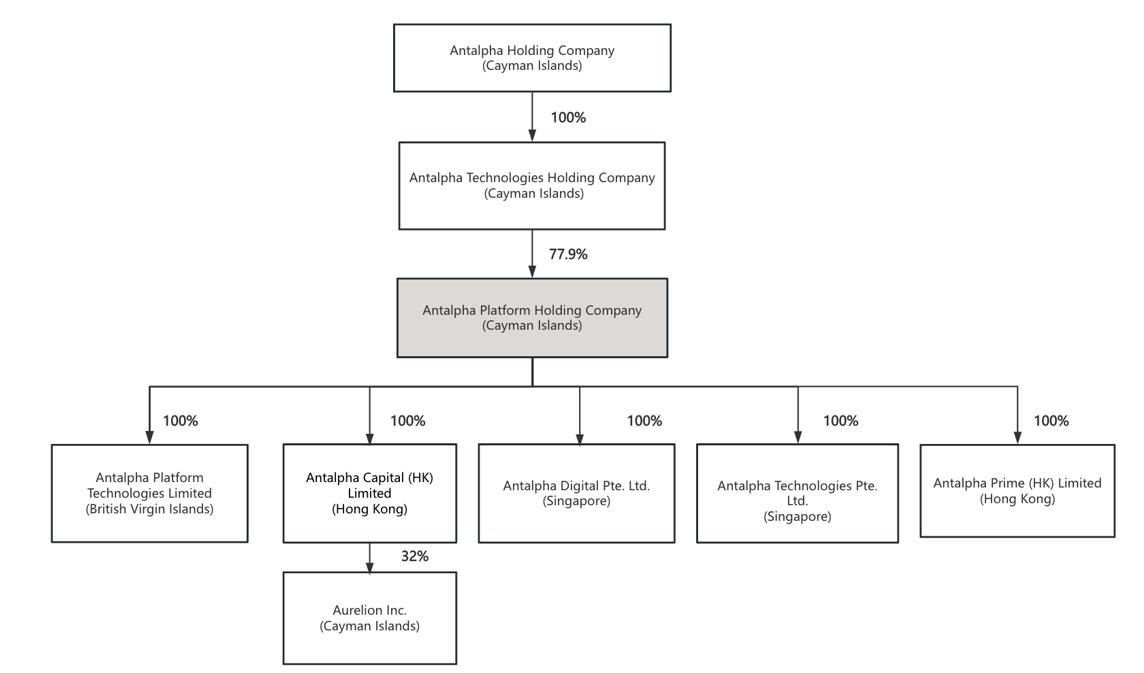
D. PROPERTY, PLANT AND EQUIPMENT
As of December 31, 2025, we lease approximately 4,340 square feet of office space in Singapore for our headquarters, which currently accommodate our principal business activities. In addition, we have offices in Hong Kong and New York. We value flexibility and permit our employees to work remotely in locations where we do not have offices. We believe doing so provides us with access to a large talent pool and a sustained advantage in hiring and retaining employees. We believe our existing facilities are sufficient for our current needs, and that additional or alternative space will be available as necessary to accommodate changes in our operations.
ITEM 4A. UNRESOLVED STAFF COMMENTS
Not applicable.
ITEM 5. OPERATING AND FINANCIAL REVIEW AND PROSPECTS
The following discussion and analysis of our financial condition and results of operations should be read in conjunction with our consolidated financial statements and the related notes included elsewhere in this annual report. This report contains forward-looking statements that involve risks and uncertainties. Our actual results and the timing of selected events could differ materially from those anticipated in these forward-looking statements as a result of various factors, including those set forth under “Item 3. Key Information—D. Risk Factors” and elsewhere in this annual report. See “Forward-Looking Information.”
A. OPERATING RESULTS
Overview
Antalpha provides financing, technology and risk management solutions to the digital asset industry. As the primary lending partner for Bitmain, we are a provider of supply chain financing solutions to institutional and corporate participants in the Bitcoin mining industry, offering loans secured by Bitcoin and Bitcoin mining machines. We have developed a technology platform, Antalpha Prime, which enables our customers to apply for and manage their digital asset loans while allowing us to closely monitor collateral positions.
80
From inception to December 31, 2025, we facilitated a total of $5.1 billion in loans, including supply chain loans that we originated and margin loans that we serviced. The amount of supply chain loans we originated increased from $344.0 million as of December 31, 2023 to $428.9 million as of December 31, 2024 and further to $1,001.1 million as of December 31, 2025, representing a year-over-year increase of 24.7% and 133%, respectively. Due to our overcollateralization requirement at origination and strict risk management capabilities, we accrued a provision of $0.3 million against the receivables on the supply chain loans for the year ended December 31, 2025. During the same periods, we have not experienced any lost any principal on our loans. We also assist our customers in obtaining margin loans, from our third-party partner, Northstar. The margin loans we serviced grew from $220.8 million as of December 31, 2023 to $1,198.7 million as of December 31, 2024 and further to $1,582.2 million as of December 31, 2025, representing a year-over-year increase of 443% and 32%, respectively.
Our revenue grew from $11.3 million for the year ended December 31, 2023 to $47.5 million for the year ended December 31, 2024 and further to $79.7 million as of December 31, 2025, representing a year-over-year increase of 321% and 68%, respectively. We recorded a net loss of $6.6 million for the year ended December 31, 2023 and a net income of $4.4 million for the year ended December 31, 2024 and net income of $24.4 million as of December 31, 2025.
Key Operating and Financial Metrics
We review the following operating and financial metrics to evaluate our business and performance.
Total loans outstanding
Total loans outstanding is a measure of our business scale and helps gauge future revenue potential. Total loans outstanding consists of the supply chain loans we originate and the third-party partner margin loans we service.
The table below summarizes total loans outstanding by loan type, both in amounts and as percentages of the total, as of the dates indicated:
| As of December 31, | ||||||||||||||||||||||||
| 2023 | 2024 | 2025 | ||||||||||||||||||||||
| Amount Outstanding | % of Total | Amount Outstanding | % of Total | Amount Outstanding | % of Total | |||||||||||||||||||
| (in thousands, except percentages) | ||||||||||||||||||||||||
| Loan type: | ||||||||||||||||||||||||
| Mining machine loans | $ | 224,424 | 39.7 | % | $ | 121,214 | 7.4 | % | 135,626 | 5.3 | % | |||||||||||||
| Hashrate loans | 119,562 | 21.2 | % | 307,654 | 18.9 | % | 865,523 | 33.5 | % | |||||||||||||||
| Supply chain loans | 343,986 | 60.9 | % | 428,868 | 26.3 | % | 1,001,149 | 38.8 | % | |||||||||||||||
| Margin loans | 220,798 | 39.1 | % | 1,198,744 | 73.7 | % | 1,582,155 | 61.2 | % | |||||||||||||||
| Total loans outstanding | $ | 564,784 | 100.0 | % | $ | 1,627,612 | 100.0 | % | 2,583,304 | 100.0 | % | |||||||||||||
The amount of supply chain loans outstanding increased by 25% from $344.0 million as of December 31, 2023 to $428.9 million as of December 31, 2024, driven by an increase of 157% in hashrate loans, offset by a decrease of 46% in mining machine loans, over the same periods. The amount of supply chain loans outstanding increased by 133% from $428.9 million as of December 31, 2024 to $1,001.1 million as of December 31, 2025, driven by an increase of 12% in mining machines loans, and an increase of 181% in hashrate loans, over the same periods. As of December 31, 2025, 91% of our mining machine loan customers have also entered into borrowing agreements with us for hashrate loans to pay for their expenditures on mining-related services. These bundled hashrate loans are typically financed with the same two-year term as the machine loans, increasing our visibility for future revenue.
81
The amount of margin loans we serviced increased by 443% from $220.8 million as of December 31, 2023 to $1,198.7 million as of December 31, 2024. The amount of margin loans we serviced increased by 32% from $1,198.7 million as of December 31, 2024 to $1,582.2 million as of December 31, 2025. Historically, when Bitcoin prices rise, customers may prefer to take out margin loans over supply chain loans, as margin loan customers may, at Northstar’s discretion, redeem a portion of the collateral when their LTV falls below a certain threshold.
Total loans outstanding increased by 188% from $564.8 million as of December 31, 2023 to $1,627.6 million as of December 31, 2024. Total loans outstanding increased by 59% from $1,627.6 million as of December 31, 2024 to $2,583.3 million as of December 31, 2025.
The table below sets out a rollforward of supply chain loan activity for the years indicated:
| For the Year Ended December 31, | ||||||||||||
| 2023 | 2024 | 2025 | ||||||||||
| (in thousands) | ||||||||||||
| Beginning supply chain loan balance | $ | 7,906 | $ | 343,986 | $ | 428,868 | ||||||
| New loans originated | 354,353 | 692,055 | 1,166,309 | |||||||||
| Repayments | (18,273 | ) | (607,173 | ) | (594,028 | ) | ||||||
| Ending supply chain loan balance | $ | 343,986 | $ | 428,868 | $ | 1,001,149 | ||||||
New supply chain loans originated for the years ended December 31, 2023, 2024 and 2025, were $354.4 million, $692.1 million and $1,166.3 million, respectively. For the years ended December 31, 2023, 2024 and 2025, there were 31, 38 and 39 mining machine loan orders, and 236, 501 and 761 hashrate loan orders, respectively. Loan repayment for the years ended December 31, 2023, 2024 and 2025, was $18.3 million, $607.2 million and $594.0 million, respectively. The relatively higher customer repayments in 2024 was due in part to certain customers repaying approximately $100 million in purchase order loans (a type of loan discontinued in 2024), as well as certain customers closing out supply chain loans and using the Bitcoin collateral they received back to take out new margin loans (see below), which allow margin loan customers to redeem, at Northstar’s discretion, Bitcoin collateral when the price of Bitcoin increases and their LTV falls below a certain level. The $594.0 million in customer repayments in 2025 was mainly because some of two-year term loans were due. No supply chain loans were refinanced during the periods presented above.
82
The table below sets out a rollforward of margin loan activity for the years indicated:
| For the Year Ended December 31, | ||||||||||||
| 2023 | 2024 | 2025 | ||||||||||
| (in thousands) | ||||||||||||
| Beginning margin loan balance | $ | 246,787 | $ | 220,798 | $ | 1,198,744 | ||||||
| New loans serviced | 247,405 | 1,234,863 | 1,194,103 | |||||||||
| Repayments | (273,394 | ) | (256,917 | ) | (810,692 | ) | ||||||
| Ending margin loan balance | $ | 220,798 | $ | 1,198,744 | $ | 1,582,155 | ||||||
New margin loans serviced for 2023, 2024 and 2025, were $247.4 million, $1,234.9 million and $1,195.1 million, respectively, the higher increase in 2024 was partly due to an increase in new margin loans taken out by supply chain loan customers using the collateral they received back from the repayment of supply chain loans. For the years ended December 31, 2023, 2024 and 2025, there were 34, 201 and 125 margin loan orders, respectively. Loan repayment for 2023, 2024 and 2025 was $273.4 million, $256.9 million and $810.7 million, respectively. No margin loans were refinanced during the periods presented above.
The table below summarizes total loans outstanding by borrower location, both in amounts and as percentages of the total, as of the dates indicated:
| As of December 31, | ||||||||||||||||||||||||
| 2023 | 2024 | 2025 | ||||||||||||||||||||||
| Amount Outstanding | % of Total | Amount Outstanding | % of Total | Amount Outstanding | % of Total | |||||||||||||||||||
| (in thousands, except percentages) | ||||||||||||||||||||||||
| Borrower location: | ||||||||||||||||||||||||
| Americas | $ | 139,064 | 24.6 | % | $ | 112,316 | 6.9 | % | $ | 153,378 | 5.9 | % | ||||||||||||
| Asia | 373,725 | 66.2 | % | 1,259,737 | 77.4 | % | 2,137,547 | 82.7 | % | |||||||||||||||
| EMEA | 51,995 | 9.2 | % | 255,559 | 15.7 | % | 292,379 | 11.3 | % | |||||||||||||||
| Total loans outstanding | $ | 564,784 | 100.0 | % | $ | 1,627,612 | 100.0 | % | $ | 2,583,304 | 100.0 | % | ||||||||||||
The Americas accounted for $112.3 million of our total loans outstanding as of December 31, 2024, representing a year-on-year decrease of 19.2% from $139.1 million as of December 31, 2023. The Americas accounted for $153.4 million of our total loans outstanding as of December 31, 2025, representing a year-on-year increase of 37% from $112.3 million as of December 31, 2024. Asia accounted for $1,259.7 million of our total loans outstanding as of December 31, 2024, representing a year-on-year increase of 237% from $373.7 million as of December 31, 2023. Asia accounted for $2,137.5 million of our total loans outstanding as of December 31, 2025, representing a year-on-year increase of 70% from $1,259.7 million as of December 31, 2024. EMEA accounted for $255.6 million of our total loans outstanding as of December 31, 2024, up from $52.0 million as of December 31, 2023. EMEA accounted for $292.4 million of our total loans outstanding as of December 31, 2025, up from $255.6 million as of December 31, 2024.
The table below summarizes the number of our customers by type for the years indicated:
| For the Year Ended December 31, | ||||||||||||
| 2023 | 2024 | 2025 | ||||||||||
| Supply chain loan customers | 29 | 42 | 47 | |||||||||
| Margin loan customers | 21 | 46 | 42 | |||||||||
| Total customers(1) | 41 | 75 | 84 | |||||||||
| (1) | Sum of supply chain loan customers and Bitcoin customers is greater than total due to the overlap between these two types of customers. |
The total number of our customers increased by 83% from 41 for the year ended December 31, 2023 to 75 for the year ended December 31, 2024. Supply chain loan customers increased by 45% from 29 to 42 over the same period, while margin loan customers increased by 119% from 21 to 46, over the same period. The total number of our customers increased by 12% from 75 for the year ended December 31, 2024 to 84 for the year ended December 31, 2025. Supply chain loan customers increased by 12% from 42 to 47 over the same period, while margin loan customers decreased by 9% from 46 to 42, over the same period. For mining machine loans, we participate in Bitmain’s sales process to assist their customers in acquiring mining machines through financing arrangements. As of December 31, 2025, 91% of our mining machine loan customers have also entered into borrowing agreements with us for hashrate loans. In addition, we source our own customers, especially for stand-alone hashrate loans and margin loans.
83
Weighted average fee rate
Weighted average fee rate is a key measure for evaluating our ability to generate income on the supply chain loans we originate and the margin loans we service. We earn a technology financing fee on the supply chain loans we originate and a technology platform fee rate on the margin loans we service. For a given period, our weighted average fee rate is calculated by dividing the sum of fees generated by each principal balance during that period by the weighted average principal, which is a measure of total loans outstanding that takes into account loan duration over the period calculated, and is presented on an annualized basis.
The table below sets out the weighted average fee rates for the years indicated:
| For the Year Ended December 31, | ||||||||||||
| 2023 | 2024 | 2025 | ||||||||||
| Weighted average technology financing fee rate | 8.9 | % | 8.5 | % | 7.8 | % | ||||||
| Weighted average technology platform fee rate | 0.8 | % | 1.2 | % | 1.5 | % | ||||||
The weighted average technology financing fee rate on the supply chain loans we originate decreased by approximately 33 basis points from 8.9% for the year ended December 31, 2023 to 8.5% for the year ended December 31, 2024, primarily due to hashrate loans increasing in proportion year over year. The weighted average technology financing fee rate on the supply chain loans we originate decreased by approximately 74 basis points from 8.5% for the year ended December 31, 2024 to 7.8% for the year ended December 31, 2025, primarily due to hashrate loans increasing in proportion. Technology financing fee rates on hashrate loans are generally lower than those on mining machine loans, as the former are collateralized with Bitcoin, a highly liquid asset. In 2025, technology financing fee rates typically ranged from 8% to 10% for mining machine loans and 6% to 9% for hashrate loans.
The weighted average technology platform fee rate increased by approximately 43 basis points from 0.8% for the year ended December 31, 2023 to 1.2% for the year ended December 31, 2024, resulting primarily from the increase in the functionality of Antalpha Prime, greater Company brand awareness and our customers’ perceived value. The weighted average technology platform fee rate increased by approximately 26 basis points from 1.2% for the year ended December 31, 2024 to 1.5% for the year ended December 31, 2025, resulting primarily from the increase in fee rate, driven by the increasing scale, stronger brand and greater pricing power.
Crypto collateral value on loans facilitated
The total value of Crypto collateral on the loans we facilitated is a key measure of the capacity of our customers to take out loans. An increase in the value of Crypto collateral, through additional customer deposits or Bitcoin price appreciation, increases our customers’ capacity to do more financing. Total collateral on the loans we facilitated is measured, because we earn technology fees on the supply chain loans we originate as well as on the third-party loans we service. We rehypothecate the secured Crypto asset from our customers to our funding partner Northstar.
The table below sets out the total value of Crypto collateral underlying the loans facilitated as of the dates indicated:
| As of December 31, | ||||||||||||
| 2023 | 2024 | 2025 | ||||||||||
| (in thousands) | ||||||||||||
Crypto collateral value on loans originated (supply chain loans) | $ | 368,620 | $ | 782,479 | $ | 1,157,713 | ||||||
Crypto collateral value on loans serviced (margin loans) | 405,673 | 2,150,720 | 2,582,066 | |||||||||
| Crypto collateral value on loans facilitated | $ | 774,293 | $ | 2,933,199 | $ | 3,739,779 | ||||||
The total value of Crypto collateral on the loans we facilitated was $2,933.2 million as of December 31, 2024, a year-over-year increase of 278.8% from the $774.3 million as of December 31, 2023. The total value of Crypto collateral on the loans we facilitated was $3,739.8 million as of December 31, 2025, a year-over-year increase of 27.5% from the $2,933.2 million as of December 31, 2024. We originate supply chain loans and hold them on our combined and consolidated balance sheets, and service third-party loans, such as margin loans, whose default risks are borne by our financing partner, Northstar.
84
Loan to value of collateral (LTV)
In addition to Bitcoin collateral, we also hold mining machines from our customers as collateral on our supply chain loans. The estimated value of mining machine collateral was $269.4 million, $191.8 million and $620 million as of December 31, 2023, 2024 and 2025, respectively. Using the combined collateral of Bitcoin and mining machines pledged to the Company, the LTV on our supply chain loan portfolio, comprising mining machine loans and hashrate loans, was approximately 54%, 44% and 57% as of December 31, 2023, 2024 and 2025, respectively. Mining machines are not as liquid as Bitcoin and market data on the fair market value of mining machines is very limited. Mining machine prices fluctuate with the price of Bitcoin and other factors impacting the digital asset economy. Their value is also impacted by factors such as machine model, operating efficiency relative to other machines in the market, operating duration, disposal scale and disposal urgency. We estimate the value of mining machines for the calculation of LTV, which is subject to significant management judgment. We cannot assure you that we would be able to dispose of the mining machines pledged to us as collateral, if needed, for an amount equal to the estimated value that we used to calculate the LTV on the mining machine collateral.
For customers who take out both mining machine loans and hashrate loans, the Company generally monitors collateral on the loan portfolio of the customer. The Company’s risk management policy considers the adequacy of collateral for a customer’s loan portfolio by considering the potential increase in LTV from newly minted Bitcoin, as well as the potential decline in mining machine value over time.
Revenue
We generate technology financing fees on the supply chain loans we originate and hold on our combined and consolidated balance sheets. These supply chain loans consist primarily of mining machine loans and hashrate loans. Other revenue generated to customers is for proprietary margin loan. We allow our financing partner, Northstar, to provide their margin loans to our customers. We contract directly with Northstar’s borrowers, provide technology and services to them over the term of the loan, and earn a platform fee for our services.
The table below shows our revenue for the years indicated:
| For the Year Ended December 31, | ||||||||||||
| 2023 | 2024 | 2025 | ||||||||||
| (in thousands) | ||||||||||||
| Technology financing fee | $ | 10,359 | $ | 38,691 | $ | 43,061 | ||||||
| Technology financing fee - related party | - | - | 14,060 | |||||||||
| Technology platform fee | 914 | 8,764 | 19,045 | |||||||||
| Others | --- | --- | 3,512 | |||||||||
| Total revenue | $ | 11,273 | $ | 47,455 | $ | 79,678 | ||||||
Our total revenue increased 321% from $11.3 million for the year ended December 31, 2023 to $47.5 million for the year ended December 31, 2024. Our total revenue increased 68% from $47.5 million for the year ended December 31, 2024 to $79.7 million for the year ended December 31, 2025. See “Item 5. Operating and Financial Review and Prospects—A. Operating Results—Key Components of Our Results of Operations—Revenue”, “Item 5. Operating and Financial Review and Prospects—A. Operating Results—Results of Operations—Comparison of the Years Ended December 31, 2023 and 2024—Revenue” and “Item 5. Operating and Financial Review and Prospects—A. Operating Results—Key Components of Our Results of Operations—Revenue”, “Item 5. Operating and Financial Review and Prospects—A. Operating Results—Results of Operations—Comparison of the Years Ended December 31, 2024 and 2025—Revenue.”
Adjusted EBITDA (non-GAAP)
We evaluate adjusted EBITDA (non-GAAP), defined as net income (loss), adjusted to exclude interest income (expense) not related to the funding costs, provision for (benefit from) income taxes, depreciation and amortization, and stock-based compensation. These adjustments are made to exclude the effects of certain non-cash and/or non-recurring items that we believe complement management’s understanding of our ongoing operational results. Our funding cost is an operating item and a significant component of our business. As such, funding cost is not excluded from adjusted EBITDA (non-GAAP).
85
Our adjusted EBITDA (non-GAAP) was a loss of $7.4 million for the year ended December 31, 2023, which improved to an adjusted EBITDA (non-GAAP) gain of $5.9 million for the year ended December 31, 2024, it further increased to a gain of $33.2 million for the year ended December 31, 2025. As a financing technology and services platform, our goal is to leverage the Antalpha Prime platform to improve our services to customers while managing the increase in costs associated with its development.
For more information about adjusted EBITDA (non-GAAP), including a reconciliation to net income (loss), its most directly comparable GAAP measure, please see “—Non-GAAP Measure.”
Factors Affecting Our Results of Operations
Our results of operations are primarily affected by the following factors:
Market demand
The size of the supply chain financing market is primarily based on the amount of capital deployed in Bitcoin mining machines, the size of the overall network hashrate environment, the price of Crypto asset, and the amount of Crypto asset in circulation available for margin loans. If these factors continue to grow, we expect more potential customers seeking to finance their business with Crypto holdings. We believe that favorable market conditions, including an imbalance in supply and demand of credit to the digital asset industry, have provided attractive opportunities for lenders, such as us, to provide customized financing structures and loan products that conventional financial institutions cannot presently provide. Additionally, we are exploring the use of our business model in other computing environments, such as GPUs for AI, to better serve our customers’ needs to expand their business.
Effectiveness of our strategic relationships and marketing
Our operating results, as well as our ability to sustain and grow our loan origination volume and the volume of the third-party loans that we service through our platform, will depend in part on our continued success in leveraging our strategic relationships with Bitmain, Northstar and other partners in the digital asset ecosystem. Additionally, ongoing investment in marketing and origination as well as continued funding at competitive rates, will help expand customer relationships and enable new loans. We are committed to dedicating significant resources to these strategic relationships, marketing efforts and business development activities, which are aimed at increasing awareness of our products and services, attracting borrowers, and drawing new funding and new funding partners to our platform.
Ability to competitively price our products and services
Our operating results depend on our ability to competitively price our products and services, particularly on the fee rates we earn on the supply chain financing we originate and the margin loans we service. Similar to other financial products, as the industry matures we anticipate fee pressure to emerge over time. Our strategy is to maintain our position as a trusted brand while developing new products and services to enhance our customer value proposition and offset the effects of any future fee pressure. Maintaining and growing customer trust in our brand is critical, as all of our loans require overcollateralization at origination. If we are unable to capture value through the development of new and existing products and services or if fee pressure emerges more rapidly than we anticipate, our operating results and financial condition may be adversely affected.
Terms of our borrowings
Our operating results will depend in large part on the differences between the income we earn and our cost of borrowing. The cost of our borrowings is accounted for as funding cost in our results of operations and is generally based on the federal funds rate plus a premium. Funding cost may fluctuate based on various factors, including the expected federal funds rate, macroeconomic factors, changes in the supply and demand for crypto assets, crypto market sentiment, and idiosyncratic events such as exchange outages or negative press. We provide collateral on our borrowings, primarily in the form of Bitcoin, by rehypothecating to our funding partner, Northstar, the Bitcoin that our customers pledge on their loans from us. Our borrowings are typically settled in crypto assets and denominated in USD. In addition, the ability to maintain 100% advance rate on our loan products will allow us to maintain an asset-light model and increase our returns on equity. If our borrowing costs increase, we could experience a decrease in net income. If our advance rate decreases, we may need to raise debt or additional equity capital to fund loans to our customers.
86
Credit risk
We are subject to credit risk in connection with our loans and accounts receivable. We seek to manage credit risk by performing deep underwriting analysis, performing compliance due diligence on our customers to manage know-your-client, know-your-transactions and anti-money laundering risks, and conducting ongoing analysis on the collateralization of loans. Credit risk is further managed through continual evaluation of collateral value, including daily monitoring of the difference between the loan amount and the collateral value. Due to our overcollateralization requirement at origination and strict risk management capabilities, the allowance, write-off and recovery balances against our loan receivables during the years ended December 31, 2023 and 2024 were immaterial. During the year ended December 31, 2025, we recognized an allowance for expected credit losses of $0.3 million. Management determined that an allowance for expected credit losses was necessary based on its CECL assessment, which incorporates historical loss data, current collateral levels, and forward-looking macroeconomic conditions. Nevertheless, unanticipated credit losses, primarily due to impaired collateral, may still occur and could adversely and materially impact our operating results.
Price of digital assets
The price of Bitcoin and other digital assets affects the size of our addressable market and the value of collateral securing our loans. As such, the price of Bitcoin in any given period may have a significant impact on our revenue or credit risk. There are a number of factors that contribute to changes in Bitcoin price, including, but not limited to, macroeconomic factors, changes in the supply and demand for crypto assets, crypto market sentiment, and idiosyncratic events such as exchange outages or negative press. Our continued growth is in part dependent upon the long-term continued growth in the overall market capitalization of Bitcoin.
Price of XAUt
We may experience variability in our earnings as a result of holding or selling substantial amounts of XAUt. Digital gold tokens; however, their market price may be influenced by factors beyond the price of gold itself, they will have an even greater impact on our financial results. These price fluctuations may cause our quarterly and annual financial results to vary materially from period to period. This volatility may result from various factors, including changes in the global gold market, fluctuations in cryptocurrency markets, macroeconomic conditions, geopolitical events, and shifts in investor demand for digital assets.
Hash price
Hash price measures the daily revenue Bitcoin miners can expect to earn per unit of computational power and is measured in dollars per terahash per second per day ($/TH/s/day). Hash price is primarily driven by the price of Bitcoin, the Bitcoin block reward, and the Bitcoin network’s hashrate. Hash price is expected to decrease with each Bitcoin halving. Non-halving related fluctuations in hash price in any given period may have a significant effect on the demand for mining machines and the level of activity in mining operations, and may therefore affect our results of operations and financial condition.
Integration of subsidiary
We invested and acquired controlling voting rights in Aurelion Inc. Goodwill represents the excess of the purchase price over the amounts assigned to the fair value of the assets acquired and the liabilities assumed of an acquired business. We test the impairment of goodwill annually, and between annual tests if we become aware of an event or a change in circumstances that would indicate the carrying value may be impaired, our operating results will be adversely and materially affected.
Regulatory environment
The regulatory environment for digital assets is complex and evolving, creating both challenges and opportunities that could affect our financial performance. Our financial prospects and continued growth depend in part on our ability to continue to operate in a compliant manner. Our platform incorporates several features to help comply with various international, federal and state laws in an efficient and cost-effective manner. We expect to continue to spend resources to comply with these laws and regulatory requirements. While new laws and regulations, or changes under existing laws and regulations, could make originating loans more difficult to achieve on acceptable terms, or at all, these events could also provide new product and market opportunities. As the industry matures, we may experience fluctuations in our operating results due to changes in the law and regulations that are applicable to our business, which may limit our ability to onboard customers, and offer our products and services across jurisdictions.
87
Key Components of Our Results of Operations
Revenue
Our revenue comprises the following offerings: 1) technology financing fees for supply chain financing and 2) technology platform fees for margin loans. 3) Other revenue to customers for proprietary margin loan.
Technology financing fees. We offer crypto asset financing solutions, such as mining machine loans, hashrate loans and purchase order loans, to institutional and corporate customers to support the acquisition of mining equipment and the payment of expenditures on mining-related services. During the term of the loans, we offer technology and services to enable crypto asset transactions and risk management. As such, we earn a technology financing fee on such technology and services support, which is calculated on the principal borrowed over the duration of the loan. The technology financing fee we charge currently ranges from 6% to 10% at origination, depending on the type of financing, market conditions and other factors. The financing we provide is denominated in USD and typically settled in USDT.
Technology platform fees. We assist customers to explore other financing solutions, including margin loans, provided by our third-party financing partner, Northstar. These margin loans, which are denominated in USD and typically settled in USDT, are collateralized by Bitcoin and Ethereum pledged to Northstar by the borrowers. Northstar typically offers margin loans requiring an LTV of between 50% to 70% at origination with open loan terms. We provide loan services to our directly contracted customers and earn technology platform fees for the services we provide over the term of the loan. We currently charge technology platform fees between 1.0% and 1.9% on the loan principal of third-party partner loans, and Northstar takes default risks on these loans. As Northstar’s loans are denominated in USD, including the technology platform fee, changes in the fair value of Bitcoin and Ethereum do not impact the Company’s technology platform fee. The technology platform fee is calculated as a percentage of the outstanding USD value of the loan. This fee can be paid in crypto assets, so long as the value of those assets equals the value of the fee owed in USD.
Operating Expenses
Our operating expenses consist of funding cost, technology and development expenses, sales and marketing expenses, and general and administrative expenses.
Funding Cost
Funding cost represents the cost of our borrowings from our funding partner, Northstar. The borrowing terms from our funding partner are open-ended and repayable at our option without penalty. These borrowings bear a funding cost, based on a percentage of the principal borrowed. Funding cost is usually settled in crypto assets and denominated in USD. Historically, funding cost has been based on the expected federal funds rate plus a premium. Funding cost may vary based on macroeconomic factors, changes in the supply and demand of crypto assets, crypto market sentiment, and idiosyncratic events such as exchange outages or negative press. The funding cost is recognized on an accrual basis and is included in funding cost in our combined and consolidated statements of operations.
Technology and Development Expenses
Technology and development expenses primarily consist of personnel-related expenses, network and other infrastructure costs, and other costs, including depreciation and amortization. Technology and development costs are expensed as incurred. We expect our research and development expenses to continue to increase in absolute amounts but decrease as a percentage of revenue in the near future, as we realize further efficiency gains by leveraging Antalpha Prime.
88
Sales and Marketing Expenses
Sales and marketing expenses primarily consist of personnel-related expenses, event and other marketing expenditures and other costs, including travel and entertainment. Sales and marketing costs are expensed as incurred. We expect sales and marketing expenses to further increase in absolute amounts but decrease as a percentage of total revenue in the near future, and we expect to see further efficiency gains from the upgrade of Antalpha Prime.
General and Administrative Expenses
General and administrative expenses primarily consist of personnel-related expenses, general overhead and administrative costs, and other costs, including professional and consulting fees. General and administrative costs are expensed as incurred. We expect general and administrative expenses to increase in absolute amounts but decrease as a percentage of revenue, as we expect to operate more efficiently with the upgrade of Antalpha Prime.
Unrealized gain on crypto assets
Unrealized gain on crypto assets mainly included the fair value gain from the XAUt holding by Aurelion. Increases in the price of XAUt may result in unrealized gains, while decreases in the price of XAUt may result in unrealized or realized losses, depending on whether we hold or sell the tokens.
Other Costs
Other costs primarily consist of service fees related to MPC and mining security services.
Taxation
Total Income Tax Expense (Benefit)
Total income tax expense (benefit) relates to the net operating loss carried forward.
Cayman Islands
We are incorporated in the Cayman Islands. The Cayman Islands currently levies no taxes on individuals or corporations based upon profits, income, gains or appreciation and there is no taxation in the nature of inheritance tax or estate duty. The Cayman Islands does not impose a withholding tax on payments of dividends to shareholders.
Hong Kong
Our subsidiaries incorporated in Hong Kong are subject to Hong Kong profit tax at a rate of up to 16.5%. Under Hong Kong tax law, our subsidiaries in Hong Kong are exempted from income tax on their foreign-derived income where specific conditions are met and there is no withholding tax in Hong Kong on remittance of dividends.
Singapore
Our subsidiaries in Singapore are all subject to Singapore income tax at the rate of 17%. Under Singapore tax law, Singapore companies are not subject to Singapore income tax on their foreign-sourced income which are not received or deemed received in Singapore or which otherwise qualify for a tax exemption. Singapore does not impose withholding tax on the distribution of dividends.
Recent Accounting Pronouncements
In December 2023, the Financial Accounting Standards Board (the “FASB”) issued ASU No. 2023-09, Income Taxes (Topic 740): Improvements to Income Tax Disclosures (“ASU 2023-09”). ASU 2023-09 expands existing income tax disclosures for rate reconciliations by requiring disclosure of certain specific categories and additional reconciling items that meet quantitative thresholds and expands disclosures for income taxes paid by requiring disaggregation by certain jurisdictions. ASU 2023-09 is effective for annual periods beginning after December 15, 2024 with early adoption permitted.
The Company adopted the updated guidance for the year ended December 31, 2025, and applied the new disclosure requirements prospectively to the current annual period. Prior period disclosures have not been adjusted to reflect the new disclosure requirements.
89
ASC 280 Segment Reporting (“ASC 280”) establishes standards for companies to report in their financial statement information about operating segments, products, services, geographic areas, and major customers. The Company has one reportable segment, and its chief operating decision maker uses one reporting segment to allocate resources and assess the performance of the Company. The Company does not distinguish between markets nor segments for the purpose of internal reporting, as such information is not meaningful to management. ASU 280 is effective for fiscal years beginning after December 15, 2023, including interim periods within fiscal years beginning after December 15, 2024. Early adoption is permitted and adoption is retrospectively to all periods presented in the financial statements. The Company elected to early adopt ASU 280 since inception, as the Company has not issued financial statements in historical periods.
In November 2024, the FASB issued ASU No. 2024-03, Income Statement—Reporting Comprehensive Income—Expense Disaggregation Disclosures (Subtopic 220-40) (“ASU 2024-03”). ASU 2024-03 requires, in the notes to the annual and interim financial statements, disaggregated information about certain income statement expense line items. ASU 2024-03 is effective for annual reporting periods beginning after December 15, 2026, and interim reporting periods beginning after December 15, 2027. Early adoption is permitted.
Results of Operations
The following table sets forth a summary of our combined and consolidated results of operations for the years indicated, both in amounts and as percentages of our total revenue. This information should be read together with our combined and consolidated financial statements and related notes included elsewhere in this annual report. The operating results in any period are not necessarily indicative of the results that may be expected for any future period.
| For the Year Ended December 31, | ||||||||||||||||||||||||
| 2023 | 2024 | 2025 | ||||||||||||||||||||||
| (in thousands, except percentages) | ||||||||||||||||||||||||
| Revenue: | ||||||||||||||||||||||||
| Technology financing fee | $ | 10,359 | 91.9 | % | $ | 38,691 | 81.5 | % | 43,061 | 11.3 | % | |||||||||||||
| Technology financing fee-related party | - | - | - | - | 14,060 | - | ||||||||||||||||||
| Technology platform fee | 914 | 8.1 | % | 8,764 | 18.5 | % | 19,045 | 23.9 | % | |||||||||||||||
| Others | --- | --- | --- | --- | 3,512 | 4.4 | % | |||||||||||||||||
| Total revenue | 11,273 | 100.0 | % | 47,455 | 100.0 | % | 79,678 | 100.0 | % | |||||||||||||||
| Operating expense: | ||||||||||||||||||||||||
| Funding cost-related party | 6,302 | 55.9 | % | 24,617 | 51.9 | % | 40,587 | 51.0 | % | |||||||||||||||
| Technology and development | 3,140 | 27.9 | % | 4,922 | 10.4 | % | 6,321 | 7.9 | % | |||||||||||||||
| Sales and marketing | 2,650 | 23.5 | % | 4,259 | 8.9 | % | 7,996 | 10.0 | % | |||||||||||||||
| General and administrative | 6,296 | 55.8 | % | 9,093 | 19.2 | % | 18,861 | 23.7 | % | |||||||||||||||
| Fair value gain on crypto assets | --- | --- | --- | --- | (5,214 | ) | - | |||||||||||||||||
| Fair value gain on crypto assets - related party | - | - | - | - | (5,186 | ) | - | |||||||||||||||||
| Other costs | 507 | 4.5 | % | 1,383 | 2.9 | % | 1,298 | 1.6 | % | |||||||||||||||
| Total operating expense | 18,895 | 167.6 | % | 44,274 | 93.3 | % | 64,663 | 81.2 | % | |||||||||||||||
| Operating (loss)/ income | (7,622 | ) | (67.6 | )% | 3,181 | 6.7 | % | 15,015 | 18.8 | % | ||||||||||||||
| Other (expense)/ income, net | (281 | ) | (2.5 | )% | 1,780 | 3.8 | % | 6,355 | 8.0 | % | ||||||||||||||
| Interest expenses | --- | --- | --- | --- | (629 | ) | (0.8 | )% | ||||||||||||||||
| Fair value (loss) on crypto assets held, net | (8 | ) | (0.0 | )% | (745 | ) | (1.6 | )% | (24 | ) | (0.0 | )% | ||||||||||||
| Fair value gain on crypto receivables/payables, net | --- | --- | --- | --- | 5,377 | 6.7 | % | |||||||||||||||||
| Fair value changes on crypto assets receivables/payables,net - related party | 7 | (0.0 | )% | 744 | 1.6 | % | 676 | 0.9 | % | |||||||||||||||
| (Loss)/ income before income tax | (7,904 | ) | (70.1 | )% | 4,960 | 10.5 | % | 26,770 | 33.6 | % | ||||||||||||||
| Income tax (benefit)/ expense | (1,319 | ) | (11.7 | )% | 567 | 1.2 | % | 2,336 | 2.9 | % | ||||||||||||||
| Net (loss)/ income | $ | (6,585 | ) | (58.4 | )% | $ | 4,393 | 9.3 | % | 24,434 | 30.7 | % | ||||||||||||
90
Comparison of the Years Ended December 31, 2024 and 2025
Revenue
| For the Year Ended December 31, | ||||||||||||
| 2024 | 2025 | YoY change | ||||||||||
| (in thousands) | % | |||||||||||
| Revenue: | ||||||||||||
| Mining machine loans | $ | 23,180 | 11,324 | (51.1 | )% | |||||||
| Mining machine loans - related party | 754 | - | ||||||||||
| Hashrate loans | 15,511 | 31,737 | 104.6 | % | ||||||||
| Hashrate loans - related party | 13,306 | - | ||||||||||
| Technology financing fees | 38,691 | 57,121 | 47.6 | % | ||||||||
| Technology platform fees | 8,764 | 19,045 | 117.3 | % | ||||||||
| Others | --- | 3,512 | --- | |||||||||
| Total revenue | $ | 47,455 | 79,678 | 67.9 | % | |||||||
Revenue increased by 67.9% from $47.5 million for the year ended December 31, 2024 to $79.7 million for the year ended December 31, 2025. Excluding the effect of other revenue of $3.5 million from pilot loans, this increase was primarily driven by a 47.6% increase in technology financing fees and, by an 117.3% increase in technology platform fees, comparing the years ended December 31, 2024 and 2025.
| (i) | Technology financing fees |
The 47.6% increase in technology financing fees from supply chain financing was attributable to increases in hashrate loans. In addition, the number of supply chain financing customers grew from 42 for the year ended December 31, 2024, to 47 for the year ended December 31, 2025. The weighted average technology financing fee rate on supply chain loans was 8.5% for the year ended December 31, 2024, compared to 7.8% for the year ended December 31, 2025. During the year ended December 31, 2025, we originated $1,166 million of new loans and had repayments of $594 million. Average loan size increased 18% from $24.7 million for the year ended December 31, 2024 to $29.1 million for the year ended December 31, 2025.
Mining machine loans. Technology financing fees on mining machine loans decreased by 47.9% from $23.2 million for the year ended December 31, 2024 to $12.1 million for the year ended December 31, 2025, mainly due to our strict risk management control policy. Before the new best-selling mining machine models enter into the promotion cycle, which are supported by our financial solution, we usually implement stricter risk control measures on loans over older models to reduce risk.
Hashrate loans. Technology financing fees from hashrate loans increased by 190.4% from $15.5 million for the year ended December 31, 2024 to $45.0 million for the year ended December 31, 2025. This increase was primarily driven by the growing electricity loan demand from miner customers with 81 EH/shashrate.
| (ii) | Technology platform fee |
The increase in total revenue was also driven by an increase in technology platform fees, which grew by 117.3% from $8.8 million for the year ended December 31, 2024 to $19.0 million for the year ended December 31, 2025. This increase was primarily due to an increase in the amount of margin loans we serviced, which grew 32.0% from $1,198.7 million for the year ended December 31, 2024 to $1,582.2 million for the year ended December 31, 2025. The increase in total volume of loans was in turn driven by a 75.0% increase in the average loan size we serviced from $31.6 million for the year ended December 31, 2024 to $55.4 million for the year ended December 31, 2025. The increase in total technology platform fee was also attributable to an increase in the net fee rate to 1.5% for the year ended December 31, 2025 from 1.2% for the year ended December 31, 2024.
91
Operating expenses
| For the Year Ended December 31, | ||||||||||||
| 2024 | 2025 | YoY change | ||||||||||
| (in thousands) | % | |||||||||||
| Operating expenses: | ||||||||||||
| Funding cost - related party | $ | 24,617 | $ | 40,587 | 64.9 | % | ||||||
| Technology and development | 4,922 | 6,321 | 28.4 | % | ||||||||
| Sales and marketing | 4,259 | 7,996 | 87.8 | % | ||||||||
| General and administrative | 9,093 | 18,861 | 107.4 | % | ||||||||
| Fair value gain on crypto assets | --- | (5,214 | ) | --- | ||||||||
| Fair value gain on crypto assets - related party | - | (5,186 | ) | - | ||||||||
| Other costs | 1,383 | 1,298 | (6.2 | )% | ||||||||
| Total operating expense | $ | 44,274 | $ | 64,663 | 46.1 | % | ||||||
| (iii) | Funding cost |
Funding cost incurred with our funding partner increased by 64.9% from $24.6 million for the year ended December 31, 2024 to $40.6 million for the year ended December 31, 2025. This increase was primarily due to the growth in supply chain loan revenue. We also experienced lower borrowing rates, with a 17 basis point decrease in our weighted average borrowing rate from 5.43% for the year ended December 31, 2024 to 5.27% for the year ended December 31, 2025. This decrease resulted from use of own fund in 2025.
| (iv) | Technology and development expenses |
Technology and development expenses increased by 28.4% from $4.9 million for the year ended December 31, 2024 to $6.3 million for the year ended December 31, 2025. This was primarily due to a 27.0% increase in labor cost as we hired more experience staffs to enhance the risk control function to our prime platform.
| (v) | Sales and marketing expenses |
Sales and marketing expenses increased 87.8% from $4.3 million for the year ended December 31, 2024 to $8.0 million for the year ended December 31, 2025. This was primarily due to a 62.4% increase in personnel-related costs as we expand investment to US market and new business, and in a less absolute amount, an increase in industry-event sponsorship expenditure.
| (vi) | General and administrative expenses |
General and administrative expenses increased by 107.4% from $9.1 million for the year ended December 31, 2024 to $18.9 million for the year ended December 31, 2025. This was primarily due to a 79.1% increase in labor cost, driven in part by an increase in share incentive plan, as well as an 207% increase in consulting fee, mainly due to increased compliance demands as we were shifting to a new business model and expanding into new markets.
| (vii) | Unrealized gain on crypto assets |
Unrealized gain on crypto assets mainly consisted of the fair value gain from the XAUt holding by Aurelion.
Income Tax Expense
Income tax expense was $(0.6 million) and $2.3 million for the years ended December 31, 2024 and 2025, respectively. The change in income tax expense was primarily attributable to the increase of taxable income.
92
Comparison of the Years Ended December 31, 2023 and 2024
Revenue
| For the Year Ended December 31, | ||||||||||||
| 2023 | 2024 | YoY change | ||||||||||
| (in thousands) | % | |||||||||||
| Revenue: | ||||||||||||
| Mining machine loans | $ | 8,037 | $ | 23,180 | 188.4 | % | ||||||
| Hashrate loans | 2,322 | 15,511 | 568.0 | % | ||||||||
| Technology financing fees | 10,359 | 38,691 | 273.5 | % | ||||||||
| Technology platform fees | 914 | 8,764 | 858.8 | % | ||||||||
| Total revenue | $ | 11,273 | $ | 47,455 | 321.0 | % | ||||||
Revenue increased by 321% from $11.3 million for the year ended December 31, 2023 to $47.5 million for the year ended December 31, 2024. This increase was primarily driven by a 274% increase in technology financing fees from supply chain financing and, to a lesser extent in absolute amounts, by an 859% increase in technology platform fees, comparing the years ended December 31, 2023 and 2024.
| (i) | Technology financing fees |
The 274% increase in technology financing fees from supply chain financing was attributable to increases in technology financing fees from both mining machine loans and hashrate loans. In addition, the number of supply chain financing customers grew from 29 for the year ended December 31, 2023 to 42 for the year ended December 31, 2024. The weighted average technology financing fee rate on supply chain loans was 8.9% for the year ended December 31, 2023, compared to 8.5% for the year ended December 31, 2024. During the year ended December 31, 2024, we originated $692.1 million of new loans and had repayments of $607.2 million. Average loan size increased 97.5% from $12.5 million for the year ended December 31, 2023 to $24.7 million for the year ended December 31, 2024.
Mining machine loans. Technology financing fees on mining machine loans increased by 188% from $8.0 million for the year ended December 31, 2023 to $23.2 million for the year ended December 31, 2024. In April 2023, we launched mining machine loans in collaboration with Bitmain, creating a financing solution to help their customers purchase on-rack Bitcoin mining machines primarily located in data centers across the United States. Since the launch of our mining machine loans, we have seen rapid growth and adoption beginning in the second half of 2023.
Hashrate loans. Technology financing fees from hashrate loans increased by 568% from $2.3 million for the year ended December 31, 2023 to $15.5 million for the year ended December 31, 2024. This increase was primarily driven by the growth of mining machine loans in the second half of 2023, with many of the customers who took out mining machine loans also securing hashrate loans. Additionally, existing hashrate customers continued to expand their loan amounts over time.
| (ii) | Technology platform fee |
The increase in total revenue was also driven by an increase in technology platform fees, which grew by 859% from $0.9 million for the year ended December 31, 2023 to $8.8 million for the year ended December 31, 2024. This increase was primarily due to an increase in the amount of margin loans we serviced, which grew 195% from $494.2 million for the year ended December 31, 2023 to $1,455.7 million for the year ended December 31, 2024. The increase in total volume of loans was in turn driven by a 119% increase in the number of customers from 21 to 46, and a 34% increase in the average loan size we serviced from $23.5 million for the year ended December 31, 2023 to $31.6 million for the year ended December 31, 2024. The increase in total technology platform fee was also attributable to an increase in the weighted average services fee rate, which increased from 0.8% to 1.2%, driven primarily by the increase in the functionality of Antalpha Prime and our customer-perceived value.
Operating expenses
| For the Year Ended December 31, | ||||||||||||
| 2023 | 2024 | YoY change | ||||||||||
| (in thousands) | % | |||||||||||
| Operating expenses: | ||||||||||||
| Funding cost - related party | $ | 6,302 | $ | 24,617 | 290.6 | % | ||||||
| Technology and development | 3,140 | 4,922 | 56.7 | % | ||||||||
| Sales and marketing | 2,650 | 4,259 | 60.7 | % | ||||||||
| General and administrative | 6,296 | 9,093 | 44.4 | % | ||||||||
| Other costs | 507 | 1,383 | 172.9 | % | ||||||||
| Total operating expense | $ | 18,895 | $ | 44,274 | 134.3 | % | ||||||
93
| (iii) | Funding cost |
Funding cost incurred with our funding partner increased by 291% from $6.3 million for the year ended December 31, 2023 to $24.6 million for the year ended December 31, 2024. This increase was primarily due to the growth in borrowing amount over the past year, in line with the overall growth of our total supply chain financing during the same period. We also experienced higher borrowing rates, with a 6 basis point increase in our weighted average borrowing rate from 5.39% for the year ended December 31, 2023 to 5.45% for the year ended December 31, 2024, compared to the same period in 2023. This increase resulted from higher expected federal funds rate and other macro factors in the digital asset economy in 2024, such as higher Bitcoin prices and greater market interest in Bitcoin.
| (iv) | Technology and development expenses |
Technology and development expenses increased by 57% from $3.1 million for the year ended December 31, 2023 to $4.9 million for the year ended December 31, 2024. This was primarily due to a 54% increase in development personnel-related costs, including the hiring of senior staff to improve the customer experience on Antalpha Prime, strengthened security and risk management through enhanced technology, and integrating third-party MPC technology with Antalpha Prime. Network-related expenses grew 64% but had less impact in absolute amount than the increase in personnel-related costs.
| (v) | Sales and marketing expenses |
Sales and marketing expenses increased 61% from $2.7 million for the year ended December 31, 2023 to $4.3 million for the year ended December 31, 2024. This was primarily due to a 52% increase in personnel-related expenses, driven in part by an increase in headcount, a 154% increase in marketing event expenses, as we diversified our financing solutions and participated in more industry events, and higher travel and entertainment expenses associated with increased marketing activities.
| (vi) | General and administrative expenses |
General and administrative expenses increased by 44% from $6.3 million for the year ended December 31, 2023 to $9.1 million for the year ended December 31, 2024. This was primarily due to a 35% increase in personnel-related expenses, driven in part by an increase in headcount, as well as an increase in legal and other professional fees that contributed to a 153% increase in corporate miscellaneous expenses. In 2024, we implemented an ERP system and increased our investment in regulatory compliance, including license applications, resulting in higher legal and other professional fees.
Income Tax (Benefit)/ Expense
Income tax (benefit)/ expense was $(1.3 million) and $0.6 million for the years ended December 31, 2023 and 2024, respectively. The change in income tax expense (benefit) was primarily attributable to the recognition of deferred assets from the net operating loss carried forward in 2023 and subsequently decreased in 2024.
Non-GAAP Measure
In addition to financial measures presented under generally accepted accounting principles in the United States, or GAAP, we evaluate non-GAAP financial measures such as adjusted EBITDA (non-GAAP). We define adjusted EBITDA (non-GAAP) as net income before interest (if non-operating), taxes, depreciation and amortization, and share-based compensation expenses. Our funding cost is an operating item and a significant component of our business. As such, it is not excluded from adjusted EBITDA (non-GAAP). We believe these adjustments eliminate the effects of certain non-cash and/or non-recurring items that we believe complement management’s understanding of our ongoing operational results. However, adjusted EBITDA is presented for supplemental informational purposes only, has limitations as an analytical tool, and should not be considered in isolation or as a substitute for financial information presented in accordance with GAAP. In addition, other companies, including companies in our industry, may calculate similarly titled non-GAAP measures differently or may use other measures to evaluate their performance, all of which could reduce the usefulness of our non-GAAP financial measures as tools for comparison. The Company will continually evaluate the usefulness of such metrics. We believe that adjusted EBITDA may be helpful to investors because it provides consistency and comparability with past financial performance and with how management views the Company’s financial performance.
94
The table below sets forth a reconciliation of adjusted EBITDA (non-GAAP) to the most comparable financial measure or measures calculated and presented in accordance with U.S. GAAP, which is net income (loss), for each of the periods indicated.
| For the Year Ended December 31, | ||||||||||||
| 2023 | 2024 | 2025 | ||||||||||
| (in thousands) | ||||||||||||
| Net income (loss) | $ | (6,585 | ) | $ | 4,393 | $ | 24,434 | |||||
| Add: income tax expense (benefit) | $ | (1,319 | ) | $ | 567 | 2,336 | ||||||
| Add: depreciation and amortization expense | $ | 517 | $ | 830 | 1,001 | |||||||
| Add: share-based compensation | — | $ | 129 | 4,767 | ||||||||
| Add: interest expenses | — | — | 629 | |||||||||
| Adjusted EBITDA (non-GAAP) | $ | (7,387 | ) | $ | 5,919 | $ | 33,167 | |||||
B. LIQUIDITY AND CAPITAL RESOURCES
We believe that our existing cash and cash equivalents, along with the crypto assets we hold, will be sufficient to meet our short-term and long-term cash requirements, including those for working capital and capital expenditure.
Our ability to meet our working capital and capital expenditure requirements will depend on many factors, including market acceptance of crypto assets and blockchain technology, our growth, our ability to attract and retain customers on our platform, the continuing market acceptance of our products and services, the ability of our platform to meet customer and partner needs, including risk management and system security, the introduction of new products and services on our platform, expansion of sales and marketing activities, and overall economic conditions.
We anticipate satisfying our short-term cash requirements with our existing cash and cash equivalents and may satisfy our long-term cash requirements with cash and cash equivalents on hand or with proceeds from future equity or debt financing.
We settle our revenues and funding costs in crypto assets that mostly consist of stablecoins pegged to the U.S. dollar. As such, our ability to meet our cash requirements and working capital needs will depend on our ability to exchange such crypto assets for fiat currency. Historically, the Parent Company provided the fiat currency needed for our working capital needs. In September 2024, our parent company provided us with $30 million in USD, further in May 2025, we raised approximately $50 million in USD from our public offering, which we have used for working capital. In the future, we may need to exchange our profits in crypto assets into fiat currency to meet our cash requirements and meet working capital needs.
To the extent that current and anticipated future sources of liquidity are insufficient to fund our future business activities and cash and other requirements, we may be required to seek additional equity or debt financing. The sale of additional equity would result in additional dilution to our stockholders. The incurrence of additional debt financing would result in debt service obligations, and the instruments governing such debt could provide for operating and financing covenants that would restrict our operations. Our ability to raise additional financing from external sources in the future may be adversely affected by various factors, such as credit rating and market conditions, and we may not be able to raise capital on terms acceptable to us or at all.
We rely on our funding partner, Northstar, as our primary funding source for supply chain financing and our primary provider of third-party financing. To finance supply chain loans, we typically rehypothecate secured Bitcoin collateral from our customer to our funding partner. As part of the 2024 Reorganization, we entered into a framework agreement with Antalpha Holding Company and Northstar, pursuant to which our funding partner agreed that the cost of capital of the funds provided by it to any third-party borrower shall not be lower than the average cost of financing provided to us. Additionally, our funding partner has given us a right of first offer with respect to certain funding transactions. If our funding partner proposes to provide funding to any person or entity other than us, our funding partner must deliver written notice to us setting out the material terms of its offer to enter into such a transaction and offer the funding opportunity to us on the same terms. See “Item 4. Information on the Company—B. Business—Our Key Strategic Partners—Northstar” for a summary of the terms of the commercial framework agreement.
95
Cash and cash equivalents
As of December 31, 2023, 2024 and 2025, our cash and cash equivalents were $0.4 million $5.9 million and $7.9 million, respectively. Our cash and cash equivalents represent cash and interest-bearing highly liquid investments held at financial institutions, and cash on hand that is not restricted to withdrawal or use with an initial maturity of three months or less.
As of December 31, 2023, 2024 and 2025, the fair values of our crypto assets held were as follows:
| As of December 31, | ||||||||||||
| 2023 | 2024 | 2025 | ||||||||||
| (in thousands) | ||||||||||||
| Crypto assets held: | ||||||||||||
| Bitcoin | $ | 1,177 | $ | 45,718 | $ | 257 | ||||||
| USDT | 4,335 | 14,275 | 11,351 | |||||||||
| Other | 248 | 35 | 33 | |||||||||
| Total crypto assets held | $ | 5,760 | $ | 60,028 | 11,641 | |||||||
Crypto assets held comprise primarily Bitcoin and USDT. Bitcoin is a highly liquid crypto asset, and USDT is a stablecoin pegged to the U.S. dollar. Although crypto assets held are not accounted for as cash and cash equivalents, we treat our crypto asset holdings as a liquidity source.
Loan payable to related party and crypto assets pledged to related party
We borrow funds from Northstar to support our financing business that are usually settled in crypto assets and denominated in USD. We are required to maintain a minimum level of collateral per our borrowing agreements with Northstar. Any significant change in crypto asset prices could impact the value of the crypto assets borrowed or the value of crypto asset collateral.
In November 2024, we entered into an amended and restated loan agreement, or the Financing Agreement, for a credit facility in the aggregate principal amount of up to $1.0 billion on an annual basis, subject to meeting certain collateral requirements. The credit facility has an accordion feature that allows us to increase the aggregate principal commitments up to $1.15 billion per year, subject to customary conditions. In June 2025, we entered into a further amended loan agreement that updated the collateral provisions to, among other things, expand the types of eligible collateral to include specified digital assets, require the collateral value to be maintained at or above the related client facility amounts, grant Northstar a first-priority security interest in the collateral, and impose related restrictions and return obligations. The Financing Agreement provides us with the right to draw loans upon our request, after which Northstar must provide us with funding within three business days. The Financing Agreement provides for financing of up to a 100% advance rate against our loan receivables. Loans under the Financing Agreement bear fixed interest on a per annum basis equal to the federal funds rate, plus a margin that can vary from 0.2% to 1.2% per annum. Our overall funding cost is impacted by the expected federal funds rate, macroeconomic factors, changes in the supply and demand for crypto assets, crypto market sentiment, and idiosyncratic events such as exchange outages or negative press. Each loan drawdown has a minimum tenor of one year and may be prepaid by us at any time without penalty. The loans contain customary representations and covenants. During the year ended December 31, 2025, we drew down $1,183.7 million on the Financing Agreement and repaid $563.0 million, of which $1,028.3 million remains outstanding at December 31, 2025. As of December 31, 2023, 2024 and 2025, crypto assets pledged to the related party consisted of the following:
| As of December 31, 2023 | As of December 31, 2024 | As of December 31, 2025 | ||||||||||||||||||||||
| Unit | Fair
value (in thousands) | Unit | Fair
value (in thousands) | Unit | Fair
value (in thousands) | |||||||||||||||||||
| USDT | 309,713 | $ | 310 | — | $ | — | — | $ | — | |||||||||||||||
| XAUt | — | — | — | — | 22,665 | 98,332 | ||||||||||||||||||
| Ethereum | — | — | — | — | 9,115 | 27,181 | ||||||||||||||||||
| Bitcoin | 8,694 | 368,620 | 8,019 | 737,007 | 12,883 | 1,131,333 | ||||||||||||||||||
| Total | $ | 368,930 | $ | 737,007 | $ | 1,256,846 | ||||||||||||||||||
See Note 12 to the combined and consolidated financial statements included elsewhere in this annual report for further information relating to our outstanding commitments and contingencies as of December 31, 2025.
Cash Flows
The following table summarizes our combined and consolidated statements of cash flows:
| For the Year Ended December 31, | ||||||||||||
| 2023 | 2024 | 2025 | ||||||||||
| (in thousands) | ||||||||||||
| Net cash used in operating activities | $ | (12,240 | ) | $ | (11,694 | ) | $ | (3,838 | ) | |||
| Net cash used in investing activities | (34,994 | ) | (76,171 | ) | (6,856 | ) | ||||||
| Net cash provided by financing activities | 47,464 | 93,353 | 12,630 | |||||||||
| Effect of exchange rate changes on cash and cash equivalents | — | — | (12 | ) | ||||||||
| Net increase in cash, cash equivalents, and restricted cash | $ | 230 | $ | 5,488 | $ | 1,924 | ||||||
96
The following table summarizes our supplemental schedule of non-cash activities and deemed capital contribution from the Parent Company for the years indicated:
| For the Year Ended December 31, | ||||||||||||
| 2023 | 2024 | 2025 | ||||||||||
| (Restated) | ||||||||||||
| Supplemental schedule of non-cash investing and financing activities | ||||||||||||
| Crypto assets received as revenue(i) | $ | 7,502,042 | $ | 46,808,313 | $ | 48,207,213 | ||||||
| Crypto assets received as revenue - USDC | — | — | 979,135 | |||||||||
| Crypto assets paid as costs and expenses(i) | (6,485,191 | ) | (22,633,785 | ) | (33,179,554 | ) | ||||||
| Crypto assets received as other income(i) | — | — | 6,534,111 | |||||||||
| Crypto assets paid as other expense(i) | — | — | (167,749 | ) | ||||||||
| Deposit/(withdrawal) of custodial crypto assets, net(i) | 646,333 | (373,732 | ) | (1,916,041 | ) | |||||||
| Loans provided to related party(i) | — | — | (278,419,042 | ) | ||||||||
| Loans provided to customers(i) | (309,818,893 | ) | (614,343,955 | ) | (887,879,223 | ) | ||||||
| Loans provided to customers – USDC | (9,600,748 | ) | — | — | ||||||||
| Loans repaid by customers(i) | 17,844,313 | 605,472,804 | 593,182,363 | |||||||||
| Loans repaid by customers – USDC | 428,486 | — | — | |||||||||
| Collateral received from related party(i) | — | — | 279,888,518 | |||||||||
| Collateral received from customers(i) | 414,952,584 | 1,176,240,978 | 1,901,052,016 | |||||||||
| Collateral returned to customers(i) | (51,283,183 | ) | (762,374,581 | ) | (1,806,024,448 | ) | ||||||
| Acquisition of investment(i) | (2,999,700 | ) | (4,993,550 | ) | — | |||||||
| Loans borrowed from related party(i) | 309,818,893 | 579,960,843 | 1,183,144,951 | |||||||||
| Loans borrowed from related party – USDC | 9,600,748 | — | — | |||||||||
| Loans repaid to related party(i) | (17,844,313 | ) | (575,345,884 | ) | (508,068,759 | ) | ||||||
| Loans repaid to related party – USDC | (428,486 | ) | — | — | ||||||||
| Collateral pledged to related party(i) | (414,952,584 | ) | (1,197,477,498 | ) | (2,103,891,348 | ) | ||||||
| Collateral returned from related party(i) | 51,283,183 | 829,400,586 | 1,685,386,710 | |||||||||
| Marginloan payment collected from related party(i)&(ii) | — | 335,362,834 | 536,399,831 | |||||||||
| Margin loan payment remitted to customer(i)&(ii) | — | (326,916,796 | ) | (521,201,516 | ) | |||||||
| Margin loan repayment collected from customer(i)&(ii) | — | 117,964,950 | 463,850,261 | |||||||||
| Margin loan repayment returned to related party(i)&(ii) | — | (120,792,421 | ) | (485,637,648 | ) | |||||||
| Margin loan collateral collected from customer(i)&(ii) | — | 132,084,182 | 583,998,731 | |||||||||
| Margin loan collateral remitted to related party(i)&(ii) | — | (132,084,182 | ) | (568,972,170 | ) | |||||||
| Margin loan collateral collected from related party(i)&(ii) | — | 485,010,701 | 1,011,354,658 | |||||||||
| Margin loan collateral returned to customer(i)&(ii) | — | (485,010,701 | ) | (1,026,502,114 | ) | |||||||
| Margin loan interest collected from customer(i)&(ii) | — | 15,641,145 | 58,015,708 | |||||||||
| Crypto margin loan interest collected from customer - USDC(ii) | — | — | 1,620 | |||||||||
| Margin loan interest remitted to related party(i)&(ii) | — | (15,641,145 | ) | (58,015,708 | ) | |||||||
| Crypto margin loan interest remitted to related party - USDC(ii) | — | — | (1,620 | ) | ||||||||
| Fund inflows between customers and related party through shared accounts(i)&(iii) | 2,744,963 | 34,537,507 | — | |||||||||
| Fund outflows between customers and related party through shared accounts(i)&(iii) | — | (37,282,470 | ) | — | ||||||||
| Proceeds of amount due to related party(i)&(iv) | 5,515,524 | 55,539 | 4,510,437 | |||||||||
| Repayment of amount due to related party(i)&(iv) | (3,162,870 | ) | (2,990,552 | ) | (1,746,444 | ) | ||||||
| Deemed capital contribution in USDC | $ | 1,025,195 | $ | (100,025 | ) | — | ||||||
| Conversion of proprietary crypto assets to fiat currency(i) | — | — | (9,263,314 | ) | ||||||||
| Conversion of proprietary crypto assets to fiat currency - USDC | — | — | (925,170 | ) | ||||||||
| USDT payment to related party for Purchasing XAUt(i)&(v) | — | — | (104,073,507 | ) | ||||||||
| XAUt received from related party(i)&(v) | — | — | 114,803,981 | |||||||||
| Collateral pledged to related party - XAUt (i) | — | — | (92,289,229 | ) | ||||||||
| Proceeds from capital injection(i)(vi) | — | — | 41,031,667 | |||||||||
| (i) | These transactions were conducted in crypto assets. |
97
| (ii) | Subsequent to the Reorganization, the Company established a dedicated clearing account, with strengthened detection capabilities, to facilitate the margin loan transactions where the Company serves the role of an agent. These transactions related to margin loans reflect the collection and remittance of funds to the customer and related party at inception and repayment of the loan. |
| (iii) | Prior to the Reorganization, the Company and related party shared the use of certain accounts. As a result, certain fund flows between related parties and customers, which were unrelated to the Company’s business activities, were routed through the Company’s shared accounts. These transactions do not pertain to categories such as revenue, costs and expenses, loan borrowings and repayments, collateral receipts and remittances, and margin loan interest receipts and remittances. |
| (iv) | Prior to the Reorganization, during the initial setup of the Antalpha Prime platform, the Company received temporary crypto fund support from related party, which was subsequently settled in the ordinary course of operations. These transactions do not pertain to categories such as revenue, costs and expenses, loan borrowings and repayments, collateral receipts and remittances and Margin loan interest receipts and remittances. |
| (v) | In connection with the Company’s announced strategy to diversify its digital asset treasury through stable and gold-backed instruments, the Company used 104 million of USDT to purchase XAUt. The acquired XAUt was subsequently pledged as collateral with the funding partner to secure funding. |
| (vi) | Gross proceeds from the AURE PIPE financing, which were received in the form of USDT, |
Operating activities
For the year ended December 31, 2025, net cash used in operating activities was $3.8 million, which consisted of net income of $24.4 million, non-cash or non-operating adjustments of negative $31.8 million, and changes in operating assets and liabilities of $3.6 million. Non-cash or non-operating adjustments primarily consisted of $49.2 million in crypto assets received as revenue driven by an increase in loan origination, $6.5 million crypto assets received as other revenue and $16.4 million in Unrealized fair value gain on crypto assets, which was partially offset by $33.2 million in costs and expenses settled with crypto assets and $4.8 million share-based compensation. Changes in operating assets and liabilities primarily consisted of a $1.5 million increase due to accrued expenses and other current liabilities, a $10.2 million increase in the conversion of proprietary crypto assets to fiat currency, which was partially offset by a $3.9 million increase in accounts receivable and a $4.3 million increase in amount due from related parties. In the next year, we expect the funding cost settled in crypto assets to increase at a similar rate as revenue from supply chain loans, while cash operating expenses are expected to increase but at a lesser rate as compared to that of revenue.
For the year ended December 31, 2024, net cash used in operating activities was $11.7 million, which consisted of net income of $4.4 million, non-cash or non-operating adjustments of $22.6 million, and changes in operating assets and liabilities of $6.6 million. Non-cash or non-operating adjustments primarily consisted of $46.8 million in crypto assets received as revenue driven by an increase in loan origination, which was partially offset by $22.6 million in funding costs settled with crypto assets, and $0.8 million in depreciation and amortization. Changes in operating assets and liabilities primarily consisted of a $6.7 million increase in amount due to related parties, arising from the payables in relation to margin loan transactions and the funding cost due to the financing partner, a $5.3 million increase in the accrual for outsource service fee and bonuses, which was partially offset by a $1.7 million increase in prepaid and other current assets related to prepaid wallet service fee and wallet service usage fee receivables, a $1.8 million decrease in lease obligations from payment settlement, and a $0.8 million increase in accounts receivable related to an increase in technology platform and financing fees owed by customers due to an increase in loans originated. In the next year, we expect the funding cost settled in crypto assets to increase at a similar rate as revenue from supply chain loans, while cash operating expenses are expected to increase but at a lesser rate as compared to that of revenue.
For the year ended December 31, 2023, net cash used in operating activities was $12.2 million, which consisted of a net loss of $6.6 million, non-cash or non-operating adjustments of $1.4 million, and changes in operating assets and liabilities of $4.3 million. Non-cash or non-operating adjustments primarily consisted of a $7.5 million increase in crypto assets received as revenue driven by an increase in loan origination and $1.3 million in deferred income taxes arising from an operating loss carryforward, partially offset by $6.5 million in funding costs settled with crypto assets, $0.5 million in depreciation and amortization and $0.4 million in unrealized loss on foreign exchange. Changes in operating assets and liabilities primarily consisted of a $3.8 million increase in accounts receivable related to an increase in technology platform and financing fees owed by customers due to an increase in loans originated and a $1.4 million decrease in lease obligation from payment settlement, partially offset by a $1.0 million increase in accrued expenses and other current liabilities mainly related to an increase in the accrual for salaries payable and bonuses.
Investing activities
Net cash used in investing activities was $6.9 million for the year ended December 31, 2025 and was primarily related to acquisition of long term investment in Cobo and D11 labs.
Net cash used in investing activities was $76.2 million for the year ended December 31, 2024 and was primarily related to the loans provided to the customers.
Net cash used in investing activities was $34.9 million for the year ended December 31, 2023 and was primarily related to the loans provided to the customers.
Financing activities
Net cash provided by financing activities was $12.6 million for the year ended December 31, 2025. The amount primarily consisted of $53.2 million net proceeds from IPO and $13.8 million from private placement, partially offset by $54.4 million in loans repaid to related party.
98
Net cash provided by financing activities was $93.3 million for the year ended December 31, 2024. The amount primarily consisted of $77.7 million in loans borrowed from related party for the loans originated to the customers, $30.0 million in cash contributed by the Parent Group during the 2024 Reorganization and a deemed capital contribution from the Parent Group of $5.2 million, partially offset by $18.7 million in loans repaid to related party and $0.9 million in payments for deferred offering costs.
Net cash provided by financing activities was $47.4 million for the year ended December 31, 2023. The amount primarily related to the $34.9 million in loans borrowed from related party for the loans originated to the customers and a deemed capital contribution from the Parent Group of $12.5 million.
Contractual Obligations and Commitments
As of December 31, 2025, we did not have any material contractual obligations or commitments, including any significant capital and other commitments, long-term obligations, or guarantees.
Off-balance Sheet Arrangements
We provide mining machine loans to our customers and these machine loans are collateralized by the machines we financed. We do not have a right to use the collateral and, therefore, do not recognize it on our combined and consolidated balance sheets since the collateral does not meet the recognition criteria.
Except as described above, (i) we have not entered into any financial guarantees or other commitments to guarantee the payment obligations of any third parties, (ii) we have not entered into any derivative contracts that are indexed to our shares and classified as shareholder’s equity or that are not reflected in our combined and consolidated financial statements, (iii) we do not have any retained or contingent interest in assets transferred to an unconsolidated entity that serves as credit, liquidity or market risk support to such entity, and (iv) we do not have any variable interest in any unconsolidated entity that provides financing, liquidity, market risk or credit support to us or engages in leasing, hedging or product development services with us.
C. RESEARCH AND DEVELOPMENT, PATENTS AND LICENSES, ETC.
See “Item 4. Information on the Company—B. Business Overview—Technology” and “Item 4. Information On the Company—B. Business Overview—Intellectual Property.”
D. TREND INFORMATION
Other than as disclosed elsewhere in this annual report, we are not aware of any trends, uncertainties, demands, commitments or events for the period from January 1, 2026 that are reasonably likely to have a material effect on our net revenues, income, profitability, liquidity or capital resources, or that would cause the disclosed financial information not to be necessarily indicative of future operating results or financial conditions, except as described below.
The market price of bitcoin has historically been volatile and has declined significantly since January 1, 2026. As our business is directly and indirectly exposed to bitcoin prices, including through our holdings, operations and customer activity, continued weakness or further declines in the market price of bitcoin could adversely affect our net revenues, income, profitability, liquidity or capital resources. In particular, lower bitcoin prices may reduce transaction volumes, decrease the value of our digital asset holdings, reduce customer engagement and demand for our products and services, and adversely affect our ability to obtain financing or raise capital on favorable terms. Additionally, a prolonged downturn in bitcoin prices could result in losses associated with our digital asset holdings, including impairment charges or adverse fair value changes, as applicable. Accordingly, the recent decline in bitcoin prices constitutes a known trend and uncertainty that is reasonably likely to materially affect our future operating results and financial condition.
E. CRITICAL ACCOUNTING POLICIES AND ESTIMATES
In preparing our financial statements in accordance with GAAP, there are certain accounting policies that may require a choice between acceptable accounting methods or may require substantial judgment or estimation in their application. The methods and judgments we use in applying our most critical accounting policies have a significant impact on the results we report in our combined and consolidated financial statements. These include: revenue recognition, crypto assets, XAUt, and goodwill and impairment assessment. An accounting estimate is considered critical if both (i) the nature of the estimates or assumptions is material due to the levels of subjectivity and judgment involved, and (ii) the impact within a reasonable range of outcomes of the estimates and assumptions is material to our combined and consolidated financial statements. These include: fair value of financial instruments, allowance for credit losses, business combinations and purchase price allocation, and share-based compensation. We believe these and other accounting policies set forth in Note 2 to the combined and consolidated financial statements should be reviewed as they are integral to understanding our results of operations and financial condition.
99
A summary of our critical accounting policies follows:
Revenue recognition
The Company generates revenue from (i) technology financing fees, (ii) technology platform fees, and (iii) interest income from proprietary lending. Revenue is recognized in accordance with ASC 606 for service-based arrangements and ASC 310 for interest income.
Under ASC 606, revenue is recognized when control of the promised services is transferred to customers in an amount that reflects the consideration the Company expects to be entitled to. The Company’s service offerings are typically highly integrated and accounted for as a single performance obligation satisfied over time.
Technology financing fees – The Company provides supply chain financing solutions and related technology-enabled services, including collateral monitoring, risk management, compliance support (AML/KYC/KYT), and loan servicing through its Antalpha Prime platform. These services are highly integrated and constitute a single performance obligation. Fees are generally calculated as a fixed percentage of the loan principal. Revenue is recognized over time on a straight-line basis over the loan term, as customers simultaneously receive and consume the benefits. Revenue is presented on a gross basis, as the Company acts as principal and assumes credit risk.
Technology platform fees – The Company facilitates third-party lending arrangements between customers and funding partners (e.g., Northstar) and provides platform access, risk monitoring, and servicing support. The Company does not assume credit risk and acts as an agent. Fees are typically calculated as a percentage of the outstanding loan balance. Revenue is recognized over time on a straight-line basis over the loan term and presented on a net basis, reflecting the Company’s role as an intermediary.
Interest income – For proprietary margin loans where the Company acts as principal, interest income is recognized using the effective interest method over the loan term, subject to collectability. Interest recognition is suspended when loans are placed on non-accrual status due to credit deterioration.
Revenue is generally denominated in USD but may be settled in cryptocurrency (e.g., USDT) at equivalent value.
Crypto assets
The Company early adopted ASU 2023-08 Intangibles—Goodwill and Other—Crypto Assets (Subtopic 350-60): Accounting for and Disclosure of Crypto Assets, starting on January 1, 2023, which requires qualified crypto assets to be measured at fair value each reporting period with changes in fair value recorded in net income. Crypto assets held are initially recorded at cost and are accounted for as intangible assets with indefinite useful lives. The costs of our crypto assets are measured on a first-in-first-out basis.
The subsequent fair value change of crypto assets is measured using quoted prices in the principal market such as Binance and other major trading platforms at the time of measurement. Given the high volatility in the price of crypto assets, we could experience a significant fluctuation in the value of the crypto assets held, which could materially affect our results of operations and financial condition.
XAUt
Our accounting for XAUt tokens involves significant management judgments and complex financial modeling, as these instruments are characterized and accounted for as hybrid financial instruments under ASC 815, Derivatives and Hedging. A critical judgment was made to classify XAUt as a hybrid instrument rather than an indefinite-lived intangible asset. Management determined that the XAUt token consists of a non-derivative host contract and an embedded derivative linked to the price of gold. The decision to bifurcate these components is based on the assessment that the economic characteristics of the gold-linked feature are not clearly and closely related to those of the financial host contract. This “cross-framework” accounting treatment represents a significant departure from typical crypto asset accounting and requires ongoing evaluation of the instrument’s contractual terms.
Goodwill and impairment assessment
Goodwill represents the excess of the purchase price over the fair value of the identifiable net assets acquired in a business combination. In accordance with ASC 350, goodwill is not amortized but is tested for impairment annually during the fourth quarter, or more frequently if triggering events occur.
The assessment of goodwill impairment involves significant estimates regarding the future performance of our reporting units. For the year ended December 31, 2025, we performed a qualitative assessment (Step 0) for the Aurelion reporting unit by evaluating relevant events and circumstances, including macro-economic conditions, industry factors, and the short duration since the acquisition date.
Based on this qualitative analysis, we determined that it was more likely than not that the fair value of the reporting unit exceeded its carrying amount. Therefore, a quantitative impairment test (Step 1) was not required, and no goodwill impairment was recognized as of December 31, 2025. However, should our future business performance or market conditions deviate significantly from our current expectations, we may be required to record impairment charges in future periods.
100
A summary of our critical accounting estimates follows:
Fair value of financial instruments
We recognize financial instruments under the following fair value hierarchy that prioritizes the inputs to valuation techniques used to measure fair value into three levels as follows:
Level 1—quoted prices (unadjusted) in active markets for identical assets or liabilities;
Level 2—observable inputs other than Level 1, quoted prices for similar assets or liabilities in active markets, quoted prices for identical or similar assets and liabilities in markets that are not active, and model-derived prices whose inputs are observable or whose significant value drivers are observable; and
Level 3—assets and liabilities whose significant value drivers are unobservable. Observable inputs are based on market data obtained from independent sources, while unobservable inputs are based on our market assumptions. Unobservable inputs require significant management judgment or estimation. In some cases, the inputs used to measure an asset or liability may fall into different levels of the fair value hierarchy. In those instances, the fair value measurement is required to be classified using the lowest level of input that is significant to the fair value measurement. Such determination requires significant management judgment. The carrying amounts of our financial assets and liabilities, such as cash and cash equivalents and accounts payable, approximate fair value due to the short-term nature of these instruments.
Our investment consists mainly of a private company that has not had frequent fund-raising, limiting its observable input. Management makes significant judgment on its fair value, and changes in our assumptions could have a material and adverse impact on the Company’s results of operations and financial condition.
Allowance for credit losses
Our estimation of expected credit losses on loan receivables and accounts receivable involves significant management judgment and is highly sensitive to the underlying assumptions used in our credit risk models. We utilize the probability of default (“PD”) and loss given default (“LGD”) approach to estimate credit losses, which requires critical judgment in defining market-triggered default events and operational default risks. The determination of these triggers and the historical look-back periods used to estimate loss severity are subjective and based on management’s assessment of the digital asset lending environment. In order to apply the PD/LGD approach, management considers the remaining expected life of the loans, current collateral levels, and forward-looking macroeconomic forecasts. We exercise significant judgment in selecting appropriate economic indicators (such as GDP growth) and assigning weightings to various economic scenarios. The resulting allowance is highly sensitive to changes in these subjective inputs.
Business combinations and purchase price allocation
We account for business combinations using the acquisition method in accordance with ASC 805, which requires that assets acquired and liabilities assumed be recorded at their fair values on the date of a controlled acquisition. The determination of fair value requires significant management judgment and the use of valuation specialists.
For the acquisition of Aurelion Inc. in October 2025, the fair value of net identifiable assets was determined using the Asset-Based Approach, which involved assessing the fair value of each asset and liability on the balance sheet at the acquisition date. Specifically, the fair values of cash, cryptocurrencies, and prepaid assets were determined to reasonably approximate their carrying values due to their nature.
The valuation of various warrant series (including Warrants-A and Warrants-B) required more complex modeling. We employed the Binomial Tree valuation approach, which utilizes backward induction to estimate the fair value of these instruments based on stock price movements, expected volatility, and risk-free interest rates. Small changes in these unobservable inputs could result in a material change to the purchase price allocation and the resulting goodwill.
101
Share-based compensation
Our measurement of share-based compensation involves significant estimates. For pre-IPO share options granted, the grant-date fair value was determined using a Binomial option pricing model. For market-based awards granted to our CEO in July 2025, the grant-date fair value was determined using a Monte Carlo simulation model, which inherently incorporates the stochastic probability of achieving market capitalization targets into the valuation. A key subjective input is the expected volatility, which was derived by averaging the Company’s limited historical trading data with the historical volatility of a selected peer group. Shifts in the subjective variables could result in material differences in the total compensation expense recognized over the requisite service period.
ITEM 6. DIRECTORS, SENIOR MANAGEMENT AND EMPLOYEES
A. DIRECTORS AND EXECUTIVE OFFICERS
The following table sets forth information regarding our directors and executive officers as of the date of this annual report.
| Directors and Executive Officers | Age | Position/Title | ||
| Moore Xin Jin | 38 | Chairperson of the Board of Directors and Chief Executive Officer | ||
| Paul Guanning Liang | 46 | Director and Chief Financial Officer | ||
| Sam Hanhui Sun | 53 | Independent Director | ||
| Yang Wang | 63 | Independent Director | ||
| Derar Islim | 41 | Chief Operating Officer |
Moore Xin Jin is our founder and Chief Executive Officer and has served as our Director and chairperson of our board of directors since 2024. Mr. Jin has been the Chairman of the board of directors of Cango Inc. (NYSE: CANG) since July 2025 and the Chairman of the board of directors Aurelion Inc. (NASDAQ: AURE) since October 2025. During Antalpha’s short history, Mr. Jin has grown the company from the ground up to over $2.6 billion in assets under management as of December 31, 2025. Mr. Jin has spent many years in the crypto mining industry, providing miners access to mining machines, data centers with low electricity cost and other services. He has worked closely with mining and crypto industry leaders and is well respected within both of these industries. Prior to founding Antalpha, Mr. Jin served as a general manager of Diansuan Information Technology, a server software provider for online shopping as well as a provider of mining machine distribution and management services from January 2018 to May 2021. Prior to that, Mr. Jin served as a general manager of Chichuang Technology, a technology platform for matching freelance developers with corporate demand for coding resources from March 2012 to October 2017.
Paul Guanning Liang has served as our Chief Financial Officer since 2024 and as our Director since 2025. Prior to joining us, Mr. Liang served as the Vice President and Chief Financial Officer of EverProX Technology Company Limited, formerly known as Broadex Technologies Company Limited, a provider of customized interconnect solutions in telecommunications, data centers and consumer electronics from July 2022 to November 2024. From October 2021 to July 2022, Mr. Liang served as the Vice President and Chief Financial Officer of Appotronics Corporation Limited, a leading laser display technology enterprise in the world. From February 2017 to September 2021, Mr. Liang served as the Chief Financial Officer of Yangtze Optical Fibre and Cable Joint Stock Limited (HKEX: 6869), a global leading provider of optical fiber preforms, optical fibers, optical fiber cables and integrated solutions. Mr. Liang received a bachelor’s degree in business administration from Sun Yat-Sen University in 2002, and is a Fellow Member of the Association of Chartered Certified Accountants.
Sam Hanhui Sun has served as our independent director since May 2025. Mr. Sun has been the Chairman of VSP Private Fund Management (Zhuhai) Co., Limited since 2021. From 2016 to 2020, Mr. Sun was a venture partner at Blue Lake Capital. From 2007 to 2015, Mr. Sun served in various senior management positions at Qunar Cayman Islands Limited and KongZhong Corporation, both of which were Nasdaq-listed. From 2004 to 2007, Mr. Sun served in several financial controller positions at Microsoft China’s R&D Group, Maersk China Co. Ltd., and SouFun.com. From 1995 to 2004, Mr. Sun worked in KPMG’s auditing practice group. Mr. Sun currently serves as a director on the boards of iQiyi (Nasdaq: IQ), Zhihu Inc. (NYSE: ZH), Yiren Digital Ltd. (NYSE: YRD) and YSB Inc. (SEHK: 9885). Mr. Sun received a bachelor’s degree in business administration from the Beijing Institute of Technology. He is a Certified Public Accountant in mainland China.
102
Yang Wang has served as our independent director since May 2025. Dr. Wang is a professor in mathematics, specializing in blockchain technology, data science, and applied mathematics. Since joining the Hong Kong University of Science and Technology (HKUST) in August 2014, Dr. Wang served as the head of the Department of Mathematics from August 2014 to October 2016, the dean of the School of Science from November 2016 to September 2020, and the Vice-President for Institutional Advancement from 2020 to March 2025. Dr. Wang has been awarded the title of Chair Professor of Department of Mathematics at HKUST since August 2014. He currently serves as a director of Iflytek Medical Technology Co. (HKEX: 2506). Dr. Wang obtained his bachelor’s degree in mathematics from the University of Science and Technology of China, and his MS and PhD degrees in mathematics from Harvard University.
Derar Islim has served as our Chief Operating Officer and Chief Executive Officer for our U.S. and EMEA operations since July 2025. Dr. Islim has extensive leadership experience in the digital asset industry. He previously served as Interim CEO and COO at Genesis, where he was responsible for business operations and strategic initiatives, focusing on stabilizing the company and maintaining continuity of services during a period of industry change. Earlier in his career, he served as a quantitative finance analyst and later as a senior trader at Bank of America Merrill Lynch. Dr. Islim earned a PhD in financial mathematics from Florida State University in March 2014 and obtained a bachelor’s degree in informatics engineering and artificial intelligence from Aleppo University in June 2007. Dr. Islim has resigned from his role as our Chief Operating Officer and Chief Executive Officer for our U.S. and EMEA operations, effective April 30, 2026. In connection with his resignation, Dr. Islim will continue to serve as an advisor to ensure a smooth and orderly transition.
B. COMPENSATION OF DIRECTORS AND EXECUTIVE OFFICERS
For the year ended December 31, 2025, we paid an aggregate of $3.0 million in cash to our executive officers and directors. We have not set aside or accrued any amount to provide pension, retirement or other similar benefits to our directors and executive officers. Our subsidiaries in Singapore are required by the applicable laws and regulations of Singapore to make contributions, as employers, to the Central Provident Fund for their executive officers who are employed by our Singapore subsidiaries as prescribed under the Central Provident Fund Act. The contribution rates vary, depending on the age of the executive officers, and whether such executive officer is a Singapore citizen or permanent resident (contributions are not required or permitted in respect of a foreigner on a work pass). Unless certain exemptions apply, our Hong Kong subsidiaries are required by the Hong Kong Mandatory Provident Fund Schemes Ordinance to make mandatory monthly contributions to an employee’s mandatory provident fund scheme in an amount of 5% of an employee’s relevant income subject to a cap of currently HK$1,500 per month per employee.
Employment Agreements and Indemnification Agreements
We have entered into employment agreements with each of our executive officers. We may terminate employment for cause, at any time, without advance notice or remuneration, for certain acts of the executive officer. In such case of termination by us, we may provide severance payments to the executive officer as may be agreed between the executive officer and us. The executive officer may resign at any time with a 30-day advance written notice.
Each executive officer has agreed to hold, both during and after the termination or expiry of his or her employment agreement, in strict confidence and not to use, except as required in the performance of his or her duties in connection with the employment or pursuant to applicable law, any of our confidential information or trade secrets, any confidential information or trade secrets of our customers or prospective customers, or the confidential or proprietary information of any third-party received by us and for which we have confidential obligations. The executive officers have also agreed to disclose in confidence to us all inventions, designs and trade secrets which they conceive, develop or reduce to practice during the executive officer’s employment with us and to assign all right, title and interest in them to us, and assist us in obtaining and enforcing patents, copyrights and other legal rights for these inventions, designs and trade secrets.
In addition, each executive officer has agreed to be bound by non-competition and non-solicitation restrictions during the term of his or her employment and typically for one year following the last date of employment. We have also entered into indemnification agreements with each of our directors and executive officers. Under these agreements, we agree to indemnify our directors and executive officers against certain liabilities and expenses incurred by such persons in connection with claims made by reason of their being a director or officer of our company.
103
Share Incentive Plan
Amended and Restated 2024 Share Incentive Plan
In November 2024, we adopted a share incentive plan, or the 2024 Share Incentive Plan, which was amended and restated in July 2025, or the Amended and Restated 2024 Share Incentive Plan. The purpose of the plan is to secure and retain the services of valuable employees, directors or consultants and provide incentives for such persons to exert their best efforts for the success of our business. The maximum aggregate number of ordinary shares that may be issued pursuant to all awards under the Amended and Restated 2024 Share Incentive Plan was 5,750,000 ordinary shares, considering the impact of the 4-to-1 share consolidation effected on April 18, 2025. As of February 28, 2026, options to purchase a total of 4,050,723 ordinary shares under the Amended and Restated 2024 Share Incentive Plan have been granted and remain outstanding, excluding awards that were forfeited or cancelled after the grant dates and considering the impact of the 4-to-1 share consolidation effected on April 18, 2025. In addition to the 2024 Share Incentive Plan, certain of our subsidiaries have adopted their own individual equity incentive plans. As the awards granted under such subsidiary plans are immaterial to our combined and consolidated financial results and share-based compensation expenses for the year ended December 31, 2025, their principal terms are not summarized herein.
The following paragraphs summarize the principal terms of the Amended and Restated 2024 Share Incentive Plan.
Type of Awards. The Amended and Restated 2024 Share Incentive Plan permits the awards of options, restricted shares, restricted share units and others approved by the administrator.
Plan Administration. The chief executive officer of the Company or a committee approved and appointed by our board of directors will administer the Amended and Restated 2024 Share Incentive Plan. The plan administrator will determine, among others, the participants to receive awards, the number of shares to be covered by each award, the form of award agreements, and the terms and conditions of each award.
Award Agreement. Awards granted under the Amended and Restated 2024 Share Incentive Plan are evidenced by an options award agreement, restricted shares award agreement or restricted share units award agreement, as applicable, that sets forth the terms, conditions and limitations for each award, which may include the term of the award, the provisions applicable in the event that the awardee’s employment or service terminates, and our authority to unilaterally or bilaterally amend, modify, suspend, cancel or rescind the award.
Eligibility. We may grant awards to our employees, consultants and directors.
Vesting Schedule. In general, the plan administrator determines the vesting schedule, which is specified in the relevant award agreement.
Exercise of Awards. The plan administrator determines the exercise or purchase price, as applicable, the payment methods and the time or times of exercise, for each award, which are stated in the relevant award agreement. However, the maximum exercisable term is ten years from the date of grant.
Transfer Restrictions. Awards may not be transferred in any manner by the participant other than in accordance with the exceptions provided in the Amended and Restated 2024 Share Incentive Plan, applicable law or the relevant award agreement.
Termination and Amendment. Unless terminated earlier, the Amended and Restated 2024 Share Incentive Plan has a term of ten years from its date of effectiveness. The administrator may at any time and from time to time terminate, amend, or modify the Amended and Restated 2024 Share Incentive Plan, subject to the approval of our shareholders under certain circumstances.
104
The following table summarizes, as of March 18, 2026, the outstanding options that we granted to our directors, executive officers and other grantees in the aggregate under the 2024 Share Incentive Plan, considering the impact of the 4-to-1 share consolidation effected on April 18, 2025:
| Name | Class A Ordinary
Shares Underlying Outstanding Options | Class B Ordinary Shares Underlying Outstanding Options | Exercise Price ($/Share) | Grant Date | Expiration Date | |||||||||
| Moore Xin Jin | 750,000 | Nominal | November 29, 2024 | November 29, 2029 | ||||||||||
| 1,500,000 | July 21, 2025 | July 20, 2031 | ||||||||||||
| Paul Guanning Liang | 45,000 | Nominal | November 29, 2024 | November 29, 2029 | ||||||||||
| Other employees and consultants as a group | 1,064,488 | Nominal | November 29, 2024 | November 29, 2029 | ||||||||||
| Other employees and consultants as a group | 324,375 | Nominal | November 29, 2024 | November 29, 2027 | ||||||||||
| Other employees and consultants as a group | 65,000 | Nominal | February 10, 2025 | February 10, 2030 | ||||||||||
| Other employees and consultants as a group | 1,000 | Nominal | February 10, 2025 | February 10, 2028 | ||||||||||
| Other employees and consultants as a group | 9,625 | Nominal | June 21, 2025 | June 21, 2030 | ||||||||||
| Other employees and consultants as a group | 176,875 | Nominal | June 25, 2025 | June 25, 2030 | ||||||||||
| Other employees and consultants as a group | 104,600 | Nominal | November 1, 2025 | November 1, 2030 | ||||||||||
C. BOARD PRACTICES
Board of Directors
Our board of directors consists of four directors. A director is not required to hold any shares in our company by way of qualification. A director who is in any way, whether directly or indirectly, interested in a contract or transaction or proposed contract or transaction with our company is required to declare the nature of his or her interest at a meeting of our directors. Subject to the Nasdaq rules and disqualification by the chairperson of the relevant board meeting, a director may vote with respect to any contract or transaction, or proposed contract or transaction notwithstanding that he or she may be interested therein, and if he or she does so his or her vote shall be counted and he or she may be counted in the quorum at any meeting of our directors at which any such contract or transaction or proposed contract or transaction is considered. Our directors may exercise all the powers of our company to raise or borrow money, and to mortgage or charge its undertaking, property and assets (present and future) and uncalled capital or any part thereof, and to issue debentures or other securities whenever money is borrowed or as security for any debt, liability or obligation of our company or of any third party. None of our non-executive directors has a service contract with us that provides for benefits upon termination of service.
Committees of the Board of Directors
We have established two committees under the board of directors: an audit committee and a compensation committee. We will adopt a charter for each of the two committees. Each committee’s members and functions are described below.
Audit Committee. Our audit committee consists of Mr. Sam Hanhui Sun and Dr. Yang Wang. Mr. Sun is the chairperson of our audit committee. We have determined that Mr. Sam Hanhui Sun and Dr. Yang Wang satisfy the “independence” requirements of Rule 5605(a)(2) of the Listing Rules of the Nasdaq Stock Market and Rule 10A-3 under the Exchange Act. We have determined that Mr. Sun qualifies as an “audit committee financial expert.” The audit committee will oversee our accounting and financial reporting processes and the audits of the financial statements of our company. The audit committee is responsible for, among other things:
| ● | appointing the independent auditors and pre-approving all auditing and non-auditing services permitted to be performed by the independent auditors; |
105
| ● | reviewing with the independent auditors any audit problems or difficulties and management’s response; |
| ● | discussing the annual audited financial statements with management and the independent auditors; |
| ● | reviewing the adequacy and effectiveness of our accounting and internal control policies and procedures and any steps taken to monitor and control major financial risk exposures; |
| ● | reviewing and approving all proposed related party transactions; |
| ● | meeting separately and periodically with management and the independent auditors; and |
| ● | monitoring compliance with our code of business conduct and ethics, including reviewing the adequacy and effectiveness of our procedures to ensure proper compliance. |
Compensation Committee. Our compensation committee consists of Dr. Yang Wang, Mr. Moore Xin Jin and Mr. Sam Hanhui Sun. Dr. Wang is the chairperson of our compensation committee. We have determined that Mr. Sam Hanhui Sun and Dr. Yang Wang satisfy the “independence” requirements of Rule 5605(a)(2) of the Listing Rules of the Nasdaq Stock Market. The compensation committee assists the board in reviewing and approving the compensation structure, including all forms of compensation, relating to our directors and executive officers. Our chief executive officer may not be present at any committee meeting during which his compensation is deliberated. The compensation committee is responsible for, among other things:
| ● | reviewing and approving, or recommending to the board for its approval, the compensation for our chief executive officer and other executive officers; |
| ● | reviewing and recommending to the board for determination with respect to the compensation of our non-employee directors; |
| ● | reviewing periodically and approving any incentive compensation or equity plans, programs or similar arrangements; and |
| ● | selecting a compensation consultant, legal counsel or other adviser only after taking into consideration all factors relevant to that person’s independence from management. |
Duties of Directors
Under Cayman Islands law, our directors owe fiduciary duties to our company, including a duty of loyalty, a duty to act honestly, and a duty to act in what they consider in good faith to be in our best interests. Our directors must also exercise their powers only for a proper purpose. Our directors also owe to our company a duty to exercise the skill they actually possess and such care and diligence that a reasonably prudent person would exercise in comparable circumstances. It was previously considered that a director need not exhibit in the performance of his or her duties a greater degree of skill than may reasonably be expected from a person of his or her knowledge and experience. However, English and Commonwealth courts have moved towards an objective standard with regard to the required skill and care and these authorities are likely to be followed in the Cayman Islands. In fulfilling their duty of care to us, our directors must ensure compliance with our memorandum and articles of association, as amended and restated from time to time, and the class rights vested thereunder in the holders of the shares. In certain limited exceptional circumstances, a shareholder may have the right to seek damages in our name if a duty owed by our directors is breached.
Our board of directors has all the powers necessary for managing, and for directing and supervising, our business affairs. The functions and powers of our board of directors include, among others:
| ● | convening shareholders’ annual and extraordinary general meetings and reporting its work to shareholders at such meetings; |
| ● | declaring dividends and distributions; |
106
| ● | appointing officers and determining the term of office of the officers; |
| ● | exercising the borrowing powers of our company and mortgaging the property of our company; and |
| ● | approving the transfer of shares in our company, including the registration of such shares in our register of members. |
Terms of Directors and Officers
Our directors may be appointed by an ordinary resolution of our shareholders. Alternatively, our board of directors may, by the affirmative vote of a simple majority of the directors present and voting at a board meeting appoint any person as a director to fill a casual vacancy on our board or as an addition to the existing board. Our directors are not automatically subject to a term of office and hold office until such time as their office is vacated or they are removed from office by an ordinary resolution of our shareholders. The service of our independent directors may be terminated by the director or by us with a 30-day advance written notice or such other shorter period of notice as mutually agreed. In addition, a director will cease to be a director if, among other things, the director (i) becomes prohibited by applicable law from being a director; (ii) becomes bankrupt or makes any arrangement or composition with his or her creditors; (iii) dies or is found to be or becomes of unsound mind; (iv) resigns his or her office by notice in writing to our company; (v) without special leave of absence from our board, is absent from three consecutive board meetings and our directors resolve that his or her office be vacated; or (vi) is removed from office pursuant to any other provision of our articles of association.
Our officers are appointed by and serve at the discretion of the board of directors, and may be removed by our board of directors.
D. EMPLOYEES
We had 79, 96 and 113 full-time employees as of December 31, 2023, 2024 and 2025, respectively. The following table sets forth the number of our employees, categorized by function, as of December 31, 2025.
| Function | Number of Employees | |||
| Technology and development | 33 | |||
| Sales and marketing | 46 | |||
| General and administrative | 34 | |||
| Total | 113 | |||
Our success depends on our ability to attract, motivate, train, and retain qualified personnel. We believe we offer competitive compensation packages and an environment that fosters development, which has enabled us to attract and retain qualified personnel. We believe that we maintain a good working relationship with our employees, and we have not experienced any material labor disputes in the past. None of our employees are represented by labor unions. We enter into standard employment agreements, as well as confidentiality and non-compete agreements with our employees in accordance with market practice. We also retain consultants and use labor outsourcing to better leverage our resources.
E. SHARE OWNERSHIP
Except as specifically noted, the following table sets forth information with respect to the beneficial ownership of our ordinary shares on an as-converted basis as of March 18, 2026 by:
| ● | each of our directors and executive officers; and |
| ● | each of our principal shareholders who beneficially own 5% or more of our total outstanding ordinary shares. |
107
The calculations in the table below are based on 23,992,516 Class A ordinary shares (excluding 1,875,247 Class A ordinary shares held by us through our ESOP platform reserved for future issuances upon the exercise or vesting of awards granted under our Share Incentive Plan, and 3,490 Class A ordinary shares repurchased by us but not yet cancelled) and nil Class B ordinary shares outstanding as of March 18, 2026. Beneficial ownership is determined in accordance with the rules and regulations of the SEC. In computing the number of shares beneficially owned by a person and the percentage ownership of that person, we have included shares that the person has the right to acquire within 60 days, including through the exercise of any option, warrant or other right or the conversion of any other security. These shares, however, are not included in the computation of the percentage ownership of any other person.
| Ordinary Shares Beneficially Owned | ||||||||||||||||||||
| Class A Ordinary Shares | Class B Ordinary Shares | Total Ordinary Shares | % of Total Ordinary Shares† | % of Aggregate Voting Power†† | ||||||||||||||||
| Directors and Executive Officers*: | ||||||||||||||||||||
| Moore Xin Jin(1) | 1,015,625 | — | 1,015,625 | 4.19 | % | 4.19 | % | |||||||||||||
| Paul Guanning Liang(2) | 15,935 | — | 15,935 | 0.07 | % | 0.07 | % | |||||||||||||
| Sam Hanhui Sun | — | — | — | — | — | |||||||||||||||
| Yang Wang | — | — | — | — | — | |||||||||||||||
| Derar Islim | — | — | — | — | — | |||||||||||||||
| All Directors and Executive Officers as a Group | 1,031,560 | — | 1,031,560 | 4.25 | % | 4.25 | % | |||||||||||||
| Principal Shareholders: | ||||||||||||||||||||
| Antalpha Technologies Holding Company(3) | 15,000,000 | — | 15,000,000 | 62.52 | % | 62.52 | % | |||||||||||||
| AMT Integrated Fund L.P.(4) | 2,500,000 | — | 2,500,000 | 10.42 | % | 10.42 | % | |||||||||||||
| Tether Investments, S.A. de C.V.(5) | 1,950,000 | — | 1,950,000 | 8.13 | % | 8.13 | % | |||||||||||||
Notes:
| * | Except as indicated otherwise below, the business address of our directors and executive officers is 7 Temasek Boulevard, #31-02, Suntec Tower 1, Singapore, 038987. The business address of Mr. Sam Hanhui Sun is 12 Killarney Road, Toronto, Ontario M5P 1L8, Canada. The business address of Dr. Yang Wang is Department of Mathematics, Hong Kong University of Science and Technology, Tower 17, Flat 2B, Clear Water Bay, Kowloon, Hong Kong. |
| † | For each person or group included in this column, percentage ownership is calculated by dividing the number of shares beneficially owned by such person or group by the sum of the total number of shares outstanding and the number of shares such person or group has the right to acquire upon exercise of an option, warrant or other right within 60 days as of March 18, 2026. The total number of Class A ordinary shares outstanding as of March 18, 2026 is 23,992,516 (excluding 1,875,247 Class A ordinary shares held by us through our ESOP platform reserved for future issuances upon the exercise or vesting of awards granted under our Share Incentive Plan, and 3,490 Class A ordinary shares repurchased by us but not yet cancelled) and the total number of Class B ordinary shares outstanding as of March 18, 2026 is nil. |
| †† | For each person or group included in this column, percentage of voting power is calculated by dividing the voting power beneficially owned by such person or group by the voting power of all of our ordinary shares as a single class. |
| (1) | Represents (i) 750,000 Class A ordinary shares held by Innoval Capital Holding Limited, which is beneficially owned by Mr. Moore Xin Jin and (ii) 265,625 Class A ordinary shares Mr. Moore Xin Jin has the right to acquire within 60 days after March 18, 2026, and does not include 1,500,000 Class B ordinary shares underlying performance-based options that are subject to vesting to the extent the performance objectives are achieved. |
| (2) | Represents 15,938 Class A ordinary shares Mr. Paul Guanning Liang has the right to acquire within 60 days after March 18, 2026. |
| (3) | Represents 15,000,000 Class A ordinary shares beneficially owned by Antalpha Technologies Holding Company as of June 30, 2025 as reported by the Schedule 13G filed by Antalpha Technologies Holding Company with the SEC on August 14, 2025. The total voting power of Antalpha Technologies Holding Company is controlled by Mr. Andrea Dal Mas, Ms. Yuan Fang and Ms. Anggun Mulia Fortunata in equal proportion (with each of them controlling one-third of the total voting power). The registered address of Antalpha Technologies Holding Company is PO Box 309, Ugland House, Grand Cayman, KY1-1104, Cayman Islands. |
| (4) | Represents 2,500,000 Class A ordinary shares beneficially owned by AMT Integrated Fund L.P. as of June 30, 2025 as reported by the Schedule 13G filed by AMT Integrated Fund L.P. with the SEC on August 14, 2025. The general partner of AMT Integrated Fund L.P. is AMT Holding Limited, which owns substantially all of the interest in AMT Integrated Fund L.P. and is controlled by Ran Cheng. The registered address of AMT Integrated Fund L.P. is P.O. Box 10008, Willow House, Cricket Square, Grand Cayman, KY1-1001, Cayman Islands. |
| (5) | Based on information provided by Tether, represents 1,950,000 Class A ordinary shares beneficially owned by Tether Investments, S.A. de C.V. as of March 18, 2026. Tether Investments, S.A. de C.V. is a wholly-owned subsidiary of Tether Global Investments Fund, SICAF, SA (formerly known as Tether Holdings, S.A. de C.V.). Mr. Giancarlo Devasini has a greater than 50% voting interest in Tether Global Investments Fund, SICAF, SA. The registered address of Tether Investments, S.A. de C.V. is Final Av. La Revolucion, Colonia San Benito, Edif. Centro, Corporativo Presidente Plaza, Nivel 12, Oficina 2, Distrito de San Salvador, Municipio de San Salvador Centro, Republica de El Salvador. Mr. Devasini disclaims beneficial ownership of these shares except to the extent of his pecuniary interest. |
108
To our knowledge, as of March 18, 2026, a total of 7,677,500 of our Class A ordinary shares were held by one record holder in the United States, representing 32% of our total issued and outstanding Class A ordinary shares as of such date (excluding 1,875,247 Class A ordinary shares held by us through our ESOP platform reserved for future issuances upon the exercise or vesting of awards granted under our Share Incentive Plan, and 3,490 Class A ordinary shares repurchased by us but not yet cancelled). Since some of the shares are held by nominees, the number of shareholders may not be representative of the number of beneficial owners.
Our ordinary shares are divided into Class A ordinary shares and Class B ordinary shares. Holders of Class A ordinary shares are entitled to one vote per share, while holders of Class B ordinary shares are entitled to twenty votes per share. Holders of Class A and Class B ordinary shares vote together as one class on all matters subject to a shareholders’ vote. Each Class B ordinary share is convertible into one Class A ordinary share at any time by the holder thereof, while Class A ordinary shares are not convertible into Class B ordinary shares under any circumstance. See “Item 10.B. Additional Information—Memorandum and Articles of Association” for a more detailed description of our Class A ordinary shares and Class B ordinary shares.
We are not aware of any arrangement that may, at a subsequent date, result in a change of control of our company.
F. DISCLOSURE OF A REGISTRANT’S ACTION TO RECOVER ERRONEOUSLY AWARDED COMPENSATION
Not applicable.
ITEM 7. MAJOR SHAREHOLDERS AND RELATED PARTY TRANSACTIONS
A. MAJOR SHAREHOLDERS
See “Item 6. Directors, Senior Management and Employees—E. Share Ownership.”
B. RELATED PARTY TRANSACTIONS
Employment Agreements and Indemnification Agreements
See “Item 6. Directors, Senior Management and Employees—B. Compensation of Directors and Executive Officers—Employment Agreements and Indemnification Agreements.”
Share Incentive Plans
See “Item 6. Directors, Senior Management and Employees—B. Compensation of Directors and Executive Officers—Share Incentive Plan.”
Commercial Framework Agreement with the Parent Company and Northstar
On November 1, 2024, we entered into a Commercial Framework Agreement with Antalpha Holding Company and Northstar to govern the post-separation arrangements among the parties. For a summary of the key terms of the Commercial Framework Agreement, see “Item 4. Information on the Company—B. Business—Our Key Strategic Partners—Our Key Strategic Partners—Northstar.”
Following the 2024 Reorganization, we no longer have any equity interest, director or management overlap, or control relationship with Northstar; however, Northstar continues to be considered a related party due to its significant influence over us arising from our substantial reliance on the funding it provides.
Financing Agreement with Northstar
In November 2024, we entered into an amended and restated Loan Agreement with Northstar, or the Financing Agreement. This agreement provides for a credit facility of up to $1.0 billion for our supply chain financing, subject to collateral requirements. The credit facility has an accordion feature that allows us to increase the aggregate commitments to up to $1.15 billion per year, subject to customary conditions. In June 2025, we entered into a further amended loan agreement that updated the collateral provisions to, among other things, expand the types of eligible collateral to include specified digital assets, require the collateral value to be maintained at or above the related client facility amounts, grant Northstar a first-priority security interest in the collateral, and impose related restrictions and return obligations. For a summary of the key terms of the Financing Agreement, see “Item 4. Information on the Company—B. Business—Our Key Strategic Partners—Our Key Strategic Partners—Northstar.”
109
Other Transactions with Our Shareholders and Related Entities
Our related party transactions are as follows:
| (i) | We incurred funding cost provided by, loans borrowed from, loans repaid to, collateral pledged to and collateral returned from Northstar. The funding cost incurred with Northstar amounted to $6.3 million, $24.6 million and $40.6 million for the years ended December 31, 2023, 2024 and 2025, respectively. Loans borrowed from Northstar amounted to $354.4 million, $657.7 million and $1.2 billion for the years ended December 31, 2023, 2024 and 2025, respectively. Loans repaid to Northstar amounted to $18.3 million, $594.0 million and $562.4 million for the years ended December 31, 2023, 2024 and 2025, respectively. Collateral pledged to Northstar amounted to $415.0 million, $1.2 billion and $2.3 billion for the years ended December 31, 2023, 2024 and 2025, respectively. Collateral returned from Northstar amounted to $51.3 million, $829.4 million and $1.7 billion for the years ended December 31, 2023, 2024 and 2025, respectively. We paid crypto assets as costs and expenses to Northstar in the amount of $6.5 million, $22.6 million and $33.2 million in 2023, 2024 and 2025, respectively. We had proceeds of amounts due to Northstar in the amount of $5.5 million, $55,539 and $4.5 million, and prepayment of amounts due to Northstar in the amount of $3.2 million, $3.0 million and $1.7 million, in 2023, 2024 and 2025, respectively. |
| (ii) | In 2025, in connection with our XAUt treasury strategy, we paid $104.1 million in USDT to Northstar to acquire an equivalent value of XAUt. |
| (iii) | We provided supply chain loans to Cango Inc. and its affiliates (collectively as “Cango”) to support its mining operations and infrastructure acquisition. Cango is considered a related party of us due to our significant influence over Cango, notwithstanding that we do not hold an equity interest in Cango. This significant influence is established through Mr. Xin Jin, the Company’s founder, Chairman, and Chief Executive Officer, who was appointed as the Chairman and a non-executive director of Cango on July 23, 2025. For the year ended December 31, 2025, since the commencement of the related party relationship on July 23, 2025, the technology financing fee income incurred with Cango amounted to $14.0 million, loans provided to Cango amounted to $278.4 million, collateral received from Cango amounted to $279.9 million. As of December 31, 2025, the loan receivables due from Cango was $556.9 million, crypto assets collateral payable due to Cango was $659.6 million, and accounts receivable due from Cango was $3.5 million. |
| (iv) | We also incurred outsourced labor-related expenses from Chanhua, an outsource agency based in Singapore, amounting to $7.5 million for the year ended December 31, 2023. Chanhua ceased being our related party after the completion of the 2024 Reorganization. |
C. INTERESTS OF EXPERTS AND COUNSEL
Not applicable.
ITEM 8. FINANCIAL INFORMATION
A. CONSOLIDATED STATEMENTS AND OTHER FINANCIAL INFORMATION
We have appended consolidated financial statements filed as part of this annual report.
Legal Proceedings
We may be subject to various legal or administrative claims and proceedings arising in the ordinary course of our business. We are currently not a party to any material legal or administrative proceedings. Litigation or any other legal or administrative proceeding, regardless of the outcome, is likely to result in substantial costs and divert our resources, including our management’s time and attention. For more information about the potential impact of legal or administrative proceedings on us, see “Risk Factors—Risks Related to Our Business—We and our business partners may be involved in legal and other disputes from time to time and we may be at a higher risk of litigation and other legal proceedings due to heightened regulatory scrutiny of the digital asset industry.”
110
Dividend Policy
Our board of directors has discretion on whether to distribute dividends, subject to certain requirements of Cayman Islands law. In addition, our shareholders may by ordinary resolution declare a dividend, but no dividend may exceed the amount recommended by our board of directors. In either case, all dividends are subject to certain restrictions under Cayman Islands law, namely that our company may only pay dividends out of profits or share premium, and provided always that in no circumstances may a dividend be paid if this would result in our company being unable to pay its debts as they fall due in the ordinary course of business. Even if our board of directors decides to pay or recommend dividends, the form, frequency and amount will depend upon our future operations and earnings, capital requirements and surplus, general financial condition, contractual restrictions and other factors that the board of directors may deem relevant.
While we may consider paying cash dividends in the future, we do not anticipate doing so in the foreseeable future. We currently intend to retain most, if not all, of our available funds and any future earnings to operate and expand our business.
Because we are a holding company, our ability to pay dividends also depends on our receipt of cash dividends from our operating subsidiaries, which may be restricted in their ability to pay dividends as a result of the laws of their respective jurisdictions of organization, agreements of our subsidiaries or covenants under any existing and future outstanding indebtedness we or our subsidiaries incur.
Under the Companies Act 1967 of Singapore, a Singapore company is only allowed to pay dividends out of profits in compliance with Section 403 of the act (which prohibits dividends from being paid out of profits applied towards the purchase of the company’s own shares or gains derived by the company from the disposal of treasury shares) and in accordance with the company’s constitution and the generally acceptable accounting principles in Singapore. The shareholders of a Singapore tax resident company are generally tax-exempt on their dividend income paid by such Singapore tax resident company. According to the Companies Ordinance (Chapter 622 of the Laws of Hong Kong), a company may only make a distribution out of profits available for distribution and must remain solvent after such distribution. There are no other restrictions or limitations on our ability to distribute earnings by dividends from our operating entities in Hong Kong. No withholding tax is payable in Hong Kong in respect of dividends paid by us.
B. SIGNIFICANT CHANGES
Except as disclosed elsewhere in this annual report, we have not experienced any significant changes since the date of our audited combined and consolidated financial statements included in this annual report.
ITEM 9. THE OFFER AND LISTING
A. OFFERING AND LISTING DETAILS.
See “—C. Markets.”
B. PLAN OF DISTRIBUTION
Not applicable.
C. MARKETS
The ordinary shares have been listed on the Nasdaq Global Select Market under the symbol “ANTA” since May 14, 2025.
D. SELLING SHAREHOLDERS
Not applicable.
111
E. DILUTION
Not applicable.
F. EXPENSES OF THE ISSUE
Not applicable.
ITEM 10. ADDITIONAL INFORMATION
A. SHARE CAPITAL
Not applicable.
B. MEMORANDUM AND ARTICLES OF ASSOCIATION
The following are summaries of material provisions of our second amended and restated memorandum and articles of association that we have adopted and of the Companies Act (As Revised) of the Cayman Islands, or the Companies Act in this section, insofar as they relate to the material terms of our ordinary shares.
Objects of Our Company. Under our memorandum and articles of association, the objects of our company are unrestricted and we have the full power and authority to carry out any object not prohibited by the Cayman Islands law.
Ordinary Shares. Our ordinary shares are divided into Class A ordinary shares and Class B ordinary shares. Holders of our Class A ordinary shares and Class B ordinary shares will have the same rights except for voting and conversion rights. Our ordinary shares are issued in registered form. Our shareholders who are non-residents of the Cayman Islands may freely hold and vote their shares.
Conversion. Each Class B ordinary share is convertible into one Class A ordinary share at any time by the holder thereof. Upon any sale, transfer, assignment or disposition of any Class B ordinary share by a shareholder to any person who is not (i) an affiliate of such shareholder, (ii) our chief executive officer or the chairman of our board of directors or (iii) an affiliate of our chief executive officer or the chairman of our board of directors, or upon a change of control of the ultimate beneficial ownership of any Class B ordinary share to any person who is not an affiliate of such shareholder, our chief executive officer or the chairman of our board of directors, or an affiliate of our chief executive officer or the chairman of our board of directors, such Class B ordinary share shall be automatically and immediately converted into the same number of Class A ordinary share.
Dividends. The holders of our ordinary shares are entitled to such dividends as may be declared by our board of directors or declared by our shareholders by ordinary resolution (provided that no dividend may be declared by our shareholders which exceeds the amount recommended by our directors). Our memorandum and articles of association provide that dividends may be declared and paid out of the funds of our company lawfully available therefor. Under the laws of the Cayman Islands, our company may pay a dividend out of either profit or share premium account, provided that in no circumstances may a dividend be paid if this would result in our company being unable to pay its debts as they fall due in the ordinary course of business.
Voting Rights. Our Class A ordinary shares and Class B ordinary shares vote together as a single class on all matters submitted to a vote of our shareholders, except as may otherwise be required by law or provided for in our current memorandum and articles of association. In respect of matters requiring shareholders’ vote, on a poll, each Class A ordinary share is entitled to one vote, and each Class B ordinary share is entitled to twenty votes. Voting at any meeting of shareholders is by show of hands unless a poll (before or on the declaration of the result of the show of hands) is demanded. A poll may be demanded by the chairperson of such meeting or any one shareholder present in person or by proxy. An ordinary resolution to be passed at a meeting by the shareholders requires the affirmative vote of a simple majority of the votes attaching to the ordinary shares cast at a meeting, while a special resolution requires the affirmative vote of no less than two-thirds of the votes cast attaching to the outstanding ordinary shares at a meeting. A special resolution will be required for important matters such as a change of name or making changes to our memorandum and articles of association. Our shareholders may, among other things, subdivide or consolidate their shares by ordinary resolution.
112
General Meetings of Shareholders. As a Cayman Islands exempted company, we are not obliged by the Companies Act to call shareholders’ annual general meetings. Our memorandum and articles of association provide that we may (but shall not be obliged to) in each calendar year hold a general meeting as our annual general meeting and we shall specify the meeting as such in the notices calling it, and the annual general meeting shall be held at such time and place as may be determined by our directors.
Shareholders’ general meetings may be convened by a majority of our board of directors or the chairman of our board of directors. Advance notice of at least ten calendar days is required for the convening of our annual general shareholders’ meeting (if any) and any other general meeting of our shareholders. A quorum required for any general meeting of shareholders consists of at least one shareholder present or by proxy, representing not less than one-third of all votes attaching to the issued and outstanding shares in our company entitled to vote and present at general meeting.
The Companies Act provides shareholders with only limited rights to requisition a general meeting, and does not provide shareholders with any right to put any proposal before a general meeting. However, these rights may be provided in a company’s articles of association. Our memorandum and articles of association provide that upon the requisition of any one or more of our shareholders who together hold shares which carry in aggregate one-third of all votes attaching to the issued and outstanding shares of our company that as at the date of the deposit carry the right to vote at general meetings of our company, our board will convene an extraordinary general meeting and put the resolutions so requisitioned to a vote at such meeting. However, our memorandum and articles of association do not provide our shareholders with any right to put any proposals before annual general meetings or extraordinary general meetings not called by such shareholders.
Transfer of Ordinary Shares. Subject to the restrictions set out in our memorandum and articles of association as set out below, any of our shareholders may transfer all or any of his or her ordinary shares by an instrument of transfer in the usual or common form or any other form approved by our board of directors.
Our board of directors may, in its absolute discretion, decline to register any transfer of any ordinary share that is not fully paid up or on which we have a lien. Our board of directors may also decline to register any transfer of any ordinary share unless:
| ● | the instrument of transfer is lodged with us, accompanied by the certificate for the ordinary shares to which it relates and such other evidence as our board of directors may reasonably require to show the right of the transferor to make the transfer; |
| ● | the instrument of transfer is in respect of only one class of shares; |
| ● | the instrument of transfer is properly stamped, if required; |
| ● | in the case of a transfer to joint holders, the number of joint holders to whom the ordinary share is to be transferred does not exceed four; and |
| ● | a fee of such maximum sum as the Nasdaq Stock Market may determine to be payable or such lesser sum as our directors may from time to time require is paid to us in respect thereof. |
If our directors refuse to register a transfer they shall, within three calendar months after the date on which the instrument of transfer was lodged, send to each of the transferor and the transferee notice of such refusal.
The registration of transfers may, on ten calendar days’ notice being given by advertisement in such one or more newspapers, by electronic means or by any other means in accordance with the rules of the Nasdaq Stock Market, be suspended and the register closed at such times and for such periods as our board of directors may from time to time determine; provided, however, that the registration of transfers shall not be suspended nor the register closed for more than 30 calendar days in any calendar year.
Liquidation. On the winding up of our company, if the assets available for distribution amongst our shareholders shall be more than sufficient to repay the whole of the share capital at the commencement of the winding up, the surplus shall be distributed amongst our shareholders in proportion to the par value of the shares held by them at the commencement of the winding up, subject to a deduction from those shares in respect of which there are monies due, of all monies payable to our company for unpaid calls or otherwise. If our assets available for distribution are insufficient to repay all of the share capital, such assets shall be distributed so that, as nearly as may be, the losses are borne by our shareholders in proportion to the par value of the shares held by them.
113
Calls on Shares and Forfeiture of Shares. Our board of directors may from time to time make calls upon shareholders for any moneys unpaid on their shares in a notice served to such shareholders at least fourteen calendar days prior to the specified time and place of payment. The shares that have been called upon and remain unpaid are subject to forfeiture.
Redemption, Repurchase and Surrender of Shares. We may issue shares on terms that such shares are subject to redemption, at our option or at the option of the holders of these shares, on such terms and in such manner as may be determined, before the issue of the shares, by our board of directors or by a special resolution of our shareholders. Our company may also repurchase any of our shares (including any redeemable shares) on such terms and in such manner as have been approved by our board of directors or by an ordinary resolution of our shareholders. Under the Companies Act, the redemption or repurchase of any share may be paid out of our company’s profits or out of the proceeds of a new issue of shares made for the purpose of such redemption or repurchase, or out of capital (including share premium account and capital redemption reserve) if our company can, immediately following such payment, pay its debts as they fall due in the ordinary course of business. In addition, under the Companies Act, no such share may be redeemed or repurchased (a) unless it is fully paid up, (b) if such redemption or repurchase would result in there being no shares outstanding or (c) if the company has commenced liquidation. In addition, our company may accept the surrender of any fully paid share for no consideration.
Variations of Rights of Shares. If at any time, our share capital is divided into different classes of shares, the rights attached to any class of shares, subject to any rights or restrictions for the time being attached to any class of shares, may be materially adversely varied with the consent in writing of the holders of two-thirds of the issued shares of that class or with the sanction of a special resolution passed at a separate meeting of the holders of the shares of the class. The rights conferred upon the holders of the shares of any class issued shall not, subject to any rights or restrictions for the time being attached to the shares of that class, be deemed to be materially adversely varied by the creation, allotment or issue of further shares ranking pari passu with or subsequent to such existing class of shares.
Issuance of Additional Shares. Our memorandum and articles of association authorize our board of directors to issue additional ordinary shares from time to time as our board of directors shall determine, to the extent of available authorized but unissued shares.
Our memorandum and articles of association also authorize our board of directors to establish from time to time one or more series of preference shares and to determine, with respect to any series of preference shares, the terms and rights of that series, including:
| ● | the designation of the series; |
| ● | the number of shares of the series; |
| ● | the dividend rights, dividend rates, conversion rights, voting rights; and |
| ● | the rights and terms of redemption and liquidation preferences. |
Our board of directors may issue preference shares, without the need for any approval or consent from, or action by, our shareholders to the extent of authorized but unissued share capital (other than the authorized but unissued ordinary shares). Issuance of these shares may dilute the voting power of holders of ordinary shares.
Inspection of Books and Records. Holders of our ordinary shares will have no general right under Cayman Islands law to inspect or obtain copies of our register of members (save for our memorandum and articles of association, our register of mortgages and charges and special resolutions of our shareholders). However, we will provide our shareholders with annual audited financial statements. See “Where You Can Find Additional Information.”
114
Anti-Takeover Provisions. Some provisions of our memorandum and articles of association may discourage, delay or prevent a change of control of our company or management that shareholders may consider favorable, including provisions that:
| ● | authorize our board of directors to issue preference shares in one or more series and to designate the price, rights, preferences, privileges and restrictions of such preference shares without any further vote or action by our shareholders; and |
| ● | limit the ability of shareholders to requisition and convene general meetings of shareholders. |
However, under Cayman Islands law, our directors may only exercise the rights and powers granted to them under our memorandum and articles of association for a proper purpose and for what they believe in good faith to be in the best interests of our company.
Exempted Company. We are an exempted company with limited liability under the Companies Act. The Companies Act distinguishes between ordinary resident companies and exempted companies. Any company that is registered in the Cayman Islands but conducts business mainly outside of the Cayman Islands may apply to be registered as an exempted company. The requirements for an exempted company are essentially the same as for an ordinary company except that an exempted company:
| ● | does not have to file an annual return of its shareholders with the Registrar of Companies; |
| ● | is not required to open its register of members for inspection; |
| ● | does not have to hold an annual general meeting; |
| ● | may obtain an undertaking against the imposition of any future taxation (such undertakings given for a period of up to 30 years); |
| ● | may register by way of continuation in another jurisdiction and be deregistered in the Cayman Islands; |
| ● | may register as a limited duration company; and |
| ● | may register as a segregated portfolio company. |
“Limited liability” means that the liability of each shareholder is limited to the amount unpaid by the shareholder on the shares of the company (except in exceptional circumstances, such as involving fraud, the establishment of an agency relationship or an illegal or improper purpose or other circumstances in which a court may be prepared to pierce or lift the corporate veil).
Exclusive Forum. Unless we consent in writing to the selection of an alternative forum, the United States District Court for the Southern District of New York (or, if the United States District Court for the Southern District of New York lacks subject matter jurisdiction over a particular dispute, the state courts in New York County, New York) shall be the exclusive forum within the United States for the resolution of any complaint asserting a cause of action arising out of or relating in any way to the federal securities laws of the United States, regardless of whether such legal suit, action, or proceeding also involves parties other than us. Any person or entity purchasing or otherwise acquiring any share or other securities in our company shall be deemed to have notice of and consented to this exclusive forum provision. Without prejudice to the foregoing, if this exclusive forum provision is held to be illegal, invalid or unenforceable under applicable law, the legality, validity or enforceability of the rest of our articles of association shall not be affected and this exclusive forum provision shall be interpreted and construed to the maximum extent possible to apply in the relevant jurisdiction with whatever modification or deletion may be necessary so as best to give effect to our intention.
115
Differences in Corporate Law
The Companies Act is derived, to a large extent, from the older Companies Acts of England but does not follow recent English statutory enactments and accordingly there are significant differences between the Companies Act and the current Companies Act of England. In addition, the Companies Act differs from laws applicable to U.S. corporations and their shareholders. Set forth below is a summary of certain significant differences between the provisions of the Companies Act applicable to us and the laws applicable to companies incorporated in the United States and their shareholders.
Mergers and Similar Arrangements. The Companies Act permits mergers and consolidations between Cayman Islands companies and between Cayman Islands companies and non-Cayman Islands companies. For these purposes, (i) “merger” means the merging of two or more constituent companies and the vesting of their undertaking, property and liabilities in one of such companies as the surviving company, and (ii) a “consolidation” means the combination of two or more constituent companies into a consolidated company and the vesting of the undertaking, property and liabilities of such companies in the consolidated company. In order to effect such a merger or consolidation, the directors of each constituent company must approve a written plan of merger or consolidation, which must then be authorized by (a) a special resolution of the shareholders of each constituent company, and (b) such other authorization, if any, as may be specified in such constituent company’s articles of association. The written plan of merger or consolidation must be filed with the Registrar of Companies of the Cayman Islands together with a declaration as to the solvency of the consolidated or surviving company, a list of the assets and liabilities of each constituent company and an undertaking that a copy of the certificate of merger or consolidation will be given to the members and creditors of each constituent company and that notification of the merger or consolidation will be published in the Cayman Islands Gazette. Court approval is not required for a merger or consolidation which is effected in compliance with these statutory procedures.
A merger between a Cayman parent company and its Cayman subsidiary or subsidiaries does not require authorization by a resolution of shareholders of that Cayman subsidiary if a copy of the plan of merger is given to every member of that Cayman subsidiary to be merged unless that member agrees otherwise. For this purpose a company is a “parent” of a subsidiary if it holds issued shares that together represent at least ninety percent (90%) of the votes at a general meeting of the subsidiary.
The consent of each holder of a fixed or floating security interest over a constituent company is required unless this requirement is waived by a court in the Cayman Islands.
Save in certain limited circumstances, a shareholder of a Cayman constituent company who dissents from the merger or consolidation is entitled to payment of the fair value of his shares (which, if not agreed between the parties, will be determined by the Cayman Islands court) upon dissenting to the merger or consolidation, provided that the dissenting shareholder complies strictly with the procedures set out in the Companies Act. The exercise of dissenter rights will preclude the exercise by the dissenting shareholder of any other rights to which he or she might otherwise be entitled by virtue of holding shares, save for the right to seek relief on the grounds that the merger or consolidation is void or unlawful.
Separate from the statutory provisions relating to mergers and consolidations, the Companies Act also contains statutory provisions that facilitate the reconstruction and amalgamation of companies by way of a scheme of arrangement between the company and its shareholders or its creditors (or any class thereof); provided that the arrangement is approved by 75% in value of the shareholders (or class of shareholders, as the case may be), or by a majority in number representing 75% in value of the creditors (or class of creditors, as the case may be) with whom the arrangement is to be made (as the case may be) that are present and voting at a meeting convened for that purpose. The convening of the meetings and subsequently the arrangement must be sanctioned by the Grand Court of the Cayman Islands. While a dissenting shareholder has the right to express to the court the view that the transaction ought not to be approved, the court can be expected to approve the arrangement if it determines that:
| ● | the statutory provisions as to the required majority vote have been met; |
| ● | the shareholders have been fairly represented at the meeting in question and the statutory majority are acting bona fide without coercion of the minority to promote interests adverse to those of the class; |
| ● | the arrangement is such that may be reasonably approved by an intelligent and honest man of that class acting in respect of his interest; and |
| ● | the arrangement is not one that would more properly be sanctioned under some other provision of the Companies Act. |
116
The Companies Act also contains a statutory power of compulsory acquisition that may facilitate the “squeeze out” of dissentient minority shareholders upon a tender offer. When a tender offer is made and accepted by holders of 90.0% of the shares affected within four months, the offeror may, within a two-month period commencing on the expiration of such four-month period, require the holders of the remaining shares to transfer such shares to the offeror on the terms of the offer. An objection can be made to the Grand Court of the Cayman Islands but this is unlikely to succeed in the case of an offer that has been so approved unless there is evidence of fraud, bad faith or collusion.
If an arrangement and reconstruction by way of scheme of arrangement is thus approved and sanctioned, or if a tender offer is made and accepted, in accordance with the foregoing statutory procedures, a dissenting shareholder would have no rights comparable to appraisal rights, which would otherwise ordinarily be available to dissenting shareholders of Delaware corporations, providing rights to receive payment in cash for the judicially determined value of the shares.
Shareholders’ Suits. In principle, we will normally be the proper plaintiff to sue for a wrong done to us as a company, and as a general rule a derivative action may not be brought by a minority shareholder. However, based on English authorities, which would in all likelihood be of persuasive authority in the Cayman Islands, the Cayman Islands court can be expected to follow and apply the common law principles (namely the rule in Foss v. Harbottle and the exceptions thereto) so that a non-controlling shareholder may be permitted to commence a class action against or derivative actions in the name of the company to challenge actions where:
| ● | a company acts or proposes to act illegally or ultra vires (and is therefore incapable of ratification by the shareholders); |
| ● | the act complained of, although not ultra vires, could only be effected duly if authorized by more than a simple majority vote that has not been obtained; and |
| ● | those who control the company are perpetrating a “fraud on the minority.” |
Indemnification of Directors and Executive Officers and Limitation of Liability. Cayman Islands law does not limit the extent to which a company’s memorandum and articles of association may provide for indemnification of officers and directors, except to the extent any such provision may be held by the Cayman Islands courts to be contrary to public policy, such as to provide indemnification against civil fraud or the consequences of committing a crime. Our memorandum and articles of association provide that we shall indemnify our officers and directors against all actions, proceedings, costs, charges, expenses, losses, damages or liabilities incurred or sustained by such directors or officer, other than by reason of such person’s dishonesty, willful default or fraud, in or about the conduct of our company’s business or affairs (including as a result of any mistake of judgment) or in the execution or discharge of his duties, powers, authorities or discretions, including, without prejudice to the generality of the foregoing, any costs, expenses, losses or liabilities incurred by such director or officer in defending (whether successfully or otherwise) any civil proceedings concerning our company or its affairs in any court whether in the Cayman Islands or elsewhere. This standard of conduct is generally the same as permitted under the Delaware General Corporation Law for a Delaware corporation.
In addition, we have entered into indemnification agreements with our directors and executive officers that provide such persons with additional indemnification beyond that provided in our memorandum and articles of association.
Insofar as indemnification for liabilities arising under the Securities Act may be permitted to our directors, officers or persons controlling us under the foregoing provisions, we have been informed that in the opinion of the SEC, such indemnification is against public policy as expressed in the Securities Act and is therefore unenforceable.
117
Directors’ Fiduciary Duties. Under Delaware corporate law, a director of a Delaware corporation has a fiduciary duty to the corporation and its shareholders. This duty has two components: the duty of care and the duty of loyalty. The duty of care requires that a director act in good faith, with the care that an ordinarily prudent person would exercise under similar circumstances. Under this duty, a director must inform himself of, and disclose to shareholders, all material information reasonably available regarding a significant transaction. The duty of loyalty requires that a director acts in a manner he reasonably believes to be in the best interests of the corporation. He must not use his corporate position for personal gain or advantage. This duty prohibits self-dealing by a director and mandates that the best interest of the corporation and its shareholders take precedence over any interest possessed by a director, officer or controlling shareholder and not shared by the shareholders generally. In general, actions of a director are presumed to have been made on an informed basis, in good faith and in the honest belief that the action taken was in the best interests of the corporation. However, this presumption may be rebutted by evidence of a breach of one of the fiduciary duties. Should such evidence be presented concerning a transaction by a director, the director must prove the procedural fairness of the transaction, and that the transaction was of fair value to the corporation.
As a matter of Cayman Islands law, a director of a Cayman Islands company is in the position of a fiduciary with respect to the company and therefore it is considered that he owes the following duties to the company—a duty to act bona fide in the best interests of the company, a duty not to make a profit based on his position as director (unless the company permits him to do so), a duty not to put himself in a position where the interests of the company conflict with his personal interest or his duty to a third party, and a duty to exercise powers for the purpose for which such powers were intended. A director of a Cayman Islands company owes to the company a duty to exercise the skill they actually possess and such care and diligence that a reasonably prudent person would exercise in comparable circumstances. It was previously considered that a director need not exhibit in the performance of his duties a greater degree of skill than may reasonably be expected from a person of his knowledge and experience. However, English and Commonwealth courts have moved towards an objective standard with regard to the required skill and care and these authorities are likely to be followed in the Cayman Islands.
Shareholder Action by Written Consent. Under the Delaware General Corporation Law, a corporation may eliminate the right of shareholders to act by written consent by amendment to its certificate of incorporation. Cayman Islands law and our memorandum and articles of association provide that our shareholders may approve corporate matters by way of a unanimous written resolution signed by or on behalf of each shareholder who would have been entitled to vote on such matter at a general meeting without a meeting being held.
Shareholder Proposals. Under the Delaware General Corporation Law, a shareholder has the right to put any proposal before the annual meeting of shareholders; provided that it complies with the notice provisions in the governing documents. A special meeting may be called by the board of directors or any other person authorized to do so in the governing documents, but shareholders may be precluded from calling special meetings.
The Companies Act provides shareholders with only limited rights to requisition a general meeting, and does not provide shareholders with any right to put any proposal before a general meeting. However, these rights may be provided in a company’s articles of association. Our memorandum and articles of association allow any one or more of our shareholders holding shares which carry in aggregate not less than one-third of the total number of votes attaching to all issued and the outstanding shares of our company that as at the date of the deposit carry the right to vote at general meetings to requisition an extraordinary general meeting of our shareholders, in which case our board is obliged to convene an extraordinary general meeting and to put the resolutions so requisitioned to a vote at such meeting. Other than this right to requisition a shareholders’ meeting, our memorandum and articles of association do not provide our shareholders with any other right to put proposals before annual general meetings or extraordinary general meetings. As a Cayman Islands exempted company, we are not obliged by law to call shareholders’ annual general meetings.
Cumulative Voting. Under the Delaware General Corporation Law, cumulative voting for elections of directors is not permitted unless the corporation’s certificate of incorporation specifically provides for it. Cumulative voting potentially facilitates the representation of minority shareholders on a board of directors since it permits the minority shareholder to cast all the votes to which the shareholder is entitled on a single director, which increases the shareholder’s voting power with respect to electing such director. There are no prohibitions in relation to cumulative voting under the laws of the Cayman Islands but our memorandum and articles of association do not provide for cumulative voting. As a result, our shareholders are not afforded any less protections or rights on this issue than shareholders of a Delaware corporation.
118
Removal of Directors. Under the Delaware General Corporation Law, a director of a corporation with a classified board may be removed only for cause with the approval of a majority of the issued and outstanding shares entitled to vote, unless the certificate of incorporation provides otherwise. Under our memorandum and articles of association, directors may be removed with or without cause, by an ordinary resolution of our shareholders. A director will also cease to be a director if he (i) becomes bankrupt or makes any arrangement or composition with his creditors; (ii) dies or is found to be or becomes of unsound mind; (iii) resigns his office by notice in writing to our company; (iv) without special leave of absence from our board, is absent from meetings of our board for three consecutive meetings and our board resolves that his office be vacated; or (v) is removed from office pursuant to any other provision of our articles of association.
Transactions with Interested Shareholders. The Delaware General Corporation Law contains a business combination statute applicable to Delaware corporations whereby, unless the corporation has specifically elected not to be governed by such statute by amendment to its certificate of incorporation, it is prohibited from engaging in certain business combinations with an “interested shareholder” for three years following the date that such person becomes an interested shareholder. An interested shareholder generally is a person or a group who or which owns or owned 15% or more of the target’s outstanding voting shares within the past three years. This has the effect of limiting the ability of a potential acquirer to make a two-tiered bid for the target in which all shareholders would not be treated equally. The statute does not apply if, among other things, prior to the date on which such shareholder becomes an interested shareholder, the board of directors approves either the business combination or the transaction which resulted in the person becoming an interested shareholder. This encourages any potential acquirer of a Delaware corporation to negotiate the terms of any acquisition transaction with the target’s board of directors.
Cayman Islands law has no comparable statute. As a result, we cannot avail ourselves of the types of protections afforded by the Delaware business combination statute. However, although Cayman Islands law does not regulate transactions between a company and its significant shareholders, it does provide that such transactions must be entered into bona fide in the best interests of the company and not with the effect of constituting a fraud on the minority shareholders.
Dissolution; Winding Up. Under the Delaware General Corporation Law, unless the board of directors approves the proposal to dissolve, dissolution must be approved by shareholders holding 100% of the total voting power of the corporation. Only if the dissolution is initiated by the board of directors may it be approved by a simple majority of the corporation’s outstanding shares. Delaware law allows a Delaware corporation to include in its certificate of incorporation a supermajority voting requirement in connection with dissolutions initiated by either an order of the courts of the Cayman Islands or by the board of directors.
Under Cayman Islands law, a company may be wound up by either an order of the courts of the Cayman Islands or by a special resolution of its members or, if the company is unable to pay its debts as they fall due, by an ordinary resolution of its members. The court has authority to order winding up in a number of specified circumstances including where it is, in the opinion of the court, just and equitable to do so.
Variation of Rights of Shares. Under the Delaware General Corporation Law, a corporation may vary the rights of a class of shares with the approval of a majority of the outstanding shares of such class, unless the certificate of incorporation provides otherwise. Under our memorandum and articles of association, if our share capital is divided into more than one class of shares, the rights attached to any such class may, subject to any rights or restrictions for the time being attached to any class, only be materially adversely varied with the consent in writing of the holders of two-thirds of the issued shares of that class or with the sanction of a special resolution passed at a separate meeting of the holders of the shares of that class. The rights conferred upon the holders of the shares of any class issued with preferred or other rights shall not, subject to any rights or restrictions for the time being attached to the shares of that class, be deemed to be materially adversely varied by the creation, allotment or issue of further shares ranking pari passu with or subsequent to them or the redemption or purchase of any shares of any class by our company. The rights of the holders of shares shall not be deemed to be materially adversely varied by the creation or issue of shares with preferred or other rights including, without limitation, the creation of shares with enhanced or weighted voting rights.
Amendment of Governing Documents. Under the Delaware General Corporation Law, a corporation’s governing documents may be amended with the approval of a majority of the outstanding shares entitled to vote, unless the certificate of incorporation provides otherwise. Under the Companies Act and our memorandum and articles of association, our memorandum and articles of association may only be amended by a special resolution of our shareholders.
119
Rights of Non-Resident or Foreign Shareholders. There are no limitations imposed by our memorandum and articles of association on the rights of non-resident or foreign shareholders to hold or exercise voting rights on our shares. In addition, there are no provisions in our memorandum and articles of association governing the ownership threshold above which shareholder ownership must be disclosed.
C. MATERIAL CONTRACTS
We have not entered into any material contracts other than in the ordinary course of business and other than those described under “Item 4. Information on the Company” “Item 7. Major Shareholders and Related Party Transactions” or elsewhere in this annual report.
D. EXCHANGE CONTROLS
See “Item 4. Information on the Company—B. Business Overview—Regulations—Regulations Relating to Foreign Exchange.”
E. TAXATION
The following summary of Cayman Islands and U.S. federal income tax considerations of an investment in the ordinary shares is based upon laws and relevant interpretations thereof in effect as of the date of this registration statement, all of which are subject to change. This summary does not deal with all possible tax considerations relating to an investment in the ordinary shares, such as the tax considerations under U.S. state and local tax laws or under the tax laws of jurisdictions other than the Cayman Islands and the United States. To the extent that the discussion relates to matters of Cayman Islands tax law, it represents the opinion of Maples and Calder (Hong Kong) LLP, our Cayman Islands counsel.
Cayman Islands Taxation
The Cayman Islands currently levies no taxes on individuals or corporations based upon profits, income, gains or appreciation and there is no taxation in the nature of inheritance tax or estate duty. There are no other taxes likely to be material to us levied by the government of the Cayman Islands except for stamp duties which may be applicable on instruments executed in, or, after execution, brought within the jurisdiction of the Cayman Islands. The Cayman Islands is not party to any double tax treaties that are applicable to any payments made to or by our company. There are no exchange control regulations or currency restrictions in the Cayman Islands.
Payments of dividends and capital in respect of our ordinary shares will not be subject to taxation in the Cayman Islands and no withholding will be required on the payment of a dividend or capital to any holder of our ordinary shares, nor will gains derived from the disposal of our ordinary shares be subject to Cayman Islands income or corporation tax.
120
United States Federal Income Tax Considerations
The following discussion is a summary of U.S. federal income tax considerations generally applicable to the ownership and disposition of our ordinary shares by a U.S. Holder (as defined below) that holds our ordinary shares as “capital assets” (generally, property held for investment) under the U.S. Internal Revenue Code of 1986, as amended (the “Code”). This discussion is based upon existing U.S. federal tax law, which is subject to differing interpretations or change, possibly with retroactive effect, and there can be no assurance that the IRS or a court will not take a contrary position. This discussion, moreover, does not address the U.S. federal estate, gift, or other non-income tax considerations, any minimum tax, the Medicare tax on certain net investment income, or any state, local or non-U.S. tax considerations, relating to the ownership or disposition of our ordinary shares. The following summary does not address all aspects of U.S. federal income taxation that may be important to particular investors in light of their individual circumstances or to persons in special tax situations such as:
| ● | banks and other financial institutions; |
| ● | insurance companies; |
| ● | pension plans; |
| ● | cooperatives; |
| ● | regulated investment companies; |
| ● | real estate investment trusts; |
| ● | broker-dealers; |
| ● | traders that elect to use a mark-to-market method of accounting; |
| ● | certain former U.S. citizens or long-term residents; |
| ● | tax-exempt entities (including private foundations); |
| ● | holders who acquire their ordinary shares pursuant to any employee share option or otherwise as compensation; |
| ● | investors that will hold their ordinary shares as part of a straddle, hedge, conversion, constructive sale or other integrated transaction for U.S. federal income tax purposes; |
| ● | investors that have a functional currency other than the U.S. dollar; |
| ● | persons that actually or constructively own ordinary shares or ordinary shares representing 10% or more of our stock (by vote or value); or |
| ● | partnerships or other entities taxable as partnerships for U.S. federal income tax purposes, or persons holding ordinary shares through such entities, |
all of whom may be subject to tax rules that differ significantly from those discussed below.
Each U.S. Holder is urged to consult its tax advisor regarding the application of U.S. federal taxation to its particular circumstances, and the state, local, non-U.S. and other tax considerations of the ownership and disposition of our ordinary shares.
General
For purposes of this discussion, a “U.S. Holder” is a beneficial owner of our ordinary shares that is, for U.S. federal income tax purposes:
| ● | an individual who is a citizen or resident of the United States; |
| ● | a corporation (or other entity treated as a corporation for U.S. federal income tax purposes) created in, or organized under the laws of, the United States or any state thereof or the District of Columbia; |
| ● | an estate the income of which is includible in gross income for U.S. federal income tax purposes regardless of its source; or |
| ● | a trust (A) the administration of which is subject to the primary supervision of a U.S. court and which has one or more U.S. persons within the meaning of Section 7701(a)(30) of the Code who have the authority to control all substantial decisions of the trust or (B) that has otherwise validly elected to be treated as a U.S. person under the Code and the applicable United States Treasury Regulations. |
121
If a partnership (or other entity or arrangement treated as a partnership for U.S. federal income tax purposes) is a beneficial owner of our ordinary shares, the tax treatment of a partner in the partnership will generally depend upon the status of the partner and the activities of the partnership. Partnerships holding our ordinary shares and their partners are urged to consult their tax advisors regarding an investment in our ordinary shares.
For U.S. federal income tax purposes, it is generally expected that a U.S. Holder of ordinary shares will be treated as the beneficial owner of the underlying shares represented by the ordinary shares. The remainder of this discussion assumes that a U.S. Holder of our ordinary shares will be treated in this manner. Accordingly, deposits or withdrawals of ordinary shares for ordinary shares will generally not be subject to U.S. federal income tax.
Passive Foreign Investment Company Considerations
A non-U.S. corporation, such as our company, will be classified as a PFIC for U.S. federal income tax purposes for any taxable year, if either (i) 75% or more of its gross income for such year consists of certain types of “passive” income (the “income test”) or (ii) 50% or more of the value of its assets (generally determined on the basis of a quarterly average) during such year is attributable to assets that produce or are held for the production of passive income (the “asset test”). For this purpose, cash and assets readily convertible into cash are categorized as passive assets and the company’s goodwill and other unbooked intangibles are taken into account. Passive income generally includes, among other things, dividends, interest, rents, royalties, and gains from the disposition of passive assets. We will be treated as owning a proportionate share of the assets and earning a proportionate share of the income of any other corporation in which we own, directly or indirectly, at least 25% (by value) of the stock.
Based on the current and anticipated value of our assets and composition of our income and assets, including goodwill and other unbooked intangibles not reflected on our balance sheet, there is a significant risk that we will be classified as a PFIC for our current taxable year and subsequent taxable years. In addition, because there are uncertainties in the application of the relevant rules with respect to a company with a business such as ours, it is possible that the IRS or a court may challenge our classification of certain income and assets as non-passive, which could result in our being or becoming a PFIC for the current and subsequent taxable years. Due to these uncertainties, our U.S. counsel expresses no opinion about our PFIC status.
If we are a PFIC for any year during which a U.S. Holder holds our ordinary shares, we generally will continue to be treated as a PFIC for all succeeding years during which such U.S. Holder holds our ordinary shares, unless we were to cease to be a PFIC and the U.S. Holder were to make a “deemed sale” election with respect to the ordinary shares. However, if we cease to be a PFIC, provided that you have not made a mark-to-market election, as described below, you may avoid some of the adverse effects of the PFIC regime by making a “deemed sale” election with respect to the ordinary shares, as applicable. If such election is made, you will be deemed to have sold our ordinary shares you hold at their fair market value and any gain from such deemed sale would be subject to the rules described below under “Passive Foreign Investment Company Rules.” After the deemed sale election, so long as we do not become a PFIC in a subsequent taxable year, your ordinary shares with respect to which such election was made will not be treated as shares in a PFIC and you will not be subject to the rules described below with respect to any “excess distribution” you receive from us or any gain from an actual sale or other disposition of the ordinary shares. The rules dealing with deemed sale elections are very complex. Each U.S. Holder should consult its tax advisors regarding the possibility and considerations of making a deemed sale election.
Dividends
Subject to the discussion below entitled “Passive Foreign Investment Company Rules,” any cash distributions paid on our ordinary shares out of our current or accumulated earnings and profits, as determined under U.S. federal income tax principles, will generally be includible in the gross income of a U.S. Holder as dividend income on the day actually or constructively received by the U.S. Holder. Because we do not intend to determine our earnings and profits on the basis of U.S. federal income tax principles, the full amount of any distribution we pay will generally be treated as a “dividend” for U.S. federal income tax purposes. Dividends received on our ordinary shares will not be eligible for the dividends received deduction generally allowed to corporations. Dividends received by individuals and certain other non-corporate U.S. Holders may be subject to tax at the lower capital gain tax rate applicable to “qualified dividend income,” provided that certain conditions are satisfied, including that (1) our ordinary shares on which the dividends are paid are readily tradeable on an established securities market in the United States (2) we are neither a PFIC nor treated as such with respect to such a U.S. Holder for the taxable year in which the dividend was paid and the preceding taxable year, and (3) certain holding period requirements are met. We expect our ordinary shares, which we intend to apply to list on the Nasdaq, will be considered readily tradeable on an established securities market in the United States, although there can be no assurance in this regard.
122
Dividends paid on our ordinary shares, if any, will generally be treated as income from foreign sources and will generally constitute passive category income for U.S. foreign tax credit purposes. Depending on the U.S. Holder’s individual facts and circumstances, a U.S. Holder may be eligible, subject to a number of complex limitations, to claim a foreign tax credit in respect of any nonrefundable foreign withholding taxes imposed on dividends received on our ordinary shares. A U.S. Holder who does not elect to claim a foreign tax credit for foreign taxes withheld may instead claim a deduction, for U.S. federal income tax purposes, in respect of such withholding, but only for a year in which such holder elects to do so for all creditable foreign income taxes. The rules governing the foreign tax credit are complex and their outcome depends in large part on the U.S. Holder’s individual facts and circumstances. Accordingly, U.S. Holders are urged to consult their tax advisors regarding the availability of the foreign tax credit under their particular circumstances.
As mentioned above, there is a significant risk that we will be classified as a PFIC for our current taxable year and subsequent taxable years. U.S. Holders are urged to consult their tax advisors regarding the availability of the reduced tax rate on dividends with respect to our ordinary shares under their particular circumstances.
Sale or Other Disposition
Subject to the discussion below entitled “Passive Foreign Investment Company Rules,” a U.S. Holder will generally recognize capital gain or loss upon the sale or other disposition of our ordinary shares in an amount equal to the difference between the amount realized upon the disposition and the holder’s adjusted tax basis in such ordinary shares. Any capital gain or loss will be long-term if the ordinary shares have been held for more than one year and will generally be U.S.-source gain or loss for U.S. foreign tax credit purposes, which will generally limit the availability of foreign tax credits. Long-term capital gain of individuals and certain other non-corporate U.S. Holders will generally be eligible for a reduced rate of taxation. The deductibility of a capital loss may be subject to limitations.
As mentioned above, there is a significant risk that we will be classified as a PFIC for our current taxable year and subsequent taxable years. U.S. Holders are urged to consult their tax advisors regarding the tax considerations of the sale or other disposition of our ordinary shares under their particular circumstances.
Passive Foreign Investment Company Rules
As mentioned above, based on the current and anticipated value of our assets and composition of our income and assets, including goodwill and other unbooked intangibles not reflected on our balance sheet, there is a significant risk that we will be classified as a PFIC for our current taxable year and subsequent taxable years. If we are classified as a PFIC for any taxable year during which a U.S. Holder holds our ordinary shares, and unless the U.S. Holder makes a mark-to-market election (as described below), the U.S. Holder will generally be subject to special tax rules on (i) any excess distribution that we make to the U.S. Holder (which generally means any distribution paid during a taxable year to a U.S. Holder that is greater than 125 percent of the average annual distributions paid in the three preceding taxable years or, if shorter, the U.S. Holder’s holding period for the ordinary shares), and (ii) any gain realized on the sale or other disposition of ordinary shares. Under the PFIC rules:
| ● | the excess distribution or gain will be allocated ratably over the U.S. Holder’s holding period for the ordinary shares; |
| ● | the amount allocated to the current taxable year and any taxable years in the U.S. Holder’s holding period prior to the first taxable year in which we are classified as a PFIC (each, a “pre-PFIC year”) will be taxable as ordinary income; |
| ● | the amount allocated to each prior taxable year, other than a pre-PFIC year, will be subject to tax at the highest tax rate in effect for individuals or corporations, as appropriate, for that year; and |
| ● | an additional tax equal to the interest charge generally applicable to underpayments of tax will be imposed on the tax attributable to each prior taxable year, other than a pre-PFIC year. |
123
If we are classified as a PFIC for any taxable year during which a U.S. Holder holds our ordinary shares and any of our subsidiaries is also a PFIC, such U.S. Holder would be treated as owning a proportionate amount (by value) of the shares of the lower-tier PFIC for purposes of the application of these rules. U.S. Holders are urged to consult their tax advisors regarding the application of the PFIC rules to any of our subsidiaries.
As an alternative to the foregoing rules, a U.S. Holder of “marketable stock” in a PFIC may make a mark-to-market election with respect to such stock, provided that such stock is traded in other than de minimis quantities on at least 15 days during each calendar quarter (“regularly traded”) on a qualified exchange or other market, as defined in applicable United States Treasury Regulations. For those purposes, we expect that our ordinary shares will be treated as marketable stock upon their listing on the Nasdaq, which is a qualified exchange for these purposes. We anticipate that our ordinary shares should qualify as being regularly traded, but no assurances may be given in this regard. If a U.S. Holder makes a valid mark-to-market election with respect to our ordinary shares, such holder will generally (i) include as ordinary income for each taxable year that we are a PFIC the excess, if any, of the fair market value of ordinary shares held at the end of the taxable year over the adjusted tax basis of such ordinary shares and (ii) deduct as an ordinary loss the excess, if any, of the adjusted tax basis of the ordinary shares over the fair market value of such ordinary shares held at the end of the taxable year, but such deduction will only be allowed to the extent of the amount previously included in income as a result of the mark-to-market election. The U.S. Holder’s adjusted tax basis in the ordinary shares would be adjusted to reflect any income or loss resulting from the mark-to-market election. If a U.S. Holder makes a mark-to-market election in a year when we are classified as a PFIC and we subsequently cease to be classified as a PFIC, the holder will not be required to take into account the gain or loss described above during any period that we are not classified as a PFIC. If a U.S. Holder makes a mark-to-market election, any gain such U.S. Holder recognizes upon the sale or other disposition of our ordinary shares in a year when we are a PFIC will be treated as ordinary income and any loss will be treated as ordinary loss, but such loss will only be treated as ordinary loss to the extent of the net amount previously included in income as a result of the mark-to-market election.
Because a mark-to-market election cannot technically be made for any lower-tier PFICs that we may own, a U.S. Holder may continue to be subject to the general PFIC rules with respect to such holder’s indirect interest in any investment held by us that is treated as an equity interest in a PFIC for U.S. federal income tax purposes.
We do not intend to provide information necessary for U.S. Holders to make qualified electing fund elections which, if available, would result in tax treatment different from (and generally less adverse than) the general tax treatment for PFICs described above.
If a U.S. Holder owns our ordinary shares during any taxable year that we are a PFIC, the holder must generally file an annual IRS Form 8621. You should consult your tax advisors regarding the U.S. federal income tax consequences of owning and disposing of our ordinary shares if we are or become a PFIC.
F. DIVIDENDS AND PAYING AGENTS
Not applicable.
G. STATEMENT BY EXPERTS
Not applicable.
H. DOCUMENTS ON DISPLAY
We previously filed a registration statement on Form F-1 (Registration No. 333-286629), as amended, with the SEC to register the issuance and sale of our ordinary shares in our initial public offering.
We are subject to periodic reporting and other informational requirements of the Exchange Act as applicable to foreign private issuers, and are required to file reports, including annual reports on Form 20-F, and other information with the SEC. All information filed with the SEC can be obtained over the internet at the SEC’s website at www.sec.gov. As a foreign private issuer, we are exempt from the rules under the Exchange Act prescribing the furnishing and content of quarterly reports and proxy statements, our principal shareholders are exempt from the reporting and short-swing profit recovery provisions contained in Section 16 of the Exchange Act and our officers, directors are exempt from the short-swing profit recovery provisions contained in Section 16 of the Exchange Act.
124
In accordance with Nasdaq Stock Market Rule 5250(d), we will post this annual report on Form 20-F on our website at http://www. ir@antalpha.com. In addition, we will provide hardcopies of our annual report free of charge to shareholders upon request.
I. SUBSIDIARY INFORMATION
Not applicable.
J. ANNUAL REPORT TO SECURITY HOLDERS
Not applicable.
ITEM 11. QUANTITATIVE AND QUALITATIVE DISCLOSURES ABOUT MARKET RISK
Market risk is the risk associated with the effect of changes in market factors on the value of the assets and liabilities held on our balance sheet, including interest rates and crypto asset risk.
Interest rate risk
Interest rate risk is the risk that future gross profit will fluctuate due to the changes in market interest rate. Changes in market interest rates would likely affect our funding costs and the technology fee rates that we charge our customers. In particular, if the market interest rate rises, we may not be able to pass on the increase in funding costs to our customers. Similarly, if market interest rates drop, funding costs may not decrease in the same magnitude as required by the customers for technology fee rates to maintain a desirable level of demand. Based on our historical observations, changes in market interest rates influence not only funding costs but also customer fee rates, fair value of crypto assets, loan demands, and other business variables. Thus, it is not possible to isolate and quantify the net impact of a change in interest rate on profitability without considering technology fee rate adjustment and other factors; but assuming that only funding cost is affected by a market rate change, and noting that funding cost is fixed at the time of borrowing, we estimate that a 100 basis point increase or decrease in the USD benchmark interest rate would result in a corresponding decrease or increase in operating income of approximately $1.2 million, $4.6 million and $7.4 million for the years ended December 31, 2023, 2024 and 2025, respectively.
Changes in our funding cost are highly correlated with changes in the expected federal funds rate and macroeconomic conditions, and may be impacted by the supply and demand for crypto assets and changes in sentiment about the digital assets. Changes in the fees we charge to customers are highly correlated with the supply and demand for crypto assets, changes in sentiment about the digital asset economy and macroeconomic conditions of the mining industry, as well as changes in the federal funds rate and macroeconomic conditions.
Crypto asset risk
Crypto asset risk is the risk that future revenue and financial position will fluctuate because of changes in the price of crypto assets. Given the high volatility in the price of crypto assets, we could experience a significant decline in the value of the collateral held, which could cause the value of, the return on, and the LTV on our loans to significantly decline and could materially and adversely affect our results of operations and financial condition. A decline in the value of crypto assets may lead to a decrease in the expected economic returns for crypto miners, and our borrowers could abandon their collateral and default on the technology financing fees and principal payments owed to the Company. Machine loans are generally provided at an LTV of 50% and the majority of our machine loans are bundled with hashrate loans, which means that the LTV on the loan portfolio to the customer can rise with each newly minted Bitcoin. If the customer LTV increases to a certain threshold, we may decide to cease providing additional hashrate loans to the customer, thereby replenishing the customer’s LTV as new Bitcoin is minted. Hashrate loans have less risk, as the loan is only extended when there is adequate value in minted Bitcoin to cover the lagging operating-expense billing. For the foregoing, it is not practicable to quantify a loss to us purely on the basis of changes in the price of Bitcoin, as we are unable to estimate the incremental value to be derived from future mining on the customer’s machines. As part of our risk management policy, when a customer’s LTV reaches above a certain threshold, we will stop providing new hashrate loans to the customer to allow the customer’s LTV to decrease over time. The Company can also liquidate collateral to repay loans. Changes in Bitcoin prices could also impact customer fee rate, our funding rates and management’s willingness to increase or decrease loan origination.
125
Market Price Risk of XAUt
In 2025, we initiated a treasury strategy to hold XAUt, a digital asset representing ownership of an undivided specific interest in physical gold. The fair value of our XAUt holdings is subject to significant volatility driven by global gold market prices, which can be influenced by monetary policies, inflation expectations, and geopolitical events. As of December 31, 2025, we held an aggregate of 39,371 XAUt tokens, which included XAUt assets recorded as XAUt and collateral receivables due from related party. These assets are measured at fair value, with changes in fair value recognized in our combined and consolidated statements of operations. Based on our aggregate holdings as of December 31, 2025, a hypothetical 10% increase or decrease in the market price of gold (and thus XAUt) from the price as of December 31, 2025, would result in a corresponding increase or decrease of approximately $17.1 million in our reported net income for the year ended December 31, 2025, and in the carrying value of our total assets as of December 31, 2025.
ITEM 12. DESCRIPTION OF SECURITIES OTHER THAN EQUITY SECURITIES
A. DEBT SECURITIES
Not applicable.
B. WARRANTS AND RIGHTS
Not applicable.
C. OTHER SECURITIES
Not applicable.
D. AMERICAN DEPOSITARY SHARES
Not applicable.
126
Part II
ITEM 13. DEFAULTS, DIVIDEND ARREARAGES AND DELINQUENCIES
None.
ITEM 14. MATERIAL MODIFICATIONS TO THE RIGHTS OF SECURITY HOLDERS AND USE OF PROCEEDS
Material Modifications to the Rights of Security Holders
None.
Use of Proceeds
The following “Use of Proceeds” information relates to the registration statement on Form F-1, as amended (File Number 333- 286629) in relation to our initial public offering, which was declared effective by the SEC on May 12, 2025. Our initial public offering closed in May 2025. Roth Capital Partners, LLC and Compass Point Research & Trading, LLC were the underwriters for our initial public offering. We offered and sold an aggregate of 4,427,500 ordinary shares at an initial public offering price of $12.80 per ordinary share, taking into account the ordinary shares sold upon the exercise of the over-allotment option by our underwriters. We raised $[49.5] million in net proceeds from our initial public offering after deducting underwriting commissions and discounts and the offering expenses payable by us.
As of December 31, 2025, we had used the net proceeds of $50.0 million from our initial public offering, including $30.0 million for supply chain loan and $20.0 million for purchase of XAUt. There is no material change in the use of proceeds as described in our registration statement on Form F-1. We still intend to use the remainder of the proceeds from our initial public offering for purposes as disclosed in our registration statement on Form F-1.
ITEM 15. CONTROLS AND PROCEDURES
Disclosure Controls and Procedures
As required by Rule 13a-15b under the Exchange Act, our management, under the supervision and with the participation of our chief executive officer and chief financial officer, has performed an evaluation of the effectiveness of our disclosure controls and procedures (within the meaning of Rules 13a-15(e) and 15d-15(e) of the Exchange Act) as of the end of the period covered by this report.
Based upon that evaluation, our management, with the participation of our chief executive officer and chief financial officer, has concluded that, due to the material weakness described below under “Internal Control over Financial Reporting,” as of December 31, 2025, our disclosure controls and procedures were not effective in ensuring that the information required to be disclosed by us in the reports that we file or submit under the Exchange Act is recorded, processed, summarized and reported, within the time periods specified in the SEC’s rules and forms, and that the information required to be disclosed by us in the reports that we file or submit under the Exchange Act is accumulated and communicated to our management, including our chief executive officer and chief financial officer, as appropriate, to allow timely decisions regarding required disclosure.
Management’s Annual Report on Internal Control over Financial Reporting
This annual report does not include a report of management’s assessment regarding internal control over financial reporting or an attestation report by our independent registered public accounting firm due to a transition period established by rules of the SEC for newly listed public companies.
127
Internal Control over Financial Reporting
In the course of auditing our combined and consolidated financial statements included in this annual report, we have identified a material weakness in our internal control over financial reporting. As defined in the standards established by the U.S. Public Company Accounting Oversight Board, or PCAOB, a “material weakness” is a deficiency, or combination of deficiencies, in internal control over financial reporting, such that there is a reasonable possibility that a material misstatement of the annual or interim financial statements will not be prevented or detected on a timely basis.
The material weakness identified is that we lack sufficient financial reporting and accounting personnel with appropriate knowledge of GAAP and the SEC reporting requirements to properly address complex GAAP accounting issues and related disclosures in accordance with GAAP and financial reporting requirements set forth by the SEC. Such material weakness, if not remediated timely, may lead to material misstatements in our combined and consolidated financial statements in the future. Neither we nor our independent registered public accounting firm undertook a comprehensive assessment of our internal control for purposes of identifying and reporting material weaknesses and other control deficiencies in our internal control over financial reporting. Had we performed a formal assessment of our internal control over financial reporting or had our independent registered public accounting firm performed an audit of our internal control over financial reporting, additional deficiencies may have been identified.
We have implemented and plan to implement a number of measures to address the material weakness that has been identified in connection with the audit of our combined and consolidated statement of cash flows. We have and plan to hire more accounting personnel to strengthen the financial reporting function and enhance our period end financial reporting policies and procedures. However, we cannot assure you that all these measures will be sufficient to remediate our material weakness in time, or at all. See “Item 3. Key Information—D. Risk Factors—Risks Related to Our Business and Industry—If we fail to maintain an effective system of internal control over financial reporting, we may be unable to accurately report our financial results or prevent fraud.”
As a company with less than $1.235 billion in revenue for the fiscal year of 2025, we qualify as an “emerging growth company” pursuant to the JOBS Act. An emerging growth company may take advantage of specified reduced reporting and other requirements that are otherwise applicable generally to public companies. These provisions include exemption from the auditor attestation requirement under Section 404 of the Sarbanes-Oxley Act of 2002 in the assessment of the emerging growth company’s internal control over financial reporting.
Attestation Report of the Registered Public Accounting Firm
See “—Management’s Annual Report on Internal Control over Financial Reporting.”
Changes in Internal Control over Financial Reporting
Other than as described above, there were no changes in our internal controls over financial reporting that occurred during the period covered by this annual report on Form 20-F that have materially affected, or are reasonably likely to materially affect, our internal control over financial reporting.
ITEM 16. [RESERVED]
ITEM 16A. AUDIT COMMITTEE FINANCIAL EXPERT
Our board of directors has determined that Mr. Sam Hanhui Sun, chairperson of our audit committee and an independent director (under the standards set forth in Rule 5605(a)(2) of the Nasdaq Stock Market Rules and Rule 10A-3 under the Exchange Act), is an audit committee financial expert.
ITEM 16B. CODE OF ETHICS
Our board of directors has adopted a code of ethics that applies to all of the directors, officers and employees. We have posted a copy of our code of business conduct and ethics on our website at http://ir@antalpha.com.
128
ITEM 16C. PRINCIPAL ACCOUNTANT FEES AND SERVICES
The following table sets forth the aggregate fees by categories specified below in connection with certain professional services rendered by WWC, P.C., our principal external auditors, for the years indicated.
| Year Ended December 31, | ||||||||
| 2024 | 2025 | |||||||
| ($ in thousands) | ||||||||
| Audit fees(1) | 215 | 450 | ||||||
| (1) | “Audit fees” means the aggregate fees billed in each of the fiscal years listed for professional services rendered by our principal auditors for the audit of our annual financial statements and review of documents filed or furnished with the SEC. |
The policy of our audit committee is to pre-approve all audit and non-audit services provided by WWC, P.C., including audit services and other services as described above, other than those for de minimis services which are approved by the audit committee prior to the completion of the audit.
ITEM 16D. EXEMPTIONS FROM THE LISTING STANDARDS FOR AUDIT COMMITTEES
Not applicable.
ITEM 16E. PURCHASES OF EQUITY SECURITIES BY THE ISSUER AND AFFILIATED PURCHASERS
On November 24, 2025, our board of directors adopted a share repurchase program. Under the share repurchase program, our company is authorized to repurchase up to an aggregate of $10.0 million worth of our ordinary shares effective until December 31, 2026. The proposed repurchases may be made from time to time on the open market at prevailing market prices, in privately negotiated transactions, in block trades and/or through other legally permissible means, depending on market conditions and in accordance with applicable rules and regulations.
The following table sets forth information about our repurchases made in the periods indicated under the share repurchase programs described above.
From November 1, 2025 (the month in which the repurchase program was adopted) through February 28, 2026, the Company only conducted share repurchases during the month of December 2025. No shares were purchased under the program during the months of November 2025, January 2026, or February 2026.
| Period | Total Number of Shares Purchased | Average Price Paid per Share | Total Number of Shares Purchased as Part of Publicly Announced Plans or Programs | Approximate Dollar Value of Shares that May Yet Be Purchased under the Plans or Programs | ||||||||||||
| December 1, 2025 – December 31, 2025 | 3,490 | $ | 9.34 | 3,490 | $ | 9,967,419 | ||||||||||
ITEM 16F. CHANGE IN REGISTRANT’S CERTIFYING ACCOUNTANT
Not applicable.
129
ITEM 16G. CORPORATE GOVERNANCE
As a Cayman Islands exempted company listed on the Nasdaq Global Market, we are subject to the Nasdaq Stock Market Rules. However, the Nasdaq Stock Market Rules permit a foreign private issuer like us to follow the corporate governance practices of its home country. Certain corporate governance practices in the Cayman Islands, which is our home country, may differ significantly from the Nasdaq listing standards. If we choose to follow home country practices in the future, our shareholders may be afforded less protection than they would otherwise enjoy under the Nasdaq Stock Market’s corporate governance listing standards applicable to U.S. domestic issuers. See “Item 3. Key Information—D. Risk Factors—Risks Related to Ownership of Our Ordinary Shares—As a company incorporated in the Cayman Islands, we are permitted to adopt certain home country practices in relation to corporate governance matters that differ significantly from the Nasdaq Stock Market Rules.”
In addition, as a “controlled company” as defined under the Nasdaq Stock Market Rules, we are permitted to elect to rely on certain exemptions from corporate governance rules. Currently, we intend to rely on all of the foregoing exemptions available to foreign private issuers and “controlled company,” such that (i) half of the members of our board of directors are independent directors, while the other half are executive directors, (ii) all members of our board of directors, including non-independent directors, may participate in the selection or recommendation of director nominees, (iii) our compensation committee consists of two independent directors and our chief executive officer (who will recuse himself from compensation matters relating to the chief executive officer), and (iv) our audit committee comprises only two independent directors. As a result, you do not have the same protection afforded to shareholders of companies that are subject to these corporate governance requirements.
ITEM 16H. MINE SAFETY DISCLOSURE
Not applicable.
ITEM 16I. DISCLOSURE REGARDING FOREIGN JURISDICTIONS THAT PREVENT INSPECTIONS
Not applicable.
ITEM 16J. INSIDER TRADING POLICIES
Our board of directors has established insider trading policies and procedures to provide guidance on the purchase, sale, and other dispositions of our securities by our directors, officers, employees, consultants, and other relevant persons to promote compliance with applicable insider trading laws, rules and regulations, and listing standards.
Our Statement of Policies
Governing Material Non-Public Information and The Prevention of Insider Trading,
ITEM 16K. CYBERSECURITY
Risk Management and Strategy
We are committed to protecting
our customers’ personal information and privacy. We have established and implemented a privacy policy on data collection, processing,
and usage. We collect personal information from our customers to the extent needed to provide services to them.
For more information, see “Item 3. Key Information—D. Risk Factors—Risks Related to Our Business—We are subject to laws, regulations, and industry requirements related to data privacy, data protection and information security, and user protection across different markets where we conduct our business and such laws, regulations, and industry requirements are constantly evolving and changing. Any actual or perceived failure to comply with such laws, regulations, and industry requirements, or our privacy policies, could harm our business.”
As of the date of this annual
report, we have
Governance
Our management team is responsible for overseeing our cybersecurity risk management and being informed on risks from cybersecurity threats. Our security department is responsible for assessing, identifying and managing material risks from cybersecurity threats to our company and monitoring the prevention, detection, mitigation and remediation of material cybersecurity incidents.
Our head of security department, who has over 10 years of experience in the field, is primarily responsible for assessing and managing cybersecurity risks and monitoring the prevention, detection, mitigation, and remediation of cybersecurity incidents. Our security department reports to our management team and provides regular updates on any material cybersecurity incidents or material risks arising from cybersecurity threats.
130
Part III
ITEM 17. FINANCIAL STATEMENTS
We have elected to provide financial statements pursuant to Item 18.
ITEM 18. FINANCIAL STATEMENTS
The consolidated financial statements of Antalpha Platform Holding Company and its subsidiaries are included at the end of this annual report.
ITEM 19. EXHIBITS
| * | Filed with this Annual Report on Form 20-F. |
| ** | Furnished with this Annual Report on Form 20-F. |
| † | Portions of this exhibit have been omitted pursuant to Rule 406 under the Securities Act. |
131
SIGNATURES
The registrant hereby certifies that it meets all of the requirements for filing on Form 20-F and that it has duly caused and authorized the undersigned to sign this annual report on its behalf.
| Antalpha Platform Holding Company | |||
| By: | /s/ Moore Xin Jin | ||
| Name: | Moore Xin Jin | ||
| Title: | Chairperson and Chief Executive Officer | ||
| Date: April 14, 2026 | |||
132
ANTALPHA PLATFORM HOLDING COMPANY
INDEX TO THE COMBINED AND CONSOLIDATED FINANCIAL STATEMENTS
| Auditor Firm ID: 1171 | Auditor Name: | Auditor Location: | ||
| WWC,P.C. | San Mateo, California |
F-1

REPORT OF INDEPENDENT REGISTERED PUBLIC ACCOUNTING FIRM
| To: | The
Stockholders and Board of Directors of Antalpha Platform Holding Company |
Opinion on the Financial Statements
We have audited the accompanying Combined and Consolidated Balance Sheets of Antalpha Platform Holding Company and its subsidiaries (collectively the “Company”) as of December 31, 2025 and 2024, and the related Combined and Consolidated Statements of Operations and Comprehensive Income, Shareholders’ Equity, and Cash Flows in each of the years for the three-year period ended December 31, 2025, and the related notes (collectively referred to as the financial statements). In our opinion, the financial statements present fairly, in all material respects, the financial position of the Company as of December 31, 2025 and 2024, and the results of its operations and its cash flows in each of the years for the three-year period ended December 31, 2025, in conformity with accounting principles generally accepted in the United States of America.
Basis for Opinion
These financial statements are the responsibility of the Company’s management. Our responsibility is to express an opinion on the Company’s financial statements based on our audits. We are a public accounting firm registered with the Public Company Accounting Oversight Board (United States) (“PCAOB”) and are required to be independent with respect to the Company in accordance with the U.S. federal securities laws and the applicable rules and regulations of the Securities and Exchange Commission and the PCAOB.
We conducted our audits in accordance with the standards of the PCAOB. Those standards require that we plan and perform the audit to obtain reasonable assurance about whether the financial statements are free of material misstatement, whether due to error or fraud. The Company is not required to have, nor were we engaged to perform, an audit of its internal control over financial reporting. As part of our audits, we are required to obtain an understanding of internal control over financial reporting, but not for the purpose of expressing an opinion on the effectiveness of the Company’s internal control over financial reporting. Accordingly, we express no such opinion.
Our audits included performing procedures to assess the risks of material misstatement of the financial statements, whether due to error or fraud, and performing procedures that respond to those risks. Such procedures included examining, on a test basis, evidence regarding the amounts and disclosures in the financial statements. Our audits also included evaluating the accounting principles used and significant estimates made by management, as well as evaluating the overall presentation of the financial statements. We believe that our audits provide a reasonable basis for our opinion.

Certified Public Accountants
PCAOB ID No.
We
have served as the Company’s auditor since 2024.
April 14, 2026

F-2
Antalpha Platform Holding Company
Combined and Consolidated Balance Sheets
(in USD, except for par value and shares data)
| December 31, 2024 | December 31, 2025 | |||||||
| Assets | ||||||||
| Current assets: | ||||||||
| Cash and cash equivalents | ||||||||
| USDC | ||||||||
| Crypto assets held | ||||||||
| XAUt | ||||||||
| Accounts receivable | ||||||||
| Amounts due from related parties | ||||||||
| Loan receivables, net, current | ||||||||
| Prepaid expenses and other current assets | ||||||||
| Crypto assets collateral receivable from related party, current | ||||||||
| Total current assets | ||||||||
| Non-current assets: | ||||||||
| Deferred tax assets | ||||||||
| Deferred offering costs | ||||||||
| Loan receivables due from related party, net, non-current | ||||||||
| Loan receivables, net, non-current | ||||||||
| Crypto assets collateral receivable from related party, non-current | ||||||||
| Property and equipment, net | ||||||||
| Right-of-use assets—operating leases | ||||||||
| Goodwill | ||||||||
| Intangible assets | ||||||||
| Investments | ||||||||
| Total non-current assets | ||||||||
| Total assets | ||||||||
| Liabilities and shareholders’ equity | ||||||||
| Current liabilities: | ||||||||
| Amounts due to related parties | ||||||||
| Operating lease liabilities, current | ||||||||
| Accrued expenses and other current liabilities | ||||||||
| Loan payables due to related party, current | ||||||||
| Crypto assets collateral payable to customers, current | ||||||||
| Total current liabilities | ||||||||
| Non-current liabilities: | ||||||||
| Loan payables due to related party, non-current | ||||||||
| Crypto assets collateral payable to related party, non-current | ||||||||
| Crypto assets collateral payable to customers, non-current | ||||||||
| Operating lease liabilities, non-current | ||||||||
| Total non-current liabilities | ||||||||
| Total liabilities | ||||||||
| Commitments and contingencies | ||||||||
| Shareholders’ equity | ||||||||
| As of December 31, 2024: | ||||||||
| Treasury share | ( | ) | ||||||
| Accumulated (losses)/income | ( | ) | ||||||
| Additional paid-in capital | ||||||||
| Accumulated other comprehensive income | ||||||||
| Total shareholders’ equity* | ||||||||
| Non-controlling interests | ||||||||
| Total liabilities and shareholders’ equity | ||||||||
| * | |
F-3
Antalpha Platform Holding Company
Combined and Consolidated Statements of Operations and Comprehensive Income
(in USD, except for shares data)
| For the Year Ended December 31, 2023 | For the Year Ended December 31, 2024 | For the Year Ended December 31, 2025 | ||||||||||
| Revenue | ||||||||||||
| Technology financing fee | ||||||||||||
| Technology financing fee - related party | ||||||||||||
| Technology platform fee | ||||||||||||
| Others | ||||||||||||
| Total revenue | ||||||||||||
| Operating expenses | ||||||||||||
| Funding cost - related party | ||||||||||||
| Technology and development | ||||||||||||
| Sales and marketing | ||||||||||||
| General and administrative | ||||||||||||
| Fair value gain on crypto assets(i) | ( | ) | ||||||||||
| Fair value gain on crypto assets - related party(i) | ( | ) | ||||||||||
| Other cost | ||||||||||||
| Total operating expenses | ||||||||||||
| Operating (loss)/income | ( | ) | ||||||||||
| Other (loss)/income, net | ( | ) | ||||||||||
| Fair value (loss) on crypto assets held, net | ( | ) | ( | ) | ( | ) | ||||||
| Fair value gain on crypto receivables/payables, net | ||||||||||||
| Fair value changes on crypto assets receivables/payables, net - related party | ||||||||||||
| (Loss)/Income before income tax | ( | ) | ||||||||||
| Income tax (benefit)/expense | ( | ) | ||||||||||
| Net (loss)/income | ( | ) | ||||||||||
| Foreign currency translation adjustment | ||||||||||||
| Comprehensive (loss)/income | ( | ) | ||||||||||
| Net income attributable to non-controlling interests | ||||||||||||
| Net (loss)/income attributable to Antalpha | ( | ) | ||||||||||
| Total comprehensive income attributable to non-controlling interests | ||||||||||||
| Total comprehensive (loss)/income attributable to Antalpha | ( | ) | ||||||||||
| Weighted average number of ordinary shares | ||||||||||||
| Basic(ii) | ||||||||||||
| Diluted(ii) | ||||||||||||
| (Loss)/Earnings per share | ||||||||||||
| Basic(ii) | ( | ) | ||||||||||
| Diluted(ii) | ( | ) | ||||||||||
| (i) |
| (ii) |
F-4
Antalpha Platform Holding Company
Combined and Consolidated Statements of Changes in Shareholders’ Equity
(in USD, except for shares data)
| Ordinary shares | Treasury shares | Accumulated | Additional paid-in | Accumulated other comprehensive | Non controlling | Total shareholders’ | ||||||||||||||||||||||||||||||
| Shares | Amount | Shares | Amount | (loss)/income | capital | income | interests | equity | ||||||||||||||||||||||||||||
| Balance as of January 1, 2023(i) | ||||||||||||||||||||||||||||||||||||
| Equity contribution from the Parent Group | — | — | ||||||||||||||||||||||||||||||||||
| Net loss | — | — | ( | ) | ( | ) | ||||||||||||||||||||||||||||||
| Balance as of December 31, 2023(i) | — | ( | ) | |||||||||||||||||||||||||||||||||
| Equity contribution from the Parent Group | — | — | ||||||||||||||||||||||||||||||||||
| Share-based compensation | — | — | ||||||||||||||||||||||||||||||||||
| Net income | — | — | ||||||||||||||||||||||||||||||||||
| Balance as of December 31, 2024 | — | ( | ) | |||||||||||||||||||||||||||||||||
| Issuance of ordinary shares | — | |||||||||||||||||||||||||||||||||||
| Acquisition of subsidiary | — | — | ||||||||||||||||||||||||||||||||||
| Share-based compensation | — | — | ||||||||||||||||||||||||||||||||||
| Exercise of share-based compensation | — | |||||||||||||||||||||||||||||||||||
| Purchase of treasury share | ( | ) | ( | ) | ( | ) | ||||||||||||||||||||||||||||||
| Net income | — | — | ||||||||||||||||||||||||||||||||||
| Other comprehensive income | — | — | ||||||||||||||||||||||||||||||||||
| Balance as of December 31, 2025 | ( | ) | ||||||||||||||||||||||||||||||||||
| (i) |
F-5
Antalpha Platform Holding Company
Combined and Consolidated Statements of Cash Flows
(in USD)
| For the Year Ended December 31, 2023 | For the Year Ended December 31, 2024 | For the Year Ended December 31, 2025 | ||||||||||
| Cash flows from operating activities | ||||||||||||
| Net (loss)/income | ( | ) | ||||||||||
| Adjustments to reconcile net (loss)/income to net cash used in operating activities | ||||||||||||
| Depreciation of property and equipment | ||||||||||||
| Amortization of right-of use assets | ||||||||||||
| Amortization of intangible assets | ||||||||||||
| Write off of plant and equipment | ||||||||||||
| Bad debt written off - other receivable | ||||||||||||
| Allowance for expected credit losses | ||||||||||||
| Deferred income taxes | ( | ) | ||||||||||
| Share-based compensation | ||||||||||||
| Unrealized loss/(gain) on foreign exchange | ( | ) | ||||||||||
| Fair value loss/(gain) on crypto assets and liabilities | ( | ) | ||||||||||
| Fair value gain on crypto assets | ( | ) | ||||||||||
| Crypto assets received as revenue | ( | ) | ( | ) | ( | ) | ||||||
| Crypto assets received as revenue - USDC | ( | ) | ||||||||||
| Crypto assets paid as costs and expenses | ||||||||||||
| Crypto assets received as other income | ( | ) | ||||||||||
| Crypto assets paid as other expense | ||||||||||||
| Changes in operating assets and liabilities | ||||||||||||
| Accounts receivable | ( | ) | ( | ) | ( | ) | ||||||
| Amount due from related parties | ( | ) | ( | ) | ( | ) | ||||||
| Prepaid expenses and other current assets | ( | ) | ||||||||||
| Accrued expenses and other current liabilities | ||||||||||||
| Amount due to related parties | ||||||||||||
| Conversion of proprietary crypto assets to fiat currency - USDC | ||||||||||||
| Conversion of proprietary crypto assets to fiat currency | ||||||||||||
| Operating lease obligations | ( | ) | ( | ) | ( | ) | ||||||
| Net cash used in operating activities | ( | ) | ( | ) | ( | ) | ||||||
| Cash flows from investing activities | ||||||||||||
| Loans provided to customers | ( | ) | ( | ) | ( | ) | ||||||
| Loans repaid by customers | ||||||||||||
| Acquisition of fixed assets | ( | ) | ( | ) | ( | ) | ||||||
| Acquisition of intangible assets | ( | ) | ||||||||||
| Acquisition of long-term investment | ( | ) | ||||||||||
| Net cash used in investing activities | ( | ) | ( | ) | ( | ) | ||||||
| Cash flows from financing activities | ||||||||||||
| Issuance of common shares to shareholders | ||||||||||||
| Loans borrowed from related party | ||||||||||||
| Loans repaid to related party | ( | ) | ( | ) | ||||||||
| Deemed capital contribution | ||||||||||||
| Funding from Parent Group upon completion of 2024 Reorganization | ||||||||||||
| Net proceeds from initial public offering (“IPO”) | ||||||||||||
| Payments for deferred offering costs | ( | ) | ||||||||||
| Purchase of treasury shares | ( | ) | ||||||||||
| Proceeds from exercise of share options | ||||||||||||
| Net proceeds from private placement | ||||||||||||
| Net cash provided by financing activities | ||||||||||||
| Effect of exchange rate changes on cash and cash equivalents | ( | ) | ||||||||||
| Net increase in cash and cash equivalents | ||||||||||||
| Cash and cash equivalents, beginning of period | ||||||||||||
| Cash and cash equivalents, end of period | ||||||||||||
| Supplemental information | ||||||||||||
| Cash paid for income tax | ||||||||||||
| Supplemental schedule of non-cash investing and financing activities | ||||||||||||
| Crypto assets received as revenue(i) | ||||||||||||
| Crypto assets received as revenue - USDC | ||||||||||||
| Crypto assets paid as costs and expenses(i) | ( | ) | ( | ) | ( | ) | ||||||
| Crypto assets received as other income(i) | ||||||||||||
| Crypto assets paid as other expense(i) | ( | ) | ||||||||||
| Deposit/(withdrawal) of custodial crypto assets, net(i) | ( | ) | ( | ) | ||||||||
| Loans provided to related party(i) | ( | ) | ||||||||||
| Loans provided to customers(i) | ( | ) | ( | ) | ( | ) | ||||||
| Loans provided to customers – USDC | ( | ) | ||||||||||
| Loans repaid by customers(i) | ||||||||||||
| Loans repaid by customers – USDC | ||||||||||||
| Collateral received from related party(i) | ||||||||||||
| Collateral received from customers(i) | ||||||||||||
| Collateral returned to customers(i) | ( | ) | ( | ) | ( | ) | ||||||
| Acquisition of investment(i) | ( | ) | ( | ) | ||||||||
| Loans borrowed from related party(i) | ||||||||||||
| Loans borrowed from related party – USDC | ||||||||||||
| Loans repaid to related party(i) | ( | ) | ( | ) | ( | ) | ||||||
| Loans repaid to related party – USDC | ( | ) | ||||||||||
| Collateral pledged to related party(i) | ( | ) | ( | ) | ( | ) | ||||||
| Collateral returned from related party(i) | ||||||||||||
| Margin loan payment collected from related party(i)&(ii) | ||||||||||||
| Margin loan payment remitted to customer(i)&(ii) | ( | ) | ( | ) | ||||||||
| Margin loan repayment collected from customer(i)&(ii) | ||||||||||||
| Margin loan repayment returned to related party(i)&(ii) | ( | ) | ( | ) | ||||||||
| Margin loan collateral collected from customer(i)&(ii) | ||||||||||||
| Margin loan collateral remitted to related party(i)&(ii) | ( | ) | ( | ) | ||||||||
| Margin loan collateral collected from related party(i)&(ii) | ||||||||||||
| Margin loan collateral returned to customer(i)&(ii) | ( | ) | ( | ) | ||||||||
| Margin loan interest collected from customer(i)&(ii) | ||||||||||||
| Margin loan interest collected from customer - USDC(ii) | ||||||||||||
| Margin loan interest remitted to related party(i) &(ii) | ( | ) | ( | ) | ||||||||
| Margin loan interest remitted to related party - USDC(ii) | ( | ) | ||||||||||
| Fund inflows between customers and related party through shared accounts(i)&(iii) | ||||||||||||
| Fund outflows between customers and related party through shared accounts(i)&(iii) | ( | ) | ||||||||||
| Proceeds of amount due to related party(i)&(iv) | ||||||||||||
| Repayment of amount due to related party(i)&(iv) | ( | ) | ( | ) | ( | ) | ||||||
| Deemed capital contribution - USDC | ( | ) | ||||||||||
| Conversion of proprietary crypto assets to fiat currency - USDC | ( | ) | ||||||||||
| Conversion of proprietary crypto assets to fiat currency(i) | ( | ) | ||||||||||
| USDT payment to related party for Purchasing XAUt(i)&(v) | ( | ) | ||||||||||
| XAUt received from related party(i)&(v) | ||||||||||||
| Collateral pledged to related party - XAUt(i) | ( | ) | ||||||||||
| Proceeds from capital injection(i)&(vi) | ||||||||||||
| (i) |
| (ii) |
| (iii) |
| (iv) |
| (v) |
| (vi) |
F-6
ANTALPHA PLATFORM HOLDING COMPANY
NOTES TO COMBINED AND CONSOLIDATED FINANCIAL STATEMENTS
1. Organization and Nature of Operations
Antalpha Platform Holding Company, collectively with its subsidiaries referred to as “Antalpha” or the “Company”, was incorporated under the laws of the Cayman Islands in August 2023. The Company is headquartered in Singapore and serves customers in Asia, the Americas and Europe, Middle East, and Africa (“EMEA”).
Antalpha commenced operation in 2022 and provides financing, technology and risk management solutions to institutional and corporate customers in the crypto asset industry. These operations are collectively referred to as the “Antalpha Business”. The Company operates through Antalpha Prime platform in the following areas:
| ● | Supply chain financing: the Company provides supply chain financing to enterprises secured by Bitcoin and Bitcoin mining machines. Antalpha offers mining machine loans and hashrate loans to pay for the acquisition of mining machines and mining operation expenditures. |
| ● | Technology and services: the Company assists customers to seek other financing solutions, including crypto margin loans and certain supply chain loans, from its funding partner Northstar. The Company acts as an agent and utilizes its technology and services capabilities to service its customers by providing loan servicing and management, anti-money laundering and other platform services during the term of the loan, and charges a platform fee for such services. |
On
May 14, 2025, the Company completed its initial public offering. In this offering, the Company issued
On October 10, 2025,
the Company invested approximately US$
2. Reorganization
In connection with the Company’s preparation for an initial public offering, a group reorganization was completed in November 2024 (the “2024 Reorganization”). As part of the reorganization, Antalpha Business operated by entities under common control (collectively referred to as the “Parent Group”) was transferred to the Company. The reorganization included the transfer of equity interests in the operating subsidiaries, the assignment of platform-related rights and loan portfolios, and the reclassification of historical net parent investment into additional paid-in capital.
As of December 31, 2025, the Company’s major subsidiaries are as follows:
| Subsidiary Name | Formation Date | Domicile Registered | Ownership | |||||
| Antalpha Platform Technologies Limited | % | |||||||
| Antalpha Technologies Pte. Ltd. | % | |||||||
| Antalpha Digital Pte. Ltd. | % | |||||||
| Antalpha Prime (HK) Limited | % | |||||||
| Antalpha Capital (HK) Limited | % | |||||||
| Aurelion Inc.* | % | |||||||
| * |
F-7
3. Summary of Significant Accounting Policies
Basis of presentation
These combined and consolidated financial statements have been prepared in accordance with United States Generally Accepted Accounting Principles (“U.S. GAAP”) and pursuant to the rules and regulations of the Securities and Exchange Commission (the “SEC”).
The combined and consolidated financial statements and accompanying notes have been prepared as though the Antalpha Group had been operating as a stand-alone business for all periods presented. The Company adopted the management approach to identify the operations of the Antalpha Business. In using management’s approach, considerations over how the business operates were utilized to identify historical operations that should be presented within the carve-out financial statements. This approach was taken due to the organizational structure of certain legal entities comprising the Antalpha Business.
All assets, liabilities, revenue, and expenses directly attributable to the operations have been reflected in these combined and consolidated financial statements on a historical cost basis, as recorded in the separate financial statements of each subsidiary of the Company, as well as certain entities in the Parent Group that were not transferred to the Company in the 2024 Reorganization. All revenues, costs, assets, and liabilities directly associated with the Antalpha Business are included in the accompanying combined and consolidated financial statements. Revenue and funding cost associated with Antalpha Business are specifically identifiable in the accounting records maintained by the Parent Group. In addition, the expenses of the Antalpha Business include certain allocations of employee and administrative expenses from the Parent Group as further discussed below.
Certain functions of the Parent Group have historically provided oversight for both the Antalpha Business and other businesses or entities within the Parent Group. These functions and related expenses include, but are not limited to, salaries and wages associated with executives and staff involved in corporate-level oversight, costs for facility maintenance, operational support, sales and marketing activities, and other common administrative support such as finance, legal, information technology, and human resources functions. The combined and consolidated financial statements of the Company include allocations of certain expenses from the Parent Group that are related to these functions historically provided by the Parent Group. The majority of these expenses have been allocated to the Company based on direct usage where identifiable, with the remainder allocated on a basis considered to be a reasonable reflection of the historical utilization levels of these services. As a result, the allocated expenses included in the combined and consolidated financial statements of Antalpha Group may not necessarily reflect the conditions that would have existed or the results of operations had the Company operated as an unaffiliated entity, and therefore, may not be indicative of future expenses that the Company will incur.
Cash and cash equivalents of the Antalpha Business are reflected in the combined and consolidated balance sheets. Payables to and receivables from the Parent Group, primarily related to the Antalpha Business, are often settled through movement to the intercompany accounts between subsidiaries of the Company and other entities under the Parent Group. Other than certain specific balances related to unsettled payables or receivables, the intercompany balances between the Antalpha Group and other entities under the Parent Group were accounted for as NPI. As part of the 2024 Reorganization, historical NPI was reclassified into APIC to align with the revised financial statement presentation.
Loan payables of the Antalpha Business are individually identified to reflect its borrowing from certain entities within the Parent Group. The collateral associated with these loans is reflected in the combined and consolidated balance sheets.
Related party transactions between the Company and Parent Group were considered to be effectively settled upon the completion of the 2024 Reorganization in November 2024. The net effect of the settlement of these transactions was reflected in additional paid-in capital in the combined and consolidated balance sheets.
The net equity of the Operating Entities acquired by the Company through the 2024 Reorganization are reflected on a combined and consolidated basis, up to the completion of the 2024 Reorganization and on a consolidated basis, after the completion of the 2024 Reorganization.
Consolidation
Subsequent to the 2024 Reorganization, the Company’s financial information has been prepared on a consolidated basis, for which the consolidation policies are described below.
Subsidiaries are all entities over which the Company has control. The Company controls an entity where the Company is exposed to, or has rights to, variable returns from its involvement with the entity and has the ability to affect those returns through its power to direct the activities of the entity. Subsidiaries are fully consolidated from the date on which control is transferred to the Company. They are deconsolidated from the date that control ceases.
Inter-company transactions, balances and unrealized gains on transactions between the Company and its subsidiaries are eliminated. Unrealized losses are also eliminated unless the transaction provides evidence of an impairment of the transferred asset. Accounting policies of subsidiaries have been changed where necessary to ensure consistency with the policies adopted by the Company.
The Company operates on a fiscal year that ends on December 31.
F-8
Business combinations
The Company accounts for business combinations using the acquisition method of accounting in accordance with ASC 805, Business Combinations. The purchase price is allocated to the assets acquired and liabilities assumed based on their estimated fair values at the acquisition date. Any excess of the purchase price over the fair value of the identifiable net assets acquired is recorded as goodwill. If the fair value of the net assets acquired exceeds the purchase price, a bargain purchase gain is recognized. Acquisition-related costs are expensed as incurred.
Goodwill
Goodwill represents the excess of the purchase price over the fair value of the identifiable net assets acquired in a business combination. Goodwill is not amortized but is tested for impairment annually, or more frequently if events or changes in circumstances indicate that it might be impaired. The Company performs its annual goodwill impairment test during the fourth quarter. The Company first assesses qualitative factors to determine whether it is more likely than not that the fair value of a reporting unit is less than its carrying amount.
Non-controlling interests
Non-controlling interests (“NCI”) represent the portion of the equity of a subsidiary not attributable, directly or indirectly, to the Company. For the Aurelion acquisition in October 2025, the NCI was initially measured at its fair value at the acquisition date. Net income or loss and each component of other comprehensive income are attributed to the equity holders of the Company and to the NCI based on their respective ownership interests.
Risk and uncertainties
The main operations of the Company are in Singapore. Accordingly, the Company’s business, financial condition, and results of operations may be influenced by political, economic, and legal environments in Singapore, as well as by the general state of the economy in Singapore. The Company’s results may be adversely affected by changes in political, regulatory and social conditions in Singapore. The Company believes that it is following existing laws and regulations including its organization and structure disclosed in Note 1 and 2, such experience may not be indicative of future results.
Use of estimates
The preparation of the combined and consolidated financial statements in accordance with US GAAP requires management to make estimates and assumptions in the financial statements and notes thereto. Significant estimates and assumptions include the determination of the recognition, measurement, and valuation of current and deferred income taxes; the valuation of privately-held investment, including impairment, allowance for expected credit losses for accounts receivable and loan receivables, the extension option of operating lease, determination of fair value of share-based compensation awards, the purchase price allocation for business combinations, including the identification and valuation of intangible assets and the resulting goodwill and the subsequent assessment of impairment.
Actual results and outcomes may differ from management’s estimates and assumptions due to risks and uncertainties. To the extent that there are material differences between these estimates and actual results, the combined and consolidated financial statements will be affected. The Company bases its estimates on historical experience and on various other assumptions that are believed to be reasonable, the result of which forms the basis for making judgments about the carrying values of assets and liabilities.
Functional and presentation currency
Items included in the combined and consolidated financial statements of each of the Company’s subsidiaries are measured using the currency of the primary economic environment in which the subsidiary operates (the “functional currency”). For certain subsidiaries acquired in October 2025, the functional currency is the Hong Kong dollar (“HKD”) or the Singapore dollar (“SGD”), as applicable. The Company presents its combined and consolidated financial statements in USD.
Transactions and balances
Foreign currency transactions during the reporting period are translated at the foreign exchange rates ruling at the transaction dates. Monetary assets and liabilities denominated in foreign currencies are translated at the foreign exchange rates ruling at the end of the reporting period. Exchange gains and losses are recognized in profit or loss.
Non-monetary assets and liabilities that are measured in terms of historical cost in a foreign currency are translated using the foreign exchange rates ruling at the transaction dates. The transaction date is the date on which the Company initially recognizes such non-monetary assets or liabilities.
F-9
Foreign currency translation
For subsidiaries whose functional currency is not the USD, their financial statements are translated into USD for consolidation purposes. Assets and liabilities are translated at the exchange rates on each balance sheet date, while equity accounts are translated at historical exchange rates. Revenues, expenses, gains, and losses are translated using the average exchange rates during each of the periods. The resulting translation adjustments are reported as foreign currency translation adjustments within other comprehensive income (loss) and shown as a separate component of shareholders’ equity.
Fair value measurements
Accounting guidance defines fair value as the price would be received from selling an asset or paid to transfer a liability in an orderly transaction between market participants at the measurement date. When determining the fair value measurements for assets and liabilities required or permitted to be recorded at fair value, the Company considers the principal or most advantageous market in which it would transact, and it considers assumptions that market participants would use when pricing the asset or liability.
Accounting guidance establishes a fair value hierarchy that requires an entity to maximize the use of observable inputs and minimize the use of unobservable inputs when measuring fair value. A financial instrument’s categorization within the fair value hierarchy is based upon the lowest level of input that is significant to the fair value measurement. Accounting guidance establishes three levels of inputs that may be used to measure fair value:
| ● | Level 1: Unadjusted quoted prices in active markets that are accessible at the measurement date for identical, unrestricted assets or liabilities. |
| ● | Level 2: Observable inputs other than quoted prices in active markets for identical assets and liabilities, quoted prices for identical or similar assets or liabilities in inactive markets, or other inputs that are observable or can be corroborated by observable market data for substantially the full term of the assets or liabilities. |
| ● | Level 3: Inputs that are generally unobservable and typically reflect management’s estimate of assumptions that market participants would use in pricing the asset or liability. |
Financial assets and liabilities of the Company primarily consist of cash and cash equivalents, accounts receivable, USDC, XAUt receivable host contract, loan receivables, other receivables, amount due from / (due to) related parties, operating lease liabilities, and accrued expenses and other liabilities. As of December 31, 2024 and 2025, the carrying values of these financial instruments approximated their fair value.
The Company determines the fair value of crypto assets held (except for USDC and XAUt receivable host contract) and the embedded derivative component of XAUt on a recurring basis in accordance with ASC 820 Fair Value Measurement, based on quoted prices on the principal market, Level 1 inputs, based on all information that is reasonably available.
The Company determines the acquisition of long term investment on a non recurring basis based on unobservable inputs (Level 3).
Cash and cash equivalents
Cash and cash equivalents include cash and interest-bearing highly liquid investments held at financial institutions, cash on hand that is not restricted to withdrawal or use with an initial maturity of three months or less.
USDC
USDC is a type of crypto asset that is backed by reserve assets in the traditional financial system, such as cash, cash equivalents, or securities.
USDC is a stablecoin redeemable on a one-to-one basis for U.S. dollars, and, thus, is accounted for as a financial instrument in the combined and consolidated balance sheets.
Crypto assets held
Crypto assets held are accounted for as intangible assets with indefinite useful lives, initially recorded at cost and subsequently remeasured at fair value on a first-in, first-out basis at the end of each reporting period, with changes in fair value recognized in net income. Fair value is measured using quoted crypto asset prices in the principal market at the time of measurement. Fair value gains and losses on crypto assets held are recognized in fair value gain/(loss) on crypto assets held, net on the combined and consolidated statements of operations. The Company uses a licensed third-party custodian.
F-10
XAUt
XAUt tokens are digital assets issued by Tether Gold representing a contractual right to an undivided specific interest in physical gold. The Company accounts for XAUt tokens as hybrid financial instruments under ASC 815, Derivatives and Hedging. These instruments are bifurcated into two components:
Receivable Host Contract: The host contract is characterized as a non-derivative financial host representing a prepaid receivable from the issuer. It is initially measured at its allocated cost and subsequently carried at amortized cost. The host contract is subject to the expected credit losses (“ECL”) model under ASC 326, which requires the Company to maintain an allowance for expected credit losses based on the issuer’s credit risk.
Embedded Derivative: The feature providing the right to receive the value of one fine troy ounce of gold is identified as an embedded derivative because its value fluctuates based on the underlying price of gold. This embedded derivative is bifurcated from the host contract as its economic characteristics and risks are not clearly and closely related to the financial host. It is measured at fair value on a recurring basis, with changes in fair value recognized in operating income within the combined and consolidated statements of operations.
Accounts receivable
Accounts receivable represents the contractual right to receive cash or crypto assets, either on demand or on fixed or determinable dates, and is recognized as an asset on the combined and consolidated balance sheets. Accounts receivable consists of the earned but uncollected amount on our technology platform fees and technology financing fees.
Accounts receivable is recorded at the transaction price, representing the consideration the Company expects to be entitled to in exchange for satisfying performance obligations. For obligations satisfied over time, receivables are recognized as revenue is earned, typically monthly.
Loan receivables
Loan receivables represent loans made to institutions and corporates, usually settled in USDT and denominated in USD. These loans are collateralized by crypto assets, mainly Bitcoin, and Bitcoin mining machines. Loan receivables are initially measured at the amount of consideration exchanged and subsequently measured at amortized cost and adjusted for potential allowance for expected credit losses.
Mining machine loans along with their bundled hashrate loans, are typically collateralized by the mining machines the Company finances and the Bitcoin generated from specified mining machines. Mining machine loans have a term of two years, and bundled hashrate loans have the same maturity date as the machine loans to which they are bundled. Both the Company and its customers have the right to initiate full repayment of outstanding machine loans and bundled hashrate loans, provided that the initiating party gives a written notice to the other party 60 days before. Such notice shall be provided at least 30 days after the later of (i) the effective date of the machine loan or (ii) the effective date of the latest bundled hashrate loan.
Prepayments must cover all outstanding amounts, and no prepayment penalty or fee applies. Standalone hashrate loans are typically collateralized by the Bitcoin generated from specified mining machines and are provided on an open term basis. Both parties can terminate the loan with a 30-day notice, provided that Borrower shall not give such notice prior to the day falling 90 days from the relevant loan effective date. which provides the Company more flexibility on its liquidity management. Loans issued by the Company carry fixed technology financing fee rates.
Allowance for expected credit losses
The Company recognizes an allowance for receivables based on expected credit losses. In determining expected credit losses, the Company considers historical loss experience, the aging of its receivable balance, the fair value of any collateral held, and any collateral increase expected. In addition, the Company incorporates forward-looking adjustments based on macroeconomic conditions. These adjustments are derived using a regression model that correlates macroeconomic indicators, such as U.S. GDP growth, with probability of default and loss severity. The resulting forward-looking multiplier is applied to the base loss estimate to reflect expected changes in the economic environment.
The Company closely monitors
the loan-to-value (“LTV”) ratio on its loan orders to ensure adequate collateralization. Under hashrate loans, a customer
extends additional financing to cover for its operating expenditure on a lagging basis, and each disbursement must satisfy contractually
defined LTV requirements, typically
F-11
The
Company’s Credit Committee regularly conducts a comprehensive review of loan orders, including assessing the market value of the
collateral securing each loan. The Company aims to avoid having an LTV rise above
Due to the collateral requirements the Company applies to such loans, the Company’s process for collateral maintenance, and collateral held by the Company, the Company’s credit exposure is significantly limited and the allowance, write-offs or recovery balances against loan receivables for the years ended December 31, 2023 and 2024 were immaterial. During the year ended December 31, 2025, following a significant expansion in the Company’s loan business, management determined that an allowance for expected credit losses against its loan receivables and accounts receivable was necessary based on its CECL assessment, which incorporates historical loss data, current collateral levels, and forward-looking macroeconomic conditions. The provision for credit losses is recognized in the combined and consolidated statements of operations.
For the XAUt receivable host contract, the Company evaluates credit losses by applying an approach analogous to the “collateral-maintenance” practical expedient under ASC 326. The economic substance of XAUt is a unit-for-unit obligation where the issuer (Tether Gold) is contractually mandated to maintain a 1:1 physical gold reserve for every token issued. As each unit of the financial host is backed by one troy ounce of physical gold held in dedicated Gold Reserves, and the issuer has demonstrated consistent compliance with this mandate (as verified by recurring third-party assurance reports), management has a reasonable expectation that the issuer will continue to fulfill its collateral-maintenance obligations. Accordingly, the Company has determined that the expected credit loss on the XAUt financial host contract is zero.
Crypto assets collateral receivable from related party
The Company enters into loan arrangements with funding partner Northstar that require the Company to pledge certain crypto assets as collateral and maintain a certain level of collateral ratio. Collateral pledged to the funding partner is shown under “crypto assets collateral receivable from related party” in the combined and consolidated balance sheets. Crypto assets pledged as collateral are initially measured at fair value on the date they are received. Subsequently, the fair value of the pledged collateral is reassessed periodically, with any changes in fair value recognized in the Company’s financial statements.
The Company rehypothecates Bitcoin pledged by its customers to the funding partner, and the secured Bitcoin are transferred to an address designated by the funding partner. Under the loan agreements, the funding partner is required to grant the Company monitoring access to the transferred collateral held at the designated address, and the funding partner is not permitted to transfer the collateral to another address without the Company’s prior written consent, which provides the Company transparency and oversight over the collateralized assets. Upon the Company’s full repayment of its obligations, the funding partner is obligated to return the same quantity and type of crypto assets originally posted as collateral. Any fair value gains or losses arising from changes in the value of crypto asset collateral receivable from the funding partner that are repledged from customer-provided collateral are offset by corresponding fair value gains or losses on crypto asset collateral payable to customers and temporarily parked crypto assets held balances in the Company’s crypto accounts, resulting in a net effect of zero.
Besides the above rehypothecation arrangements, the Company also pledges proprietary XAUt assets to its funding partner to get fundings. For these collateral receivables there is no corresponding offset on the liability side. As a result, fair value changes on these assets are reflected in “fair value gain/(loss) on crypto-receivables, net” in the Company’s combined and consolidated statements of operations. For AURE’ XAUt collateral receivables due from related party, the fair value changes are recorded in “Fair value gain on crypto assets”.
As of December 31, 2024 and December 31, 2025, the Company has not defaulted on any of its borrowings.
Crypto assets collateral payable to customers
The Company enters into lending arrangements with its customers that require the customers to pledge crypto assets as collateral. The Company records such obligation to return collateral to the customers as “crypto assets collateral payable to customers” on the combined and consolidated balance sheets. Crypto assets collateral payable to customers are initially recorded at cost if the Company has the right to sell, pledge, or rehypothecate the collateral, and are subsequently remeasured at fair value at the end of each reporting period. Any fair value gains or losses arising from changes in the value of crypto asset collateral payable to customers are offset by corresponding fair value gains or losses on crypto asset collateral receivables from the funding partner and temporarily parked crypto assets held balances in the Company’s crypto accounts, resulting in a net effect of zero.
The Company generally requires the customer to deposit Bitcoin as the primary form of collateral on its loans. However, in certain instances where a customer withdraws Bitcoin to settle outstanding obligations, the remaining balance, if in small residual amount, may come back to the Company as USDT. Such residual balance would be included in the collateral balance reflected in the financial statements.
The loan agreements with the customers stipulate that collateral shall be returned in the same type of asset originally provided by the Company assuming no defaults. The Company is not obligated to return collateral equal to the fair value of the borrowings if the customer defaults on its loans. Instead, the Company has the right to liquidate the collateral to cover outstanding obligations.
F-12
Off-balance sheet collateral arrangements
The Company takes security over mining machines as collateral on mining machine loans, where the Company does not have the right to use the collateral. As such, the Company does not recognize the physical assets on the combined and consolidated balance sheets, because the collateral does not meet the recognition criteria.
Leases
The Company determines if an arrangement is a lease at inception. A lease is classified at the inception date as either a finance lease or an operating lease.
Operating leases are included in operating lease right-of-use (“ROU”) assets, current operating lease liabilities and non-current operating lease liabilities, in the Company’s combined and consolidated balance sheets. ROU assets represent the Company’s right to use an underlying asset for the lease term and lease liabilities represent the Company’s obligation to make lease payments arising from the lease. Operating lease ROU assets and liabilities are recognized at commencement date based on the present value of lease payments over the lease term. When determining the lease term, the Company includes options to extend or terminate the lease when it is reasonably certain that it will exercise that option, if any. As the Company’s leases do not provide an implicit rate, the Company used an incremental borrowing rate based on the information available at commencement date in determining the present value of lease payments.
The Company has elected to adopt the following lease policies in conjunction with the adoption of ASU 2016-02: (i) for leases that have lease terms of 12 months or less and does not include a purchase option that is reasonably certain to exercise, the Company elected not to apply ASC 842 recognition requirements; and (ii) the Company elected to apply the package of practical expedients for existing arrangements entered into prior to April 1, 2020 to not reassess (a) whether an arrangement is or contains a lease, (b) the lease classification applied to existing leases, and (c) initial direct costs.
Investment
The Company accounts for long-term investments in equity securities
at cost on the combined and consolidated balance sheets. The Company records an investment at cost when it is a privately held company
without readily determinable fair value, the Company holds less than
Deferred offering costs
Pursuant to ASC 340, Other Assets and Deferred Costs, deferred offering costs consist of incremental costs, such as legal, accounting, and other professional fees, directly attributable to an offering of equity securities. These costs are initially capitalized and subsequently charged against the gross proceeds of the offering as a reduction of additional paid-in capital upon the completion of the offering. If an offering is terminated or aborted, the deferred offering costs are expensed immediately.
Capitalized offering costs related to ongoing or future equity programs, including at-the-market offering programs, are maintained on the combined and consolidated balance sheets as long as the Company remains committed to the offering and it is probable that the program will be completed.
Upon the completion of the Company’s initial public offering on May
14, 2025, deferred offering costs directly attributable to the IPO were charged against the gross proceeds of the offering as a reduction
of additional paid-in capital. As of December 31, 2025, deferred offering costs of US$
Property and equipment, net
Property
and equipment, net is stated at cost less accumulated depreciation. Depreciation is computed using the straight-line method over the
lesser of the estimated useful life of the asset or the remaining lease term.
| Property and Equipment | Useful Life | |
| Computer equipment | ||
| Furniture and fixtures |
The Company evaluates impairments of its property and equipment whenever events or changes in circumstances indicate that the carrying amount of the assets may not be recoverable. If the asset is not recoverable, measurement of an impairment loss is based on the fair value of the asset. When an impairment loss is recognized, the carrying amount of the asset is reduced to its estimated fair value.
F-13
Impairment for long-lived assets
The Company’s long-lived assets with finite lives, including property and equipment, net are reviewed for impairment whenever events or changes in circumstances (such as a significant adverse change to market conditions that will impact the future use of the assets) indicate that the carrying value of an asset may not be recoverable. The Company assesses the recoverability of the assets based on the undiscounted future cash flows the assets are expected to generate and recognizes an impairment loss when estimated undiscounted future cash flows expected to result from the use of the asset plus net proceeds expected from disposition of the asset, if any, are less than the carrying value of the asset. If an impairment is identified, the Company will reduce the carrying amount of the asset to its estimated fair value based on a discounted cash flows approach or, when available and appropriate, to comparable market values. As of December 31, 2024 and 2025, no impairment of long-lived assets was recognized.
Loan payables to related party and funding cost
The Company enters into loan arrangements with its funding partner on a secured basis, which are accounted for as “loan payables due to related party”. These loans are initially recognized at fair value, net of any directly attributable transaction costs, and subsequently measured at amortized cost using the effective interest method.
The Company primarily utilizes these borrowings to facilitate financing for its primary lending under a variable rate structure. Loan proceeds may be used for supply chain loans, and other purposes as mutually agreed upon from time to time. These borrowings have open-ended terms and are repayable at the option of the Company without penalty.
During the pre carve-out period, fund flows on its customer loans were facilitated through non-Antalpha accounts under the Parent Group, as the Company did not have its own accounts. Following the Company’s carve-out and commencement of independent operations, fund flows are now facilitated through the Antalpha Prime platform using Cobo technologies, with funds directed either to customers or to supply chain vendors, such as the mining machine supplier or hosting service providers.
These borrowings are denominated in USD and typically settled in USDT. The associated funding-cost fee is calculated as a percentage of the borrowed amount and is also typically settled in USDT while being denominated in USD. The funding cost is recognized on an accrued basis and included in funding cost in the combined and consolidated statements of operations.
Share-based compensation
On November 29, 2024, the Board of Directors adopted the 2024 Share Incentive Plan (the “2024 Incentive Plan”), which was subsequently amended and restated in July 2025. Share-based awards, which include service-based awards, performance-based awards, and awards with market-based vesting conditions, are measured at the grant date based on the fair value of the award.
The recognition method for compensation expenses is as follows:
| (a) | service-based awards are expensed on a straight-line basis over the requisite service period; |
| (b) | performance-based awards that vest upon a liquidity event (e.g., an initial public offering) are recognized when the achievement of the performance target becomes probable; and |
| (c) | market-based awards, such as those with specified market capitalization targets, are recognized over the derived service period regardless of whether the market conditions are ultimately met, provided that the requisite service period is completed. The grant-date fair value of market-based awards incorporates the probability of reaching the specified targets. |
The Company recognizes share-based compensation expenses net of actual forfeitures, over the requisite service period or when it becomes probable that performance conditions will be met.
The determination of the fair value of share-based compensation is performed with the assistance of an independent valuation specialist. The Company estimates the fair value of share options using the Binomial option pricing model for awards with service or performance conditions. For awards with market-based vesting conditions, the Company utilizes a Monte Carlo simulation model to determine the fair value of the share options by incorporating the probability of achieving the specified market capitalization targets into the valuation.
Key
assumptions include the fair value of the Company’s ordinary shares (Class A or Class B, as applicable), expected volatility, expected
term, risk-free interest rates, and expected dividend yield. The Company estimates its expected volatility by considering both its own
historical share price volatility and the historical volatility of comparable publicly traded companies over a period equivalent to the
expected term of the awards. The risk-free interest rate is based on the U.S. Treasury yield curve in effect at the time of grant. The
expected dividend yield is
F-14
Revenue recognition
The Company collects a technology financing fee as principal on its supply chain lending and a technology platform fee as an agent in providing third-party lending to its directly contracted customers. For these two streams of revenue, the Company adopted ASC 606 Revenue from Contracts with Customers (“ASC 606”) using the modified retrospective approach. Revenue is recognized when the promised services are transferred to the customer in an amount that reflects the consideration the Company expects to be entitled to in exchange for those services. The Company collects a technology financing fee as principal on its supply chain lending and a technology platform fee as an agent in providing third-party lending to its directly contracted customers. In 2025, the Company also generates other revenue from its proprietary margin loan business, where the Company acts as the principal and earns interest income on loans extended to customers. For this stream of revenue, the Company adopted ASC 310 Receivables (“ASC 310”) using effective interest rate method.
Technology financing fee
The Company acts as principal in its supply chain financing business. During the term of its loans, the Company provides technology and services to support collateral and loan portfolio management, crypto-asset fund transfer and risk management. Customers have access to the Antalpha Prime technology platform and service support over the term of the loans. The Company applies the following five-step model to determine revenue recognition on its technology financing fees:
| 1. | Identify the Contract with Customers: the Company enters into supply chain financing agreements with customers, outlining financing terms and associated obligations, such as the loan principal, fee rate, repayment schedule and collateral requirements. Supply chain loans including the following: mining machine loan, hashrate loan and bundled hashrate loan. Hashrate loan enables the customer to make payments on operating expenditures related to Bitcoin mining. All of our machine loan customers also take out hashrate loans, known as bundled hashrate loans. |
| ● | Mining machine loans have a term of two years and bundled hashrate loans have the same maturity date when bundled with machine loans. Both parties have the right to initiate full repayment on the loans with a 60-day notice. Prepayments must cover all outstanding amounts, and no prepayment penalty or fee apply. Mining machines are secured during the term of the machine loans, and Bitcoin generated from such machines (minus new hashrate loans) adds to the collateral on the loan portfolio. If a customer defaults on a loan, the Company has the right to liquidate the collateral on the loans to recover outstanding balances. |
| ● | Standalone hashrate loans are provided for the payment of mining operating expenditures based on the hashrate output of specified machines, independent of the machine purchase. Standalone hashrate loans are collateralized by Bitcoin generated from specified mining machines net of additional hashrate loans extended at each period. Both parties can terminate the loan with a 30-day notice after 90 days from the loan effective date. |
| 2. | Identify Performance Obligations: the Company provides the following technology access and services to its technology financing fee customers: |
| ● | Access to Antalpha Prime for Risk Monitoring and MPC Technology Services: Customers are provided access to the Antalpha Prime technology platform to monitor and manage their collateral risk and make fund transfers using MPC technologies. Antalpha Prime enables customers to access loan portfolio information, collateral value and loan-to-value (LTV) ratio in near real time; |
| ● | Ongoing Transaction Management and Compliance Monitoring: The Company conducts Anti-Money Laundering (AML) and Counter-Terrorist Financing (CFT) procedures on its vendors on behalf of its customers, and performs Know Your Client (KYC) and Know Your Transaction (KYT) monitoring in line with its AML policy, and supports its customers to meet their AML requirements; and |
| ● | Loan Servicing and Account Service Support: The Company provides service support during application of the loan and throughout the term of the loan, including documentation preparation and support for loan approval, issuance of digital asset addresses and implementation of risk management to ensure secure and timely fund transfers. Customer also has access to best-in-class service support to attend to various matters, such as fund-transfer facilitation, inquiry on recommended vendors relating to mining machine operation, billing questions, etc. |
These services above are highly integrated and interdependent, and, thus, are treated as a single performance obligation over the term of the loan.
| 3. | Determine the Transaction Price: Technology financing fees are calculated as a fixed percentage of the loan principal, reflecting the Company’s commitment to provide fully integrated technology and service support, rather than merely extending credit. Technology financing fees are denominated in USD and are typically settled in USDT. |
| 4. | Allocate the Transaction Price: Given that the Company provides an integrated financing solution, the entire transaction price is allocated to a single performance obligation. |
| 5. | Recognize Revenue As Performance Obligations are Satisfied: Revenue is recognized over time on a straight-line basis throughout the loan duration, as customers simultaneously receive and consume the benefits of the Company’s performance obligations during the loan term. The revenue is recorded on a gross basis, as the Company acts as the principal, retaining pricing discretion and assuming credit risk for the aforementioned performance obligations. |
F-15
Technology platform fee
Through
the Antalpha Prime platform, the Company helps non-U.S. customers connect with and obtain crypto margin loans and certain supply chain
loans from its funding partner, Northstar, who funds and bears default risks on these loans. Per the loan agreements, these loans are
denominated in USD, but can be funded and repaid in crypto assets so long as the value is equivalent to the principal USD value in the
loan agreement. These loans are typically settled in USDT. The Company acts as a service provider to its directly contracted customers
and earn a technology platform fee on crypto margin loans over the term of the loan. For crypto margin loans, the Company currently charges
an annualized technology platform fee rate between
| 1. | Identify the Contract with Customers: The Company enters into a platform service agreement with its customer, which governs the customer’s access to the Company’s technology platform and services. Additionally, the Company has separate service agreements with its funding partner that stipulate the Company will deduct its technology service fee from customer’s crypto asset remittance before transferring the loan interest payment to the funding partner. |
| 2. | Identify Performance Obligations: The Company provides the following services to its technology platform fee customers: |
| ● | Access to Antalpha Prime for Risk Monitoring: Customers are provided access to Antalpha Prime to monitor and manage their collateral risk. The Company’s financing partners hold default risks on the third-party loans, and fund transfers on these third-party loans are made directly between the Company’s financing partners and the customers; and |
| ● | Loan Servicing and Account Service Support: The Company provides service support during the loan application process and throughout the term of the loan, including documentation preparation and support for loan application and approval, and service support during the term of the loan, including coordination between the customers and financing partner, attending to questions on the loan term and billing questions, etc. |
Since these services are highly integrated and interdependent, they are treated as a single performance obligation that is satisfied over time.
| 3. | Determine the Transaction Price: Technology platform fees are calculated as a fixed percentage of the outstanding balance on the loan provided by the funding partner. The fees are denominated in USD and are typically settled in cryptocurrency, such as USDT. |
| 4. | Allocate the Transaction Price: As the Company provides a single, integrated technology solution, the entire transaction price is allocated to a single performance obligation. |
| 5. | Recognize Revenue as Performance Obligations are Satisfied: Revenue is recognized on a straight-line basis over the loan period, as customers continuously receive and benefit from the Company’s performance obligations throughout the loan term. The Company records revenue on a net basis, acting as an agent between its funding partners and customers by facilitating a range of technological support services for both parties. As an agent, the Company does not assume any credit risk for the performance obligations it provides. |
Other revenue
Other revenue consists of interest income earned from the Company’s proprietary margin loan activities. For these loans, the Company acts as the principal to fund the loans, and bears the full risk of counterparty default.
Revenue is recognized as interest income over the term of the loan using the effective interest method. Interest income is recognized only to the extent it is deemed collectible. The Company evaluates the creditworthiness of the borrowers and the sufficiency of the collateral (typically digital assets) on a recurring basis. If a loan is placed on non-accrual status due to credit deterioration, the recognition of interest income is suspended.
As of December 31, 2025, all such proprietary margin loan arrangements had been fully settled, and no related loan balances or interest receivables remained outstanding.
Funding cost
Funding cost represents the cost of borrowings from the funding partner and are expensed as incurred.
Technology and development
Technology and development expenses primarily consist of personnel related expenses, network and other infrastructure costs, and other costs, including travel and depreciation. Technology and development costs are expensed as incurred.
Sales and marketing
Sales and marketing expenses primarily consist of personnel related expenses, event and other marketing expenditures and other costs, including travel and entertainment and depreciation. Sales and marketing costs are expensed as incurred.
F-16
General and administrative
General and administrative expenses primarily consist of personnel-related expenses, general overhead and administrative costs, provision for credit loss, and other costs, including travel and entertainment and depreciation. General and administrative costs are expensed as incurred.
Employee benefit
Defined contribution plan
The Company participates in the national/statutory pension schemes as defined by the laws of Singapore, Hong Kong and United States jurisdictions in which it has operations. Contributions to defined contribution pension schemes are recognized as an expense in the period in which the related service is performed.
Government grants
The Company recognizes government grants when it is reasonably assured that the grants will be received and the conditions attached to them will be met. Grants are recorded in other income/(expenses), net, if they are intended to compensate for costs incurred.
Income taxes
The Company accounts for income taxes using the asset and liability method, whereby deferred tax asset and liability account balances are determined based on temporary differences between the financial statement and tax bases of assets and liabilities using enacted tax rates in effect for the year in which the differences are expected to affect taxable income. A valuation allowance is established when management estimates that it is more likely than not that deferred tax assets will not be realized. Realization of deferred tax assets is dependent upon future pre-tax earnings, the reversal of temporary differences between book and tax income, and the expected tax rates in future periods.
The Company is required to evaluate the tax positions taken in the course of preparing its tax returns to determine whether tax positions are more likely than not to be sustained by the applicable tax authority. Tax benefits of positions not deemed to meet the “more-likely-than-not” threshold would be recorded as a tax expense in the current year. The amount recognized is subject to estimate and management judgment with respect to the likely outcome of each uncertain tax position. The amount that is ultimately sustained for an individual uncertain tax position or for all uncertain tax positions in the aggregate could differ from the amount that is initially recognized. It is the Company’s practice to recognize interest and penalties related to income tax matters in income tax expense.
Commitments and contingencies
In the normal course of business, the Company is subject to contingencies, including legal proceedings and claims arising out of the business that relate to a wide range of matters. The Company recognizes its liability for such contingency if it determines it is probable that a loss has occurred, and a reasonable estimate of the loss can be made. The Company may consider many factors in making these assessments including historical and the specific facts and circumstances of each matter.
Related party transactions
Parties, whether they are corporation or individual, are considered to be related if the Company has the ability, directly or indirectly, to control the other party or exercise significant influence over the other party in making financial and operating decisions. Companies are also considered to be related if they are subject to common control or common significant influence, such as a family member or relative, shareholder, or a related corporation.
Earnings/(loss) per share
The Company computes earnings per share (“EPS”) in accordance with ASC 260 “Earnings per Share”. ASC 260 requires companies to present basic and diluted EPS. Basic EPS is measured as net income divided by the weighted average number of ordinary shares outstanding for the period. Diluted EPS presents the diluted effect on a per share basis of the potential ordinary shares (e.g., share-based payment awards) as if they had been converted at the beginning of the periods presented, or issuance date, if later. The dilutive impact of share options granted under the Company’s share incentive plan is considered using the treasury stock method.
F-17
Service-Based Options: Under ASC 260, unvested options subject only to service conditions shall be included in diluted EPS based on the estimated number of options expected to vest. Accordingly, for the year ended December 31, 2025, the weighted-average number of service-based options outstanding was included in the diluted EPS calculation.
Performance-Based
Options: These options vest only upon a qualifying liquidity event. A qualifying liquidity event occurred upon the Company’s initial
public offering on May 14, 2025, and accordingly, a total of
Market-Based
Options: As of December 31, 2025, the
Potential ordinary shares that have an anti-dilutive effect (i.e., those that increase income per share or decrease loss per share) are excluded from the calculation of diluted EPS. For the year ended December 31, 2023, 2024, and 2025, there were no ordinary shares that have an anti-dilutive effect.
Segment information
Operating segments are defined as components of an enterprise about
which separate financial information is available that is evaluated regularly by the chief operating decision maker in deciding how to
allocate resources and assess performance. The Company’s CODM is the Chief Executive Officer. Prior to the acquisition of Aurelion
in October 2025, the Company operated as a single operating segment. Following the acquisition, the Company reorganized its internal reporting
structure and the CODM began to review financial information and allocate resources based on
Comparative information for the prior year has been recast to conform to the current year’s presentation. As the majority of the Company’s long-lived assets are located in Singapore, no geographical segments are presented.
Recently issued accounting pronouncements
The Company is an emerging growth company (“EGC”) as defined by the Jumpstart Our Business Startups Act (“JOBS Act”). The JOBS Act provides that an EGC can take advantage of extended transition periods for complying with new or revised accounting standards. This allows an EGC to delay adoption of certain accounting standards until those standards would otherwise apply to private companies. The Company elected to take advantage of the extended transition periods. However, this election will not apply should the Company cease to be classified as an EGC.
In December 2023, the Financial Accounting Standards Board (“FASB”) issued Accounting Standards Update (“ASU”) No. 2023-09, Income Taxes (Topic 740): Improvements to Income Tax Disclosures (“ASU 2023-09”). ASU 2023-09 expands existing income tax disclosures for rate reconciliations by requiring disclosure of certain specific categories and additional reconciling items that meet quantitative thresholds and expands disclosures for income taxes paid by requiring disaggregation by certain jurisdictions. ASU 2023-09 is effective for annual periods beginning after December 15, 2024. The Company adopted the updated guidance for the year ended December 31, 2025, and applied the new disclosure requirements prospectively to the current annual period. Prior period disclosures have not been adjusted to reflect the new disclosure requirements.
ASC 280 Segment Reporting (“ASC 280”) establishes standards for companies to report in their financial statement information about operating segments, products, services, geographic areas, and major customers. The Company has one reportable segment, and its chief operating decision maker uses one reporting segment to allocate resources and assess the performance of the Company. The Company does not distinguish between markets nor segments for the purpose of internal reporting, as such information is not meaningful to management. ASU 280 is effective for fiscal years beginning after December 15, 2023, including interim periods within fiscal years beginning after December 15, 2024. Early adoption is permitted and adoption is retrospectively to all periods presented in the financial statements. The Company elected to early adopt ASU 280 since inception, as the Company has not issued financial statements in historical periods.
Recent accounting pronouncements not yet adopted
In November 2024, the FASB issued ASU No. 2024-03, Income Statement—Reporting Comprehensive Income—Expense Disaggregation Disclosures (Subtopic 220-40) (“ASU 2024-03”). ASU 2024-03 requires, in the notes to the annual and interim financial statements, disaggregated information about certain income statement expense line items. ASU 2024-03 is effective for annual reporting periods beginning after December 15, 2026, and interim reporting periods beginning after December 15, 2027. Early adoption is permitted.
Management does not believe that any recently issued, but not yet effective, accounting standards, if currently adopted, would have a material effect on the Company’s financial statements.
F-18
4. Goodwill from business combination
On October 10, 2025, the
Company acquired
Following the acquisition, Aurelion implemented a XAUt treasury strategy, pursuant to which XAUt serves as Aurelion’s primary treasury reserve asset. The acquisition aligns with the Company’s strategic objective of strengthening its balance sheet through tokenized real-world assets that provide a hedge against inflation, fiat currency devaluation and crypto volatility.
The acquisition was accounted for as an acquisition of a business using
the acquisition method of accounting. Under this method, the assets acquired and liabilities assumed are recognized at their respective
fair values as of the acquisition date. Goodwill represents the excess of the purchase price over the amounts assigned to the fair value
of the assets acquired and the liabilities assumed of an acquired business. The goodwill of US$
As of December 31, 2025,
the Company had US$
The following table presents the allocation of the purchase consideration:
| (in USD) | ||||
| Cash and cash equivalents | ||||
| USDT | ||||
| Prepaid expenses and other assets, net | ||||
| Amounts due to related parties | ( | ) | ||
| Other payables and accrued liabilities | ( | ) | ||
| Total identifiable assets and liabilities acquired | ||||
| Less: Non-controlling interest | ||||
| Goodwill | ||||
| Total purchase consideration | ||||
The fair value of cash and cash equivalents, USDT, prepaid expenses and other current assets, net, amounts due to related parties, and other payables and accrued liabilities was determined to be their respective carrying values due to the short-term nature of the assets and liabilities.
The operating results of
Aurelion Inc. have been included in the Company’s consolidated statements of operations since the acquisition date.
| (in USD) | Acquisition date through December 31, 2025 | |||
| Revenue | ||||
| Net income | ||||
| Less: Net income attributable to non-controlling interests | ||||
| Net income attributable to the Company | ||||
The following unaudited pro forma financial information summarizes
the combined results of operations for Aurelion Inc., as if the company were combined as of January 1, 2024. The unaudited pro forma information
does not reflect the effect of costs or synergies that may result from the acquisition. This unaudited pro forma information is presented
for informational purposes only and is not necessarily indicative of future operating results of the combined company.
| (in USD) | Year ended December 31, 2024 | Year ended December 31, 2025 | ||||||
| Revenue | ||||||||
| Net (loss)/income | ( | ) | ||||||
| Less: Net (loss) attributable to non-controlling interests | ( | ) | ( | ) | ||||
| Net income attributable to the Company | ||||||||
F-19
5. Revenue
The Company provides the following offerings: 1) technology, services and funding to customers for a technology financing fee, and 2) technology and services to customers for a technology platform fee. 3) other revenue to customers for proprietary margin loan.
The following table represents the Company’s revenue:
| Year ended | Year ended | Year ended | ||||||||||
| (in USD) | December 31, 2023 | December 31, 2024 | December 31, 2025 | |||||||||
| Revenue - Over time | ||||||||||||
| Technology financing fee | ||||||||||||
| Technology platform fee | ||||||||||||
| Others | ||||||||||||
| Total revenue | ||||||||||||
6. Other (loss)/income, net
Other (loss)/income, net consists of the following:
| Year ended December 31, | Year ended December 31, | Year ended December 31, | ||||||||||
| (in USD) | 2023 | 2024 | 2025 | |||||||||
| Unrealized foreign exchange (losses)/gains, net | ( | ) | ||||||||||
| Realized foreign exchange (losses)/gains, net | ( | ) | ( | ) | ||||||||
| Government grants | ||||||||||||
| Wallet service usage fee(i) | ||||||||||||
| Mining pool commission(ii) | ||||||||||||
| Interest income | ||||||||||||
| Loan interest expense(iii) | ( | ) | ||||||||||
| Other | ( | ) | ||||||||||
| Total other (loss)/income, net | ( | ) | ||||||||||
| (i) |
| (ii) |
| (iii) |
7. Crypto assets held
The
Company may receive crypto assets from its customers as a form of payment on its technology financing fee or technology platform fee,
and may use such crypto assets to settle payables to its funding partner. The Company maintains its crypto assets at a third-party licensed
custodian for storing and transferring its crypto assets as needed.
| December 31, 2024 | December 31, 2025 | |||||||||||||||||||||||
| Units | Fair value (USD) | Cost basis (USD) | Units | Fair value (USD) | Cost basis (USD) | |||||||||||||||||||
| Bitcoin | ||||||||||||||||||||||||
| USDT | ||||||||||||||||||||||||
| Ethereum | ||||||||||||||||||||||||
| Other crypto assets | ||||||||||||||||||||||||
| Total crypto assets held | ||||||||||||||||||||||||
| * |
The cumulative realized losses
occurred during the year ended December 31, 2023, 2024 and 2025 was US$
F-20
The following table summarizes crypto assets activities for the year ended December 31, 2024 and 2025:
| (in USD) | Bitcoin | USDT | ETH & Others | Total | ||||||||||||
| Balance as of January 1, 2024 | ||||||||||||||||
| Crypto assets received as revenue | ||||||||||||||||
| Crypto assets paid as costs and expenses | ( | ) | ( | ) | ( | ) | ( | ) | ||||||||
| Loans borrowed from related party | ||||||||||||||||
| Loans repaid to related party | ( | ) | ( | ) | ||||||||||||
| Loans provided to customer | ( | ) | ( | ) | ||||||||||||
| Loans repaid by customer | ||||||||||||||||
| Collateral received from customer | ||||||||||||||||
| Collateral returned to customer | ( | ) | ( | ) | ||||||||||||
| Collateral pledged to related party | ( | ) | ( | ) | ||||||||||||
| Collateral returned from related party | ||||||||||||||||
| Acquisition of investment | ( | ) | ( | ) | ||||||||||||
| Deemed repayment to the Parent Group | ( | ) | ( | ) | ||||||||||||
| Deposit/(withdrawal) of custodial crypto assets, net | ( | ) | ( | ) | ( | ) | ( | ) | ||||||||
| BTC loan payment collected from related party(i) | ||||||||||||||||
| BTC loan payment remitted to customer(i) | ( | ) | ( | ) | ||||||||||||
| BTC loan repayment collected from customer(i) | ||||||||||||||||
| BTC loan repayment returned to related party(i) | ( | ) | ( | ) | ||||||||||||
| BTC loan collateral collected from customer(i) | ||||||||||||||||
| BTC loan collateral remitted to related party(i) | ( | ) | ( | ) | ||||||||||||
| BTC loan collateral collected from related party(i) | ||||||||||||||||
| BTC loan collateral returned to customer(i) | ( | ) | ( | ) | ( | ) | ||||||||||
| BTC loan interest collected from customer(i) | ||||||||||||||||
| BTC loan interest remitted to related party(i) | ( | ) | ( | ) | ||||||||||||
| Fund inflows between customers and related party through shared accounts(ii) | ||||||||||||||||
| Fund outflows between customers and related party through shared accounts(ii) | ( | ) | ( | ) | ( | ) | ||||||||||
| Proceeds of amount due to related party(iii) | ||||||||||||||||
| Repayment of amount due to related party(iii) | ( | ) | ( | ) | ( | ) | ( | ) | ||||||||
| Unrealized fair value (gain)/loss on crypto assets | ( | ) | ( | ) | ( | ) | ||||||||||
| Balance as of December 31, 2024 | ||||||||||||||||
| Crypto assets received as revenue | ||||||||||||||||
| Crypto assets paid as cost and expenses | ( | ) | ( | ) | ||||||||||||
| Crypto assets received as other income | ||||||||||||||||
| Crypto assets paid as other expense | ( | ) | ( | ) | ( | ) | ( | ) | ||||||||
| Loans borrowed from related party | ||||||||||||||||
| Loans repaid to related party | ( | ) | ( | ) | ||||||||||||
| Loans provided to related party | ( | ) | ( | ) | ||||||||||||
| Loans provided to customers | ( | ) | ( | ) | ||||||||||||
| Loans repaid by customers | ||||||||||||||||
| Collateral received from related party | — | |||||||||||||||
| Collateral received from customers | ||||||||||||||||
| Collateral returned to customers | ( | ) | ( | ) | ( | ) | ( | ) | ||||||||
| Collateral pledged to related party | ( | ) | ( | ) | ||||||||||||
| Collateral returned from related party | ||||||||||||||||
| Deposit (withdrawal)/deposit of custodial crypto assets, net | ( | ) | ( | ) | ( | ) | ||||||||||
| Margin loan payment collected from related party(i) | ||||||||||||||||
| Margin loan payment remitted to customer(i) | ( | ) | ( | ) | ||||||||||||
| Margin loan repayment collected from customer(i) | ||||||||||||||||
| Margin loan repayment returned to related party(i) | ( | ) | ( | ) | ||||||||||||
| Margin loan collateral collected from customer(i) | ||||||||||||||||
| Margin loan collateral remitted to related party(i) | ( | ) | ( | ) | ||||||||||||
| Margin loan collateral collected from related party(i) | ||||||||||||||||
| Margin loan collateral returned to customer(i) | ( | ) | ( | ) | ( | ) | ||||||||||
| Margin loan interest collected from customer(i) | ||||||||||||||||
| Margin loan interest remitted to related party(i) | ( | ) | ( | ) | ||||||||||||
| Proceeds of amount due to related party(iii) | ||||||||||||||||
| Repayment of amount due to related party(iii) | ( | ) | ( | ) | ( | ) | ||||||||||
| Conversion of proprietary crypto assets to fiat currency | ( | ) | ( | ) | ( | ) | ( | ) | ||||||||
| USDT payment to related party for Purchasing XAUT | ( | ) | ( | ) | ||||||||||||
| Proceeds from capital injection | ||||||||||||||||
| Unrealized fair value loss/(gain) on crypto assets | ( | ) | ( | ) | ( | ) | ||||||||||
| Balance as of December 31, 2025 | ||||||||||||||||
| (i) | Subsequent to the Reorganization, the Company established a dedicated clearing account, with strengthened detection capabilities, to facilitate the Margin loan transactions where the Company serves the role of an agent. These transactions related to margin loans reflect the collection and remittance of funds to the customer and related party at inception and repayment of the loan. |
F-21
| (ii) | Prior to the Reorganization, the Company and related party shared the use of certain accounts. As a result, certain fund flows between related parties and customers, which were unrelated to the Company’s business activities, were routed through the Company’s shared accounts. These transactions do not pertain to categories such as revenue, costs and expenses, loan borrowings and repayments, collateral receipts and remittances and Margin loan interest receipts and remittances. |
| (iii) | Prior to the Reorganization, during the initial setup of the Antalpha Prime platform, the Company received temporary crypto fund support from related party, which was subsequently settled in the ordinary course of operations. These transactions do not pertain to categories such as revenue, costs and expenses, loan borrowings and repayments, collateral receipts and remittances and margin loan interest receipts and remittances. |
8. XAUt
The following table presents the carrying amounts of XAUt as of December 31, 2024 and 2025:
| (in USD) | December 31, 2024 | December 31, 2025 | ||||||
| Host contract | ||||||||
| Embedded derivative | ||||||||
| Total carrying amount of XAUt | ||||||||
The embedded derivative is measured at fair value on a recurring basis. The Company determines the fair value using observable market inputs, primarily quoted prices of XAUt in active markets (Level 1).
For the year ended December 31, 2025, the Company
recognized a fair value gain of US$
The Company holds XAUt primarily as part of its treasury management strategy under AURE, with the objective of maintaining exposure to gold-linked assets while enhancing liquidity and capital flexibility.
9. Accounts receivable
Accounts receivable, consisted of the following:
| (in USD) | December 31, 2024 | December 31, 2025 | ||||||
| Accounts receivable: | ||||||||
| Technology financing fee receivables | ||||||||
| Technology platform fee receivables | ||||||||
| Total accounts receivable | ||||||||
Accounts receivable are non-interest bearing and are generally on
10. Loan receivables and crypto asset collateral payable to customers and related party
The Company offers fixed-rate loans that are typically settled in USDT and denominated in USD to customers to finance the purchase of on-rack mining machines and expenditures on mining-related services, including electricity, maintenance and repair, and other service cost.
The following table describes the Company’s loan receivables:
| (In USD) | December 31, 2024 | December 31, 2025 | ||||||
| Loan receivables, current | ||||||||
| Less: Allowance of expected credit losses | ( | ) | ||||||
| Loan receivables, current, net | ||||||||
| Loan receivables, non-current | ||||||||
| Less: Allowance of expected credit losses | ( | ) | ||||||
| Loan receivables, non-current, net | ||||||||
| Total loan receivables due from customers, net | ||||||||
| Loan receivables due from related party, non-current | ||||||||
| Less: Allowance of expected credit losses | ( | ) | ||||||
| Total loan receivables due from related party, net | ||||||||
| Total loan receivables, net | ||||||||
F-22
The following table describes types of Company’s loan receivables:
| (In USD) | December 31, 2024 | December 31, 2025 | ||||||
| Mining machine loans | ||||||||
| Hashrate loans | ||||||||
| Less: Allowance of expected credit losses | ( | ) | ||||||
| Total loan receivables, net | ||||||||
As of December 31, 2024, and 2025, there were overdue loan receivables, and all loans remained over-collateralized.
The following table are movements of provision for expected credit losses:
| (In USD) | December 31, 2024 | December 31, 2025 | ||||||
| Provision for allowance for expected credit losses, beginning | ||||||||
| Additions | ||||||||
| Provision for allowance for expected credit losses, ending | ||||||||
Loan receivables are fully collateralized by crypto assets and/or Bitcoin
mining machines from customers. The Company has the right to sell, pledge or rehypothecate the crypto asset collateral pledged by the
customers and the Company is not obligated to return collateral equal to the fair value of the borrowings should the customers default.
| (in USD) | December 31, 2024 | December 31, 2025 | ||||||
| Short-term collateral payables | ||||||||
| Long-term collateral payables, current | ||||||||
| Total collateral payables, current | ||||||||
| Long-term collateral payables to customers, non-current | ||||||||
| Long-term collateral payable to related party, non-current | ||||||||
| Total collateral payables | ||||||||
Customer collateral consisted as follows:
| December 31, 2024 | December 31, 2025 | |||||||||||||||
| Units | Fair value (USD) | Units | Fair value (USD) | |||||||||||||
| USDT | ||||||||||||||||
| Bitcoin - Customer | ||||||||||||||||
| Bitcoin - Related party | ||||||||||||||||
| ETH | ||||||||||||||||
| Total | ||||||||||||||||
The Company enters into supply-chain financing arrangements with its customers and related party that require the customer to pledge Bitcoin as collateral. In certain instances where the customer withdraws Bitcoin to settle outstanding obligations, the remaining balance, usually in small residual amounts, may be returned to the Company in USDT. Assuming no customer default, the collateral shall be returned in the same type and quantity of crypto asset originally pledged by the customer. In addition to “crypto assets collateral payable to customers” recognized on the combined and consolidated balance sheets, the Company also takes security over Bitcoin mining machines as collateral, which are not included on the combined and consolidated balance sheets as of December 31, 2024 and 2025, as such collateral did not meet the recognition criteria.
F-23
11. Prepaid expenses and other current assets
Prepaid expenses and other current assets consist of the following:
| (in USD) | December 31, 2024 | December 31, 2025 | ||||||
| Prepaid wallet service fee (i) | ||||||||
| Wallet service usage fee receivables (ii) | ||||||||
| Prepaid IT related expenses | ||||||||
| Office sub-lease receivables (iii) | ||||||||
| Office rent deposit | ||||||||
| Insurance expenses | ||||||||
| Other | ||||||||
| Total prepaid expense and other current assets | ||||||||
| (i) |
| (ii) |
| (iii) |
12. Loan payables due to related party and crypto asset collateral receivable from related party
Loan payables consist of the following:
| (in USD) | December 31, 2024 | December 31, 2025 | ||||||
| Short-term loan payables | ||||||||
| Long-term loan payables, current portion | ||||||||
| Total loan payables, current | ||||||||
| Long-term loan payables, non-current portion | ||||||||
| Term loan payables | ||||||||
| Total loan payables, non current | ||||||||
| Total loan payables | ||||||||
Short-term payables due to
funding partner consist of borrowings made by the Company, usually settled in USDT and denominated in USD, and payable within one year.
The Company acquires its funding from its funding partner, Northstar, and the funding rates borne by the borrowings ranged from
Long-term loan payables due to funding partner are usually settled in USDT and denominated in USD, and has a duration of more than one year.
The Company has the option to repay the loan principal at any given
time without penalty. The interest rates borne by the borrowings ranged from
F-24
Term loan payables due to
funding partner were incurred by Aurelion, a subsidiary of Antalpha. The loan has a term of
The Company enters into borrowing arrangements and pledges crypto assets
as collateral to its funding partner.
| (in USD) | December 31, 2024 | December 31, 2025 | ||||||
| Short-term collateral receivables | ||||||||
| Long-term collateral receivables, current | ||||||||
| Total collateral receivables, current | ||||||||
| Long-term collateral receivables, non-current | ||||||||
| Collateral receivables - Term loan | ||||||||
| Total collateral receivables, non-current | ||||||||
| Total collateral receivables | ||||||||
| December 31, 2024 | December 31, 2025 | |||||||||||||||
| Units | Fair Value USD | Units | Fair Value USD | |||||||||||||
| Bitcoin | ||||||||||||||||
| Ethereum | ||||||||||||||||
| XAUt | ||||||||||||||||
| XAUt - Term loan | ||||||||||||||||
| Total | ||||||||||||||||
Crypto assets pledged as collateral are initially measured at their fair value on the date they are received. Subsequent to initial recognition, the Company periodically remeasures the fair value of the collateral, with any changes in fair value recognized in the Company’s financial statements.
As of December 31, 2023, under the Company’s back-to-back pledging
arrangement with its funding partner, any fair value gains or losses arising from the remeasurement of crypto asset collateral payables
to customers were fully offset by corresponding changes in the fair value of crypto asset collateral receivables from the funding partner.
As of December 31, 2024, while the Company’s collateral management approach has evolved, the total crypto asset collateral payables
and receivables remain balanced, with any temporary differences reflected in the Company’s crypto assets held. As a result, these
gains or losses net to
Under the agreement between the Company and its funding partner upon the Company’s full repayment of its obligations, provided there are no defaults, the funding partner is obligated to return the same quantity and type of crypto assets originally posted as collateral.
F-25
13. Property and equipment, net
Property and equipment, net, consists of the following:
| (in USD) | December 31, 2024 | December 31, 2025 | ||||||
| Computer equipment | ||||||||
| Furniture and fixtures | ||||||||
| Subtotal | ||||||||
| Less: Accumulated depreciation | ( | ) | ( | ) | ||||
| Property and equipment, net | ||||||||
Depreciation expenses of property and equipment, net for the year ended
December 31, 2023, 2024 and 2025, are amounted to US$
14. Right-of-use assets—operating leases
The Company’s operating leases are primarily related to office premises and facilities. For leases with terms greater than 12 months, the Company records the related asset and obligation at the present value of lease payments over the term. Certain leases include renewal options and/or termination options that are factored into the Company’s determination of lease payments when appropriate.
Amounts relating to right-of-use assets on operating leases and the associated accumulated amortization are summarized as follows:
| (in USD) | December 31, 2024 | December 31, 2025 | ||||||
| Office premises | ||||||||
| Staff accommodation | ||||||||
| Office equipment | ||||||||
| Subtotal | ||||||||
| Less: Accumulated amortization | ( | ) | ( | ) | ||||
| Right of use assets—operating leases, net | ||||||||
Amortization expenses of assets under operating lease arrangements, net for the year ended December 31 2023, 2024 and 2025 are US$
15. Intangible assets
Intangible assets, net
Intangible assets, net, consists of the following:
| (in USD) | December 31, 2024 | December 31, 2025 | ||||||
| Software license | ||||||||
| Subtotal | ||||||||
| Less: Accumulated amortization | ( | ) | ||||||
| Intangible assets, net | ||||||||
F-26
16. Investment
| (in USD) | December 31, 2024 | December 31, 2025 | ||||||
| Balance at beginning of the year | ||||||||
| Addition | ||||||||
| Balance at the end of the year | ||||||||
The following are movements for Cobo investments:
| (in USD) | December 31, 2024 | December 31, 2025 | ||||||
| Balance at beginning of the year | ||||||||
| Addition | ||||||||
| Balance at the end of the year | ||||||||
The following are movements for D11 labs investments:
| (in USD) | December 31, 2024 | December 31, 2025 | ||||||
| Balance at beginning of the year | ||||||||
| Addition | ||||||||
| Balance at the end of the year | ||||||||
On June 1, 2023, Cobo Global Limited (“Cobo”) and the Company entered into a framework agreement (“Cobo Agreement”) whereby Cobo agreed to provide multi-party computation technology services to the Company under various service agreements. As part of the agreements, the Company will make a series of payments to Cobo from 2023 through 2027, and in each round, the Company agrees to make payment for the following:
1) prepaid service credit and 2) Cobo preferred shares.
In June 2023, the Company made the first payment
of US$
In June 2024, the Company paid Cobo a second payment of US$
In July 2025, the Company made a third payment of US$
The Company allocated such initial payments between prepaid expenses and investment based on the relative fair values of the service credit and Cobo’s preferred shares acquired. The value allocated for the service credit is recognized in prepaid service fee as disclosed in Note 9 above. The fair value of the service credit has been assessed by the Company as its best estimate for the expense that is expected to be incurred during the agreed upon service period, and was amortized based on actual usage over the expected life of 24 months. The Company elected to account for the investment using the measurement alternative as the equity security is without a readily determinable fair value and do not give the Company significant influence over Cobo. Per the measurement alternative, the investment is recorded at cost, less any impairment, plus or minus changes resulting from observable price changes.
In 2025, the Company entered into an agreement with D11 Labs Limited
(“D11 Labs”), a provider of global financial payment services, to acquire
As of December 31, 2024 and 2025, impairments or observable price adjustments were recognized, as there were no relevant changes resulting from observable price changes or indications of impairment.
17. Lease liabilities
The Company entered into various non-cancellable operating lease agreements for certain leasehold properties. The Company determines if an arrangement is a lease, or contains a lease, at inception and records the lease in the financial statements upon lease commencement, which is the date when the underlying asset is made available for use by the lessor.
F-27
As of December 31, 2024 and 2025, the Company’s operating leases
had a weighted average remaining lease term of
The interest rate used to determine the present value of the future lease payments is the Company’s incremental borrowing rate because the interest rate implicit in the leases is not readily determinable. The Company’s incremental borrowing rate is estimated to approximate the interest rate on a collateralized basis with similar terms and payments, and in economic environments where the leased asset is located.
Future operating lease payments, as of December 31, 2025 are detailed as follows:
| Lease liabilities | (in USD) | |||
| 2026 | ||||
| 2027 | ||||
| 2028 | ||||
| 2029 | ||||
| 2030 | ||||
| Total future lease payments | ||||
| Less: Imputed interest | ( | ) | ||
| Present value of operating lease liabilities | ||||
| Less: Lease liabilities, current | ||||
| Lease liabilities, non-current | ||||
18. Fair value measurements
The following table sets forth by level, within the fair value hierarchy, the Company’s assets and liabilities measured and recorded at fair value on a recurring basis:
| (in USD) | December 31, 2024 | December 31, 2025 | ||||||
| Assets | ||||||||
| Crypto assets held | ||||||||
| Crypto asset collateral receivable from related party | ||||||||
| USDC | ||||||||
| Total assets | ||||||||
| Liabilities | ||||||||
| Amounts due to related parties—crypto assets liabilities | ||||||||
| Crypto asset collateral payable to customers | ||||||||
| Crypto assets collateral payable to related party | ||||||||
| Total liabilities | ||||||||
Assets and liabilities not measured at fair value on a recurring basis
In addition to measuring assets and liabilities at fair value on a recurring basis, we also measure certain assets and liabilities at fair value on a nonrecurring basis. Our non-financial assets, including operating lease rights-of-use assets and property and equipment, are measured at fair value when there is an indication of impairment and the carrying amount exceeds the asset’s projected undiscounted cash flows. These assets are recorded at fair value only when an impairment charge is recognized.
For acquisition of long term investment accounted for under the measurement alternative, the Company re-measures the investment to fair value when there are observable price changes in orderly transactions for identical or similar investment in the same issuer. The non-recurring fair value measurement to the carrying amount of an investment usually requires management to estimate a price adjustment for the different rights and obligations between a similar instrument of the same issuer with an observable price change in an orderly transaction and the investment held by the Company. The valuation methodology involved requires management to use observable transaction price at the transaction date and other unobservable inputs (Level 3) such as expected volatility and probability of exit events as it relates to liquidation and redemption preferences. Estimating the fair value of investee without observable market prices is highly judgmental due to the subjectivity of unobservable (Level 3) inputs used in the valuation methodologies to determine fair value.
Assets and liabilities not measured and recorded at fair value
As of December 31, 2024 and 2025, the fair value of cash and cash equivalents, accounts receivable, USDC, loan receivables, other receivables, amount due from/(due to) related parties accrued expenses and other liabilities approximated their carrying values due to their short-term nature.
F-28
The carrying amounts of operating lease liabilities approximate their fair values as they are subject to interest rates close to the market rate of interests for similar arrangements with financial institution.
19. Shareholders’ equity
Ordinary shares
Upon incorporation, the Company had
On September 25, 2024, the Company subdivided each of the authorized
and/or issued ordinary share into
On November 1, 2024, the Company subdivided each of the authorized
and/or issued ordinary share into
In November 2024, the Company completed the 2024 Reorganization (Note
2), resulting in
On April 18, 2025, the Company effected a
On May 14, 2025, the Company
completed its initial public offering on the Nasdaq Stock Market, pursuant to which
On July 21, 2025, the Company
re-designated its share capital into two classes of ordinary shares. The authorized share capital of the Company became US$
As of December 31, 2025, no Class B Ordinary Shares have been issued. All issued and outstanding ordinary shares are Class A Ordinary Shares, which are accounted for as equity. The above transactions are considered stock split in nature, which are presented on a retroactive basis for the periods presented.
Dividend rights
Ordinary shares are treated equally, identically and ratably, on a per share basis, with respect to dividends that may be declared by the Board.
Voting rights
Holders of ordinary shares are entitled to
Right to receive liquidation distributions
Upon a liquidation, dissolution or winding-up of the Company, the assets legally available for distribution to shareholders would be distributed ratably among the holders of ordinary shares, subject to prior satisfaction of all outstanding debt and liabilities.
Equity Contribution from the Parent Group
For the years ended December 31, 2023, and 2024, the Parent Group made
net equity contributions of US$
In September 2024, the Parent Group provided US$
Additionally, the Company and the Parent Group waived all net outstanding
amounts due to and due from the Company, which resulted in a total net settlement of US$
As part of the reorganization, historical NPI was reclassified into APIC to align with the revised financial statement presentation.
F-29
20. Share-based compensation
Share Option Plan
In November 2024, the Company adopted a share incentive plan, or the
2024 Share Incentive Plan, which was amended and restated in July 2025, or the Amended and Restated 2024 Share Incentive Plan. The purpose
of the plan is to secure and retain the services of valuable employees, directors or consultants and provide incentives for such persons
to exert their best efforts for the success of the Company. Under the Amended and Restated 2024 Incentive Plan, the Company is authorized
to issue an aggregate of
The following summarize the terms of the Amended and Restated 2024 Incentive Plan.
Types of Awards: The Amended and Restated 2024 Share Incentive Plan permits the awards of options, restricted shares, restricted share units and others approved by the administrator.
Plan Administration: The chief executive officer of the Company or a committee approved and appointed by our board of directors will administer the Amended and Restated 2024 Share Incentive Plan. The plan administrator will determine, among others, the participants to receive awards, the number of share to be covered by each award, the form of award agreements, and the terms and conditions of each award.
Eligibility: The Company may grant awards to its employees, consultants and directors.
Award Agreement: Awards granted under the Amended and Restated 2024 Share Incentive Plan are evidenced by an options award agreement, restricted shares award agreement or restricted share units award agreement, as applicable, that sets forth the terms, conditions and limitations for each award, which may include the term of the award, the provisions applicable in the event that the awardee’s employment or service terminates, and authority to unilaterally or bilaterally amend, modify, suspend, cancel or rescind the award.
Vesting Schedule: In general, the plan administrator determines the vesting schedule, which is set forth in the award agreement.
Service-based options generally vest over
Performance-based options vest when the shares of the Company have been listed and traded on a stock exchange, or reach other liquidity event. Market-based awards vest when the market conditions are ultimately met, provided that the requisite service period is completed.
Exercise of Awards. The plan administrator determines the exercise
or purchase price, as applicable, the payment methods and the time or times of exercise, for each award, which are stated in the relevant
award agreement. However, the maximum exercisable term is
Transfer Restrictions. Awards may not be transferred in any manner by the participant other than in accordance with the exceptions provided in the Amended and Restated 2024 Share Incentive Plan, applicable law or the relevant award agreement.
Exercise Price. The exercise price for both service-based awards option
and performance-based awards option is US$
Expiration Date. The service-based award options will expire on the fifth (5th) anniversary of the grant date, the performance-based award options will expire on the third (3rd) anniversary of the grant date, and the market-based award options will expire on the sixth (6th) anniversary of the grant date.
The fair values of service-based and performance-based awards are estimated on the date of grant using the Binomial option pricing model, and the fair values of market-based awards are estimated using the Monte Carlo simulation model, based on the assumptions noted in the table below.
F-30
The following assumptions were used for service-based and performance-based options granted during the years ended December 31, 2024 and 2025:
| Year
ended December 31, 2024 | Year
ended December 31, 2025 | |||||||
| Risk-free interest rate | % | % | ||||||
| Illiquidity Discount | % | % | ||||||
| Expected stock price volatility | % | % | ||||||
| Dividend yield | % | % | ||||||
| Expected terms | ||||||||
| Service-based awards | ||||||||
| Performance-based awards | ||||||||
| Expected exercise price per share, in USD | ||||||||
| Maximum exercise multiple | ||||||||
The following assumptions were used for market-based options granted during the year ended December 31, 2025:
| Year
ended December 31, 2025 | ||||
| Risk-free interest rate | % | |||
| Expected stock price volatility | % | |||
| Dividend yield | % | |||
| Expected terms | ||||
| Expected exercise price per share, in USD | ||||
| Maximum exercise multiple | ||||
The summary of the activity of share options during the years ended December 31, 2024 and 2025 is as follows giving retroactive effect to the Reverse Stock Split:
| Share Options | Number of Options | Weighted Average Exercise Price per share | Weighted- Average Remaining Contractual Term | Weighted- average grant-date fair value | Aggregate Intrinsic Value | |||||||||||||||
| (USD) | (Years) | (USD) | (USD) | |||||||||||||||||
| Service-based Share Options | ||||||||||||||||||||
| Outstanding at January 1, 2024 | — | — | — | — | — | |||||||||||||||
| Granted | — | |||||||||||||||||||
| Exercised | — | — | ||||||||||||||||||
| Forfeited | — | — | — | |||||||||||||||||
| Outstanding at December 31, 2024 | ||||||||||||||||||||
| Granted | — | |||||||||||||||||||
| Exercised | ( | ) | — | |||||||||||||||||
| Forfeited | ( | ) | — | — | ||||||||||||||||
| Outstanding at December 31, 2025 | ||||||||||||||||||||
| Performance-based Share Options | ||||||||||||||||||||
| Outstanding at January 1, 2024 | — | — | — | — | — | |||||||||||||||
| Granted | — | |||||||||||||||||||
| Exercised | — | — | ||||||||||||||||||
| Forfeited | — | — | — | |||||||||||||||||
| Outstanding at December 31, 2024 | ||||||||||||||||||||
| Granted | — | |||||||||||||||||||
| Exercised | ( | ) | — | — | ||||||||||||||||
| Forfeited | ( | ) | — | — | — | |||||||||||||||
| Outstanding at December 31, 2025 | ||||||||||||||||||||
| Market-based Share Options | ||||||||||||||||||||
| Outstanding at January 1, 2025 | — | — | — | — | ||||||||||||||||
| Granted | — | |||||||||||||||||||
| Exercised | — | — | ||||||||||||||||||
| Forfeited | — | — | — | |||||||||||||||||
| Outstanding at December 31, 2025 | ||||||||||||||||||||
F-31
For the year ended December
31, 2024 and 2025, the Company recorded share-based compensation expense of US$
The share-based compensation expense is classified as follows in the combined and consolidated statements of operations:
| Year ended December 31, | Year ended December 31, | Year ended December 31, | ||||||||||
| (in USD) | 2023 | 2024 | 2025 | |||||||||
| Technology and development | ||||||||||||
| Sales and marketing | ||||||||||||
| General and administrative | ||||||||||||
| Total share-based compensation expenses | ||||||||||||
21. Commitment and contingencies
As of December 31, 2025, the Company had no material commitments or contingencies.
22. Income taxes
Cayman Islands
The Company is a company incorporated in the Cayman Islands and conducts its primary business operations through its subsidiaries incorporated in Hong Kong and Singapore. Under the current laws of the Cayman Islands, the Company is not subject to tax on income or capital gains.
Hong Kong
Subsidiaries
incorporated in Hong Kong are subject to Hong Kong corporate tax rate of
Singapore
Subsidiaries
incorporated in Singapore are subject to the Singapore corporate tax rate of
Income (loss)/income before income taxes consists of:
| Year ended December 31, | ||||||||||||
| 2023 | 2024 | 2025 | ||||||||||
| Singapore | ( | ) | ||||||||||
| Non-Singapore | ( | ) | ||||||||||
| Total (loss)/income before income taxes | ( | ) | ||||||||||
Income tax (benefit)/expense consists of the following:
| Year ended December 31, | Year ended December 31, | Year ended December 31, | ||||||||||
| (in USD) | 2023 | 2024 | 2025 | |||||||||
| Current income tax | ||||||||||||
| Deferred income tax | ( | ) | ||||||||||
| Income tax (benefits)/expense | ( | ) | ||||||||||
The Company is headquartered in Singapore and recognizes the majority of its revenues through its subsidiaries in Singapore.
The Company’s effective tax rate of
| Year ended December 31, 2023 | Year ended December 31, 2024 | |||||||
| Statutory income tax rate | % | % | ||||||
| Effect of deferred professional fee | % | ( | )% | |||||
| Effective tax rate | % | % | ||||||
F-32
| Year Ended December 31, | ||||||||
| 2025 | ||||||||
| (in USD) | Percent | |||||||
| Statutory income tax rate | % | |||||||
| Effect of deferred professional fee | ( | ) | ( | )% | ||||
| Effect of AURE income before income taxes | ( | ) | ( | )% | ||||
| Effect of gain on unrealized crypto | ( | ) | ( | )% | ||||
| Effect of share-based compensation | % | |||||||
| Other permanent differences | ( | ) | % | |||||
| Effective tax rate | % | |||||||
Deferred income taxes reflect
the net tax effects of temporary differences between the carrying amounts of assets and liabilities for financial reporting purposes and
the amounts used for income tax purposes.
| December 31 | December 31, | |||||||||||||||
| 2024 | 2025 | |||||||||||||||
| (in USD) | Singapore | Hong Kong | Singapore | Hong Kong | ||||||||||||
| Deferred tax assets | ||||||||||||||||
| Net operating loss carried forward | ||||||||||||||||
| Unutilized leave | ||||||||||||||||
| Lease liabilities | ||||||||||||||||
| Total deferred tax assets | ||||||||||||||||
| Deferred tax liabilities | ||||||||||||||||
| Property and equipment | ||||||||||||||||
| Lease right-of-use assets | ||||||||||||||||
| Total deferred tax liabilities | ||||||||||||||||
| Total deferred tax assets, net | ||||||||||||||||
As of December 31, 2024
and 2025, the tax losses carried forward by the Company were entirely within its Singapore subsidiaries, amounting to US$
23. Related party transactions
The following sets forth the related parties and their relationships with the Company:
| December 31, 2024 | ||||||||
| Company Name | December 31, 2023 | Relationship prior to the 2024 Reorganization | Relationship after the 2024 Reorganization | December 31, 2025 | ||||
| Northstar Digital Holding Limited and its affiliates (“Northstar”) | ||||||||
| Bitmain Technologies Limited (“Bitmain”) | ||||||||
| Chanhua Pte. Ltd. (“Chanhua”) | ||||||||
| Antpool Technologies Pte. Ltd. (“Antpool”) | ||||||||
| Mr. Moore Jin Xin | ||||||||
| Cango Inc. and its affiliates (“Cango”) | ||||||||
| * |
F-33
Related party transactions as follows:
| Year Ended December 31, | Year Ended December 31, | Year Ended December 31, | ||||||||||||
| Related party | 2023 | 2024 | 2025 | |||||||||||
| Revenue | Cango | |||||||||||||
| Funding cost | Northstar | |||||||||||||
| Monitoring service fee | Northstar | |||||||||||||
| Labor-related expenses | Chanhua | |||||||||||||
| Wallet service usage fee | Northstar, Bitmain and Antpool | |||||||||||||
| Sub-leased office space expenses allocation | Bitmain, Antpool and Chanhua | |||||||||||||
| General management fee | Northstar | |||||||||||||
| Collateral received from related party | Cango | |||||||||||||
| Loans provided to related party | Cango | ( | ) | |||||||||||
| Loans borrowed from related party | Northstar | |||||||||||||
| Loans repaid to related party | Northstar | ( | ) | ( | ) | ( | ) | |||||||
| Collateral pledged to related party | Northstar | ( | ) | ( | ) | ( | ) | |||||||
| Collateral returned from related party | Northstar | |||||||||||||
| Crypto assets paid as costs and expenses | Northstar | |||||||||||||
| Deposit/(withdrawal) of custodial crypto assets, net | Northstar | ( | ) | ( | ) | |||||||||
| Margin loan payment collected from related party | Northstar | |||||||||||||
| Margin loan repayment returned to related party | Northstar | ( | ) | ( | ) | |||||||||
| Margin loan collateral remitted to related party | Northstar | ( | ) | ( | ) | |||||||||
| Margin loan collateral collected from related party | Northstar | |||||||||||||
| Margin loan interest remitted to related party | Northstar | ( | ) | ( | ) | |||||||||
| Fund inflows between customers and related party through shared accounts | Northstar | |||||||||||||
| Fund outflows between customers and related party through shared accounts | Northstar | ( | ) | |||||||||||
| Proceeds of amount due to related party | Northstar | |||||||||||||
| Prepayment of amount due to related party | Northstar | ( | ) | ( | ) | ( | ) | |||||||
| USDT payment to related party for Purchasing XAUT | Northstar | ( | ) | |||||||||||
| XAUT received from related party | Northstar | |||||||||||||
| Collateral pledged to related party - XAUT | Northstar | ( | ) | |||||||||||
F-34
Balance due from/due to related parties
As of December 31, 2025 and 2024, assets and liabilities due from and due to related parties were as follows:
| December 31, | December 31, | |||||||
| (in USD) | 2024 | 2025 | ||||||
| Amounts due from related parties | ||||||||
| Crypto asset collateral receivables due from Northstar (i) | ||||||||
| Loan receivables due from Cango | ||||||||
| Northstar | ||||||||
| Cango (ii) | ||||||||
| Amounts due to related parties | ||||||||
| Crypto assets held on behalf of Northstar (iii) | ( | ) | ||||||
| Northstar (iv) | ||||||||
| Northstar (v) | ||||||||
| Crypto assets collateral payable to Cango | ||||||||
| Loan payables due to Northstar (vi) | ||||||||
| (i) |
| (ii) |
| (iii) |
| (iv) | The balance represent payables due to Northstar related to Bitcoin loan transactions. |
For the years ended December 31, 2023, 2024 and
2025, fair value gain/(loss) on crypto-denominated liabilities due to related parties, including balances described in (iii) and (iv),
amounted to US$
| (v) |
| (vi) |
24. Segment information
The Company applies ASC280, Segment Reporting, in determining its reportable segments. Starting from the fourth quarter of 2025, following the acquisition of controlling interest in Aurelion Inc. (“AURE”), the Company shifted its internal reporting structure. The CODM now reviews financial information on a consolidated basis and by operating segments to make decisions about allocating resources and assessing the Company’s performance.
The Company’s
Antalpha Prime (“AA”): primarily includes the Company’s core technology-driven financing solutions, including supply chain financing, technology platform services, and risk management solutions provided to institutional customers in the crypto asset industry.
Aurelion (“AURE”): primarily consists of the newly acquired business operations under Aurelion Inc., which focuses on XAUt treasury strategies.
Goodwill was attributable to the assembled workforce of synergies expected to be achieved from the combined operations of the Company and Aurelion. The goodwill recognized is not expected to be deductible for tax purposes. The goodwill was assigned to the Aurelion reportable segment.
F-35
The following table provides a summary of the Company’s segment operating results for the years ended December 31, 2023, 2024 and 2025:
Year
Ended | Year
Ended | Year Ended December 31, 2025 | ||||||||||||||||||
| AA | AURE | GROUP | ||||||||||||||||||
| Segment revenue | ||||||||||||||||||||
| Revenue | ||||||||||||||||||||
| Less: | ||||||||||||||||||||
| Segment expense | ||||||||||||||||||||
| Funding cost | ||||||||||||||||||||
| Technology and development | ||||||||||||||||||||
| Sales and marketing | ||||||||||||||||||||
| General and administrative | ||||||||||||||||||||
| Unrealized gain on XAUt and XAUt collateral receivables due from related party | ( | ) | ( | ) | ||||||||||||||||
| Other costs (i) | ||||||||||||||||||||
| Segment net (loss)/income | ( | ) | ||||||||||||||||||
| Reconciliation of profit or loss | ||||||||||||||||||||
| Adjustments and reconciling items | ||||||||||||||||||||
| Other segment items | ||||||||||||||||||||
| Other (expense)/income, net | ( | ) | ( | ) | ||||||||||||||||
| Fair value gain/(loss) on crypto assets held, net | ( | ) | ( | ) | ( | ) | ( | ) | ||||||||||||
| Fair value changes on crypto assets receivables/payables, net | ||||||||||||||||||||
| Income tax (benefit)/expense | ( | ) | ||||||||||||||||||
| Net (loss)/income | ( | ) | ||||||||||||||||||
| (i) |
The following table presents other segment items for the years ended December 31, 2023, 2024 and 2025:
Year
Ended | Year
Ended | Year Ended December 31, 2025 | ||||||||||||||||||
| AA | AURE | GROUP | ||||||||||||||||||
| Depreciation and amortization* | ||||||||||||||||||||
| Share-based compensation* | ||||||||||||||||||||
Technology and development,
sales and marketing, and general and administrative expenses include share-based compensation of , $
F-36
25. Concentration of risk
The Company’s cash and cash equivalents, USDC, accounts receivable and loans receivable are potentially subjected to the concentration of credit risk. The Company invests cash and cash equivalents in highly liquid time deposits. The Company has not experienced losses on these accounts and does not believe it is exposed to any significant credit risk with respect to these accounts.
The issuer of USDC reported that, as of December 31, 2024 and 2025, their underlying reserves were held in cash, short-duration U.S. Treasuries, and overnight U.S. Treasury repurchase agreements within segregated accounts for the benefit of USDC holders.
The following table sets forth a summary of single customers who represent 10% or more of the Company’s total revenue:
| (in USD) | December
31, | December
31, | December
31, | |||||||||
| Customer A | ||||||||||||
| Customer B | ||||||||||||
| Customer C | ||||||||||||
| Customer D | ||||||||||||
| Customer H | ||||||||||||
The following table sets forth a summary of single customers who represent 10% or more of the Company’s total accounts receivable, net, as of the following:
| December 31, | December 31, | |||||||
| (in USD) | 2024 | 2025 | ||||||
| Customer B | ||||||||
| Customer D | ||||||||
| Customer E | ||||||||
| Customer I | ||||||||
The following table sets forth a summary of single customers who represent 10% or more of the Company’s total loan receivables as of the following:
| December 31, | December 31, | |||||||
| (in USD) | 2024 | 2025 | ||||||
| Customer A | ||||||||
| Customer B | ||||||||
| Customer C | ||||||||
| Customer I | ||||||||
The Company derives primarily all of its funding from its funding partner, Northstar, with whom the Company was under common control before the 2024 Reorganization.
F-37
Credit risk
The Company is subject to credit risk in connection with its loan receivables and accounts receivable. The Company seeks to manage credit risk by performing deep underwriting analysis, performing due diligence on its customers to manage know-your-client, know-your-transactions and anti-money laundering risks, and conducting ongoing analysis on the overcollateralization of loans. Credit risk will also be addressed through the continuous evaluation of collateral value, with daily monitoring of any variances between the loan amount and the collateral value. Due to our overcollateralization requirement at origination and strict risk management, the allowance, write-off and recovery balances against its loan receivables for year ended December 31, 2024 and 2025 were immaterial.
Crypto asset risk
Crypto asset risk is the risk that future revenue and financial position will fluctuate because of changes in the price of crypto assets. Given the high volatility in the price of crypto assets, we could experience a significant decline in the value of the collateral held, which could cause the value of, and the return on, our loans to significantly decline and could materially and adversely affect our results of operations and financial condition. A decline in the value of crypto assets will lead to a decrease in the expected economic returns for crypto miners; if this happens, the customers could abandon their collateral and default on the technology financing fee and principal payments owed to the Company. When a customer takes out hashrate loan, when the monthly yield of Bitcoin mining is higher than the increase in loan amount to pay for the month operating expenditure, the excess in Bitcoin mining adds to the collateral from the customer each month. Thus, a decision by the customer on whether to abandon a loan position may also take into consideration the potential increase in collateral position from future mining. A change in crypto price could also impact the technology financing fee we charge to the customers and our funding rate. Given the many scenarios that could play out as a result of a change in crypto asset prices, we are unable to reliably estimate the impact to our financial result by a degree of change in crypto asset prices.
Interest rate risk
Interest rate risk is the risk that future gross profit will fluctuate due to the changes in market interest rate. The Company’s exposure to interest rate risk arises primarily when the market interest rate rises, the Company may not be able to pass on the increase in funding costs through technology financing fee and technology platform fee to the customers. Similarly, when the market interest rates drop, the funding costs may not drop in the same magnitude as required by the customers for technology financing fee rates to maintain desirable level of demand. Our funding rate is highly correlated to the changes in Fed funds rate, as well as to changes in macro economic and cryptoeconomy factors, whereas the technology financing fee we charge to customers is closely correlated to the macro factors impacting the cryptoeconomy and the Bitcoin mining industry, as well as influenced by the Fed funds rate. Due to the many variables involved, it is difficult to isolate and quantify the net impact on profitability.
However, using a simplified and direct assumption
that only funding costs are affected by market rate changes, without adjusting customer fee rates or considering other factors, the Company
estimates that a
26. Subsequent event
The Company has considered all events from December 31, 2025 through April 14, 2026, which is the date that these combined and consolidated financial statements are available to be issued. Other than described below, there are no material subsequent events that require disclosure in these combined and consolidated financial statements.
Subsequent to December 31,
2025, Cango repaid a substantial portion of its outstanding loan receivables. As of April 14, 2026, the loan receivables balance due from
Cango decreased from $
F-38
Exhibit 1.1
THE COMPANIES ACT (AS REVISED) OF THE CAYMAN ISLANDS
COMPANY LIMITED BY SHARES
SECOND AMENDED AND RESTATED MEMORANDUM OF ASSOCIATION
OF
ANTALPHA PLATFORM HOLDING COMPANY
(adopted by a Special Resolution passed on July 21, 2025 and effective on July 21, 2025 )
| 1. | The name of the Company is Antalpha Platform Holding Company. |
| 2. | The Registered Office of the Company will be situated at the offices of Maples Corporate Services Limited, PO Box 309, Ugland House, Grand Cayman, KY1-1104, Cayman Islands, or at such other location within the Cayman Islands as the Directors may from time to time determine. |
| 3. | The objects for which the Company is established are unrestricted and the Company shall have full power and authority to carry out any object not prohibited by the Companies Act or any other law of the Cayman Islands. |
| 4. | The Company shall have and be capable of exercising all the functions of a natural person of full capacity irrespective of any question of corporate benefit as provided by the Companies Act. |
| 5. | The Company will not trade in the Cayman Islands with any person, firm or corporation except in furtherance of the business of the Company carried on outside the Cayman Islands; provided that nothing in this section shall be construed as to prevent the Company effecting and concluding contracts in the Cayman Islands, and exercising in the Cayman Islands all of its powers necessary for the carrying on of its business outside the Cayman Islands. |
| 6. | The liability of each Shareholder is limited to the amount, if any, unpaid on the Shares held by such Shareholder. |
| 7. | The authorized share capital of the Company is US$62,500 divided into 62,500,000 Ordinary Shares of a par value of US$0.001 each, comprising of (i) 59,375,000 Class A Ordinary Shares of a par value of US$0.001 each, and (ii) 3,125,000 Class B Ordinary Shares of a par value of US$0.001 each. Subject to the Companies Act and the Articles, the Company shall have power to redeem or purchase any of its Shares and to increase or reduce its authorized share capital and to sub-divide or consolidate the said Shares or any of them and to issue all or any part of its capital whether original, redeemed, increased or reduced with or without any preference, priority, special privilege or other rights or subject to any postponement of rights or to any conditions or restrictions whatsoever and so that unless the conditions of issue shall otherwise expressly provide every issue of shares whether stated to be ordinary, preference or otherwise shall be subject to the powers on the part of the Company hereinbefore provided. |
| 8. | The Company has the power contained in the Companies Act to deregister in the Cayman Islands and be registered by way of continuation in some other jurisdictions. |
| 9. | Capitalized terms that are not defined in this Memorandum of Association bear the same meanings as those given in the Articles. |
THE COMPANIES ACT (AS REVISED) OF THE CAYMAN ISLANDS
COMPANY LIMITED BY SHARES
SECOND AMENDED AND RESTATED ARTICLES OF ASSOCIATION
OF
ANTALPHA PLATFORM HOLDING COMPANY
(adopted by a Special Resolution passed on July 21, 2025 and effective on July 21, 2025)
TABLE A
The regulations contained or incorporated in Table A in the First Schedule of the Companies Act shall not apply to the Company and the following Articles shall comprise the articles of association of the Company.
| 1. | In these Articles the following defined terms will have the meanings ascribed to them, if not inconsistent with the subject or context: |
| “Affiliate” | means in respect of a Person, any other Person that, directly or indirectly, through one or more intermediaries, controls, is controlled by, or is under common control with, such Person, and (i) in the case of a natural person, shall include, without limitation, such person’s spouse, parents, children, siblings, mother-in-law, father-in-law, brothers-in-law and sisters-in-law, whether by blood, marriage or adoption, a trust for the benefit of any of the foregoing, and a corporation, partnership or any other entity wholly or jointly owned by any of the foregoing, and (ii) in the case of an entity, shall include a partnership, a corporation or any other entity or any natural person which directly, or indirectly through one or more intermediaries, controls, is controlled by, or is under common control with, such entity. The term “control” shall mean the ownership, directly or indirectly, of shares possessing more than fifty per cent (50%) of the voting power of the corporation, partnership or other entity (other than, in the case of a corporation, securities having such power only by reason of the happening of a contingency), or having the power to control the management or elect a majority of members to the board of directors or equivalent decision-making body of such corporation, partnership or other entity; | |
| “Articles” | means these second amended and restated articles of association of the Company, as amended and restated or substituted from time to time; | |
| “Board” and “Board of Directors” and “Directors” | means the directors of the Company for the time being, or as the case may be, the directors assembled as a board or as a committee thereof; | |
| “Chairman” | means the chairman of the Board of Directors; | |
| “CEO” | means the chief executive officer of the Company; | |
| “Class” or “Classes” | means any class or classes of Shares as may from time to time be issued by the Company; | |
| “Class A Ordinary Share” | means a Class A ordinary share of a par value of US$0.001 in the capital of the Company and having the rights provided for in these Articles; |
2
| “Class B Ordinary Share” | means a Class B ordinary share of a par value of US$0.001 in the capital of the Company and having the rights provided for in these Articles; | |
| “Commission” | means the Securities and Exchange Commission of the United States or any other federal agency for the time being administering the Securities Act; | |
| “Communications Facilities” | means technology (including video, video-conferencing, internet or online conferencing applications, telephone or tele-conferencing and/or any other video-communications, internet or online conferencing application or telecommunications facilities) by means of which all Persons participating in a meeting are capable of hearing and being heard by each other; | |
| “Companies Act” | means the Companies Act (As Revised) of the Cayman Islands and any statutory amendment or re-enactment thereof; | |
| “Company” | means Antalpha Platform Holding Company, a Cayman Islands exempted company; | |
| “Company’s Website” | means the main corporate/investor relations website of the Company, the address or domain name of which has been disclosed in any registration statement filed by the Company with the Commission in connection with the initial public offering of the Ordinary Shares, or which has otherwise been notified to Shareholders; | |
| “Designated Stock Exchange” | means the stock exchange in the United States on which any Shares or other securities of the Company are listed for trading; | |
| “Designated Stock Exchange Rules” | means the relevant code, rules and regulations, as amended, from time to time, applicable as a result of the original and continued listing of any Shares or other securities of the Company on the Designated Stock Exchange; | |
| “electronic” | has the meaning given to it in the Electronic Transactions Act and any amendment thereto or re-enactments thereof for the time being in force and includes every other law incorporated therewith or substituted therefor; | |
| “electronic communication” | means a communication sent by electronic means, including electronic posting to the Company’s Website, transmission to any number, address or internet website (including the website of the Commission) or other electronic delivery methods as otherwise decided and approved by not less than two-thirds of the vote of the Board; | |
| “electronic record” | has the meaning given to it in the Electronic Transactions Act and any amendment thereto or re-enactments thereof for the time being in force and includes every other law incorporated therewith or substituted therefor; | |
| “Electronic
Transactions Act” |
means the Electronic Transactions Act (As Revised) of the Cayman Islands and any statutory amendment or re-enactment thereof; | |
| “Exchange Act” | means the Securities and Exchange Act of 1934 of the United States of America, as amended, and the rules and regulations of the Commission thereunder, in effect at the time; | |
| “Memorandum of Association” | means the second amended and restated memorandum of association of the Company, as amended or substituted from time to time; |
3
| “Ordinary Resolution” | means a resolution: | ||
| (a) | passed by a simple majority of the votes cast by such Shareholders as, being entitled to do so, vote in person or, where proxies are allowed, by proxy or, in the case of corporations, by their duly authorized representatives, at a general meeting of the Company held in accordance with these Articles; or | ||
| (b) | approved in writing by all of the Shareholders entitled to vote at a general meeting of the Company in one or more instruments each signed by one or more of the Shareholders and the effective date of the resolution so adopted shall be the date on which the instrument, or the last of such instruments, if more than one, is executed; | ||
| “Ordinary Share” | means a Class A Ordinary Share or a Class B Ordinary Share; | |
| “paid up” | means paid up as to the par value in respect of the issue of any Shares and includes credited as paid up; | |
| “Person” | means any natural person, firm, company, joint venture, partnership, corporation, association or other entity (whether or not having a separate legal personality) or any of them as the context so requires; | |
| “Present” | means in respect of any Person, such Person’s presence at a general meeting of Shareholders (or any meeting of the holders of any Class of Shares), which may be satisfied by means of such Person or, if a corporation or other non-natural Person, its duly authorized representative (or, in the case of any Shareholder, a proxy which has been validly appointed by such Shareholder in accordance with these Articles), being: (a) physically present at the venue specified in the notice convening the meeting; or (b) in the case of any meeting at which Communications Facilities are permitted in accordance with these Articles, including any Virtual Meeting, connected by means of the use of such Communications Facilities in accordance with procedures specified in the notice convening such general meeting; and “Presence” shall be construed accordingly; | |
| “Register” | means the Register of Members of the Company maintained in accordance with the Companies Act; | |
| “Registered Office” | means the registered office of the Company as required by the Companies Act; | |
| “Retirement” | means the voluntary resignation or involuntary departure by an individual serving as both CEO and Chairman from both of his positions as CEO and Chairman, such that he no longer holds either position. For the avoidance of doubt, the CEO or Chairman shall not be deemed to have retired if he continues to serve in either capacity; | |
| “Seal” | means the common seal of the Company (if adopted) including any facsimile thereof; | |
| “Secretary” | means any Person appointed by the Directors to perform any of the duties of the secretary of the Company; | |
| “Securities Act” | means the Securities Act of 1933 of the United States, as amended, or any similar federal statute and the rules and regulations of the Commission thereunder, all as the same shall be in effect at the time; | |
| “Share” | means a share in the capital of the Company. All references to “Shares” herein shall be deemed to be Shares of any or all Classes as the context may require. For the avoidance of doubt in these Articles the expression “Share” shall include a fraction of a Share; |
4
| “Shareholder” or “Member” | means a Person who is registered as the holder of one or more Shares in the Register; | |
| “Share Premium Account” | means a share premium account established in accordance with these Articles and the Companies Act; | |
| “signed” | means bearing a signature or representation of a signature affixed by mechanical means or an electronic symbol or process attached to or logically associated with an electronic communication and executed or adopted by a Person with the intent to sign the electronic communication; |
| “Special Resolution” | means a special resolution of the Company passed in accordance with the Companies Act, being a resolution: | ||
| (a) | passed by not less than two-thirds of the votes cast by such Shareholders as, being entitled to do so, vote in person or, where proxies are allowed, by proxy or, in the case of corporations, by their duly authorized representatives, at a general meeting of the Company of which notice specifying the intention to propose the resolution as a special resolution has been duly given; or | ||
| (b) | approved in writing by all of the Shareholders entitled to vote at a general meeting of the Company in one or more instruments each signed by one or more of the Shareholders and the effective date of the special resolution so adopted shall be the date on which the instrument or the last of such instruments, if more than one, is executed; | ||
| “Treasury Share” | means a Share held in the name of the Company as a treasury share in accordance with the Companies Act; | |
| “United States” | means the United States of America, its territories, its possessions and all areas subject to its jurisdiction; and | |
| “Virtual Meeting” | means any general meeting of the Shareholders (or any meeting of the holders of any Class of Shares) at which the Shareholders (and any other permitted participants of such meeting, including without limitation the chairman of the meeting and any Directors) are permitted to be Present solely by means of Communications Facilities. |
| 2. | In these Articles, save where the context requires otherwise: |
| (a) | words importing the singular number shall include the plural number and vice versa; |
| (b) | words importing the masculine gender only shall include the feminine gender and any Person as the context may require; |
| (c) | the word “may” shall be construed as permissive and the word “shall” shall be construed as imperative; |
| (d) | reference to a dollar or dollars (or US$) and to a cent or cents is reference to dollars and cents of the United States; |
| (e) | reference to a statutory enactment shall include reference to any amendment or re-enactment thereof for the time being in force; |
5
| (f) | reference to any determination by the Directors shall be construed as a determination by the Directors in their sole and absolute discretion and shall be applicable either generally or in any particular case; |
| (g) | any phrase introduced by the terms “including”, “include” or “in particular” or similar expression shall be construed as illustrative and shall not limit the sense of the words preceding those terms; |
| (h) | reference to “in writing” shall be construed as written or represented by any means reproducible in writing, including any form of print, lithograph, email, facsimile, photograph or telex or represented by any other substitute or format for storage or transmission for writing including in the form of an electronic record or partly one and partly another; |
| (i) | any requirements as to delivery under the Articles include delivery in the form of an electronic record or an electronic communication; |
| (j) | any requirements as to execution or signature under the Articles, including the execution of the Articles themselves, can be satisfied in the form of an electronic signature as defined in the Electronic Transactions Act; and |
| (k) | Sections 8 and 19(3) of the Electronic Transactions Act shall not apply. |
| 3. | Subject to the last two preceding Articles, any words defined in the Companies Act shall, if not inconsistent with the subject or context, bear the same meaning in these Articles. |
PRELIMINARY
| 4. | The business of the Company may be conducted as the Directors see fit. |
| 5. | The Registered Office shall be at such address in the Cayman Islands as the Directors may from time to time determine. The Company may in addition establish and maintain such other offices and places of business and agencies in such places as the Directors may from time to time determine. |
| 6. | The expenses incurred in the formation of the Company and in connection with the offer for subscription and issue of Shares shall be paid by the Company. Such expenses may be amortized over such period as the Directors may determine and the amount so paid shall be charged against income and/or capital in the accounts of the Company as the Directors shall determine. |
| 7. | The Directors shall keep, or cause to be kept, the Register at such place as the Directors may from time to time determine and, in the absence of any such determination, the Register shall be kept at the Registered Office. |
SHARES
| 8. | Subject to these Articles and where applicable the Designated Stock Exchange Rules, all Shares for the time being unissued shall be under the control of the Directors who may, in their absolute discretion and without the approval of the Members, cause the Company to: |
| (a) | issue, allot and dispose of Shares (including, without limitation, preferred shares) (whether in certificated form or non-certificated form) to such Persons, in such manner, on such terms and having such rights and being subject to such restrictions as they may from time to time determine; |
| (b) | grant rights over Shares or other securities to be issued in one or more classes or series as they deem necessary or appropriate and determine the designations, powers, preferences, privileges and other rights attaching to such Shares or securities, including dividend rights, voting rights, conversion rights, terms of redemption and liquidation preferences, any or all of which may be greater than the powers, preferences, privileges and rights associated with the then issued and outstanding Shares, at such times and on such other terms as they think proper; and |
| (c) | grant options with respect to Shares and issue warrants, convertible securities or similar instruments conferring the right upon the holders thereof to subscribe for, purchase or receive any Shares or securities in the capital of the Company on such terms as it may from time to time determine. |
6
| 9. | The Directors may authorize the division of Shares into any number of Classes and the different Classes shall be authorized, established and designated (or re-designated as the case may be) and the variations in the relative rights (including, without limitation, voting, dividend and redemption rights), restrictions, preferences, privileges and payment obligations as between the different Classes (if any) may be fixed and determined by the Directors or by an Ordinary Resolution. The Directors may issue Shares with such preferred or other rights, all or any of which may be greater than the rights of Ordinary Shares, at such time and on such terms as they may think appropriate. Notwithstanding Article 18, the Directors may issue from time to time, out of the authorized share capital of the Company (other than the authorized but unissued Ordinary Shares), series of preferred shares in their absolute discretion and without approval of the Members; provided, however, before any preferred shares of any such series are issued, the Directors shall by resolution of Directors determine, with respect to any series of preferred shares, the terms and rights of that series, including: |
| (a) | the designation of such series, the number of preferred shares to constitute such series and the subscription price thereof if different from the par value thereof; |
| (b) | whether the preferred shares of such series shall have voting rights, in addition to any voting rights provided by law, and, if so, the terms of such voting rights, which may be general or limited; |
| (c) | the dividends, if any, payable on such series, whether any such dividends shall be cumulative, and, if so, from what dates, the conditions and dates upon which such dividends shall be payable, and the preference or relation which such dividends shall bear to the dividends payable on any shares of any other class or any other series of shares; |
| (d) | whether the preferred shares of such series shall be subject to redemption by the Company, and, if so, the times, prices and other conditions of such redemption; |
| (e) | whether the preferred shares of such series shall have any rights to receive any part of the assets available for distribution amongst the Members upon the liquidation of the Company, and, if so, the terms of such liquidation preference, and the relation which such liquidation preference shall bear to the entitlements of the holders of shares of any other class or any other series of shares; |
| (f) | whether the preferred shares of such series shall be subject to the operation of a retirement or sinking fund and, if so, the extent to and manner in which any such retirement or sinking fund shall be applied to the purchase or redemption of the preferred shares of such series for retirement or other corporate purposes and the terms and provisions relative to the operation thereof; |
| (g) | whether the preferred shares of such series shall be convertible into, or exchangeable for, shares of any other class or any other series of preferred shares or any other securities and, if so, the price or prices or the rate or rates of conversion or exchange and the method, if any, of adjusting the same, and any other terms and conditions of conversion or exchange; |
| (h) | the limitations and restrictions, if any, to be effective while any preferred shares of such series are outstanding upon the payment of dividends or the making of other distributions on, and upon the purchase, redemption or other acquisition by the Company of, the existing shares or shares of any other class of shares or any other series of preferred shares; |
| (i) | the conditions or restrictions, if any, upon the creation of indebtedness of the Company or upon the issue of any additional shares, including additional shares of such series or of any other class of shares or any other series of preferred shares; and |
| (j) | any other powers, preferences and relative, participating, optional and other special rights, and any qualifications, limitations and restrictions thereof, |
and, for such purposes, the Directors may reserve an appropriate number of Shares for the time being unissued. The Company shall not issue Shares to bearer.
7
| 10. | The Company may insofar as may be permitted by law, pay a commission to any Person in consideration of his subscribing or agreeing to subscribe whether absolutely or conditionally for any Shares. Such commissions may be satisfied by the payment of cash or the lodgment of fully or partly paid-up Shares or partly in one way and partly in the other. The Company may also pay such brokerage as may be lawful on any issue of Shares. |
| 11. | The Directors may refuse to accept any application for Shares, and may accept any application in whole or in part, for any reason or for no reason. |
CLASS A ORDINARY SHARES AND CLASS B ORDINARY SHARES
| 12. | Holders of Class A Ordinary Shares and Class B Ordinary Shares shall at all times vote together as one class on all resolutions submitted to a vote by the Members. Each Class A Ordinary Share shall entitle the holder thereof to one (1) vote on all matters subject to vote at general meetings of the Company, and each Class B Ordinary Share shall entitle the holder thereof to twenty (20) votes on all matters subject to vote at general meetings of the Company. |
| 13. | Each Class B Ordinary Share is convertible into one (1) Class A Ordinary Share at any time at the option of the holder thereof. The right to convert shall be exercisable by the holder of the Class B Ordinary Share delivering a written notice to the Company that such holder elects to convert a specified number of Class B Ordinary Shares into Class A Ordinary Shares. In no event shall Class A Ordinary Shares be convertible into Class B Ordinary Shares. |
| 14. | Any conversion of Class B Ordinary Shares into Class A Ordinary Shares pursuant to these Articles shall be effected by means of the re-designation and re-classification of each relevant Class B Ordinary Share as a Class A Ordinary Share. Such conversion shall become effective (i) in the case of any conversion effected pursuant to Article 13, forthwith upon the receipt by the Company of the written notice delivered to the Company as described in Article 13 (or at such later date as may be specified in such notice) and upon entries being made in the Register to record the re-designation and re-classification of the relevant Class B Ordinary Shares as Class A Class Shares, or (ii) in the case of any automatic conversion effected pursuant to Articles 15 or 16, forthwith upon occurrence of the event specified in Articles 15 or 16 which triggers such automatic conversion, and upon entries being made in the Register to record the re-designation and re-classification of the relevant Class B Ordinary Shares as Class A Ordinary Shares at the relevant time. |
| 15. | Each Class B Ordinary Share shall automatically be re-designated into one Class A Ordinary Share without any action being required by the holders of Class B Ordinary Shares, whether or not the certificates representing such shares are surrendered to the Company or its transfer agent, upon the death, incapacity, or Retirement of the holder of Class B Ordinary Shares. |
| 16. | Upon any sale, transfer, assignment or disposition of any Class B Ordinary Share by a Shareholder to any Person who is not (i) an Affiliate of such Shareholder, (ii) the CEO or Chairman or (iii) an Affiliate of the CEO or Chairman, or upon a change of control of the ultimate beneficial ownership of any Class B Ordinary Share to any Person who is not an Affiliate of such Shareholder, the CEO or Chairman, or an Affiliate of the CEO or Chairman, such Class B Ordinary Share shall be automatically and immediately converted into the same number of Class A Ordinary Share. For the avoidance of doubt, (i) a sale, transfer, assignment or disposition shall be effective upon the Company’s registration of such sale, transfer, assignment or disposition in its Register; and (ii) the creation of any pledge, charge, encumbrance or other third party right of whatever description on any Class B Ordinary Shares to secure a holder’s contractual or legal obligations shall not be deemed as a sale, transfer, assignment or disposition unless and until any such pledge, charge, encumbrance or other third party right is enforced and results in the third party holding legal title to the relevant Class B Ordinary Shares, in which case all the related Class B Ordinary Shares shall be automatically converted into the same number of Class A Ordinary Shares. For purpose of this Article 16, beneficial ownership shall have the meaning set forth in Rule 13d-3 under the Exchange Act. |
| 17. | Save and except for voting rights and conversion rights as set out in Articles 12 to 16 (inclusive), the Class A Ordinary Shares and the Class B Ordinary Shares shall rank pari passu with one another and shall have the same rights, preferences, privileges and restrictions. |
8
MODIFICATION OF RIGHTS
| 18. | Whenever the capital of the Company is divided into different Classes the rights attached to any such Class may, subject to any rights or restrictions for the time being attached to any Class, only be materially adversely varied with the consent in writing of the holders of two-thirds of the issued Shares of that Class or with the sanction of a Special Resolution passed at a separate meeting of the holders of the Shares of that Class. To every such separate meeting all the provisions of these Articles relating to general meetings of the Company or to the proceedings thereat shall, mutatis mutandis, apply, except that the necessary quorum shall be one or more Persons holding or representing by proxy at least one-third in nominal or par value amount of the issued Shares of the relevant Class (but so that if at any adjourned meeting of such holders a quorum as above defined is not Present, those Shareholders who are Present shall form a quorum) and that, subject to any rights or restrictions for the time being attached to the Shares of that Class, every Shareholder of the Class shall on a poll have one vote for each Share of the Class held by him. For the purposes of this Article the Directors may treat all the Classes or any two or more Classes as forming one Class if they consider that all such Classes would be affected in the same way by the proposals under consideration, but in any other case shall treat them as separate Classes. |
| 19. | The rights conferred upon the holders of the Shares of any Class issued with preferred or other rights shall not, subject to any rights or restrictions for the time being attached to the Shares of that Class, be deemed to be materially adversely varied by, inter alia, the creation, allotment or issue of further Shares ranking pari passu with or subsequent to them or the redemption or purchase of any Shares of any Class by the Company. The rights of the holders of Shares shall not be deemed to be materially adversely varied by the creation or issue of Shares with preferred or other rights including, without limitation, the creation of Shares with enhanced or weighted voting rights. |
CERTIFICATES
| 20. | The Shares will be issued in fully registered, book-entry form. Certificates will not be issued unless the Directors determine otherwise. Every Person whose name is entered as a Member in the Register may, without payment and upon its written request, request a certificate within two calendar months after allotment or lodgment of transfer (or within such other period as the conditions of issue shall provide) in the form determined by the Directors. All certificates for Shares shall specify the Share or Shares held by that Person, provided that in respect of a Share or Shares held jointly by several Persons the Company shall not be bound to issue more than one certificate, and delivery of a certificate for a Share to one of several joint holders shall be sufficient delivery to all. All certificates for Shares shall be delivered personally or sent through the post addressed to the Member entitled thereto at the Member’s registered address as appearing in the Register. |
| 21. | Every share certificate of the Company shall bear such legends as may be required under applicable laws, including the Securities Act. |
| 22. | Any two or more certificates representing Shares of any one Class held by any Member may at the Member’s request be cancelled and a single new certificate for such Shares issued in lieu on payment (if the Directors shall so require) of one dollar (US$1.00) or such smaller sum as the Directors shall determine. |
| 23. | If a share certificate shall be damaged or defaced or alleged to have been lost, stolen or destroyed, a new certificate representing the same Shares may be issued to the relevant Member upon request, subject to delivery up of the old certificate or (if alleged to have been lost, stolen or destroyed) compliance with such conditions as to evidence and indemnity and the payment of out-of-pocket expenses of the Company in connection with the request as the Directors may think fit. |
| 24. | In the event that Shares are held jointly by several Persons, any request may be made by any one of the joint holders and if so made shall be binding on all of the joint holders. |
9
FRACTIONAL SHARES
| 25. | The Directors may issue fractions of a Share and, if so issued, a fraction of a Share shall be subject to and carry the corresponding fraction of liabilities (whether with respect to nominal or par value, premium, contributions, calls or otherwise), limitations, preferences, privileges, qualifications, restrictions, rights (including, without prejudice to the generality of the foregoing, voting and participation rights) and other attributes of a whole Share. If more than one fraction of a Share of the same Class is issued to or acquired by the same Shareholder such fractions shall be accumulated. |
LIEN
| 26. | The Company has a first and paramount lien on every Share (whether or not fully paid) for all amounts (whether presently payable or not) payable at a fixed time or called in respect of that Share. The Company also has a first and paramount lien on every Share registered in the name of a Person indebted or under liability to the Company (whether he is the sole registered holder of a Share or one of two or more joint holders) for all amounts owing by him or his estate to the Company (whether or not presently payable). The Directors may at any time declare a Share to be wholly or in part exempt from the provisions of this Article. The Company’s lien on a Share extends to any amount payable in respect of it, including but not limited to dividends. |
| 27. | The Company may sell, in such manner as the Directors in their absolute discretion think fit, any Share on which the Company has a lien, but no sale shall be made unless an amount in respect of which the lien exists is presently payable nor until the expiration of fourteen calendar days after a notice in writing, demanding payment of such part of the amount in respect of which the lien exists as is presently payable, has been given to the registered holder for the time being of the Share, or the Persons entitled thereto by reason of his death or bankruptcy. |
| 28. | For giving effect to any such sale the Directors may authorize a Person to transfer the Shares sold to the purchaser thereof. The purchaser shall be registered as the holder of the Shares comprised in any such transfer and he shall not be bound to see to the application of the purchase money, nor shall his title to the Shares be affected by any irregularity or invalidity in the proceedings in reference to the sale. |
| 29. | The proceeds of the sale after deduction of expenses, fees and commissions incurred by the Company shall be received by the Company and applied in payment of such part of the amount in respect of which the lien exists as is presently payable, and the residue shall (subject to a like lien for sums not presently payable as existed upon the Shares prior to the sale) be paid to the Person entitled to the Shares immediately prior to the sale. |
CALLS ON SHARES
| 30. | Subject to the terms of the allotment, the Directors may from time to time make calls upon the Shareholders in respect of any moneys unpaid on their Shares, and each Shareholder shall (subject to receiving at least fourteen calendar days’ notice specifying the time or times of payment) pay to the Company at the time or times so specified the amount called on such Shares. A call shall be deemed to have been made at the time when the resolution of the Directors authorizing such call was passed. |
| 31. | The joint holders of a Share shall be jointly and severally liable to pay calls in respect thereof. |
| 32. | If a sum called in respect of a Share is not paid before or on the day appointed for payment thereof, the Person from whom the sum is due shall pay interest upon the sum at the rate of eight percent per annum from the day appointed for the payment thereof to the time of the actual payment, but the Directors shall be at liberty to waive payment of that interest wholly or in part. |
| 33. | The provisions of these Articles as to the liability of joint holders and as to payment of interest shall apply in the case of non-payment of any sum which, by the terms of issue of a Share, becomes payable at a fixed time, whether on account of the amount of the Share, or by way of premium, as if the same had become payable by virtue of a call duly made and notified. |
10
| 34. | The Directors may make arrangements with respect to the issue of partly paid Shares for a difference between the Shareholders, or the particular Shares, in the amount of calls to be paid and in the times of payment. |
| 35. | The Directors may, if they think fit, receive from any Shareholder willing to advance the same all or any part of the moneys uncalled and unpaid upon any partly paid Shares held by him, and upon all or any of the moneys so advanced may (until the same would, but for such advance, become presently payable) pay interest at such rate (not exceeding without the sanction of an Ordinary Resolution, eight percent per annum) as may be agreed upon between the Shareholder paying the sum in advance and the Directors. No such sum paid in advance of calls shall entitle the Member paying such sum to any portion of a dividend declared in respect of any period prior to the date upon which such sum would, but for such payment, become presently payable. |
FORFEITURE OF SHARES
| 36. | If a Shareholder fails to pay any call or instalment of a call in respect of partly paid Shares on the day appointed for payment, the Directors may, at any time thereafter during such time as any part of such call or instalment remains unpaid, serve a notice on him requiring payment of so much of the call or instalment as is unpaid, together with any interest which may have accrued. |
| 37. | The notice shall name a further day (not earlier than the expiration of fourteen calendar days from the date of the notice) on or before which the payment required by the notice is to be made, and shall state that in the event of non-payment at or before the time appointed, the Shares in respect of which the call was made will be liable to be forfeited. |
| 38. | If the requirements of any such notice as aforesaid are not complied with, any Share in respect of which the notice has been given may at any time thereafter, before the payment required by notice has been made, be forfeited by a resolution of the Directors to that effect. |
| 39. | A forfeited Share may be sold or otherwise disposed of on such terms and in such manner as the Directors think fit, and at any time before a sale or disposition the forfeiture may be cancelled on such terms as the Directors think fit. |
| 40. | A Person whose Shares have been forfeited shall cease to be a Shareholder in respect of the forfeited Shares, but shall, notwithstanding, remain liable to pay to the Company all moneys which at the date of forfeiture were payable by him to the Company in respect of the Shares forfeited, but his liability shall cease if and when the Company receives payment in full of the amount unpaid on the Shares forfeited. |
| 41. | A certificate in writing under the hand of a Director that a Share has been duly forfeited on a date stated in the certificate shall be conclusive evidence of the facts in the declaration as against all Persons claiming to be entitled to the Share. |
| 42. | The Company may receive the consideration, if any, given for a Share on any sale or disposition thereof pursuant to the provisions of these Articles as to forfeiture and may execute a transfer of the Share in favor of the Person to whom the Share is sold or disposed of and that Person shall be registered as the holder of the Share and shall not be bound to see to the application of the purchase money, if any, nor shall his title to the Shares be affected by any irregularity or invalidity in the proceedings in reference to the disposition or sale. |
| 43. | The provisions of these Articles as to forfeiture shall apply in the case of non-payment of any sum which by the terms of issue of a Share becomes due and payable, whether on account of the amount of the Share, or by way of premium, as if the same had been payable by virtue of a call duly made and notified. |
11
TRANSFER OF SHARES
| 44. | The instrument of transfer of any Share shall be in writing and in any usual or common form or such other form as the Directors may, in their absolute discretion, approve and be executed by or on behalf of the transferor and if in respect of a nil or partly paid up Share, or if so required by the Directors, shall also be executed on behalf of the transferee and shall be accompanied by the certificate (if any) of the Shares to which it relates and such other evidence as the Directors may reasonably require to show the right of the transferor to make the transfer. The transferor shall be deemed to remain a Shareholder until the name of the transferee is entered in the Register in respect of the relevant Shares. |
| 45. |
| (a) | The Directors may in their absolute discretion decline to register any transfer of Shares which is not fully paid up or on which the Company has a lien, or if, in the Directors’ sole discretion, such transfer may constitute a violation or breach of any applicable laws or regulations, or the terms of any applicable agreements to which any Member or any of its Affiliates is a party. |
| (b) | The Directors may also decline to register any transfer of any Share unless: |
| (i) | the instrument of transfer is lodged with the Company, accompanied by the certificate for the Shares to which it relates and such other evidence as the Board may reasonably require to show the right of the transferor to make the transfer; |
| (ii) | the instrument of transfer is in respect of only one Class of Shares; |
| (iii) | the instrument of transfer is properly stamped, if required; |
| (iv) | in the case of a transfer to joint holders, the number of joint holders to whom the Share is to be transferred does not exceed four; and |
| (v) | a fee of such maximum sum as the Designated Stock Exchange may determine to be payable, or such lesser sum as the Board of Directors may from time to time require, is paid to the Company in respect thereof. |
| 46. | The registration of transfers may, on ten calendar days’ notice being given by advertisement in such one or more newspapers, by electronic means or by any other means in accordance with the Designated Stock Exchange Rules, be suspended and the Register closed at such times and for such periods as the Directors may, in their absolute discretion, from time to time determine, provided always that such registration of transfer shall not be suspended nor the Register closed for more than thirty calendar days in any calendar year. |
| 47. | All instruments of transfer that are registered shall be retained by the Company. If the Directors refuse to register a transfer of any Shares, they shall within three calendar months after the date on which the transfer was lodged with the Company send notice of the refusal to each of the transferor and the transferee. |
TRANSMISSION OF SHARES
| 48. | The legal personal representative of a deceased sole holder of a Share shall be the only Person recognized by the Company as having any title to the Share. In the case of a Share registered in the name of two or more holders, the survivors or survivor, or the legal personal representatives of the deceased survivor, shall be the only Person recognized by the Company as having any title to the Share. |
| 49. | Any Person becoming entitled to a Share in consequence of the death or bankruptcy of a Shareholder shall, upon such evidence being produced as may from time to time be required by the Directors, have the right either to be registered as a Shareholder in respect of the Share or, instead of being registered himself, to make such transfer of the Share as the deceased or bankrupt Person could have made; but the Directors shall, in either case, have the same right to decline or suspend registration as they would have had in the case of a transfer of the Share by the deceased or bankrupt Person before the death or bankruptcy. |
12
| 50. | A Person becoming entitled to a Share by reason of the death or bankruptcy of a Shareholder shall be entitled to the same dividends and other advantages to which he would be entitled if he were the registered Shareholder, except that he shall not, before being registered as a Shareholder in respect of the Share, be entitled in respect of it to exercise any right conferred by membership in relation to meetings of the Company, provided however, that the Directors may at any time give notice requiring any such Person to elect either to be registered himself or to transfer the Share, and if the notice is not complied with within ninety calendar days, the Directors may thereafter withhold payment of all dividends, bonuses or other monies payable in respect of the Share until the requirements of the notice have been complied with. |
REGISTRATION OF EMPOWERING INSTRUMENTS
| 51. | The Company shall be entitled to charge a fee not exceeding one U.S. dollar (US$1.00) on the registration of every probate, letters of administration, certificate of death or marriage, power of attorney, notice in lieu of distringas, or other instrument. |
ALTERATION OF SHARE CAPITAL
| 52. | The Company may from time to time by Ordinary Resolution increase the share capital by such sum, to be divided into Shares of such Classes and amount, as the resolution shall prescribe. |
| 53. | The Company may by Ordinary Resolution: |
| (a) | increase its share capital by new Shares of such amount as it thinks expedient; |
| (b) | consolidate and divide all or any of its share capital into Shares of a larger amount than its existing Shares; |
| (c) | subdivide its Shares, or any of them, into Shares of an amount smaller than that fixed by the Memorandum, provided that in the subdivision the proportion between the amount paid and the amount, if any, unpaid on each reduced Share shall be the same as it was in case of the Share from which the reduced Share is derived; and |
| (d) | cancel any Shares that, at the date of the passing of the resolution, have not been taken or agreed to be taken by any Person and diminish the amount of its share capital by the amount of the Shares so cancelled. |
| 54. | The Company may by Special Resolution reduce its share capital and any capital redemption reserve in any manner authorized by the Companies Act. |
REDEMPTION, PURCHASE AND SURRENDER OF SHARES
| 55. | Subject to the provisions of the Companies Act and these Articles, the Company may: |
| (a) | issue Shares that are to be redeemed or are liable to be redeemed at the option of the Shareholder or the Company. The redemption of Shares shall be effected in such manner and upon such terms as may be determined, before the issue of such Shares, by either the Board or by the Shareholders by Special Resolution; |
| (b) | purchase its own Shares (including any redeemable Shares) on such terms and in such manner and terms as have been approved by the Board or by the Members by Ordinary Resolution, or are otherwise authorized by these Articles; and |
| (c) | make a payment in respect of the redemption or purchase of its own Shares in any manner permitted by the Companies Act, including out of its capital, profits or the proceeds of a fresh issue of Shares. |
| 56. | The purchase of any Share shall not oblige the Company to purchase any other Share other than as may be required pursuant to applicable law and any other contractual obligations of the Company. |
| 57. | The holder of the Shares being purchased shall be bound to deliver up to the Company the certificate(s) (if any) thereof for cancellation and thereupon the Company shall pay to him the purchase or redemption monies or consideration in respect thereof. |
| 58. | The Directors may accept the surrender for no consideration of any fully paid Share. |
13
TREASURY SHARES
| 59. | The Directors may, prior to the purchase, redemption or surrender of any Share, determine that such Share shall be held as a Treasury Share. |
| 60. | The Directors may determine to cancel a Treasury Share or transfer a Treasury Share on such terms as they think proper (including, without limitation, for nil consideration). |
GENERAL MEETINGS
| 61. | All general meetings other than annual general meetings shall be called extraordinary general meetings. |
| 62. |
| (a) | The Company may (but shall not be obliged to) in each calendar year hold a general meeting as its annual general meeting and shall specify the meeting as such in the notices calling it. The annual general meeting shall be held at such time and place as may be determined by the Directors and permitted by the Designated Stock Exchange Rules. |
| (b) | At these meetings the report of the Directors (if any) shall be presented. |
| 63. |
| (a) | The Chairman or a majority of the Directors (acting by a resolution of the Board) may call general meetings, and they shall on a Shareholders’ requisition forthwith proceed to convene an extraordinary general meeting of the Company. |
| (b) | A Shareholders’ requisition is a requisition of Members holding at the date of deposit of the requisition Shares which carry in aggregate not less than one-third of all votes attaching to all issued and outstanding Shares of the Company that as at the date of the deposit carry the right to vote at general meetings of the Company. |
| (c) | The requisition must state the objects of the meeting and must be signed by the requisitionists and deposited at the Registered Office, and may consist of several documents in like form each signed by one or more requisitionists. |
| (d) | If there are no Directors as at the date of the deposit of the Shareholders’ requisition, or if the Directors do not within twenty-one (21) calendar days from the date of the deposit of the requisition duly proceed to convene a general meeting to be held within a further twenty-one (21) calendar days, the requisitionists, or any of them representing more than one-half of the total voting rights of all of them, may themselves convene a general meeting, but any meeting so convened shall not be held after the expiration of three calendar months after the expiration of the said twenty-one (21) calendar days. |
| (e) | A general meeting convened as aforesaid by requisitionists shall be convened in the same manner as nearly as possible as that in which general meetings are to be convened by Directors. |
NOTICE OF GENERAL MEETINGS
| 64. | At least ten (10) calendar days’ notice shall be given for any general meeting. Every notice shall be exclusive of the day on which it is given or deemed to be given and of the day for which it is given and shall specify the place (except in the case of a Virtual Meeting), the day and the hour of the meeting and the general nature of the business and shall be given in the manner hereinafter mentioned or in such other manner if any as may be prescribed by the Company, provided that a general meeting of the Company shall, whether or not the notice specified in this Article has been given and whether or not the provisions of these Articles regarding general meetings have been complied with, be deemed to have been duly convened if it is so agreed: |
| (a) | in the case of an annual general meeting, by all the Shareholders (or their proxies) entitled to attend and vote thereat; and |
| (b) | in the case of an extraordinary general meeting, by two-thirds of the Shareholders having a right to attend and vote at the meeting, Present at the meeting. |
14
| 65. | The accidental omission to give notice of a meeting to or the non-receipt of a notice of a meeting by any Shareholder shall not invalidate the proceedings at any meeting. |
PROCEEDINGS AT GENERAL MEETINGS
| 66. | No business except for the appointment of a chairman for the meeting shall be transacted at any general meeting unless a quorum of Shareholders is Present at the time when the meeting proceeds to business. One or more Shareholders holding Shares which carry in aggregate (or representing by proxy) not less than one-third of all votes attaching to all Shares in issue and entitled to vote at such general meeting, Present at the meeting, shall be a quorum for all purposes. |
| 67. | If within half an hour from the time appointed for the meeting a quorum is not Present, the meeting shall be dissolved. |
| 68. | If the Directors wish to make this facility available for a specific general meeting or all general meetings of the Company, Presence at the relevant general meeting of the Company may be by means of Communications Facilities. Without limiting the generality of the foregoing, the Directors may determine that any general meeting may be held as a Virtual Meeting. The notice of any general meeting at which Communications Facilities may be utilized (including any Virtual Meeting) must disclose the Communications Facilities that will be used, including the procedures to be followed by any Shareholder or other participant of the meeting who wishes to utilize such Communications Facilities for the purposes of attending and participating in such meeting, including attending and casting any vote thereat. |
| 69. | The Chairman, if any, of the Board of Directors shall preside as chairman at every general meeting of the Company. If there is no such Chairman of the Board of Directors, or if at any general meeting he is not Present within fifteen minutes after the time appointed for holding the meeting or is unwilling to act as chairman of the meeting, any Director or Person nominated by the Chairman (or, in the absence of such Chairman nomination, the Directors) shall preside as chairman of that meeting, failing which the Shareholders Present shall choose any Person Present to be chairman of that meeting. |
| 70. | The chairman of any general meeting shall be entitled to attend and participate at any such general meeting by means of Communications Facilities, and to act as the chairman of such general meeting, in which event the following provisions shall apply: |
| (a) | The chairman of the meeting shall be deemed to be Present at the meeting; and |
| (b) | If the Communications Facilities are interrupted or fail for any reason to enable the chairman of the meeting to hear and be heard by all other Persons participating in the meeting, then the other Directors Present at the meeting shall choose another Director Present to act as chairman of the meeting for the remainder of the meeting; provided that if no other Director is Present at the meeting, or if all the Directors Present decline to take the chair, then the meeting shall be automatically adjourned to the same day in the next week and at such time and place as shall be decided by the Board. |
| 71. | The chairman of the meeting may with the consent of any general meeting at which a quorum is Present (and shall if so directed by the meeting) adjourn the meeting from time to time and from place to place, but no business shall be transacted at any adjourned meeting other than the business left unfinished at the meeting from which the adjournment took place. When a meeting, or adjourned meeting, is adjourned for fourteen calendar days or more, notice of the adjourned meeting shall be given as in the case of an original meeting. Save as aforesaid it shall not be necessary to give any notice of an adjournment or of the business to be transacted at an adjourned meeting. |
| 72. | The Directors may cancel or postpone any duly convened general meeting at any time prior to such meeting, except for general meetings requisitioned by the Shareholders in accordance with these Articles, for any reason or for no reason, upon notice in writing to Shareholders. A postponement may be for a stated period of any length or indefinitely as the Directors may determine. |
15
| 73. | At any general meeting a resolution put to the vote of the meeting shall be decided on a show of hands, unless a poll is (before or on the declaration of the result of the show of hands) demanded by the chairman of the meeting or any Shareholder Present, and unless a poll is so demanded, a declaration by the chairman of the meeting that a resolution has, on a show of hands, been carried, or carried unanimously, or by a particular majority, or lost, and an entry to that effect in the book of the proceedings of the Company, shall be conclusive evidence of the fact, without proof of the number or proportion of the votes recorded in favor of, or against, that resolution. |
| 74. | If a poll is duly demanded it shall be taken in such manner as the chairman of the meeting directs, and the result of the poll shall be deemed to be the resolution of the meeting at which the poll was demanded. |
| 75. | All questions submitted to a meeting shall be decided by an Ordinary Resolution except where a greater majority is required by these Articles or by the Companies Act. In the case of an equality of votes, whether on a show of hands or on a poll, the chairman of the meeting at which the show of hands takes place or at which the poll is demanded, shall be entitled to a second or casting vote. |
| 76. | A poll demanded on the election of a chairman of the meeting or on a question of adjournment shall be taken forthwith. A poll demanded on any other question shall be taken at such time as the chairman of the meeting directs. |
VOTES OF SHAREHOLDERS
| 77. | Subject to any rights and restrictions for the time being attached to any Share, on a show of hands every Shareholder Present at the meeting shall, at a general meeting of the Company, each have one (1) vote and on a poll every Shareholder Present at the meeting shall have one (1) vote for each Class A Ordinary Share and twenty (20) votes for each Class B Ordinary Share of which he is the holder. |
| 78. | In the case of joint holders the vote of the senior who tenders a vote whether in person or by proxy (or, if a corporation or other non-natural person, by its duly authorized representative or proxy) shall be accepted to the exclusion of the votes of the other joint holders and for this purpose seniority shall be determined by the order in which the names stand in the Register. |
| 79. | Shares carrying the right to vote that are held by a Shareholder of unsound mind, or in respect of whom an order has been made by any court having jurisdiction in lunacy, may be voted, whether on a show of hands or on a poll, by his committee, or other Person in the nature of a committee appointed by that court, and any such committee or other Person may vote in respect of such Shares by proxy. |
| 80. | No Shareholder shall be entitled to vote at any general meeting of the Company unless all calls, if any, or other sums presently payable by him in respect of Shares carrying the right to vote held by him have been paid. |
| 81. | On a poll votes may be given either personally or by proxy. |
| 82. | Each Shareholder, other than a recognized clearing house (or its nominee(s)) or depositary (or its nominee(s)), may only appoint one proxy on a show of hand. The instrument appointing a proxy shall be in writing under the hand of the appointor or of his attorney duly authorized in writing or, if the appointor is a corporation, either under Seal or under the hand of an officer or attorney duly authorized. A proxy need not be a Shareholder. |
| 83. | An instrument appointing a proxy may be in any usual or common form or such other form as the Directors may approve. |
16
| 84. | The instrument appointing a proxy shall be deposited at the Registered Office or at such other place as is specified for that purpose in the notice convening the meeting, or in any instrument of proxy sent out by the Company: |
| (a) | not less than 48 hours before the time for holding the meeting or adjourned meeting at which the person named in the instrument proposes to vote; or |
| (b) | in the case of a poll taken more than 48 hours after it is demanded, be deposited as aforesaid after the poll has been demanded and not less than 24 hours before the time appointed for the taking of the poll; or |
| (c) | where the poll is not taken forthwith but is taken not more than 48 hours after it was demanded be delivered at the meeting at which the poll was demanded to the chairman of the meeting or to the secretary or to any Director, |
provided that the Directors may in the notice convening the meeting, or in an instrument of proxy sent out by the Company, direct that the instrument appointing a proxy may be deposited at such other time (no later than the time for holding the meeting or adjourned meeting) at the Registered Office or at such other place as is specified for that purpose in the notice convening the meeting, or in any instrument of proxy sent out by the Company. The chairman of the meeting may in any event at his discretion direct that an instrument of proxy shall be deemed to have been duly deposited. An instrument of proxy that is not deposited in the manner permitted shall be invalid.
| 85. | The instrument appointing a proxy shall be deemed to confer authority to demand or join in demanding a poll. |
| 86. | A resolution in writing signed by all the Shareholders for the time being entitled to receive notice of and to attend and vote at general meetings of the Company (or being corporations by their duly authorized representatives) shall be as valid and effective as if the same had been passed at a general meeting of the Company duly convened and held. |
CORPORATIONS ACTING BY REPRESENTATIVES AT MEETINGS
| 87. | Any corporation which is a Shareholder or a Director may by resolution of its directors or other governing body authorize such Person as it thinks fit to act as its representative at any meeting of the Company or of any meeting of holders of a Class or of the Directors or of a committee of Directors, and the Person so authorized shall be entitled to exercise the same powers on behalf of the corporation which he represents as that corporation could exercise if it were an individual Shareholder or Director. |
DEPOSITARY AND CLEARING HOUSES
| 88. | If a recognized clearing house (or its nominee(s)) or depositary (or its nominee(s)) is a Member of the Company it may, by resolution of its directors or other governing body or by power of attorney, authorize such Person(s) as it thinks fit to act as its representative(s) at any general meeting of the Company or of any Class of Shareholders provided that, if more than one Person is so authorized, the authorization shall specify the number and Class of Shares in respect of which each such Person is so authorized. A Person so authorized pursuant to this Article shall be entitled to exercise the same powers on behalf of the recognized clearing house (or its nominee(s)) or depositary (or its nominee(s)) which he represents as that recognized clearing house (or its nominee(s)) or depositary (or its nominee(s)) could exercise if it were an individual Member holding the number and Class of Shares specified in such authorization, including the right to vote individually on a show of hands. |
17
DIRECTORS
| 89. |
| (a) | Unless otherwise determined by the Company in general meeting, the number of Directors shall not be less than three (3) Directors, the exact number of Directors to be determined from time to time by the Board of Directors. |
| (b) | The Board of Directors shall elect and appoint a Chairman by a majority of the Directors then in office. The period for which the Chairman will hold office will also be determined by a majority of all of the Directors then in office. The Chairman shall preside as chairman at every meeting of the Board of Directors. To the extent the Chairman is not present at a meeting of the Board of Directors within fifteen minutes after the time appointed for holding the same, the attending Directors may choose one of their number to be the chairman of the meeting. |
| (c) | The Company may by Ordinary Resolution appoint any person to be a Director. |
| (d) | The Board may, by the affirmative vote of a simple majority of the remaining Directors present and voting at a Board meeting, appoint any person as a Director, to fill a casual vacancy on the Board or as an addition to the Board. |
| (e) | An appointment of a Director may be on terms that the Director shall automatically retire from office (unless he has sooner vacated office) at the next or a subsequent annual general meeting or upon any specified event or after any specified period in a written agreement between the Company and the Director, if any; but no such term shall be implied in the absence of express provision. Each Director whose term of office expires shall be eligible for re-election at a meeting of the Shareholders or re-appointment by the Board. |
| 90. | A Director may be removed from office by an Ordinary Resolution, notwithstanding anything in these Articles or in any agreement between the Company and such Director (but without prejudice to any claim for damages under such agreement). A vacancy on the Board created by the removal of a Director under the previous sentence may be filled by an Ordinary Resolution or by the affirmative vote of a simple majority of the remaining Directors present and voting at a Board meeting. The notice of any meeting at which a resolution to remove a Director shall be proposed or voted upon must contain a statement of the intention to remove that Director and such notice must be served on that Director not less than ten (10) calendar days before the meeting. Such Director is entitled to attend the meeting and be heard on the motion for his removal. |
| 91. | The Board may, from time to time, and except as required by applicable law or Designated Stock Exchange Rules, adopt, institute, amend, modify or revoke the corporate governance policies or initiatives of the Company and determine on various corporate governance related matters of the Company as the Board shall determine by resolution of Directors from time to time. |
| 92. | A Director shall not be required to hold any Shares in the Company by way of qualification. A Director who is not a Member of the Company shall nevertheless be entitled to attend and speak at general meetings. |
| 93. | The remuneration of the Directors may be determined by the Directors or by Ordinary Resolution. |
| 94. | The Directors shall be entitled to be paid their travelling, hotel and other expenses properly incurred by them in going to, attending and returning from meetings of the Directors, or any committee of the Directors, or general meetings of the Company, or otherwise in connection with the business of the Company, or to receive such fixed allowance in respect thereof as may be determined by the Directors from time to time, or a combination partly of one such method and partly the other. |
ALTERNATE DIRECTOR OR PROXY
| 95. | Any Director may in writing appoint another Person to be his alternate and, save to the extent provided otherwise in the form of appointment, such alternate shall have authority to sign written resolutions on behalf of the appointing Director, but shall not be required to sign such written resolutions where they have been signed by the appointing director, and to act in such Director’s place at any meeting of the Directors at which the appointing Director is unable to be present. Every such alternate shall be entitled to attend and vote at meetings of the Directors as a Director when the Director appointing him is not personally present and where he is a Director to have a separate vote on behalf of the Director he is representing in addition to his own vote. A Director may at any time in writing revoke the appointment of an alternate appointed by him. Such alternate shall be deemed for all purposes to be a Director and shall not be deemed to be the agent of the Director appointing him. The remuneration of such alternate shall be payable out of the remuneration of the Director appointing him and the proportion thereof shall be agreed between them. |
18
| 96. | Any Director may appoint any Person, whether or not a Director, to be the proxy of that Director to attend and vote on his behalf, in accordance with instructions given by that Director, or in the absence of such instructions at the discretion of the proxy, at a meeting or meetings of the Directors which that Director is unable to attend personally. The instrument appointing the proxy shall be in writing under the hand of the appointing Director and shall be in any usual or common form or such other form as the Directors may approve, and must be lodged with the chairman of the meeting of the Directors at which such proxy is to be used, or first used, prior to the commencement of the meeting. |
POWERS AND DUTIES OF DIRECTORS
| 97. | Subject to the Companies Act, these Articles and to any resolutions passed in a general meeting, the business of the Company shall be managed by the Directors, who may pay all expenses incurred in setting up and registering the Company and may exercise all powers of the Company. No resolution passed by the Company in general meeting shall invalidate any prior act of the Directors that would have been valid if that resolution had not been passed. |
| 98. | Subject to these Articles, the Directors (and, for the avoidance of doubt, without the approval of the Members) may from time to time appoint any natural person or corporation, whether or not a Director to hold such office in the Company as the Directors may think necessary for the administration of the Company, including but not limited to, chief executive officer, one or more other executive officers, president, one or more vice presidents, treasurer, assistant treasurer, manager or controller, and for such term and at such remuneration (whether by way of salary or commission or participation in profits or partly in one way and partly in another), and with such powers and duties as the Directors may think fit. Any natural person or corporation so appointed by the Directors may be removed by the Directors (and, for the avoidance of doubt, without the approval of the Members). The Directors may also appoint one or more of their number to the office of managing director upon like terms, but any such appointment shall ipso facto terminate if any managing director ceases for any cause to be a Director, or if the Company by Ordinary Resolution resolves that his tenure of office be terminated. |
| 99. | The Directors may appoint any natural person or corporation to be a Secretary (and if need be an assistant Secretary or assistant Secretaries) who shall hold office for such term, at such remuneration and upon such conditions and with such powers as they think fit. Any Secretary or assistant Secretary so appointed by the Directors may be removed by the Directors or by the Company by Ordinary Resolution. |
| 100. | The Directors may delegate any of their powers to committees consisting of such member or members of their body as they think fit; any committee so formed shall in the exercise of the powers so delegated conform to any regulations that may be imposed on it by the Directors. |
| 101. | The Directors may from time to time and at any time by power of attorney (whether under Seal or under hand) or otherwise appoint any company, firm or Person or body of Persons, whether nominated directly or indirectly by the Directors, to be the attorney or attorneys or authorized signatory (any such Person being an “Attorney” or “Authorized Signatory”, respectively) of the Company for such purposes and with such powers, authorities and discretion (not exceeding those vested in or exercisable by the Directors under these Articles) and for such period and subject to such conditions as they may think fit, and any such power of attorney or other appointment may contain such provisions for the protection and convenience of Persons dealing with any such Attorney or Authorized Signatory as the Directors may think fit, and may also authorize any such Attorney or Authorized Signatory to delegate all or any of the powers, authorities and discretion vested in him. |
| 102. | The Directors may from time to time provide for the management of the affairs of the Company in such manner as they shall think fit and the provisions contained in the three next following Articles shall not limit the general powers conferred by this Article. |
19
| 103. | The Directors from time to time and at any time may establish any committees, local boards or agencies for managing any of the affairs of the Company and may appoint any natural person or corporation to be a member of such committees or local boards and may appoint any managers or agents of the Company and may fix the remuneration of any such natural person or corporation. |
| 104. | The Directors from time to time and at any time may delegate to any such committee, local board, manager or agent any of the powers, authorities and discretions for the time being vested in the Directors and may authorize the members for the time being of any such local board, or any of them to fill any vacancies therein and to act notwithstanding vacancies and any such appointment or delegation may be made on such terms and subject to such conditions as the Directors may think fit and the Directors may at any time remove any natural person or corporation so appointed and may annul or vary any such delegation, but no Person dealing in good faith and without notice of any such annulment or variation shall be affected thereby. |
| 105. | Any such delegates as aforesaid may be authorized by the Directors to sub-delegate all or any of the powers, authorities, and discretion for the time being vested in them. |
BORROWING POWERS OF DIRECTORS
| 106. | The Directors may from time to time at their discretion exercise all the powers of the Company to raise or borrow money and to mortgage or charge its undertaking, property and assets (present and future) and uncalled capital or any part thereof, to issue debentures, debenture stock, bonds and other securities, whether outright or as collateral security for any debt, liability or obligation of the Company or of any third party. |
THE SEAL
| 107. | The Seal shall not be affixed to any instrument except by the authority of a resolution of the Directors provided always that such authority may be given prior to or after the affixing of the Seal and if given after may be in general form confirming a number of affixing of the Seal. The Seal shall be affixed in the presence of a Director or a Secretary (or an assistant Secretary) or in the presence of any one or more Persons as the Directors may appoint for the purpose and every Person as aforesaid shall sign every instrument to which the Seal is so affixed in their presence. |
| 108. | The Company may maintain a facsimile of the Seal in such countries or places as the Directors may appoint and such facsimile Seal shall not be affixed to any instrument except by the authority of a resolution of the Directors provided always that such authority may be given prior to or after the affixing of such facsimile Seal and if given after may be in general form confirming a number of affixing of such facsimile Seal. The facsimile Seal shall be affixed in the presence of such Person or Persons as the Directors shall for this purpose appoint and such Person or Persons as aforesaid shall sign every instrument to which the facsimile Seal is so affixed in their presence and such affixing of the facsimile Seal and signing as aforesaid shall have the same meaning and effect as if the Seal had been affixed in the presence of and the instrument signed by a Director or a Secretary (or an assistant Secretary) or in the presence of any one or more Persons as the Directors may appoint for the purpose. |
| 109. | Notwithstanding the foregoing, a Secretary or any assistant Secretary shall have the authority to affix the Seal, or the facsimile Seal, to any instrument for the purposes of attesting authenticity of the matter contained therein but which does not create any obligation binding on the Company. |
DISQUALIFICATION OF DIRECTORS
| 110. | The office of Director shall be vacated, if the Director: |
| (a) | becomes prohibited by applicable law from being a Director; |
| (b) | becomes bankrupt or makes any arrangement or composition with his creditors; |
| (c) | dies or is found to be or becomes of unsound mind; |
| (d) | resigns his office by notice in writing to the Company; |
20
| (e) | without special leave of absence from the Board, is absent from meetings of the Board for three consecutive meetings and the Board (excluding the absent Director) resolves that his office be vacated; or |
| (f) | is removed from office pursuant to any other provision of these Articles. |
PROCEEDINGS OF DIRECTORS
| 111. | The Directors may meet together (either within or outside the Cayman Islands) for the despatch of business, adjourn, and otherwise regulate their meetings and proceedings as they think fit. Questions arising at any meeting shall be decided by a majority of votes. At any meeting of the Directors, each Director present in person or represented by his proxy or alternate shall be entitled to one vote. In case of an equality of votes the chairman of the meeting shall have a second or casting vote. A Director may, and a Secretary or assistant Secretary on the requisition of a Director shall, at any time summon a meeting of the Directors. |
| 112. | A Director may participate in any meeting of the Directors, or of any committee appointed by the Directors of which such Director is a member, by means of Communications Facilities and such participation shall be deemed to constitute presence in person at the meeting. |
| 113. | The quorum necessary for the transaction of the business of the Board may be fixed by the Directors, and unless so fixed, the quorum shall be a majority of Directors then in office. A Director represented by proxy or by an alternate Director at any meeting shall be deemed to be present for the purposes of determining whether or not a quorum is present. |
| 114. | A Director who is in any way, whether directly or indirectly, interested in a contract or transaction or proposed contract or transaction with the Company shall declare the nature of his interest at a meeting of the Directors. A general notice given to the Directors by any Director to the effect that he is a member of any specified company or firm and is to be regarded as interested in any contract or transaction which may thereafter be made with that company or firm shall be deemed a sufficient declaration of interest in regard to any contract so made or transaction so consummated. Subject to the Designated Stock Exchange Rules and disqualification by the chairman of relevant Board meeting, a Director may vote in respect of any contract or transaction or proposed contract or transaction notwithstanding that he may be interested therein and if he does so his vote shall be counted and he may be counted in the quorum at any meeting of the Directors at which any such contract or transaction or proposed contract or transaction shall come before the meeting for consideration. |
| 115. | A Director may hold any other office or place of profit under the Company (other than the office of auditor) in conjunction with his office of Director for such period and on such terms (as to remuneration and otherwise) as the Directors may determine and no Director or intending Director shall be disqualified by his office from contracting with the Company either with regard to his tenure of any such other office or place of profit or as vendor, purchaser or otherwise, nor shall any such contract or arrangement entered into by or on behalf of the Company in which any Director is in any way interested be liable to be avoided, nor shall any Director so contracting or being so interested be liable to account to the Company for any profit realized by any such contract or arrangement by reason of such Director holding that office or of the fiduciary relation thereby established. A Director, notwithstanding his interest, may be counted in the quorum present at any meeting of the Directors whereat he or any other Director is appointed to hold any such office or place of profit under the Company or whereat the terms of any such appointment are arranged and he may vote on any such appointment or arrangement. |
| 116. | Any Director may act by himself or through his firm in a professional capacity for the Company, and he or his firm shall be entitled to remuneration for professional services as if he were not a Director; provided that nothing herein contained shall authorize a Director or his firm to act as auditor to the Company. |
21
| 117. | The Directors shall cause minutes to be made for the purpose of recording: |
| (a) | all appointments of officers made by the Directors; |
| (b) | the names of the Directors present at each meeting of the Directors and of any committee of the Directors; and |
| (c) | all resolutions and proceedings at all meetings of the Company, and of the Directors and of committees of Directors. |
| 118. | When the chairman of a meeting of the Directors signs the minutes of such meeting the same shall be deemed to have been duly held notwithstanding that all the Directors have not actually come together or that there may have been a technical defect in the proceedings. |
| 119. | A resolution in writing signed by all the Directors or all the members of a committee of Directors entitled to receive notice of a meeting of Directors or committee of Directors, as the case may be (an alternate Director, subject as provided otherwise in the terms of appointment of the alternate Director, being entitled to sign such a resolution on behalf of his appointer), shall be as valid and effectual as if it had been passed at a duly called and constituted meeting of Directors or committee of Directors, as the case may be. When signed a resolution may consist of several documents each signed by one or more of the Directors or his duly appointed alternate. |
| 120. | The continuing Directors may act notwithstanding any vacancy in their body but if and for so long as their number is reduced below the number fixed by or pursuant to these Articles as the necessary quorum of Directors, the continuing Directors may act for the purpose of increasing the number, or of summoning a general meeting of the Company, but for no other purpose. |
| 121. | Subject to any regulations imposed on it by the Directors, a committee appointed by the Directors may elect a chairman of its meetings. If no such chairman is elected, or if at any meeting the chairman is not present within fifteen minutes after the time appointed for holding the meeting, the committee members present may choose one of their number to be chairman of the meeting. |
| 122. | A committee appointed by the Directors may meet and adjourn as it thinks proper. Subject to any regulations imposed on it by the Directors, questions arising at any meeting shall be determined by a majority of votes of the committee members present and in case of an equality of votes the chairman shall have a second or casting vote. |
| 123. | All acts done by any meeting of the Directors or of a committee of Directors, or by any Person acting as a Director, shall notwithstanding that it be afterwards discovered that there was some defect in the appointment of any such Director or Person acting as aforesaid, or that they or any of them were disqualified, be as valid as if every such Person had been duly appointed and was qualified to be a Director. |
PRESUMPTION OF ASSENT
| 124. | A Director who is present at a meeting of the Board of Directors at which an action on any Company matter is taken shall be presumed to have assented to the action taken unless his dissent shall be entered in the minutes of the meeting or unless he shall file his written dissent from such action with the person acting as the chairman or secretary of the meeting before the adjournment thereof or shall forward such dissent by registered post to such person immediately after the adjournment of the meeting. Such right to dissent shall not apply to a Director who voted in favor of such action. |
DIVIDENDS
| 125. | Subject to any rights and restrictions for the time being attached to any Shares, the Directors may from time to time declare dividends (including interim dividends) and other distributions on Shares in issue and authorize payment of the same out of the funds of the Company lawfully available therefor. |
| 126. | Subject to any rights and restrictions for the time being attached to any Shares, the Company by Ordinary Resolution may declare dividends, but no dividend shall exceed the amount recommended by the Directors. |
22
| 127. | The Directors may, before recommending or declaring any dividend, set aside out of the funds legally available for distribution such sums as they think proper as a reserve or reserves which shall, in the absolute discretion of the Directors, be applicable for meeting contingencies or for equalizing dividends or for any other purpose to which those funds may be properly applied, and pending such application may in the absolute discretion of the Directors, either be employed in the business of the Company or be invested in such investments (other than Shares of the Company) as the Directors may from time to time think fit. |
| 128. | Any dividend payable in cash to the holder of Shares may be paid in any manner determined by the Directors. If paid by cheque it will be sent by mail addressed to the holder at his address in the Register, or addressed to such person and at such addresses as the holder may direct. Every such cheque or warrant shall, unless the holder or joint holders otherwise direct, be made payable to the order of the holder or, in the case of joint holders, to the order of the holder whose name stands first on the Register in respect of such Shares, and shall be sent at his or their risk and payment of the cheque or warrant by the bank on which it is drawn shall constitute a good discharge to the Company. |
| 129. | The Directors may determine that a dividend shall be paid wholly or partly by the distribution of specific assets (which may consist of the shares or securities of any other company) and may settle all questions concerning such distribution. Without limiting the generality of the foregoing, the Directors may fix the value of such specific assets, may determine that cash payment shall be made to some Shareholders in lieu of specific assets and may vest any such specific assets in trustees on such terms as the Directors think fit. |
| 130. | Subject to any rights and restrictions for the time being attached to any Shares, all dividends shall be declared and paid according to the amounts paid up on the Shares, but if and for so long as nothing is paid up on any of the Shares dividends may be declared and paid according to the par value of the Shares. No amount paid on a Share in advance of calls shall, while carrying interest, be treated for the purposes of this Article as paid on the Share. |
| 131. | If several Persons are registered as joint holders of any Share, any of them may give effective receipts for any dividend or other moneys payable on or in respect of the Share. |
| 132. | No dividend shall bear interest against the Company. |
| 133. | Any dividend unclaimed after a period of six calendar years from the date of declaration of such dividend may be forfeited by the Board of Directors and, if so forfeited, shall revert to the Company. |
ACCOUNTS, AUDIT AND ANNUAL RETURN AND DECLARATION
| 134. | The books of account relating to the Company’s affairs shall be kept in such manner as may be determined from time to time by the Directors. |
| 135. | The books of account shall be kept at the Registered Office, or at such other place or places as the Directors think fit, and shall always be open to the inspection of the Directors. |
| 136. | The Directors may from time to time determine whether and to what extent and at what times and places and under what conditions or regulations the accounts and books of the Company or any of them shall be open to the inspection of Shareholders not being Directors, and no Shareholder (not being a Director) shall have any right to inspect any account or book or document of the Company except as conferred by law or authorized by the Directors or by Ordinary Resolution. |
| 137. | The accounts relating to the Company’s affairs shall be audited in such manner and with such financial year end as may be determined from time to time by the Directors or failing any determination as aforesaid shall not be audited. |
| 138. | The Directors may (and, for the avoidance of doubt, without the approval of the Members) appoint an auditor of the Company who shall hold office until removed from office by a resolution of the Directors and may fix his or their remuneration. |
23
| 139. | Every auditor of the Company shall have a right of access at all times to the books and accounts and vouchers of the Company and shall be entitled to require from the Directors and officers of the Company such information and explanation as may be necessary for the performance of the duties of the auditors. |
| 140. | The auditors shall, if so required by the Directors, make a report on the accounts of the Company during their tenure of office at the next annual general meeting following their appointment, and at any time during their term of office, upon request of the Directors or any general meeting of the Members. |
| 141. | The Directors in each calendar year shall prepare, or cause to be prepared, an annual return and declaration setting forth the particulars required by the Companies Act and deliver a copy thereof to the Registrar of Companies in the Cayman Islands. |
CAPITALIZATION OF RESERVES
| 142. | Subject to the Companies Act, the Directors may: |
| (a) | resolve to capitalize an amount standing to the credit of reserves (including any Share Premium Account, capital redemption reserve and profit and loss account), which is available for distribution; |
| (b) | appropriate the sum resolved to be capitalized to the Shareholders in proportion to the nominal amount of Shares (whether or not fully paid) held by them respectively and apply that sum on their behalf in or towards: |
| (i) | paying up the amounts (if any) for the time being unpaid on Shares held by them respectively, or |
| (ii) | paying up in full unissued Shares or debentures of a nominal amount equal to that sum, |
and allot the Shares or debentures, credited as fully paid, to the Shareholders (or as they may direct) in those proportions, or partly in one way and partly in the other, but any Share Premium Account, the capital redemption reserve and profits which are not available for distribution may, for the purposes of this Article, only be applied in paying up unissued Shares to be allotted to Shareholders credited as fully paid;
| (c) | make any arrangements they think fit to resolve a difficulty arising in the distribution of a capitalized reserve and in particular, without limitation, where Shares or debentures become distributable in fractions the Directors may deal with the fractions as they think fit; |
| (d) | authorize a Person to enter (on behalf of all the Shareholders concerned) into an agreement with the Company providing for either: |
| (i) | the allotment to the Shareholders respectively, credited as fully paid, of Shares or debentures to which they may be entitled on the capitalization, or |
| (ii) | the payment by the Company on behalf of the Shareholders (by the application of their respective proportions of the reserves resolved to be capitalized) of the amounts or part of the amounts remaining unpaid on their existing Shares, |
and any such agreement made under this authority being effective and binding on all those Shareholders; and
| (e) | generally do all acts and things required to give effect to the resolution. |
| 143. | Notwithstanding any provisions in these Articles, the Directors may resolve to capitalize an amount standing to the credit of reserves (including any Share Premium Account, capital redemption reserve and profit and loss account) or otherwise available for distribution by applying such sum in paying up in full unissued Shares to be allotted and issued to: |
| (a) | employees (including Directors) or service providers of the Company or its Affiliates upon exercise or vesting of any options or awards granted under any share incentive scheme or employee benefit scheme or other arrangement which relates to such persons that has been adopted or approved by the Directors or the Members; |
24
| (b) | any trustee of any trust or administrator of any share incentive scheme or employee benefit scheme to whom shares are to be allotted and issued by the Company in connection with the operation of any share incentive scheme or employee benefit scheme or other arrangement which relates to such persons that has been adopted or approved by the Directors or Members; or |
| (c) | any depositary of the Company for the purposes of the issue, allotment and delivery by the depositary of shares to employees (including Directors) or service providers of the Company or its Affiliates upon exercise or vesting of any options or awards granted under any share incentive scheme or employee benefit scheme or other arrangement which relates to such persons that has been adopted or approved by the Directors or the Members. |
SHARE PREMIUM ACCOUNT
| 144. | The Directors shall in accordance with the Companies Act establish a Share Premium Account and shall carry to the credit of such account from time to time a sum equal to the amount or value of the premium paid on the issue of any Share. |
| 145. | There shall be debited to any Share Premium Account on the redemption or purchase of a Share the difference between the nominal value of such Share and the redemption or purchase price provided always that at the discretion of the Directors such sum may be paid out of the profits of the Company or, if permitted by the Companies Act, out of capital. |
NOTICES
| 146. | Except as otherwise provided in these Articles, any notice or document may be served by the Company or by the Person entitled to give notice to any Shareholder either personally, or by posting it by airmail or a recognized courier service in a prepaid letter addressed to such Shareholder at his address as appearing in the Register, or by electronic mail to any electronic mail address such Shareholder may have specified in writing for the purpose of such service of notices, or by facsimile to any facsimile number such Shareholder may have specified in writing for the purpose of such service of notices, or by placing it on the Company’s Website should the Directors deem it appropriate. In the case of joint holders of a Share, all notices shall be given to that one of the joint holders whose name stands first in the Register in respect of the joint holding, and notice so given shall be sufficient notice to all the joint holders. |
| 147. | Notices sent from one country to another shall be sent or forwarded by prepaid airmail or a recognized courier service. |
| 148. | Any Shareholder Present at any meeting of the Company shall for all purposes be deemed to have received due notice of such meeting and, where requisite, of the purposes for which such meeting was convened. |
| 149. | Any notice or other document, if served by: |
| (a) | post, shall be deemed to have been served five calendar days after the time when the letter containing the same is posted; |
| (b) | facsimile, shall be deemed to have been served upon production by the transmitting facsimile machine of a report confirming transmission of the facsimile in full to the facsimile number of the recipient; |
| (c) | recognized courier service, shall be deemed to have been served 48 hours after the time when the letter containing the same is delivered to the courier service; or |
| (d) | electronic means, shall be deemed to have been served immediately (i) upon the time of the transmission to the electronic mail address supplied by the Shareholder to the Company or (ii) upon the time of its placement on the Company’s Website. |
25
In proving service by post or courier service it shall be sufficient to prove that the letter containing the notice or documents was properly addressed and duly posted or delivered to the courier service.
| 150. | Any notice or document delivered or sent by post to or left at the registered address of any Shareholder in accordance with the terms of these Articles shall notwithstanding that such Shareholder be then dead or bankrupt, and whether or not the Company has notice of his death or bankruptcy, be deemed to have been duly served in respect of any Share registered in the name of such Shareholder as sole or joint holder, unless his name shall at the time of the service of the notice or document have been removed from the Register as the holder of the Share, and such service shall for all purposes be deemed a sufficient service of such notice or document on all Persons interested (whether jointly with or as claiming through or under him) in the Share. |
| 151. | Notice of every general meeting of the Company shall be given to: |
| (a) | all Shareholders holding Shares with the right to receive notice and who have supplied to the Company an address for the giving of notices to them; and |
| (b) | every Person entitled to a Share in consequence of the death or bankruptcy of a Shareholder, who but for his death or bankruptcy would be entitled to receive notice of the meeting. |
No other Person shall be entitled to receive notices of general meetings.
INFORMATION
| 152. | Subject to the relevant laws, rules and regulations applicable to the Company, no Member shall be entitled to require discovery of any information in respect of any detail of the Company’s trading or any information which is or may be in the nature of a trade secret or secret process which may relate to the conduct of the business of the Company and which in the opinion of the Board would not be in the interests of the Members of the Company to communicate to the public. |
| 153. | Subject to due compliance with the relevant laws, rules and regulations applicable to the Company, the Board shall be entitled to release or disclose any information in its possession, custody or control regarding the Company or its affairs to any of its Members including, without limitation, information contained in the Register and transfer books of the Company. |
INDEMNITY
| 154. | Every Director (including for the purposes of this Article any alternate Director appointed pursuant to the provisions of these Articles), Secretary, assistant Secretary, or other officer for the time being and from time to time of the Company (but not including the Company’s auditors) and the personal representatives of the same (each an “Indemnified Person”) shall be indemnified and secured harmless against all actions, proceedings, costs, charges, expenses, losses, damages or liabilities incurred or sustained by such Indemnified Person, other than by reason of such Indemnified Person’s own dishonesty, willful default or fraud, in or about the conduct of the Company’s business or affairs (including as a result of any mistake of judgment) or in the execution or discharge of his duties, powers, authorities or discretions, including without prejudice to the generality of the foregoing, any costs, expenses, losses or liabilities incurred by such Indemnified Person in defending (whether successfully or otherwise) any civil proceedings concerning the Company or its affairs in any court whether in the Cayman Islands or elsewhere. |
| 155. | No Indemnified Person shall be liable: |
| (a) | for the acts, receipts, neglects, defaults or omissions of any other Director or officer or agent of the Company; |
| (b) | for any loss on account of defect of title to any property of the Company; |
| (c) | on account of the insufficiency of any security in or upon which any money of the Company shall be invested; |
| (d) | for any loss incurred through any bank, broker or other similar Person; |
26
| (e) | for any loss occasioned by any negligence, default, breach of duty, breach of trust, error of judgement or oversight on such Indemnified Person’s part; or |
| (f) | for any loss, damage or misfortune whatsoever which may happen in or arise from the execution or discharge of the duties, powers, authorities, or discretions of such Indemnified Person’s office or in relation thereto; |
unless the same shall happen through such Indemnified Person’s own dishonesty, willful default or fraud.
FINANCIAL YEAR
| 156. | Unless the Directors otherwise prescribe, the financial year of the Company shall end on December 31 in each calendar year and shall begin on January 1 in each calendar year. |
NON-RECOGNITION OF TRUSTS
| 157. | No Person shall be recognized by the Company as holding any Share upon any trust and the Company shall not, unless required by law, be bound by or be compelled in any way to recognize (even when having notice thereof) any equitable, contingent, future or partial interest in any Share or (except only as otherwise provided by these Articles or as the Companies Act requires) any other right in respect of any Share except an absolute right to the entirety thereof in each Shareholder registered in the Register. |
WINDING UP
| 158. | If the Company shall be wound up the liquidator may, with the sanction of a Special Resolution of the Company and any other sanction required by the Companies Act, divide amongst the Members in species or in kind the whole or any part of the assets of the Company (whether they shall consist of property of the same kind or not) and may for that purpose value any assets and determine how the division shall be carried out as between the Members or different classes of Members. The liquidator may, with the like sanction, vest the whole or any part of such assets in trustees upon such trusts for the benefit of the Members as the liquidator, with the like sanction, shall think fit, but so that no Member shall be compelled to accept any asset upon which there is a liability. |
| 159. | If the Company shall be wound up, and the assets available for distribution amongst the Members shall be insufficient to repay the whole of the share capital, such assets shall be distributed so that, as nearly as may be, the losses shall be borne by the Members in proportion to the par value of the Shares held by them. If in a winding up the assets available for distribution amongst the Members shall be more than sufficient to repay the whole of the share capital at the commencement of the winding up, the surplus shall be distributed amongst the Members in proportion to the par value of the Shares held by them at the commencement of the winding up subject to a deduction from those Shares in respect of which there are monies due, of all monies payable to the Company for unpaid calls or otherwise. This Article is without prejudice to the rights of the holders of Shares issued upon special terms and conditions. |
AMENDMENT OF ARTICLES OF ASSOCIATION
| 160. | Subject to the Companies Act, the Company may at any time and from time to time by Special Resolution alter or amend these Articles in whole or in part. |
CLOSING OF REGISTER OR FIXING RECORD DATE
| 161. | For the purpose of determining those Shareholders that are entitled to receive notice of, attend or vote at any meeting of Shareholders or any adjournment thereof, or those Shareholders that are entitled to receive payment of any dividend, or in order to make a determination as to who is a Shareholder for any other purpose, the Directors may provide that the Register shall be closed for transfers for a stated period which shall not exceed in any case thirty calendar days in any calendar year. |
27
| 162. | In lieu of or apart from closing the Register, the Directors may fix in advance a date as the record date for any such determination of those Shareholders that are entitled to receive notice of, attend or vote at a meeting of the Shareholders and for the purpose of determining those Shareholders that are entitled to receive payment of any dividend the Directors may, at or within ninety calendar days prior to the date of declaration of such dividend, fix a subsequent date as the record date for such determination. |
| 163. | If the Register is not so closed and no record date is fixed for the determination of those Shareholders entitled to receive notice of, attend or vote at a meeting of Shareholders or those Shareholders that are entitled to receive payment of a dividend, the date on which notice of the meeting is posted or the date on which the resolution of the Directors declaring such dividend is adopted, as the case may be, shall be the record date for such determination of Shareholders. When a determination of those Shareholders that are entitled to receive notice of, attend or vote at a meeting of Shareholders has been made as provided in this Article, such determination shall apply to any adjournment thereof. |
REGISTRATION BY WAY OF CONTINUATION
| 164. | The Company may by Special Resolution resolve to be registered by way of continuation in a jurisdiction outside the Cayman Islands or such other jurisdiction in which it is for the time being incorporated, registered or existing. In furtherance of a resolution adopted pursuant to this Article, the Directors may cause an application to be made to the Registrar of Companies to deregister the Company in the Cayman Islands or such other jurisdiction in which it is for the time being incorporated, registered or existing and may cause all such further steps as they consider appropriate to be taken to effect the transfer by way of continuation of the Company. |
DISCLOSURE
| 165. | The Directors, or any service providers (including the officers, the Secretary and the registered office provider of the Company) specifically authorized by the Directors, shall be entitled to disclose to any regulatory or judicial authority (including the Designated Stock Exchange) any information regarding the affairs of the Company including without limitation information contained in the Register and books of the Company. |
EXCLUSIVE FORUM
| 166. | Unless the Company consents in writing to the selection of an alternative forum, the United States District Court for the Southern District of New York (or, if the United States District Court for the Southern District of New York lacks subject matter jurisdiction over a particular dispute, the state courts in New York County, New York) shall be the exclusive forum within the United States for the resolution of any complaint asserting a cause of action arising out of or relating in any way to the federal securities laws of the United States, including the Securities Act and the Exchange Act, regardless of whether such legal suit, action, or proceeding also involves parties other than the Company. Any person or entity purchasing or otherwise acquiring any Share or other securities in the Company, or purchasing or otherwise acquiring American depositary shares issued pursuant to deposit agreements, cannot waive compliance with the federal securities laws of the United States, including the Securities Act and the Exchange Act, and the rules and regulations thereunder, with respect to claims arising under the federal securities laws of the United States, including the Securities Act and the Exchange Act, and shall be deemed to have notice of and consented to the provisions of this Article. Without prejudice to the foregoing, if the provision in this Article is held to be illegal, invalid or unenforceable under applicable law, the legality, validity or enforceability of the rest of these Articles shall not be affected and this Article shall be interpreted and construed to the maximum extent possible to apply in the relevant jurisdiction with whatever modification or deletion may be necessary so as best to give effect to the intention of the Company. |
28
Exhibit 2.2
Description of Rights of Each Class of Securities
Registered under Section 12 of the Securities Exchange Act of 1934 (the “Exchange Act”)
Class A ordinary shares, par value US$0.0001 per share, of Antalpha Platform Holding Company (“we,” “our,” “our company,” or “us”) are registered under Section 12(b) of the Exchange Act, and listed and traded on the Nasdaq Global Select Market. This exhibit contains a description of the rights of the holders of Class A ordinary shares.
Description of Class A Ordinary Shares [Note: Cayman counsel to review and update this section]
The following is a summary of material provisions of our currently effective second amended and restated memorandum and articles of association (the “Memorandum and Articles of Association”), as well as the Companies Act (as amended) of the Cayman Islands (the “Companies Act”) insofar as they relate to the material terms of our ordinary shares. Notwithstanding this, because it is a summary, it may not contain all the information that you may otherwise deem important. For more complete information, you should read the entire Memorandum and Articles of Association, which, which are filed with the SEC as an exhibit to our annual report on Form 20-F (File No. 001-42637) for the fiscal year ended December 31, 2025.
Type and Class of Securities (Item 9.A.5 of Form 20-F)
Each Class A ordinary share has US$0.0001 par value. The number of Class A ordinary shares that have been issued as of the last day of the financial year ended December 31, 2025 is provided on the cover of the annual report on Form 20-F filed in April, 2026 (the “2025 Form 20-F”). Our Class A ordinary shares may be held in either certificated or uncertificated form.
Preemptive Rights (Item 9.A.3 of Form 20-F)
Our shareholders do not have preemptive rights.
Limitations or Qualifications (Item 9.A.6 of Form 20-F)
We have a dual-class voting structure such that our authorized and issued ordinary shares consist of Class A ordinary shares and Class B ordinary shares (with certain shares remaining undesignated, with power for our directors to designate and issue such classes of shares as they think fit). Holders of Class A ordinary shares are entitled to one vote per share, while holders of Class B ordinary shares are entitled to 20 votes per share. Each Class B ordinary share is convertible into one Class A ordinary share at any time by the holder thereof, while Class A ordinary shares are not convertible into Class B ordinary shares under any circumstances. Upon any sale, transfer, assignment or disposition of any Class B ordinary share by a shareholder to any person who is not (i) an affiliate of such shareholder, (ii) our chief executive officer or the chairman of our board of directors or (iii) an affiliate of our chief executive officer or the chairman of our board of directors, or upon a change of control of the ultimate beneficial ownership of any Class B ordinary share to any person who is not an affiliate of such shareholder, our chief executive officer or the chairman of our board of directors, or an affiliate of our chief executive officer or the chairman of our board of directors, such Class B ordinary share shall be automatically and immediately converted into the same number of Class A ordinary share.
Rights of Other Types of Securities (Item 9.A.7 of Form 20-F)
Not applicable.
Rights of Class A Ordinary Shares (Item 10.B.3 of Form 20-F)
Ordinary Shares
Our ordinary shares are divided into Class A ordinary shares and Class B ordinary shares. Holders of our Class A ordinary shares and Class B ordinary shares will have the same rights except for voting and conversion rights. Our ordinary shares are issued in registered form. Our shareholders who are non-residents of the Cayman Islands may freely hold and vote their shares.
Conversion
Each Class B ordinary share is convertible into one Class A ordinary share at any time by the holder thereof. Upon any sale, transfer, assignment or disposition of any Class B ordinary share by a shareholder to any person who is not (i) an affiliate of such shareholder, (ii) our chief executive officer or the chairman of our board of directors or (iii) an affiliate of our chief executive officer or the chairman of our board of directors, or upon a change of control of the ultimate beneficial ownership of any Class B ordinary share to any person who is not an affiliate of such shareholder, our chief executive officer or the chairman of our board of directors, or an affiliate of our chief executive officer or the chairman of our board of directors, such Class B ordinary share shall be automatically and immediately converted into the same number of Class A ordinary share.
Dividends
The holders of our ordinary shares are entitled to such dividends as may be declared by our board of directors or declared by our shareholders by ordinary resolution (provided that no dividend may be declared by our shareholders which exceeds the amount recommended by our directors). Our Memorandum and Articles of Association provide that dividends may be declared and paid out of the funds of our company lawfully available therefor. Under the laws of the Cayman Islands, our company may pay a dividend out of either profit or share premium account, provided that in no circumstances may a dividend be paid if this would result in our company being unable to pay its debts as they fall due in the ordinary course of business.
Voting Rights
Our Class A ordinary shares and Class B ordinary shares vote together as a single class on all matters submitted to a vote of our shareholders, except as may otherwise be required by law or provided for in our current Memorandum and Articles of Association. In respect of matters requiring shareholders’ vote, on a poll, each Class A ordinary share is entitled to one vote, and each Class B ordinary share is entitled to twenty votes. Voting at any meeting of shareholders is by show of hands unless a poll (before or on the declaration of the result of the show of hands) is demanded. A poll may be demanded by the chairperson of such meeting or any one shareholder present in person or by proxy. An ordinary resolution to be passed at a meeting by the shareholders requires the affirmative vote of a simple majority of the votes attaching to the ordinary shares cast at a meeting, while a special resolution requires the affirmative vote of no less than two-thirds of the votes cast attaching to the outstanding ordinary shares at a meeting. A special resolution will be required for important matters such as a change of name or making changes to our Memorandum and Articles of Association. Our shareholders may, among other things, subdivide or consolidate their shares by ordinary resolution.
2
General Meetings of Shareholders
As a Cayman Islands exempted company, we are not obliged by the Companies Act to call shareholders’ annual general meetings. Our Memorandum and Articles of Association provide that we may (but shall not be obliged to) in each calendar year hold a general meeting as our annual general meeting and we shall specify the meeting as such in the notices calling it, and the annual general meeting shall be held at such time and place as may be determined by our directors.
Shareholders’ general meetings may be convened by a majority of our board of directors or the chairman of our board of directors. Advance notice of at least ten calendar days is required for the convening of our annual general shareholders’ meeting (if any) and any other general meeting of our shareholders. A quorum required for any general meeting of shareholders consists of at least one shareholder present or by proxy, representing not less than one-third of all votes attaching to the issued and outstanding shares in our company entitled to vote and present at general meeting.
The Companies Act provides shareholders with only limited rights to requisition a general meeting, and does not provide shareholders with any right to put any proposal before a general meeting. However, these rights may be provided in a company’s articles of association. Our Memorandum and Articles of Association provide that upon the requisition of any one or more of our shareholders who together hold shares which carry in aggregate one-third of all votes attaching to the issued and outstanding shares of our company that as at the date of the deposit carry the right to vote at general meetings of our company, our board will convene an extraordinary general meeting and put the resolutions so requisitioned to a vote at such meeting. However, our Memorandum and Articles of Association do not provide our shareholders with any right to put any proposals before annual general meetings or extraordinary general meetings not called by such shareholders.
Transfer of Ordinary Shares
Subject to the restrictions set out in our Memorandum and Articles of Association as set out below, any of our shareholders may transfer all or any of his or her ordinary shares by an instrument of transfer in the usual or common form or any other form approved by our board of directors.
3
Our board of directors may, in its absolute discretion, decline to register any transfer of any ordinary share that is not fully paid up or on which we have a lien. Our board of directors may also decline to register any transfer of any ordinary share unless:
| ● | the instrument of transfer is lodged with us, accompanied by the certificate for the ordinary shares to which it relates and such other evidence as our board of directors may reasonably require to show the right of the transferor to make the transfer; |
| ● | the instrument of transfer is in respect of only one class of shares; |
| ● | the instrument of transfer is properly stamped, if required; |
| ● | in the case of a transfer to joint holders, the number of joint holders to whom the ordinary share is to be transferred does not exceed four; and |
| ● | a fee of such maximum sum as the Nasdaq Stock Market may determine to be payable or such lesser sum as our directors may from time to time require is paid to us in respect thereof. |
If our directors refuse to register a transfer they shall, within three calendar months after the date on which the instrument of transfer was lodged, send to each of the transferor and the transferee notice of such refusal.
The registration of transfers may, on ten calendar days’ notice being given by advertisement in such one or more newspapers, by electronic means or by any other means in accordance with the rules of the Nasdaq Stock Market, be suspended and the register closed at such times and for such periods as our board of directors may from time to time determine; provided, however, that the registration of transfers shall not be suspended nor the register closed for more than 30 calendar days in any calendar year.
Liquidation
On the winding up of our company, if the assets available for distribution amongst our shareholders shall be more than sufficient to repay the whole of the share capital at the commencement of the winding up, the surplus shall be distributed amongst our shareholders in proportion to the par value of the shares held by them at the commencement of the winding up, subject to a deduction from those shares in respect of which there are monies due, of all monies payable to our company for unpaid calls or otherwise. If our assets available for distribution are insufficient to repay all of the share capital, such assets shall be distributed so that, as nearly as may be, the losses are borne by our shareholders in proportion to the par value of the shares held by them.
4
Calls on Shares and Forfeiture of Shares.
Our board of directors may from time to time make calls upon shareholders for any moneys unpaid on their shares in a notice served to such shareholders at least fourteen calendar days prior to the specified time and place of payment. The shares that have been called upon and remain unpaid are subject to forfeiture.
Redemption, Repurchase and Surrender of Shares
We may issue shares on terms that such shares are subject to redemption, at our option or at the option of the holders of these shares, on such terms and in such manner as may be determined, before the issue of the shares, by our board of directors or by a special resolution of our shareholders. Our company may also repurchase any of our shares (including any redeemable shares) on such terms and in such manner as have been approved by our board of directors or by an ordinary resolution of our shareholders. Under the Companies Act, the redemption or repurchase of any share may be paid out of our company’s profits or out of the proceeds of a new issue of shares made for the purpose of such redemption or repurchase, or out of capital (including share premium account and capital redemption reserve) if our company can, immediately following such payment, pay its debts as they fall due in the ordinary course of business. In addition, under the Companies Act, no such share may be redeemed or repurchased (a) unless it is fully paid up, (b) if such redemption or repurchase would result in there being no shares outstanding or (c) if the company has commenced liquidation. In addition, our company may accept the surrender of any fully paid share for no consideration.
Requirements to Change the Rights of Holders of Class A Ordinary Shares (Item 10.B.4 of Form 20-F)
Variations of Rights of Shares
If at any time, our share capital is divided into different classes of shares, the rights attached to any class of shares, subject to any rights or restrictions for the time being attached to any class of shares, may be materially adversely varied with the consent in writing of the holders of two-thirds of the issued shares of that class or with the sanction of a special resolution passed at a separate meeting of the holders of the shares of the class. The rights conferred upon the holders of the shares of any class issued shall not, subject to any rights or restrictions for the time being attached to the shares of that class, be deemed to be materially adversely varied by the creation, allotment or issue of further shares ranking pari passu with or subsequent to such existing class of shares.
Limitations on the Rights to Own Class A Ordinary Shares (Item 10.B.6 of Form 20-F)
There are no limitations under the laws of the Cayman Islands or under the Memorandum and Articles of Association that limit the right of non-resident or foreign owners to hold or vote Class A ordinary shares.
5
Provisions Affecting Any Change of Control (Item 10.B.7 of Form 20-F)
Anti-Takeover Provisions. Some provisions of our Memorandum and Articles of Association may discourage, delay or prevent a change of control of our company or management that shareholders may consider favorable, including provisions that:
| ● | authorize our board of directors to issue preference shares in one or more series and to designate the price, rights, preferences, privileges and restrictions of such preference shares without any further vote or action by our shareholders; and |
| ● | limit the ability of shareholders to requisition and convene general meetings of shareholders. |
However, under Cayman Islands law, our directors may only exercise the rights and powers granted to them under our Memorandum and Articles of Association for a proper purpose and for what they believe in good faith to be in the best interests of our company.
Ownership Threshold (Item 10.B.8 of Form 20-F)
There are no provisions under Cayman Islands law applicable to us, or under the Memorandum and Articles of Association, that require us to disclose shareholder ownership above any particular ownership threshold.
Differences Between the Law of Different Jurisdictions (Item 10.B.9 of Form 20-F)
The Companies Act is derived, to a large extent, from the older Companies Acts of England but does not follow recent English statutory enactments and accordingly there are significant differences between the Companies Act and the current Companies Act of England. In addition, the Companies Act differs from laws applicable to U.S. corporations and their shareholders. Set forth below is a summary of certain significant differences between the provisions of the Companies Act applicable to us and the laws applicable to companies incorporated in the United States and their shareholders.
Mergers and Similar Arrangements
The Companies Act permits mergers and consolidations between Cayman Islands companies and between Cayman Islands companies and non-Cayman Islands companies. For these purposes, (i) “merger” means the merging of two or more constituent companies and the vesting of their undertaking, property and liabilities in one of such companies as the surviving company, and (ii) a “consolidation” means the combination of two or more constituent companies into a consolidated company and the vesting of the undertaking, property and liabilities of such companies in the consolidated company. In order to effect such a merger or consolidation, the directors of each constituent company must approve a written plan of merger or consolidation, which must then be authorized by (a) a special resolution of the shareholders of each constituent company, and (b) such other authorization, if any, as may be specified in such constituent company’s articles of association. The written plan of merger or consolidation must be filed with the Registrar of Companies of the Cayman Islands together with a declaration as to the solvency of the consolidated or surviving company, a list of the assets and liabilities of each constituent company and an undertaking that a copy of the certificate of merger or consolidation will be given to the members and creditors of each constituent company and that notification of the merger or consolidation will be published in the Cayman Islands Gazette. Court approval is not required for a merger or consolidation which is effected in compliance with these statutory procedures.
6
A merger between a Cayman parent company and its Cayman subsidiary or subsidiaries does not require authorization by a resolution of shareholders of that Cayman subsidiary if a copy of the plan of merger is given to every member of that Cayman subsidiary to be merged unless that member agrees otherwise. For this purpose a company is a “parent” of a subsidiary if it holds issued shares that together represent at least ninety percent (90%) of the votes at a general meeting of the subsidiary.
The consent of each holder of a fixed or floating security interest over a constituent company is required unless this requirement is waived by a court in the Cayman Islands.
Save in certain limited circumstances, a shareholder of a Cayman constituent company who dissents from the merger or consolidation is entitled to payment of the fair value of his shares (which, if not agreed between the parties, will be determined by the Cayman Islands court) upon dissenting to the merger or consolidation, provided that the dissenting shareholder complies strictly with the procedures set out in the Companies Act. The exercise of dissenter rights will preclude the exercise by the dissenting shareholder of any other rights to which he or she might otherwise be entitled by virtue of holding shares, save for the right to seek relief on the grounds that the merger or consolidation is void or unlawful.
Separate from the statutory provisions relating to mergers and consolidations, the Companies Act also contains statutory provisions that facilitate the reconstruction and amalgamation of companies by way of a scheme of arrangement between the company and its shareholders or its creditors (or any class thereof); provided that the arrangement is approved by 75% in value of the shareholders (or class of shareholders, as the case may be), or by a majority in number representing 75% in value of the creditors (or class of creditors, as the case may be) with whom the arrangement is to be made (as the case may be) that are present and voting at a meeting convened for that purpose. The convening of the meetings and subsequently the arrangement must be sanctioned by the Grand Court of the Cayman Islands. While a dissenting shareholder has the right to express to the court the view that the transaction ought not to be approved, the court can be expected to approve the arrangement if it determines that:
| ● | the statutory provisions as to the required majority vote have been met; |
| ● | the shareholders have been fairly represented at the meeting in question and the statutory majority are acting bona fide without coercion of the minority to promote interests adverse to those of the class ; |
| ● | the arrangement is such that may be reasonably approved by an intelligent and honest man of that class acting in respect of his interest; and |
7
| ● | the arrangement is not one that would more properly be sanctioned under some other provision of the Companies Act. |
The Companies Act also contains a statutory power of compulsory acquisition that may facilitate the “squeeze out” of dissentient minority shareholders upon a tender offer. When a tender offer is made and accepted by holders of 90.0% of the shares affected within four months, the offeror may, within a two-month period commencing on the expiration of such four-month period, require the holders of the remaining shares to transfer such shares to the offeror on the terms of the offer. An objection can be made to the Grand Court of the Cayman Islands but this is unlikely to succeed in the case of an offer that has been so approved unless there is evidence of fraud, bad faith or collusion.
If an arrangement and reconstruction by way of scheme of arrangement is thus approved and sanctioned, or if a tender offer is made and accepted in accordance with the foregoing statutory procedures, a dissenting shareholder would have no rights comparable to appraisal rights, which would otherwise ordinarily be available to dissenting shareholders of Delaware corporations, providing rights to receive payment in cash for the judicially determined value of the shares.
Shareholders’ Suits
In principle, we will normally be the proper plaintiff to sue for a wrong done to us as a company, and as a general rule a derivative action may not be brought by a minority shareholder. However, based on English authorities, which would in all likelihood be of persuasive authority in the Cayman Islands, the Cayman Islands court can be expected to follow and apply the common law principles (namely the rule in Foss v. Harbottle and the exceptions thereto) so that a non-controlling shareholder may be permitted to commence a class action against or derivative actions in the name of the company to challenge actions where:
| ● | a company acts or proposes to act illegally or ultra vires (and is therefore incapable of ratification by the shareholders); |
| ● | the act complained of, although not ultra vires, could only be effected duly if authorized by more than a simple majority vote that has not been obtained; and |
| ● | those who control the company are perpetrating a “fraud on the minority.” |
Indemnification of Directors and Executive Officers and Limitation of Liability
Cayman Islands law does not limit the extent to which a company’s memorandum and articles of association may provide for indemnification of officers and directors, except to the extent any such provision may be held by the Cayman Islands courts to be contrary to public policy, such as to provide indemnification against civil fraud or the consequences of committing a crime. Our Memorandum and Articles of Association provide that we shall indemnify our officers and directors against all actions, proceedings, costs, charges, expenses, losses, damages or liabilities incurred or sustained by such directors or officer, other than by reason of such person’s dishonesty, willful default or fraud, in or about the conduct of our company’s business or affairs (including as a result of any mistake of judgment) or in the execution or discharge of his duties, powers, authorities or discretions, including, without prejudice to the generality of the foregoing, any costs, expenses, losses or liabilities incurred by such director or officer in defending (whether successfully or otherwise) any civil proceedings concerning our company or its affairs in any court whether in the Cayman Islands or elsewhere. This standard of conduct is generally the same as permitted under the Delaware General Corporation Law for a Delaware corporation.
8
In addition, we have entered into indemnification agreements with our directors and executive officers that provide such persons with additional indemnification beyond that provided in our Memorandum and Articles of Association.
Insofar as indemnification for liabilities arising under the Securities Act may be permitted to our directors, officers or persons controlling us under the foregoing provisions, we have been informed that in the opinion of the SEC, such indemnification is against public policy as expressed in the Securities Act and is therefore unenforceable.
Directors’ Fiduciary Duties
Under Delaware corporate law, a director of a Delaware corporation has a fiduciary duty to the corporation and its shareholders. This duty has two components: the duty of care and the duty of loyalty. The duty of care requires that a director act in good faith, with the care that an ordinarily prudent person would exercise under similar circumstances. Under this duty, a director must inform himself of, and disclose to shareholders, all material information reasonably available regarding a significant transaction. The duty of loyalty requires that a director acts in a manner he reasonably believes to be in the best interests of the corporation. He must not use his corporate position for personal gain or advantage. This duty prohibits self-dealing by a director and mandates that the best interest of the corporation and its shareholders take precedence over any interest possessed by a director, officer or controlling shareholder and not shared by the shareholders generally. In general, actions of a director are presumed to have been made on an informed basis, in good faith and in the honest belief that the action taken was in the best interests of the corporation. However, this presumption may be rebutted by evidence of a breach of one of the fiduciary duties. Should such evidence be presented concerning a transaction by a director, the director must prove the procedural fairness of the transaction, and that the transaction was of fair value to the corporation.
As a matter of Cayman Islands law, a director of a Cayman Islands company is in the position of a fiduciary with respect to the company and therefore it is considered that he owes the following duties to the company—a duty to act bona fide in the best interests of the company, a duty not to make a profit based on his position as director (unless the company permits him to do so), a duty not to put himself in a position where the interests of the company conflict with his personal interest or his duty to a third party, and a duty to exercise powers for the purpose for which such powers were intended. A director of a Cayman Islands company owes to the company a duty to exercise the skill they actually possess and such care and diligence that a reasonably prudent person would exercise in comparable circumstances. It was previously considered that a director need not exhibit in the performance of his duties a greater degree of skill than may reasonably be expected from a person of his knowledge and experience. However, English and Commonwealth courts have moved towards an objective standard with regard to the required skill and care and these authorities are likely to be followed in the Cayman Islands.
9
Shareholder Action by Written Consent
Under the Delaware General Corporation Law, a corporation may eliminate the right of shareholders to act by written consent by amendment to its certificate of incorporation. Cayman Islands law and our memorandum and articles of association provide that our shareholders may approve corporate matters by way of a unanimous written resolution signed by or on behalf of each shareholder who would have been entitled to vote on such matter at a general meeting without a meeting being held.
Shareholder Proposals
Under the Delaware General Corporation Law, a shareholder has the right to put any proposal before the annual meeting of shareholders; provided that it complies with the notice provisions in the governing documents. A special meeting may be called by the board of directors or any other person authorized to do so in the governing documents, but shareholders may be precluded from calling special meetings.
The Companies Act provides shareholders with only limited rights to requisition a general meeting, and does not provide shareholders with any right to put any proposal before a general meeting. However, these rights may be provided in a company’s articles of association. Our Memorandum and Articles of Association allow any one or more of our shareholders holding shares which carry in aggregate not less than one-third of the total number of votes attaching to all issued and the outstanding shares of our company that as at the date of the deposit carry the right to vote at general meetings to requisition an extraordinary general meeting of our shareholders, in which case our board is obliged to convene an extraordinary general meeting and to put the resolutions so requisitioned to a vote at such meeting. Other than this right to requisition a shareholders’ meeting, our Memorandum and Articles of Association do not provide our shareholders with any other right to put proposals before annual general meetings or extraordinary general meetings. As a Cayman Islands exempted company, we are not obliged by law to call shareholders’ annual general meetings.
Cumulative Voting
Under the Delaware General Corporation Law, cumulative voting for elections of directors is not permitted unless the corporation’s certificate of incorporation specifically provides for it. Cumulative voting potentially facilitates the representation of minority shareholders on a board of directors since it permits the minority shareholder to cast all the votes to which the shareholder is entitled on a single director, which increases the shareholder’s voting power with respect to electing such director. There are no prohibitions in relation to cumulative voting under the laws of the Cayman Islands but our Memorandum and Articles of Association do not provide for cumulative voting. As a result, our shareholders are not afforded any less protections or rights on this issue than shareholders of a Delaware corporation.
10
Removal of Directors
Under the Delaware General Corporation Law, a director of a corporation with a classified board may be removed only for cause with the approval of a majority of the issued and outstanding shares entitled to vote, unless the certificate of incorporation provides otherwise. Under our Memorandum and Articles of Association, directors may be removed with or without cause, by an ordinary resolution of our shareholders. A director will also cease to be a director if he (i) becomes bankrupt or makes any arrangement or composition with his creditors; (ii) dies or is found to be or becomes of unsound mind; (iii) resigns his office by notice in writing to our company; (iv) without special leave of absence from our board, is absent from meetings of our board for three consecutive meetings and our board resolves that his office be vacated; or (v) is removed from office pursuant to any other provision of our articles of association.
Transactions with Interested Shareholders
The Delaware General Corporation Law contains a business combination statute applicable to Delaware corporations whereby, unless the corporation has specifically elected not to be governed by such statute by amendment to its certificate of incorporation, it is prohibited from engaging in certain business combinations with an “interested shareholder” for three years following the date that such person becomes an interested shareholder. An interested shareholder generally is a person or a group who or which owns or owned 15% or more of the target’s outstanding voting shares within the past three years. This has the effect of limiting the ability of a potential acquirer to make a two-tiered bid for the target in which all shareholders would not be treated equally. The statute does not apply if, among other things, prior to the date on which such shareholder becomes an interested shareholder, the board of directors approves either the business combination or the transaction which resulted in the person becoming an interested shareholder. This encourages any potential acquirer of a Delaware corporation to negotiate the terms of any acquisition transaction with the target’s board of directors.
Cayman Islands law has no comparable statute. As a result, we cannot avail ourselves of the types of protections afforded by the Delaware business combination statute. However, although Cayman Islands law does not regulate transactions between a company and its significant shareholders, it does provide that such transactions must be entered into bona fide in the best interests of the company and not with the effect of constituting a fraud on the minority shareholders.
Dissolution; Winding Up
Under the Delaware General Corporation Law, unless the board of directors approves the proposal to dissolve, dissolution must be approved by shareholders holding 100% of the total voting power of the corporation. Only if the dissolution is initiated by the board of directors may it be approved by a simple majority of the corporation’s outstanding shares. Delaware law allows a Delaware corporation to include in its certificate of incorporation a supermajority voting requirement in connection with dissolutions initiated by either an order of the courts of the Cayman Islands or by the board of directors.
11
Under Cayman Islands law, a company may be wound up by either an order of the courts of the Cayman Islands or by a special resolution of its members or, if the company is unable to pay its debts as they fall due, by an ordinary resolution of its members. The court has authority to order winding up in a number of specified circumstances including where it is, in the opinion of the court, just and equitable to do so.
Variation of Rights of Shares
Under the Delaware General Corporation Law, a corporation may vary the rights of a class of shares with the approval of a majority of the outstanding shares of such class, unless the certificate of incorporation provides otherwise. Under our Memorandum and Articles of Association, if our share capital is divided into more than one class of shares, the rights attached to any such class may, subject to any rights or restrictions for the time being attached to any class, only be materially adversely varied with the consent in writing of the holders of two-thirds of the issued shares of that class or with the sanction of a special resolution passed at a separate meeting of the holders of the shares of that class. The rights conferred upon the holders of the shares of any class issued with preferred or other rights shall not, subject to any rights or restrictions for the time being attached to the shares of that class, be deemed to be materially adversely varied by the creation, allotment or issue of further shares ranking pari passu with or subsequent to them or the redemption or purchase of any shares of any class by our company. The rights of the holders of shares shall not be deemed to be materially adversely varied by the creation or issue of shares with preferred or other rights including, without limitation, the creation of shares with enhanced or weighted voting rights.
Amendment of Governing Documents
Under the Delaware General Corporation Law, a corporation’s governing documents may be amended with the approval of a majority of the outstanding shares entitled to vote, unless the certificate of incorporation provides otherwise. Under the Companies Act and our Memorandum and Articles of Association, our memorandum and articles of association may only be amended by a special resolution of our shareholders.
Rights of Non-Resident or Foreign Shareholders
There are no limitations imposed by our Memorandum and Articles of Association on the rights of non-resident or foreign shareholders to hold or exercise voting rights on our shares. In addition, there are no provisions in our Memorandum and Articles of Association governing the ownership threshold above which shareholder ownership must be disclosed.
Changes in Capital (Item 10.B.10 of Form 20-F)
Our shareholders may from time to time by ordinary resolution:
| ● | increase our share capital by such sum, to be divided into shares of such classes and amount, as the resolution shall prescribe; |
12
| ● | increase our share capital by new shares of such amount as they think expedient; |
| ● | consolidate and divide all or any of our share capital into shares of a larger amount than our existing shares; |
| ● | subdivide our existing shares, or any of them into shares of a smaller amount, provided that in the subdivision the proportion between the amount paid and the amount, if any, unpaid on each reduced share shall be the same as it was in case of the share from which the reduced share is derived; or |
| ● | cancel any shares which, at the date of the passing of the resolution, have not been taken or agreed to be taken by any person and diminish the amount of our share capital by the amount of the shares so canceled. |
| ● | Our shareholders may by special resolution reduce our share capital or any capital redemption reserve in any manner permitted by law. |
Debt Securities (Item 12.A of Form 20-F)
Not applicable.
Warrants and Rights (Item 12.B of Form 20-F)
Not applicable.
Other Securities (Item 12.C of Form 20-F)
Not applicable.
Description of American Depositary Shares (Items 12.D.1 and 12.D.2 of Form 20-F)
Not applicable.
13
Exhibit 4.2
INDEMNIFICATION AGREEMENT
This INDEMNIFICATION AGREEMENT (this “Agreement”) is made as of _______________ by and between Antalpha Platform Holding Company, an exempted company incorporated and existing under the laws of the Cayman Islands (the “Company”), and ____________________, an individual, (Passport No.: _________) (the “Indemnitee”).
WHEREAS, the Indemnitee has agreed to serve as a director, officer or consultant of the Company or its subsidiaries and in such capacity will render valuable services to the Company; and
WHEREAS, in order to induce and encourage highly experienced and capable persons such as the Indemnitee to render valuable services to the Company, the board of directors of the Company (the “Board”) has determined that this Agreement is not only reasonable and prudent, but necessary to promote and ensure the best interests of the Company and its shareholders;
NOW, THEREFORE, in consideration of the premises and mutual agreements hereinafter set forth, and other good and valuable consideration, including, without limitation, the service of the Indemnitee, the receipt of which hereby is acknowledged, and in order to induce the Indemnitee to render valuable services the Company, the Company and the Indemnitee hereby agree as follows:
1. Definitions. As used in this Agreement:
(a) “Change in Control” shall mean a change in control of the Company of a nature that would be required to be reported in response to Item 6(e) of Schedule 14A of Regulation 14A (or in response to any similar item on any similar or successor schedule or form) promulgated under the United States Securities Exchange Act of 1934, as amended, and the rules and regulations promulgated thereunder (collectively, the “Act”), whether or not the Company is then subject to such reporting requirement; provided, however, that, without limitation, such a Change in Control shall be deemed to have occurred (irrespective of the applicability of the initial clause of this definition) if (i) any “person” (as such term is used in Sections 13(d) and 14(d) of the Act, but excluding any trustee or other fiduciary holding securities pursuant to an employee benefit or welfare plan or employee share plan of the Company or any subsidiary or affiliate of the Company, or any entity organized, appointed, established or holding securities of the Company with voting power for or pursuant to the terms of any such plan) becomes the “beneficial owner” (as defined in Rule 13d-3 under the Act), directly or indirectly, of securities of the Company representing 30% or more of the combined voting power of the Company’s then outstanding securities without the prior approval of at least two-thirds of the Continuing Directors (as defined below) in office immediately prior to such person’s attaining such interest; (ii) the Company is a party to a merger, consolidation, scheme of arrangement, sale of assets or other reorganization, or a proxy contest, as a consequence of which Continuing Directors in office immediately prior to such transaction or event constitute less than a majority of the Board of the Company (or any successor entity) thereafter; or (iii) during any period of two (2) consecutive years, individuals who at the beginning of such period constituted the Board of the Company (including for this purpose any new director whose election or nomination for election by the Company’s shareholders was approved by a vote of at least two-thirds of the directors then still in office who were directors at the beginning of such period) (such directors being referred to herein as “Continuing Directors”) cease for any reason to constitute at least a majority of the Board of the Company.
(b) “Disinterested Director” with respect to any request by the Indemnitee for indemnification or advancement of expenses hereunder shall mean a director of the Company who neither is nor was a party to the Proceeding (as defined below) in respect of which indemnification or advancement is being sought by the Indemnitee.
(c) The term “Expenses” shall mean, without limitation, expenses of Proceedings, including attorneys’ fees, disbursements and retainers, accounting and witness fees, expenses related to preparation for service as a witness and to service as a witness, travel and deposition costs, expenses of investigations, judicial or administrative proceedings and appeals, amounts paid in settlement of a Proceeding by or on behalf of the Indemnitee, costs of attachment or similar bonds, any expenses of attempting to establish or establishing a right to indemnification or advancement of expenses, under this Agreement, the Company’s Memorandum of Association and Articles of Association as currently in effect (the “Articles”), applicable law or otherwise, and reasonable compensation for time spent by the Indemnitee in connection with the investigation, defense or appeal of a Proceeding or action for indemnification for which the Indemnitee is not otherwise compensated by the Company or any third party. The term “Expenses” shall not include the amount of judgments, fines, interest or penalties, or excise taxes assessed with respect to any employee benefit or welfare plan, which are actually levied against or sustained by the Indemnitee to the extent sustained after final adjudication.
(d) The term “Independent Legal Counsel” shall mean any firm of attorneys reasonably selected by the Board of the Company, so long as such firm has not represented the Company, the Company’s subsidiaries or affiliates, the Indemnitee, any entity controlled by the Indemnitee, or any party adverse to the Company, within the preceding five (5) years. Notwithstanding the foregoing, the term “Independent Legal Counsel” shall not include any person who, under applicable standards of professional conduct then prevailing, would have a conflict of interest in representing either the Company or the Indemnitee in an action to determine the Indemnitee’s right to indemnification or advancement of expenses under this Agreement, the Company’s Articles, applicable law or otherwise.
(e) The term “Proceeding” shall mean any threatened, pending or completed action, suit, arbitration, alternate dispute resolution mechanism, or other proceeding (including, without limitation, an appeal therefrom), formal or informal, whether brought in the name of the Company or otherwise, whether of a civil, criminal, administrative or investigative nature, and whether by, in or involving a court or an administrative, other governmental or private entity or body (including, without limitation, an investigation by the Company or its Board), by reason of (i) the fact that the Indemnitee is or was a director, [officer or consultant] of the Company, or is or was serving at the request of the Company as an agent of another enterprise, whether or not the Indemnitee is serving in such capacity at the time any liability or expense is incurred for which indemnification or reimbursement is to be provided under this Agreement, (ii) any actual or alleged act or omission or neglect or breach of duty, including, without limitation, any actual or alleged error or misstatement or misleading statement, which the Indemnitee commits or suffers while acting in any such capacity, or (iii) the Indemnitee attempting to establish or establishing a right to indemnification or advancement of expenses pursuant to this Agreement, the Company’s Articles, applicable law or otherwise.
-2-
(f) The phrase “serving at the request of the Company as an agent of another enterprise” or any similar terminology shall mean, unless the context otherwise requires, serving at the request of the Company as a director, officer, employee or agent of another corporation, partnership, joint venture, limited liability company, trust, employee benefit or welfare plan or other enterprise, foreign or domestic. The phrase “serving at the request of the Company” shall include, without limitation, any service as a director/an executive officer of the Company which imposes duties on, or involves services by, such director/executive officer with respect to the Company or any of the Company’s subsidiaries, affiliates, employee benefit or welfare plans, such plan’s participants or beneficiaries or any other enterprise, foreign or domestic. In the event that the Indemnitee shall be a director, officer, employee or agent of another corporation, partnership, joint venture, limited liability company, trust, employee benefit or welfare plan or other enterprise, foreign or domestic, 50% or more of the ordinary shares, combined voting power or total equity interest of which is owned by the Company or any subsidiary or affiliate thereof, then it shall be presumed conclusively that the Indemnitee is so acting at the request of the Company.
2. Services by the Indemnitee. The Indemnitee agrees to serve as a director, officer or consultant of the Company or its subsidiaries under the terms of the Indemnitee’s agreement with the Company or its subsidiaries for so long as the Indemnitee is duly elected or appointed or until such time as the Indemnitee tenders a resignation in writing or is removed from the Indemnitee’s position; provided, however, that the Indemnitee may at any time and for any reason resign from such position (subject to any other contractual obligation or other obligation imposed by operation of law).
3. Proceedings by or in the Right of the Company. The Company shall indemnify the Indemnitee if the Indemnitee is a party to or threatened to be made a party to or is otherwise involved in any Proceeding by or in the right of the Company to procure a judgment in its favor by reason of the fact that the Indemnitee is or was a director, officer or consultant of the Company or its subsidiaries, or is or was serving at the request of the Company as an agent of another enterprise, against all Expenses, judgments, fines, interest or penalties, and excise taxes assessed with respect to any employee benefit or welfare plan, which are actually and reasonably incurred by the Indemnitee in connection with the defense or settlement of such a Proceeding, if the Indemnitee acted in good faith and in a manner the Indemnitee reasonably believed to be in, or not opposed to, the best interests of the Company; except that no indemnification under this section shall be made in respect of any claim, issue or matter as to which such person shall have been adjudicated by final judgment by a court of competent jurisdiction to be liable to the Company for willful misconduct in the performance of his/her duty to the Company, unless and only to the extent that the court in which such Proceeding was brought shall determine upon application that, despite the adjudication of liability but in view of all the circumstances of the case, such person is fairly and reasonably entitled to indemnity for such amounts which such other court shall deem proper.
4. Proceeding Other Than a Proceeding by or in the Right of the Company. The Company shall indemnify the Indemnitee if the Indemnitee is a party to or threatened to be made a party to or is otherwise involved in any Proceeding (other than a Proceeding by or in the right of the Company), by reason of the fact that the Indemnitee is or was a director, or officer [or consultant] of the Company, or is or was serving at the request of the Company as an agent of another enterprise, against all Expenses, judgments, fines, interest or penalties, and excise taxes assessed with respect to any employee benefit or welfare plan, which are actually and reasonably incurred by the Indemnitee in connection with such a Proceeding, to the fullest extent permitted by applicable law; provided, however, that any settlement of a Proceeding must be approved in advance in writing by the Company (which approval shall not be unreasonably withheld).
-3-
5. Indemnification for Costs, Charges and Expenses of Witness or Successful Party. Notwithstanding any other provision of this Agreement (except as set forth in subparagraph 9(a) hereof), and without a requirement for determination as required by Paragraph 8 hereof, to the extent that the Indemnitee (a) has prepared to serve or has served as a witness in any Proceeding in any way relating to (i) the Company or any of the Company’s subsidiaries, affiliates, employee benefit or welfare plans or such plan’s participants or beneficiaries or (ii) anything done or not done by the Indemnitee as a director, officer or consultant of the Company or its subsidiaries or in connection with serving at the request of the Company as an agent of another enterprise, or (b) has been successful in defense of any Proceeding or in defense of any claim, issue or matter therein, on the merits or otherwise, including the dismissal of a Proceeding without prejudice or the settlement of a Proceeding without an admission of liability, the Indemnitee shall be indemnified against all Expenses actually and reasonably incurred by the Indemnitee in connection therewith to the fullest extent permitted by applicable law.
6. Partial Indemnification. If the Indemnitee is entitled under any provision of this Agreement to indemnification by the Company for a portion of the Expenses, judgments, fines, interest or penalties, or excise taxes assessed with respect to any employee benefit or welfare plan, which are actually and reasonably incurred by the Indemnitee in the investigation, defense, appeal or settlement of any Proceeding, but not, however, for the total amount of the Indemnitee’s Expenses, judgments, fines, interest or penalties, or excise taxes assessed with respect to any employee benefit or welfare plan, then the Company shall nevertheless indemnify the Indemnitee for the portion of such Expenses, judgments, fines, interest or penalties or excise taxes to which the Indemnitee is entitled.
7. Advancement of Expenses. The Expenses incurred by the Indemnitee in any Proceeding shall be paid promptly by the Company in advance of the final disposition of the Proceeding at the written request of the Indemnitee to the fullest extent permitted by applicable law; provided, however, that the Indemnitee shall set forth in such request reasonable evidence that such Expenses have been incurred by the Indemnitee in connection with such Proceeding, a statement that such Expenses do not relate to any matter described in subparagraph 9(a) of this Agreement, and an undertaking in writing to repay any advances if it is ultimately determined as provided in subparagraph 8(b) of this Agreement that the Indemnitee is not entitled to indemnification under this Agreement.
8. Indemnification Procedure; Determination of Right to Indemnification.
(a) Promptly after receipt by the Indemnitee of notice of the commencement of any Proceeding, the Indemnitee shall, if a claim for indemnification or advancement of Expenses in respect thereof is to be made against the Company under this Agreement, notify the Company of the commencement thereof in writing. The failure and delay to so notify the Company will not relieve the Company from any liability which the Company may have to the Indemnitee under this Agreement unless the Company shall have lost significant substantive or procedural rights with respect to the defense of any Proceeding as a result of such omission to so notify.
-4-
(b) The Indemnitee shall be conclusively presumed to have met the relevant standards of conduct, if any, as defined by applicable law, for indemnification pursuant to this Agreement and shall be absolutely entitled to such indemnification, unless a determination is made that the Indemnitee has not met such standards by (i) the Board by a majority vote of a quorum thereof consisting of Disinterested Directors, (ii) the shareholders of the Company by majority vote of a quorum thereof consisting of shareholders who are not parties to the Proceeding due to which a claim for indemnification is made under this Agreement, (iii) Independent Legal Counsel as set forth in a written opinion (it being understood that such Independent Legal Counsel shall make such determination only if the quorum of Disinterested Directors referred to in clause (i) of this subparagraph 8(b) is not obtainable or if the Board of the Company by a majority vote of a quorum thereof consisting of Disinterested Directors so directs), or (iv) a court of competent jurisdiction; provided, however, that if a Change in Control shall have occurred and the Indemnitee so requests in writing, such determination shall be made only by a court of competent jurisdiction.
(c) If a claim for indemnification or advancement of Expenses under this Agreement is not paid by the Company within thirty (30) days after receipt by the Company of written notice thereof, the rights provided by this Agreement shall be enforceable by the Indemnitee in any court of competent jurisdiction. Such judicial proceeding shall be made de novo. The burden of proving that indemnification or advances are not appropriate shall be on the Company. Neither the failure of the directors or shareholders of the Company or Independent Legal Counsel to have made a determination prior to the commencement of such action that indemnification or advancement of Expenses is proper in the circumstances because the Indemnitee has met the applicable standard of conduct, if any, nor an actual determination by the directors or shareholders of the Company or Independent Legal Counsel that the Indemnitee has not met the applicable standard of conduct shall be a defense to an action by the Indemnitee or create a presumption for the purpose of such an action that the Indemnitee has not met the applicable standard of conduct. The termination of any Proceeding by judgment, order, settlement or conviction, or upon a plea of nolo contendere or its equivalent, shall not, of itself (i) create a presumption that the Indemnitee did not act in good faith and in a manner which he reasonably believed to be in the best interests of the Company and/or its shareholders, and, with respect to any criminal Proceeding, that the Indemnitee had reasonable cause to believe that his conduct was unlawful or (ii) otherwise adversely affect the rights of the Indemnitee to indemnification or advancement of Expenses under this Agreement, except as may be provided herein.
(d) If a court of competent jurisdiction shall determine that the Indemnitee is entitled to any indemnification or advancement of Expenses hereunder, the Company shall pay all Expenses actually and reasonably incurred by the Indemnitee in connection with such adjudication (including, but not limited to, any appellate proceedings).
(e) With respect to any Proceeding for which indemnification or advancement of Expenses is requested, the Company will be entitled to participate therein at its own expense and, except as otherwise provided below, to the extent that it may wish, the Company may assume the defense thereof, with counsel reasonably satisfactory to the Indemnitee. After notice from the Company to the Indemnitee of its election to assume the defense of a Proceeding, the Company will not be liable to the Indemnitee under this Agreement for any Expenses subsequently incurred by the Indemnitee in connection with the defense thereof, other than as provided below. The Company shall not settle any Proceeding in any manner which would impose any penalty or limitation on the Indemnitee without the Indemnitee’s written consent. The Indemnitee shall have the right to employ his/her own counsel in any Proceeding, but the fees and expenses of such counsel incurred after notice from the Company of its assumption of the defense of the Proceeding shall be at the expense of the Indemnitee, unless (i) the employment of counsel by the Indemnitee has been authorized by the Company, (ii) the Indemnitee shall have reasonably concluded that there may be a conflict of interest between the Company and the Indemnitee in the conduct of the defense of a Proceeding, or (iii) the Company shall not in fact have employed counsel to assume the defense of a proceeding, in each of which cases the fees and expenses of the Indemnitee’s counsel shall be advanced by the Company. The Company shall not be entitled to assume the defense of any Proceeding brought by or on behalf of the Company or as to which the Indemnitee has reasonably concluded that there may be a conflict of interest between the Company and the Indemnitee.
-5-
9. Limitations on Indemnification. No payments pursuant to this Agreement shall be made by the Company:
(a) To indemnify or advance funds to the Indemnitee for Expenses with respect to (i) Proceedings initiated or brought voluntarily by the Indemnitee and not by way of defense, except with respect to Proceedings brought to establish or enforce a right to indemnification under this Agreement or any other statute or law or otherwise as required under applicable law or (ii) Expenses incurred by the Indemnitee in connection with preparing to serve or serving, prior to a Change in Control, as a witness in cooperation with any party or entity who or which has threatened or commenced any action or proceeding against the Company, or any director, officer, employee, trustee, agent, representative, subsidiary, parent corporation or affiliate of the Company, but such indemnification or advancement of Expenses in each such case may be provided by the Company if the Board finds it to be appropriate;
(b) To indemnify the Indemnitee for any Expenses, judgments, fines, interest or penalties sustained in any Proceeding for an accounting of profits made from the purchase or sale by the Indemnitee of securities of the Company pursuant to the provisions of Section 16(b) of the Act or similar provisions of any foreign or United States federal, state or local statute or regulation;
(c) To indemnify the Indemnitee for any Expenses, judgments, fines, interest or penalties, or excise taxes assessed with respect to any employee benefit or welfare plan, for which the Indemnitee is indemnified by the Company otherwise than pursuant to this Agreement;
(d) To indemnify the Indemnitee for any Expenses (including without limitation any Expenses relating to a Proceeding attempting to enforce this Agreement), judgments, fines, interest or penalties, or excise taxes assessed with respect to any employee benefit or welfare plan, on account of the Indemnitee’s conduct if such conduct shall be finally adjudged to have been knowingly fraudulent, deliberately dishonest or willful misconduct, including, without limitation, breach of the duty of loyalty; or
(e) If a court of competent jurisdiction finally determines that any indemnification hereunder is unlawful. In this respect, the Company and the Indemnitee have been advised that the U.S. Securities and Exchange Commission takes the position that indemnification for liabilities arising under securities laws is against public policy and is, therefore, unenforceable and that claims for indemnification should be submitted to appropriate courts for adjudication;
(f) To indemnify the Indemnitee in connection with Indemnitee’s personal tax matter; or
(g) To indemnify the Indemnitee with respect to any claim related to any dispute or breach arising under any contract or similar obligation between the Company or any of its subsidiaries or affiliates and such Indemnitee.
-6-
10. Continuation of Indemnification. All agreements and obligations of the Company contained herein shall continue during the period that the Indemnitee is a director, officer or consultant of the Company or its subsidiaries (or is or was serving at the request of the Company as an agent of another enterprise, foreign or domestic) and shall continue thereafter so long as the Indemnitee shall be subject to any possible Proceeding by reason of the fact that the Indemnitee was a director, officer or consultant of the Company or its subsidiaries or serving in any other capacity referred to in this Paragraph 10.
11. Indemnification Hereunder Not Exclusive. The indemnification provided by this Agreement shall not be deemed to be exclusive of any other rights to which the Indemnitee may be entitled under the Company’s Articles, any agreement, vote of shareholders or vote of Disinterested Directors, provisions of applicable law, or otherwise, both as to action or omission in the Indemnitee’s official capacity and as to action or omission in another capacity on behalf of the Company while holding such office.
12. Successors and Assigns.
(a) This Agreement shall be binding upon the Indemnitee, and shall inure to the benefit of, the Indemnitee and the Indemnitee’s heirs, executors, administrators and assigns, whether or not the Indemnitee has ceased to be a director, officer or consultant, and the Company and its successors and assigns. Upon the sale of all or substantially all of the business, assets or share capital of the Company to, or upon the merger of the Company into or with, any corporation, partnership, joint venture, trust or other person, this Agreement shall inure to the benefit of and be binding upon both the Indemnitee and such purchaser or successor person. Subject to the foregoing, this Agreement may not be assigned by either party without the prior written consent of the other party hereto.
(b) If the Indemnitee is deceased and is entitled to indemnification under any provision of this Agreement, the Company shall indemnify the Indemnitee’s estate and the Indemnitee’s spouse, heirs, executors, administrators and assigns against, and the Company shall, and does hereby agree to assume, any and all Expenses actually and reasonably incurred by or for the Indemnitee or the Indemnitee’s estate, in connection with the investigation, defense, appeal or settlement of any Proceeding. Further, when requested in writing by the spouse of the Indemnitee, and/or the Indemnitee’s heirs, executors, administrators and assigns, the Company shall provide appropriate evidence of the Company’s agreement set out herein to indemnify the Indemnitee against and to itself assume such Expenses.
13. Subrogation. In the event of payment under this Agreement, the Company shall be subrogated to the extent of such payment to all of the rights of recovery of the Indemnitee, who shall execute all documents required and shall do all acts that may be necessary to secure such rights and to enable the Company effectively to bring suit to enforce such rights.
-7-
14. Severability. Each and every paragraph, sentence, term and provision of this Agreement is separate and distinct so that if any paragraph, sentence, term or provision thereof shall be held to be invalid, unlawful or unenforceable for any reason, such invalidity, unlawfulness or unenforceability shall not affect the validity, unlawfulness or enforceability of any other paragraph, sentence, term or provision hereof. To the extent required, any paragraph, sentence, term or provision of this Agreement may be modified by a court of competent jurisdiction to preserve its validity and to provide the Indemnitee with the broadest possible indemnification permitted under applicable law. The Company’s inability, pursuant to a court order or decision, to perform its obligations under this Agreement shall not constitute a breach of this Agreement.
15. Savings Clause. If this Agreement or any paragraph, sentence, term or provision hereof is invalidated on any ground by any court of competent jurisdiction, the Company shall nevertheless indemnify the Indemnitee as to any Expenses, judgments, fines, interest or penalties, or excise taxes assessed with respect to any employee benefit or welfare plan, which are incurred with respect to any Proceeding to the fullest extent permitted by any (a) applicable paragraph, sentence, term or provision of this Agreement that has not been invalidated or (b) applicable law.
16. Interpretation; Governing Law. This Agreement shall be construed as a whole and in accordance with its fair meaning and any ambiguities shall not be construed for or against either party. Headings are for convenience only and shall not be used in construing meaning. This Agreement shall be governed and interpreted in all respects in accordance with the laws of the Cayman Islands.
17. Amendments. No amendment, waiver, modification, termination or cancellation of this Agreement shall be effective unless in writing signed by the party against whom enforcement is sought. The indemnification rights afforded to the Indemnitee hereby are contract rights and may not be diminished, eliminated or otherwise affected by amendments to the Company’s Articles, or by other agreements of the Company.
18. Counterparts. This Agreement may be executed in one or more counterparts, all of which shall be considered one and the same agreement and shall become effective when one or more counterparts have been signed by each party and delivered to the other.
19. Notices. Any notice required or permitted by this Agreement shall be in writing and shall be delivered as follows with notice deemed given as indicated: (i) by personal delivery when delivered personally; (ii) by overnight courier upon written verification of receipt; (iii) by facsimile transmission upon acknowledgment of receipt of electronic transmission; (iv) by certified or registered mail, return receipt requested, upon verification of receipt; or (v) sent by e-mail with confirmation of receipt. Notice shall be sent to the addresses set forth on the signature page of this Agreement or such other address as either party may specify in writing.
[The remainder of this page is intentionally left blank.]
-8-
IN WITNESS WHEREOF, the parties have executed this Indemnification Agreement as of the date first written above.
| ANTALPHA PLATFORM HOLDING COMPANY | ||
| By: | ||
| Name: | ||
| Title: | ||
| Company address: | ||
| INDEMNITEE | ||
| By: | ||
| Name: | ||
| Indemnitee address: | ||
[Signature Page to Indemnification Agreement]
Exhibit 4.3
EMPLOYMENT AGREEMENT
This EMPLOYMENT AGREEMENT (this “Agreement”) is entered into as of __________________, by and between Antalpha Platform Holding Company, an exempted company incorporated and existing under the laws of the Cayman Islands (the “Company” and, together with its subsidiaries and affiliated entities, the “Group”) and ________________ (Passport No.: _____________________) (the “Executive”).
RECITALS
WHEREAS, the Company desires to employ the Executive and to assure itself of the services of the Executive during the term of Employment (as defined below) and under the terms and conditions of this Agreement;
WHEREAS, the Executive desires to be employed by the Company during the term of Employment and under the terms and conditions of this Agreement;
AGREEMENT
NOW, THEREFORE, in consideration of the premises and the mutual covenants and agreements herein contained, the Company and the Executive agree as follows:
| 1. | EMPLOYMENt |
The Company hereby agrees to employ the Executive and the Executive hereby accepts such employment, on the terms and conditions hereinafter set forth (the “Employment”).
| 2. | TERM |
Subject to the terms and conditions of this Agreement, the term of the Employment shall commence on ____________________ (the “Effective Date”) and shall have an indefinite duration, unless it is terminated pursuant to this Agreement or as mutually agreed by the parties hereto (the period during which this Agreement is effective being referred to hereafter as the “Term”).
It is understood and agreed that to the extent an employment agreement or similar agreement has been entered into by and between a member of the Group on one hand and the Executive on the other hand (the “Operative Employment Agreement”), and the Operative Employment Agreement is terminated for any reasons pursuant to the terms therein, the Employment shall also be terminated unless mutually agreed by both parties.
| 3. | POSITION AND Duties |
| (a) | During the Term, the Executive shall serve as ______________________ of the Company or in such other position or positions with a level of duties and responsibilities consistent with the foregoing with the Company and/or its subsidiaries and affiliates as the board of directors of the Company (the “Board”) may specify from time to time and shall have the duties, responsibilities and obligations customarily assigned to individuals serving in the position or positions in which the Executive serves hereunder and as assigned by the Board, or with the Board’s authorization, by the Company’s Chief Executive Officer. |
| (b) | The Executive agrees to serve without additional compensation, if elected or appointed thereto, as a director of any member of the Group and as a member of any committees of the board of directors of any such entity, provided that the Executive is indemnified for serving in any and all such capacities on a basis no less favorable than is currently provided to any other director of any member of the Group. |
| (c) | The Executive agrees to devote all of his/her working time and efforts to the performance of his/her duties for the Company and to faithfully and diligently serve the Company in accordance with the Operative Employment Agreement, this Agreement and the guidelines, policies and procedures of the Company approved from time to time by the Board. |
| 4. | NO BREACH OF CONTRACT |
The Executive hereby represents to the Company that: (i) the execution and delivery of this Agreement by the Executive and the performance by the Executive of the Executive’s duties hereunder shall not constitute a breach of, or otherwise contravene, the terms of any other agreement or policy to which the Executive is a party or by which the Executive is otherwise bound, except that the Executive does not make any representation with respect to agreements required to be entered into by and between the Executive and any member of the Group pursuant to the applicable law of the jurisdiction in which the Executive is based, if any; (ii) that the Executive is not in possession of any information (including, without limitation, confidential information and trade secrets) the knowledge of which would prevent the Executive from freely entering into this Agreement and carrying out his/her duties hereunder; and (iii) that the Executive is not bound by any confidentiality, trade secret or similar agreement with any person or entity other than any member of the Group.
The parties acknowledge and agree that the Executive shall continue to comply with the provisions of the Operative Employment Agreement and any another agreement entered into between the Company or any other member of the Group on one hand and the Executive on the other hand.
2
| 5. | Compensation and BenefitS |
| (a) | Cash Compensation. The Executive’s salary, remuneration and benefits shall be specified in the Operative Employment Agreement or any other agreement between the Company or another member of the Group on one hand and the Executive on the other hand, subject to annual review and adjustment by the Board or any committee designated by the Board. |
| (b) | Equity Incentives. During the Term, the Executive shall be eligible to participate, at a level comparable to similarly situated executives of the Company, in such long-term compensation arrangements as may be authorized from time to time by the Board, including any share incentive plan the Company may adopt from time to time in its sole discretion, subject to the terms and provisions of such arrangements as well as the terms and conditions as set forth in the Operative Employment Agreement. |
| (c) | Benefits. During the Term, the Executive shall be entitled to participate in all of the employee benefit plans and arrangements made available by the Company to its similarly situated executives, including, but not limited to, any retirement plan, medical insurance plan and travel/holiday policy, subject to and on a basis consistent with the terms, conditions and overall administration of such plans and arrangements as well as the terms of the Operative Employment Agreement. |
| (d) | Payment. Subject to the terms and conditions as set forth in the Operative Employment Agreement, all compensation, salary, benefits and remuneration payable pursuant to this Agreement and the Operative Employment Agreement may be paid by the Company or any other member of the Group, as decided by the Company in its sole discretion. |
| 6. | Termination of THIS Agreement |
The Employment may be terminated as follows:
| (a) | Death. The Employment shall terminate upon the Executive’s death. |
| (b) | Termination by Company. The Company shall have the right to terminate the Employment at any time with “Cause” without advance notice pursuant to the terms and conditions hereof. For purposes of this Agreement, “Cause” shall have the meanings ascribed to it in the Operative Employment Agreement. |
| (c) | Termination by the Executive. The Executive shall have the right to terminate the Employment at any time by giving a 30 days’ advance notice in writing pursuant to the terms and conditions under the Operative Employment Agreement. |
| (d) | Notice of Termination. Any termination of the Executive’s employment under this Agreement shall be communicated by written notice of termination (“Notice of Termination”) from the terminating party to the other party. The notice of termination shall indicate the specific provision(s) of this Agreement relied upon in effecting the termination. |
3
| (e) | Date of Termination. The “Date of Termination” shall mean (1) the date set forth in the Notice of Termination, or (2) if the Executive’s employment is terminated by the Executive’s death, the date of his/her death. |
| (f) | Effect of Termination. |
| (1) | In the event of termination of the Employment, by either party for any reason, the Company shall pay to the Executive (or his or her beneficiary in the event of his/her death) any base salary or other compensation earned but not paid to the Executive prior to the effective date of such termination. All other benefits due the Executive following his/her the termination of the Employment shall be determined in accordance with the plans, policies and practices of the Company. |
| (2) | In the event of termination of the Employment by the Company other than for Cause, the Company shall pay to the Executive any additional amount as required by applicable law. |
| (g) | Return of Company Property. The Executive agrees that following the termination of the Executive’s employment for any reason, or at any time prior to the Executive’s termination upon the request of the Company, he/she shall return all property of the Group that is then in or thereafter comes into his/her possession, including, but not limited to, any Confidential Information (as defined below) or Intellectual Property (as defined below), or any other documents, contracts, agreements, plans, photographs, projections, books, notes, records, electronically stored data, and all copies, excerpts, or summaries of the foregoing, as well as any automobile or other materials or equipment supplied by the Group to the Executive, if any. |
| (h) | Requirement for a Release. Notwithstanding the foregoing, the Company’s obligations to pay or provide any benefits shall (1) cease as of the date the Executive breaches any of the provisions of Sections 8, 9, and 10 hereof, and (2) be conditioned on the Executive signing the Company’s customary release of claims in favor of the Group and the expiration of any revocation period provided for in such release. |
| 7. | Confidentiality and NonDisclosure |
| (a) | The Executive acknowledges and agrees that: (A) the Executive holds a position of trust and confidence with the Company and that his/her employment by the Company will require that the Executive have access to and knowledge of valuable and sensitive information, material, and devices relating to the Group and/or its business, activities, products, services, business partners, customers, and vendors; including, but not limited to, the following, regardless of the form in which the same is accessed, maintained or stored: the identity of the Group’s actual and prospective customers and, as applicable, their representatives; prior, current or future research or development activities of the Group; the products and services provided or offered by the Group to customers or potential customers and the manner in which such services are performed or to be performed; the product and/or service needs of actual or prospective customers; pricing and cost information; information concerning the development, engineering, design, specifications, acquisition or disposition of products, and/or services of the Group; user base personal data, programs, software and source codes, licensing information, personnel information, advertising client information, vendor information, marketing plans and techniques, forecasts, and other trade secrets (“Confidential Information”); and (B) the direct and indirect disclosure of any such Confidential Information would place the Group at a competitive disadvantage and would do damage, monetary or otherwise, to the Group’s business. |
4
| (b) | During the Term and at all times thereafter, the Executive shall not, directly or indirectly, whether individually, as a director, stockholder, owner, partner, employee, consultant, principal or agent of any business, or in any other capacity, publish or make known, disclose, furnish, reproduce, make available, or utilize any of the Confidential Information without the prior express written approval of the Company, other than in the proper performance of the duties contemplated herein, unless and until such Confidential Information is or shall become general public knowledge through no fault of the Executive. |
| (c) | In the event that the Executive is required by law to disclose any Confidential Information, the Executive agrees to give the Company prompt advance written notice thereof and to provide the Company with reasonable assistance in obtaining an order to protect the Confidential Information from public disclosure. |
| (d) | The failure to mark any Confidential Information as confidential shall not affect its status as Confidential Information under this Agreement. |
| (e) | This Section 8 shall survive the termination of this Agreement for any reason. In the event the Executive breaches this Section 8, the Company shall have right to seek remedies permissible under applicable law. |
| 8. | Intellectual property |
The Executive hereby agrees to transfer to the Company or another member of the Group as designated by the Company all intellectual property rights in the works created during the Employment or other intellectual property rights deemed to be occupational works in accordance with applicable laws and regulations (the “Occupational Works”). The “intellectual property rights” as referred to in this section means all current and future intellectual property rights, including but not limited to patent rights, trademarks or copyrights in any country, whether registered or not. The Executive agrees that, throughout the course of the Employment and at all times thereafter, he or she shall execute all necessary documents and take all necessary action to implement the foregoing transfer of the Occupational Works to the Group. The Executive acknowledged that the Company shall, where permitted by applicable laws and regulations, hold all rights and interests in the Occupational Works, including any patent or copyrights. The Executive further agrees that, throughout the course of the Employment and at all times thereafter, the Executive and his or her heirs, assignees and representatives will, upon the Company’s requests, assign exclusively to the Company or another member of the Group as designated by the Company any right, title and interest in the Occupational Work and assist in the preparation and execution of all applications and instruments and carry out other tasks or procedures necessary in accordance with applicable laws and regulations for the Company or another member of the Group as designated by the Company to obtain and maintain the patent and other intellectual property right in any applicable jurisdictions and/or protecting the rights and interests of the Company or another member of the Group as designated by the Company in the Occupational Works.
5
This Section 9 shall survive the termination of this Agreement for any reason. In the event the Executive breaches this Section 9, the Company shall have right to seek remedies permissible under applicable law.
| 9. | Non-competition AND NON-SOLICITATION |
| (a) | Non-Competition. In consideration of the provision of the Employment by and covenants of the Company hereunder, the adequacy of which as consideration is hereby acknowledged by the parties hereto, the Executive agree that during the Term and for a period of one year following the termination of the Employment for whatever reason, the Executive shall not engage in Competition (as defined below) with the Group. For purposes of this Agreement, “Competition” by the Executive shall mean the Executive’s engaging in, or otherwise directly or indirectly being employed by or acting as a consultant or lender to, or being a director, officer, employee, principal, agent, stockholder, member, owner or partner of, or permitting the Executive’s name to be used in connection with the activities of, any other business or organization which competes, directly or indirectly, with the Group in the Business; provided, however, it shall not be a violation of this Section 10(a) for the Executive to become the registered or beneficial owner of up to five percent (5%) of any class of the capital stock of a publicly traded corporation in Competition with the Group, provided that the Executive does not otherwise participate in the business of such corporation. |
For purposes of this Agreement, “Business” means the provision of supply chain financing solutions to institutional and corporate participants in the Bitcoin mining industry and any other business which the Group engages in, or is preparing to become engaged in, during the Term.
| (b) | Non-Solicitation; Non-Interference. During the Term and for a period of one year following the termination of the Executive’s employment for any reason, the Executive agrees that he/she will not, directly or indirectly, for the Executive’s benefit or for the benefit of any other person or entity, do any of the following: |
| (1) | solicit from any customer or business partner doing business with the Group during the Term business of the same or of a similar nature to the Business; |
6
| (2) | solicit from any known potential customer of the Group business of the same or of a similar nature to that which has been the subject of a known written or oral bid, offer or proposal by the Group, or of substantial preparation with a view to making such a bid, proposal or offer; |
| (3) | solicit the employment or services of, or hire or engage, any person who is known to be employed or engaged by the Group; or |
| (4) | otherwise interfere with the business or accounts of the Group, including, but not limited to, with respect to any relationship or agreement between the Group and any vendor or supplier. |
| (c) | Injunctive Relief; Indemnity of Company. The Executive agrees that any breach or threatened breach of subsections (a) and (b) of this Section 10 would result in irreparable injury and damage to the Company for which an award of money to the Company would not be an adequate remedy. The Executive therefore also agrees that in the event of said breach or any reasonable threat of breach, the Company shall be entitled to seek an immediate injunction and restraining order to prevent such breach and/or threatened breach and/or continued breach by the Executive and/or any and all persons and/or entities acting for and/or with the Executive. The terms of this paragraph shall not prevent the Company from pursuing any other available remedies for any breach or threatened breach hereof, including, but not limited to, remedies available under this Agreement and the recovery of damages. The Executive and the Company further agree that the provisions of this Section 10 are reasonable. The Executive agrees to indemnify and hold harmless the Company from and against all reasonable expenses (including reasonable fees and disbursements of counsel) which may be incurred by the Company in connection with, or arising out of, any violation of this Agreement by the Executive. This Section 10 shall survive the termination of this Agreement for any reason. |
| 10. | Withholding Taxes |
Notwithstanding anything else herein to the contrary, the Company may withhold (or cause there to be withheld, as the case may be) from any amounts otherwise due or payable under or pursuant to this Agreement such national, state, provincial, local or any other income, employment, or other taxes as may be required to be withheld pursuant to any applicable law or regulation.
7
| 11. | Assignment |
This Agreement is personal in its nature and neither of the parties hereto shall, without the consent of the other, assign or transfer this Agreement or any rights or obligations hereunder; provided, however, that the Company may assign or transfer this Agreement or any rights or obligations hereunder to any member of the Group without such consent. If the Executive should die while any amounts would still be payable to the Executive hereunder if the Executive had continued to live, all such amounts unless otherwise provided herein shall be paid in accordance with the terms of this Agreement to the Executive’s devisee, legatee, or other designee or, if there be no such designee, to the Executive’s estate. The Company will require any and all successors (whether direct or indirect, by purchase, merger, consolidation or otherwise) to all or substantially all of the business and/or assets of the Company to expressly assume and agree to perform this Agreement in the same manner and to the same extent that the Company would be required to perform it if no such succession had taken place. Failure of the Company to obtain such assumption and agreement prior to the effectiveness of any such succession shall be a breach of this Agreement and shall entitle the Executive to compensation from the Company in the same amount and on the same terms as the Executive would be entitled to hereunder if the Company had terminated the Executive’s employment other than for Cause, except that for purposes of implementing the foregoing, the date on which any such succession becomes effective shall be deemed the Date of Termination. As used in this Section 12, “Company” shall mean the Company as herein before defined and any successor to its business and/or assets as aforesaid which executes and delivers the agreement provided for in this Section 12 or which otherwise becomes bound by all the terms and provisions of this Agreement by operation of law.
| 12. | Severability |
If any provision of this Agreement or the application thereof is held invalid, the invalidity shall not affect other provisions or applications of this Agreement which can be given effect without the invalid provisions or applications and to this end the provisions of this Agreement are declared to be severable.
| 13. | Entire Agreement |
This Agreement and the Operative Employment Agreement constitute the entire agreement and understanding between the Executive and the Company regarding the terms of the Employment and supersede all prior or contemporaneous oral or written agreements concerning such subject matter. The Executive acknowledges that he/she has not entered into this Agreement in reliance upon any representation, warranty or undertaking which is not set forth in this Agreement.
For the avoidance of doubt, in case of any conflict between this Agreement and the Operative Employment Agreement as to the Executive’s compensation, the term of the Employment, and the Executive’s non-compete, confidentiality and non-solicitation obligations, the Operative Employment Agreement shall prevail. This Agreement may not be changed or modified except by an amendment in writing signed by both of the parties hereto.
| 14. | Governing Law |
This Agreement shall be governed by and construed in accordance with the laws of the Cayman Islands without regard to the conflict of laws principles thereof.
8
| 15. | AMENDMENT |
This Agreement may not be amended, modified or changed (in whole or in part), except by a formal, definitive written agreement expressly referring to this Agreement, which agreement is executed by both of the parties hereto.
| 16. | Waiver |
Neither the failure nor any delay on the part of a party to exercise any right, remedy, power or privilege under this Agreement shall operate as a waiver thereof, nor shall any single or partial exercise of any right, remedy, power or privilege preclude any other or further exercise of the same or of any right, remedy, power or privilege, nor shall any waiver of any right, remedy, power or privilege with respect to any occurrence be construed as a waiver of such right, remedy, power or privilege with respect to any other occurrence. No waiver shall be effective unless it is in writing and is signed by the party asserted to have granted such waiver.
| 17. | Notices |
All notices, requests, demands, and other communications required or permitted under this Agreement shall be in writing and shall be deemed to have been duly given and made if (i) delivered by hand, (ii) otherwise delivered against receipt therefor, (iii) sent by a recognized courier with next-day or second-day delivery to the last known address of the other party; or (iv) sent by e-mail with confirmation of receipt.
| 18. | Counterparts |
This Agreement may be executed in any number of counterparts, each of which shall be deemed an original as against any party whose signature appears thereon, and all of which together shall constitute one and the same instrument. This Agreement shall become binding when one or more counterparts hereof, individually or taken together, shall bear the signatures of all of the parties reflected hereon as the signatories. Photographic copies of such signed counterparts may be used in lieu of the originals for any purpose.
| 19. | NO INTERPRETATION AGAINST DRAFTER |
Each party recognizes that this Agreement is a legally binding contract and acknowledges that such party has had the opportunity to consult with legal counsel of choice. In any construction of the terms of this Agreement, the same shall not be construed against either party on the basis of that party being the drafter of such terms.
[Remainder of the page intentionally left blank.]
9
IN WITNESS WHEREOF, this Agreement has been executed as of the date first written above.
| COMPANY: | Antalpha Platform Holding Company | |
| a Cayman Islands exempted company | ||
| By: | ||
| Name: | ||
| Title: | ||
| EXECUTIVE: | ||
| Name: | ||
| Address: | ||
Exhibit 4.7
Amended and Restated Loan Agreement
THIS AMENDED AND RESTATED LOAN AGREEMENT (this “Agreement”) is made effective as of __1st June__ , 2025 (the “Effective Date”).
BY AND BETWEEN:
| (1) | Northstar Digital (HK) Limited, a company incorporated under the laws of Hong Kong having its registered address at Room 419, Level 4, Dina House, Ruttonjee Centre, 3-11 Duddell Street, Central, Hong Kong (the “Lender”); and |
| (2) | Antalpha Digital Pte. Ltd., a company incorporated in Singapore, having its registered address at 1 Raffles Place, #36-01 One Raffles Place, Singapore, 048616 (the “Borrower”), |
each a “Party” and collectively as the “Parties”.
WHEREAS:
| (A) | The Parties are party to the Loan Agreement original dated as of 4 August 2022 (“Original Loan Agreement”), under which the Borrower desires to borrow and the Lender agrees to lend Digital Currency (as defined below) from time to time (the “Loan Assets”) to facilitate its business operations in accordance with the terms and conditions therein. |
| (B) | The Borrower has requested that the Lender agree to amend and restate the Original Loan Agreement to make certain modifications, as set forth below. |
| (C) | The Lenders has agreed to make such amendment and restatement upon the terms and conditions set forth in this Agreement. |
| (D) | Accordingly, in consideration of the mutual conditions and agreements set forth in this Agreement, and for good and valuable consideration, the receipt of which is hereby acknowledged, the Parties hereby agree as follows. |
IT IS AGREED as follows:
| 1. | Defined Terms. |
“Business Day” means a day on which banks are generally open for business in Singapore and excluding any Saturday or Sunday.
“Collateral” has the meaning set out in paragraph 3.1 of this Agreement.
“Digital Currency” means Bitcoin (BTC), USDT, USDC, XAUT or any other digital currency as agreed between the Parties.
“Digital Assets” means any digital representation of value or rights that is created, recorded, or stored electronically and can be transferred, stored, or traded using distributed ledger technology or any similar technology, including, without limitation, cryptocurrencies, stablecoins, digital tokens and other similar digital units of value, whether now existing or developed in the future.
“Encumbrance” means any lien, claim, charge (whether fixed or floating), security interest, mortgage, pledge, easement, conditional sale or other title retention agreement, defect in title, covenant or other restrictions of any kind.
“Fed Rate” means the lower limit of the target range for the federal funds rate set by the Federal Open Market Committee of the Board of Governors of the U.S. Federal Reserve System in effect of the Business Day (or, if such day is not a Business Day or such rate has not yet been published for such day, the immediately preceding Business Day) or, if: (i) such rate is no longer available, any comparable successor rate: and (ii) such rate or successor rate is set as a single rate, rather than a range, such rate. Any change in the lower limit of the target range for the federal funds rate shall be effective from and including the date of such change.
“Loan Assets” means any amount of Digital Currency or any other property agreed between the Parties from time to time transferred in a Loan until such Digital Currency or other property (or identical Digital Currency or other property) amount is transferred back to Lender.
“Loan Facility” means the committed Loan made available by the Lender to the Borrower under this Agreement, up to the maximum aggregate amount specified herein and on the terms and conditions set out in this Agreement.
“T” means the date that the transfer request is submitted by the Borrower to the Lender.
“Termination Date” means the earlier of (i) the fifth (5th) anniversary of the Effective Date; and (ii) the date upon which the Loan Assets become immediately due and payable pursuant to Clauses 6 (Repayment) and 10 (Events of Default).
| 2. | Loan. |
Clause 2 of the Original Agreement shall be, and is hereby, amended and restated in its entirety as follows:
| 2.1. | The Lender shall make available to the Borrower a committed loan facility in a minimum aggregate amount of US$1,000,000,000 per year (the “Loan”), under which the Loan Assets may be made available from time to time in accordance with the terms and conditions of this Agreement. Each drawing of the Loan Assets shall be subject to a written request from the Borrower. Upon the Borrower’s request, the Lender shall make available an additional amount equal to 15% of the committed Loan Facility for that year, subject to the terms and conditions of this Agreement. The Parties shall review the amount of the committed loan facility on an annual basis. |
| 2.2. | The Lender agrees not to provide funding to other supply chain finance companies that compete with the Borrower during the term of this Agreement without the prior written consent of the Borrower. |
| 2.3. | The Parties agree that the minimum tenor for each drawdown shall be one (1) year from the date of the transfer of the Loan Assets to the Borrower, which can be further extended by mutual agreement between the Parties. |
| 2.4. | The primary purpose of the Loan is for the Borrower to provide facilities to its clients, including but not limited to machines loan, purchase order loan and hashrate loan, or other such facilities or purpose as agreed by the Parties from time to time. The Borrower may request Loan Assets in an amount up to the loan receivable amount provided to its clients. |
2
| 3. | Collateral. |
Clause 3 of the Original Agreement shall be, and is hereby, amended and restated in its entirety as follows:
| 3.1 | Unless otherwise agreed by the Parties, the Borrower shall ensure that the value of the collateral it takes from its clients as security for the facilities provided to those clients, including but not limited to deposits for purchase orders, mining machines and all Digital Currency (being, for these purposes, bitcoin (BTC), ether (ETH), Tether Gold (XAUT), Tether (USDT), USD Coin (USDC) and any other Digital Assets as may be agreed between the Parties from time to time) (the “Collateral”), shall not be less than the amount of the facilities provided to the relevant client at the time this Loan Facility is granted. For the purposes of this Clause 3, references to Collateral include all Digital Assets received by the Borrower including, without limitation(i) from the Borrower’s clients and (ii) from all subsidiaries that are directly or indirectly controlled by the parent company of the Borrower. |
| 3.2 | The Borrower hereby pledges, charges, assigns and grants to the Lender a first priority, continuing security interest in all of its rights, title and interest in, to and under the Collateral (including any proceeds thereof) to secure the prompt and complete payment and performance of all the Borrower's obligations pursuant to this Agreement. |
| 3.3 | The Lender shall provide the Borrower with viewing access and the right to monitor the Digital Assets delivered as Collateral standing to the credit of the relevant wallet address(es), and shall not transfer, or permit the transfer of, such Digital Assets to any other address without the prior written consent of the Borrower. |
| 3.4 | For the avoidance of doubt, upon repayment in full of the Loaned Assets and all other amounts then due and payable in respect of the relevant Loan, the Lender shall return to the Borrower the same type and amount of Collateral as was originally delivered by or on behalf of the Borrower, by transferring such Collateral to the wallet address(es) notified in writing by the Borrower for that purpose. |
| 4. | Account Management and Monitoring. |
Clause 4 of the Original Agreement shall be, and is hereby, amended and restated in its entirety as follows:
| 4.1 | The Parties shall use the address as agreed by both parties in writing for the purpose of transferring the Loan Assets under this Agreement. |
| 4.2 | Transferring timelines: |
| (i) | For Request submitted before 15:00 (GMT+8), the Lender shall transfer the Loan Assets to the designated account of the Borrower by 12:00 (GMT+8) on T + three (3) Business Day; or |
| (ii) | For Request submitted after 15:00 (GMT+8), the Lender shall transfer the Loan Assets to the designated account of the Borrower by 24:00 (GMT+8) on T + three (3) Business Day. |
3
| 4.3 | The Borrower shall as soon as reasonably practicable inform the Lender in case of default or other circumstances under the loan agreements with its clients that will trigger liquidation of the BTC provided to the Lender as Collateral. In such a case, the Lender shall transfer the BTC to the designated account of the Borrower immediately, and the Borrower shall repay the relevant Loan Assets within five (5) Business Days to the address designated by the Lender as soon as possible. |
| 5. | Interest. |
Clause 5 of the Original Agreement shall be, and is hereby, amended and restated in its entirety as follows:
| 5.1 | The Loan shall bear the interest in the rate as set out in the Schedule. |
| 5.2 | Except as otherwise provided herein, such interest shall accrue from the same day for Loan Assets received in the Borrower’s designated account before 10:00 (GMT+8), and from the next Business Day for Loan Assets received after 10:00 (GMT+8). |
| 5.3 | The interest shall be settled on a monthly basis. The Lender shall provide the interest invoice for the previous month to the Borrower on or before the third (3rd) calendar day of each month. |
| 5.4 | The Borrower shall pay the interest of the previous month to the Lender by the twelfth (12th) calendar day of each month, and if that day is not a Business Day, the next Business Day. |
| 5.5 | In the event of late interest payment, the Parties shall resolve in good faith. The Lender shall retain the right to charge a penalty interest at an annual rate of 10% daily until it is fully repaid. |
| 6. | Repayment and Prepayment. |
Clause 6 of the Original Agreement shall be, and is hereby, amended and restated in its entirety as follows:
| 6.1 | The Borrower shall have the right to repay at any time and from time to time, in whole or in part, the outstanding principal balance of the Loan Assets (including any interest accrued thereon) by providing prior written notice to the Lender. All repayments shall be made without penalty and the committed facilities amount shall be reinstated for the amount repaid. The Lender does not have the right to ask for early repayment. |
| 6.2 | The Borrower may repay any or all of the Loan to the Lender in the form of fiat currency or Digital Currency. The Borrower shall repay such amount of fiat currency or Digital Currency which, if converted into USD using the spot rate quoted on a principal foreign exchange trading venue (with respect to fiat currency) or Binance (with respect to Digital Currency) or any other prevailing commercially available source designated by the Lender at the time of such repayment, would be no less than the amount the Lender would receive if paid in USD. Notwithstanding the above, any repayment of the Loan in any form of Digital Currency, fiat currency or other property (other than the currency in which the Loan is denominated) shall be subject to the prior consent of the Lender, such consent not to be unreasonably withheld or delayed, and to agreement between the Parties on the form of such payment. |
| 6.3 | The last day of interest calculation shall be the date on which the Borrower makes the payment to the designated repayment address of the Lender. |
| 7. | Conflict; Prevailing Terms |
| 7.1. | In the event of any inconsistency or conflict between any definition or provision in this Agreement and any corresponding definition or provision in the Original Agreement, the terms of this Agreement shall prevail as between the Parties. Except as expressly amended or supplemented by this Agreement, all other terms and conditions of the Original Agreement shall remain in full force and effect and shall continue to govern the relationship between the Parties. |
[Remainder of page intentionally left blank]
4
Schedule
5
IN WITNESS WHEREOF, the undersigned have executed this Agreement as a deed.
| EXECUTED AS A DEED BY: | ||
| Northstar Digital (HK) Limited | ||
| By: | /s/ Weichao Zhang | |
| Name: | Weichao Zhang | |
| Title: | Director | |
| EXECUTED AS A DEED BY: | ||
| Antalpha Digital Pte. Ltd | ||
| By: | /s/ Xin Jin | |
| Name: | Xin Jin | |
| Title: | Authorized Signatory | |
6
Exhibit 4.8
Antalpha Platform Holding Company
DIRECTOR AGREEMENT
This Director Agreement (the “Agreement”) is made and entered into as of _____________________, by and between Antalpha Platform Holding Company, a Cayman Islands company (the “Company”), and ____________________ (Passport No.: _______________) (the “Director”).
I. SERVICES
1.1 Board of Directors. The Director is appointed to serve as a director of the Company’s board of directors (the “Board”), effective as of the date when the U.S. Securities and Exchange Commission declares effective the Company’s registration statement on Form F-1 in connection with the Company’s initial public offering (the “Effective Date”), until the earlier of (i) the date on which the Director ceases to be a member of the Board for any reason; (ii) the date of termination of this Agreement in accordance with Section 5.2 hereof; and (iii) one (1) year from the Effective Date (such earlier date being the “Expiration Date”), subject to the terms of the then-current Memorandum and Articles of Association of the Company (the “Memorandum and Articles”). The Board shall consist of the Director and such other members as are nominated and elected pursuant to the Memorandum and Articles.
1.2 Director Services. The Director’s services to the Company hereunder shall include service on the Board and service on (as applicable) the audit committee, compensation committee, nominating and corporate governance committee and such other committee of the Board in accordance with applicable law and stock exchange rules as well as the Memorandum and Articles and the charter of the relevant committee(s), and such other services mutually agreed to by the Director and the Company (the “Director Services”).
II. COMPENSATION
2.1 Expense Reimbursement. The Company shall reimburse the Director for all reasonable travel and other out-of-pocket expenses incurred in connection with the Director Services rendered by the Director.
2.2 Compensation to Director. The Director shall receive from the Company compensation pursuant to Exhibit A hereto.
2.3 No Other Compensation. Except for the compensation provided in this Section II, the Director shall not be entitled to any other compensation, whether in cash or in kind, for the Director Services.
III. duties of director
3.1 Fiduciary Duties. In fulfilling his/her managerial responsibilities, the Director shall be charged with a fiduciary duty to the Company. The Director shall be attentive and inform himself/herself of all material facts regarding a decision before taking action. In addition, the Director’s actions shall be motivated solely by the best interests of the Company.
3.2 Confidentiality. During the Term of this Agreement, and for a period of one (1) year after the Expiration Date, the Director shall maintain in strict confidence all information he/she has obtained or shall obtain from the Company that the Company has designated as “confidential” or that is by its nature confidential, relating to the Company’s business, operations, properties, assets, services, condition (financial or otherwise), liabilities, employee relations, customers (including customer usage statistics), suppliers, prospects, technology, or trade secrets, except to the extent such information (i) is in the public domain through no act or omission of the Director, (ii) is required to be disclosed by law or a valid order by a court or other governmental body, or (iii) is independently learned by the Director outside of his/her relationship with the Company and its affiliates (the “Confidential Information”).
3.3 Nondisclosure and Nonuse Obligations. The Director will use the Confidential Information solely to perform the Director Services for the benefit of the Company. The Director will treat all Confidential Information of the Company with the same degree of care as the Director treats his/her own Confidential Information, and the Director will use his/her best efforts to protect the Confidential Information. The Director will not use the Confidential Information for his/her own benefit or the benefit of any other person or entity, except as may be specifically permitted in this Agreement. The Director will immediately give notice to the Company of any unauthorized use or disclosure by or through him/her, or of which he/she becomes aware, of the Confidential Information. The Director agrees to assist the Company in remedying any such unauthorized use or disclosure of the Confidential Information.
3.4 Return of the Company Property. All materials furnished to the Director by the Company, whether delivered to the Director by the Company or made by the Director in the performance of Director Services under this Agreement (the “Company Property”), are the sole and exclusive property of the Company. The Director agrees to promptly deliver the original and any copies of the Company Property to the Company at any time upon the Company’s request. Upon termination of this Agreement by either party for any reason, the Director agrees to promptly deliver to the Company or destroy, at the Company’s option, the original and any copies of the Company Property. The Director agrees to certify in writing that the Director has so returned or destroyed all such Company Property.
IV. COVENANTS OF director
4.1 No Conflict of Interest. During the Term of this Agreement, the Director shall not be employed by, own, manage, control or participate in the ownership, management, operation or control of any business entity that is competitive with the Company or otherwise undertake any obligation inconsistent with the terms hereof, provided that Director may continue the Director’s current affiliation or other current relationships with the entity or entities described on Exhibit B (all of which entities are referred to collectively as “Current Affiliations”). This Agreement is subject to the current terms and agreements governing the Director’s relationship with Current Affiliations, and nothing in this Agreement is intended to be or will be construed to inhibit or limit any of the Director’s obligations to Current Affiliations. The Director represents that nothing in this Agreement conflicts with the Director’s obligations to Current Affiliations. A business entity shall be deemed to be “competitive with the Company” for purpose of this Article IV only if and to the extent it engages in the business substantially similar to the Company’s business. If the Director undertakes any duty, investment or other obligation that may present a conflict of interest prohibited under this Section 4.1, the Director shall inform the Board in advance. If the Board decides such proposed new obligation would present an actual conflict of interest prohibited hereunder and the Director still undertakes the new obligation, the Board shall have the right to remove the Director from the Board.
2
4.2 Noninterference with Business. During the Term of this Agreement, and for a period of one (1) year after the Expiration Date, the Director agrees not to interfere with the business of the Company in any manner. By way of example and not of limitation, the Director agrees not to solicit or induce any employee, independent contractor, customer, supplier or business partner of the Company to terminate or breach his/her/its employment, contractual or other relationship with the Company.
V. Term and Termination
5.1 Term. This Agreement is effective as of the Effective Date as provided for in Section 1.1 above and will continue until the Expiration Date (the “Term”).
5.2 Termination. Either party may terminate this Agreement at any time upon thirty (30) days prior written notice to the other party, or such shorter period as the parties may agree upon.
5.3 Survival. The rights and obligations contained in Articles III and IV will survive any termination or expiration of this Agreement.
VI. Miscellaneous
6.1 Assignment. Except as expressly permitted by this Agreement, neither party shall assign, delegate, or otherwise transfer any of its rights or obligations under this Agreement without the prior written consent of the other party. Subject to the foregoing, this Agreement will be binding upon and inure to the benefit of the parties hereto and their respective heirs, legal representatives, successors and assigns.
6.2 No Waiver. The failure of any party to insist upon the strict observance and performance of the terms of this Agreement shall not be deemed a waiver of other obligations hereunder, nor shall it be considered a future or continuing waiver of the same terms.
6.3 Notices. Any notice required or permitted by this Agreement shall be in writing and shall be delivered as follows with notice deemed given as indicated: (i) by personal delivery when delivered personally; (ii) by overnight courier upon written verification of receipt; (iii) by facsimile transmission upon acknowledgment of receipt of electronic transmission; (iv) by certified or registered mail, return receipt requested, upon verification of receipt; or (v) sent by e-mail with confirmation of receipt. Notice shall be sent to the addresses set forth on the signature page of this Agreement or such other address as either party may specify in writing.
6.4 Governing Law. This Agreement shall be governed in all respects by the laws of the Cayman Islands without regard to conflicts of law principles thereof.
6.5 Severability. Should any provisions of this Agreement be held by a court of law to be illegal, invalid or unenforceable, the legality, validity and enforceability of the remaining provisions of this Agreement shall not be affected or impaired thereby.
6.6 Entire Agreement. This Agreement constitutes the entire agreement between the parties relating to this subject matter and supersedes all prior or contemporaneous oral or written agreements concerning such subject matter. The terms of this Agreement will govern all Director Services undertaken by the Director for the Company.
6.7 Amendments. This Agreement may only be amended, modified or changed by an agreement signed by the Company and the Director. The terms contained herein may not be altered, supplemented or interpreted by any course of dealing or practices.
6.8 Counterparts. This Agreement may be executed in two counterparts, each of which shall be deemed an original, but all of which together shall constitute one and the same instrument.
[The remainder of this page is intentionally left blank.]
3
IN WITNESS WHEREOF, the parties have executed this Agreement as of the date first written above.
| Company: | Antalpha Platform Holding Company | |
| By: | ||
| Name: | ||
| Title: | ||
| Company address: | ||
| Director: | ||
| Name: | ||
| Director address: | ||
[Signature Page to Director Agreement]
EXHIBIT A
Director’s Compensation
EXHIBIT B
Director’s Current Affiliations
Exhibit 8.1
List of Principal Subsidiaries of the Registrant
| Subsidiary | Place of Incorporation | |
| Antalpha Digital Pte. Ltd. | Singapore | |
| Antalpha Technologies Pte. Ltd. | Singapore | |
| Antalpha Capital (HK) Limited | Hong Kong | |
| Antalpha Prime (HK) Limited | Hong Kong | |
| Antalpha Platform Technologies Limited | British Virgin Islands | |
| Aurelion Inc. | Cayman Islands |
Exhibit 11.2
Antalpha Platform Holding Company
Statement of PolicIES
Governing Material non-public Information and
The Prevention of InsideR Trading
(AS
ADOPTED BY THE BOARD OF DIRECTORS OF Antalpha Platform
Holding Company ON APRIL 18, 2025, effective on May 12, 2025)
This Statement of Policies Governing Material Non-Public Information and the Prevention of Insider Trading (this “Statement”) applies to all directors, officers, employees and consultants of Antalpha Platform Holding Company and its subsidiaries and consolidated and affiliated entities, if any (collectively, the “Company”).
This Statement consists of three sections: Section I provides an overview; Section II sets forth the Company’s policies prohibiting insider trading; and Section III explains insider trading.
I. SUMMARY
Preventing insider trading is necessary to comply with United States securities laws and to preserve the reputation and integrity of the Company, as well as that of all persons affiliated with it. “Insider trading” occurs when any person purchases or sells any securities while in possession of inside information relating to the securities. As explained in Section III below, “inside information” is information which is considered to be both “material” and “non-public.”
The Company considers strict compliance with the policies set forth in this Statement (collectively, the “Policy”) to be a matter of utmost importance. Violation of the Policy could cause extreme reputational damage and possible legal liability to you and the Company. Knowing or willful violations of the letter or spirit of the Policy will be grounds for immediate dismissal from the Company. Violation of the Policy might expose the violator to severe criminal penalties, as well as civil liability to any person harmed by the violation. The monetary damages flowing from a violation could be multiple times the profit realized by the violator, not to mention the attorney’s fees of the persons harmed.
This Statement applies to all directors, officers, employees and consultants of the Company and extends to all of such persons’ activities within and outside their duties at the Company. Every director, officer, employee and consultant of the Company must review this Statement, and when requested by the Company, must execute and return the Certification of Compliance attached hereto to the Head of the Compliance Department for the Company (the “Compliance Officer”) within seven (7) days after receiving the request. Questions regarding this Statement should be directed to the Compliance Officer by e-mail at compliance@antalpha.com.
II. POLICIES PROHIBITING INSIDER TRADING
For purposes of this Statement, the terms “purchase” and “sell” of securities exclude the acceptance of options or other share-based awards granted by the Company and the exercise of options or vesting of other share-based awards, if applicable, that does not involve the sale of securities. Among other things, the cashless exercise of options does involve the sale of securities and therefore is subject to the policies set forth below. The Policy does not apply to the exercise of a tax withholding right pursuant to which you elect to have the Company withhold ordinary shares subject to an option or other award to satisfy tax withholding requirements.
A. No Trading – No director, officer, employee or consultant of the Company may purchase or sell any ordinary shares or other securities of the Company or enter into a binding security trading plan in compliance with Rule 10b5-1 under the U.S. Securities Exchange Act of 1934, as amended (a “Trading Plan”) while in possession of material non-public information relating to the Company or its ordinary shares or other securities (the “Material Information”).
In the event that the Material Information possessed by you relates to the ordinary shares or other securities of the Company, the above policy will require waiting for at least twenty-four (24) hours after public disclosure of the Material Information by the Company, which twenty-four (24) hours shall include in all events at least one full Trading Day on the stock exchange where the Company’s ordinary shares are listed and traded (the “Stock Exchange”) following such public disclosure. The term “Trading Day” is defined as a day on which the Stock Exchange is open for trading. Except for public holidays in the United States, the Stock Exchange’s regular trading hours are from 9:30 a.m. to 4:00 p.m., New York City time, Monday through Friday.
In addition, no director, officer, employee or consultant of the Company may purchase or sell any securities of the Company or enter into a Trading Plan, without the prior clearance by the Compliance Officer, during any period designated as a “limited trading period” by the Company, regardless of whether such director, officer, employee or consultant possesses any Material Information.
Furthermore, all transactions in the securities of the Company (including without limitation, acquisitions and dispositions of the ordinary shares, the sale of ordinary shares issued upon exercise of options or vesting of other share-based awards and the execution of a Trading Plan, but excluding the acceptance of options or other share-based awards granted by the Company and the exercise of options or vesting of other share-based awards that does not involve the sale of securities) by directors, officers and key employees designated by the Company from time to time must be pre-approved by the Compliance Officer.
Please see Section III below for an explanation of the Material Information.
B. Trading Window – Assuming none of the “no trading” restrictions set forth in Section II-A above applies, no director, officer, employee or consultant of the Company may purchase or sell any securities of the Company or enter into a Trading Plan other than during a Trading Window.
A “Trading Window” is the period in any fiscal quarter of the Company commencing at the close of business on the second Trading Day following the date of the Company’s public disclosure of its financial results for the prior year or quarter, as applicable, and ending on December 31, March 31, June 30 or September 30, as the case may be.
2
In other words,
(1) beginning on January 1 of each year, no director, officer, employee or consultant of the Company may purchase or sell any securities of the Company or enter into a Trading Plan until the close of business on the second Trading Day following the date of the Company’s public disclosure of its financial results for the fiscal year ended on December 31 of the prior year, and
(2) beginning on April 1, July 1 and October 1 of each year, respectively, no director, officer, employee or consultant of the Company may purchase or sell any securities of the Company or enter into a Trading Plan until the close of business on the second Trading Day following the date of the Company’s public disclosure of its financial results for the fiscal quarter ended on March 31, June 30 and September 30 of that year, respectively.
If the Company’s public disclosure of its financial results for the prior period occurs on a Trading Day more than four hours before the Stock Exchange closes, then such date of disclosure shall be considered the first Trading Day following such public disclosure.
Please note that trading in any securities of the Company during the Trading Window is not a “safe harbor,” and all directors, officers, employees and consultants of the Company should strictly comply with the Policy.
When in doubt, do not trade! Check with the Compliance Officer first.
Notwithstanding the foregoing, sale of securities of the Company pursuant to an existing Trading Plan which was entered into in accordance with the Policy and in compliance with applicable law is not subject to the restrictions on trading in Sections II-A and II-B above.
C. No Tipping – No director, officer, employee or consultant of the Company may directly or indirectly disclose any Material Information to anyone who trades in securities (so-called “tipping”), regardless of whether the person or entity who receives the information, the “tippee,” is related to you and regardless of whether you receive any monetary benefit from the tippee.
D. Confidentiality – No director, officer, employee or consultant of the Company may communicate any Material Information to anyone outside the Company under any circumstances unless approved by the Compliance Officer in advance, or to anyone within the Company other than on a need-to-know basis.
E. No Comment – No director, officer, employee or consultant of the Company may discuss any internal matters or developments of the Company with anyone outside the Company, except as required for the performance of regular corporate duties. Unless you are expressly authorized to the contrary, if you receive any inquiries about the Company or its securities by the financial press, research analysts or others, or any requests for comments or interviews, you are required to decline comment and direct the inquiry or request to ir@antalpha.com, who is responsible for coordinating and overseeing the release of information of the Company to the investing public, analysts and others in compliance with applicable laws and regulations.
3
F. Corrective Action – If you become aware that any potential Material Information has been or may have been inadvertently disclosed, you must notify the Compliance Officer immediately so that the Company can determine whether or not corrective action, such as general disclosure to the public, is warranted.
G. Rule 10b5-1 Trading Plans – Rule 10b5-1 provides an affirmative defense against insider trading liability under U.S. securities laws. A person subject to this Policy can rely on this defense and trade in the Company’s securities, regardless of their awareness of inside information, if the transaction occurs pursuant to a pre-arranged written Trading Plan that was entered into when the person was not in possession of material non-public information and that complies with the requirements of Rule 10b5-1.
Anyone subject to this Policy who wishes to enter into a Trading Plan must submit the Trading Plan to the Compliance Officer for approval at least five business days prior to the planned entry into the Trading Plan. Trading Plans may not be adopted by a person when he or she is in possession of material non-public information about the Company or its securities and must comply with the requirements of Rule 10b5-1 (including specified waiting periods and limitations on multiple overlapping plans and single trade plans).
Once a Trading Plan is adopted, you must not exercise any subsequent influence over the amount of securities to be traded, the price at which they are to be traded or the date(s) of the trade(s). You may amend or replace a Trading Plan only during periods when trading is permitted in accordance with this Policy, and you must submit any proposed amendment or replacement of a Trading Plan to the Compliance Officer for approval prior to adoption. You must provide notice to the Compliance Officer prior to terminating a Trading Plan. You should understand that a modification or termination of a Trading Plan may call into question your good faith in entering into and operating the plan (and therefore may jeopardize the availability of the affirmative defense against insider trading allegations).
III. EXPLANATION OF INSIDER TRADING
As noted above, “insider trading” refers to the purchase or sale of a security while in possession of “material” “non-public” information relating to the security. “Securities” include not only stocks, bonds, notes and debentures, but also options, warrants and similar instruments. “Purchase” and “sale” are defined broadly under the U.S. federal securities laws. “Purchase” includes not only the actual purchase of a security, but any contract to purchase or otherwise acquire a security. “Sale” includes not only the actual sale of a security, but any contract to sell or otherwise dispose of a security. These definitions extend to a broad range of transactions, including conventional cash-for-stock transactions, the grant and exercise of stock options and acquisitions and exercises of warrants or puts, calls or other options related to a security. It is generally understood that “insider trading” includes the following:
| ● | trading by insiders while in possession of material non-public information; |
4
| ● | trading by persons other than insiders while in possession of material non-public information where the information either was given in breach of an insider’s fiduciary duty to keep it confidential or was misappropriated; and |
| ● | communicating or tipping material non-public information to others, including recommending the purchase or sale of a security while in possession of material non-public information. |
As noted above, for purposes of this Statement, the terms “purchase” and “sell” of securities exclude the acceptance of options or other share-based awards granted by the Company and the exercise of options or vesting of other share-based awards that does not involve the sale of securities. Among other things, the cashless exercise of options does involve the sale of securities and therefore is subject to the Policy.
What Facts are Material?
The materiality of a fact depends upon the circumstances. A fact is considered “material” if there is a substantial likelihood that a reasonable investor would consider it important in making a decision to buy, sell or hold a security or where the fact is likely to have a significant effect on the market price of the securities. Information may be material even if it relates to future, speculative or contingent events and even if it is significant only when considered in combination with publicly available information. Material information can be positive or negative and can relate to virtually any aspect of a company’s business or to any type of security, debt or equity.
Examples of material information include (but are not limited to) information concerning:
| ● | dividends; |
| ● | corporate earnings or earnings forecasts, or changes to previously released earnings announcements or guidance; |
| ● | changes in financial condition or asset value; |
| ● | negotiations for the mergers or acquisitions or dispositions of significant subsidiaries or assets; |
| ● | significant new contracts or the loss of a significant contract; |
| ● | significant new products or services; |
| ● | significant marketing plans or changes in such plans; |
| ● | capital investment plans or changes in such plans; |
| ● | material litigation, administrative action or governmental investigations or inquiries about the Company, any of its affiliated companies, or any of its officers or directors; |
5
| ● | significant borrowings or financings; |
| ● | defaults on borrowings; |
| ● | new equity or debt offerings; |
| ● | adoption of repurchase plans or amendment of existing repurchase plans; |
| ● | significant personnel changes; |
| ● | a cybersecurity incident or risk that may adversely impact the Company’s business, reputation or share value; |
| ● | changes in accounting methods and write-offs; and |
| ● | any substantial change in industry circumstances or competitive conditions which could significantly affect the Company’s earnings or prospects for expansion. |
A good general rule of thumb: when in doubt, do not trade.
What is Non-public?
Information is “non-public” if it is not available to the general public. In order for information to be considered public, it must be widely disseminated in a manner making it generally available to investors through such media as Dow Jones, Reuters Economic Services, The Wall Street Journal, Bloomberg, Associated Press, PR Newswire or United Press International. Circulation of rumors, even if accurate and reported in the media, does not constitute effective public dissemination.
In addition, even after a public announcement, a reasonable period of time must lapse in order for the market to react to the information. Generally, one should allow approximately forty-eight (48) hours following publication as a reasonable waiting period before such information is deemed to be public.
Who is an Insider?
“Insiders” include directors, officers, employees and consultants of a company and anyone else who has material non-public information about a company. Insiders have independent fiduciary duties to their company and its shareholders not to trade on material non-public information relating to the company’s securities. All directors, officers, employees and consultants of the Company are considered insiders with respect to material non-public information about business, activities and securities of the Company. The directors, officers, employees and consultants of the Company may not trade the Company’s securities while in possession of material non-public information relating to the Company or tip (or communicate except on a need-to-know basis) such information to others.
6
It should be noted that trading by household members of a director, officer, employee or consultant can be the responsibility of such director, officer, employee or consultant under certain circumstances and could give rise to legal and Company-imposed sanctions.
Trading by Persons Other than Insiders
Insiders may be liable for communicating or tipping material non-public information to a third party (a “tippee”), and insider trading violations are not limited to trading or tipping by insiders. Persons other than insiders also can be liable for insider trading, including tippees who trade on material non-public information tipped to them or individuals who trade on material non-public information which has been misappropriated.
Tippees inherit an insider’s duties and are liable for trading on material non-public information tipped to them by an insider. Similarly, just as insiders are liable for the insider trading of their tippees, so are tippees who pass the material non-public information along to others who trade on such information. In other words, a tippee’s liability for insider trading is no different from that of an insider. Tippees can obtain material non-public information by receiving overt tips from others or through, among other things, conversations at social, business, or other gatherings.
Penalties for Engaging in Insider Trading
Penalties for trading on or tipping material non-public information can extend significantly beyond any profits made or losses avoided, both for individuals engaging in the unlawful conduct and their employers. The United States Securities and Exchange Commission and the United States Department of Justice have made the civil and criminal prosecution of insider trading violations a top priority. Enforcement remedies available to the government or private plaintiffs under the U.S. federal securities laws include:
| ● | administrative sanctions; |
| ● | sanctions by self-regulatory organizations in the securities industry; |
| ● | civil injunctions; |
| ● | damage awards to private plaintiffs; |
| ● | disgorgement of profits gained by the violator; |
| ● | civil fines for the violator of up to three times the amount of profit gained or loss avoided by the violator; |
| ● | civil fines for the employer or other controlling person of a violator (i.e., where the violator is an employee or other controlled person) of up to the greater of approximately US$2,500,000 or three times the amount of profit gained or loss avoided by the violator; |
| ● | criminal fines for individual violators of up to US$5,000,000 (US$25,000,000 for an entity); and |
7
| ● | jail sentences of up to 20 years. |
In addition, insider trading could result in serious sanctions by the Company, including immediate dismissal. Insider trading violations are not limited to violations of the U.S. federal securities laws. Other U.S. federal and state civil or criminal laws, such as the laws prohibiting mail and wire fraud and the Racketeer Influenced and Corrupt Organizations Act (RICO), also may be violated upon the occurrence of insider trading.
Material Non-public Information Regarding Other Companies
This Policy and the guidelines described herein also apply to material non-public information relating to other companies, including the Company’s customers, vendors and suppliers (“Business Partners”), particularly when that information is obtained in the course of employment with, or other services performed by, or on behalf of, the Company. Civil and criminal penalties, and discipline, including termination of employment for cause, may result from trading on material non-public information regarding the Company’s Business Partners. Each individual should treat material non-public information about the Company’s Business Partners with the same care required with respect to information related directly to the Company.
Individual Responsibility
Each person subject to this Policy is individually responsible for complying with this Policy and ensuring the compliance of any family members, such as spouses, minor children, adult family members who share the same household, and any other person or entity whose securities trading decisions are influenced or controlled by the person whose transactions are subject to this Policy. Accordingly, you should make your family and household members aware of the need to confer with you before they trade in the Company’s securities, and you should treat all such transactions for the purposes of this Policy and applicable securities laws concerning trading while in possession of material non-public information as if the transactions were for your own account.
8
Exhibit 12.1
Certification by the Principal Executive Officer Pursuant to Section 302 of the Sarbanes-Oxley Act of 2002
I, Moore Xin Jin, certify that:
| 1. | I have reviewed this annual report on Form 20-F of Antalpha Platform Holding Company; |
| 2. | Based on my knowledge, this report does not contain any untrue statement of a material fact or omit to state a material fact necessary to make the statements made, in light of the circumstances under which such statements were made, not misleading with respect to the period covered by this report; |
| 3. | Based on my knowledge, the financial statements, and other financial information included in this report, fairly present in all material respects the financial condition, results of operations and cash flows of the company as of, and for, the periods presented in this report; |
| 4. | The company’s other certifying officer(s) and I are responsible for establishing and maintaining disclosure controls and procedures (as defined in Exchange Act Rules 13a-15(e) and 15d-15(e)) for the company and have: |
| (a) | Designed such disclosure controls and procedures, or caused such disclosure controls and procedures to be designed under our supervision, to ensure that material information relating to the company, including its consolidated subsidiaries, is made known to us by others within those entities, particularly during the period in which this report is being prepared; |
| (b) | [reserved] |
| (c) | Evaluated the effectiveness of the company’s disclosure controls and procedures and presented in this report our conclusions about the effectiveness of the disclosure controls and procedures, as of the end of the period covered by this report based on such evaluation; and |
| (d) | Disclosed in this report any change in the company’s internal control over financial reporting that occurred during the period covered by the annual report that has materially affected, or is reasonably likely to materially affect, the company’s internal control over financial reporting; and |
| 5. | The company’s other certifying officer(s) and I have disclosed, based on our most recent evaluation of internal control over financial reporting, to the company’s auditors and the audit committee of the company’s board of directors (or persons performing the equivalent functions): |
| (a) | All significant deficiencies and material weaknesses in the design or operation of internal control over financial reporting which are reasonably likely to adversely affect the company’s ability to record, process, summarize and report financial information; and |
| (b) | Any fraud, whether or not material, that involves management or other employees who have a significant role in the company’s internal control over financial reporting. |
| Date: April 14, 2026 | ||
| By: | /s/ Moore Xin Jin | |
| Name: | Moore Xin Jin | |
| Title: | Chief Executive Officer | |
Exhibit 12.2
Certification by the Principal Financial Officer Pursuant to Section 302 of the Sarbanes-Oxley Act of 2002
I, Paul Guanning Liang, certify that:
| 1. | I have reviewed this annual report on Form 20-F of Antalpha Platform Holding Company; |
| 2. | Based on my knowledge, this report does not contain any untrue statement of a material fact or omit to state a material fact necessary to make the statements made, in light of the circumstances under which such statements were made, not misleading with respect to the period covered by this report; |
| 3. | Based on my knowledge, the financial statements, and other financial information included in this report, fairly present in all material respects the financial condition, results of operations and cash flows of the company as of, and for, the periods presented in this report; |
| 4. | The company’s other certifying officer(s) and I are responsible for establishing and maintaining disclosure controls and procedures (as defined in Exchange Act Rules 13a-15(e) and 15d-15(e)) for the company and have: |
| (a) | Designed such disclosure controls and procedures, or caused such disclosure controls and procedures to be designed under our supervision, to ensure that material information relating to the company, including its consolidated subsidiaries, is made known to us by others within those entities, particularly during the period in which this report is being prepared; |
| (b) | [reserved] |
| (c) | Evaluated the effectiveness of the company’s disclosure controls and procedures and presented in this report our conclusions about the effectiveness of the disclosure controls and procedures, as of the end of the period covered by this report based on such evaluation; and |
| (d) | Disclosed in this report any change in the company’s internal control over financial reporting that occurred during the period covered by the annual report that has materially affected, or is reasonably likely to materially affect, the company’s internal control over financial reporting; and |
| 5. | The company’s other certifying officer(s) and I have disclosed, based on our most recent evaluation of internal control over financial reporting, to the company’s auditors and the audit committee of the company’s board of directors (or persons performing the equivalent functions): |
| (a) | All significant deficiencies and material weaknesses in the design or operation of internal control over financial reporting which are reasonably likely to adversely affect the company’s ability to record, process, summarize and report financial information; and |
| (b) | Any fraud, whether or not material, that involves management or other employees who have a significant role in the company’s internal control over financial reporting. |
| Date: April 14, 2026 | ||
| By: | /s/ Paul Guanning Liang | |
| Name: | Paul Guanning Liang | |
| Title: | Chief Financial Officer | |
Exhibit 13.1
Certification by the Principal Executive Officer
Pursuant to Section 906 of the Sarbanes-Oxley Act of 2002
In connection with the Annual Report of Antalpha Platform Holding Company (the “Company”) on Form 20-F for the year ended December 31, 2025 as filed with the Securities and Exchange Commission on the date hereof (the “Report”), I, Moore Xin Jin, Chief Executive Officer of the Company, certify, pursuant to 18 U.S.C. Section 1350, as adopted pursuant to Section 906 of the Sarbanes-Oxley Act of 2002, that to my knowledge:
| (1) | The Report fully complies with the requirements of Section 13(a) or 15(d) of the Securities Exchange Act of 1934; and |
| (2) | The information contained in the Report fairly presents, in all material respects, the financial condition and results of operations of the Company. |
| Date: April 14, 2026 | ||
| By: | /s/ Moore Xin Jin | |
| Name: | Moore Xin Jin | |
| Title: | Chief Executive Officer | |
Exhibit 13.2
Certification by the Principal Financial Officer
Pursuant to Section 906 of the Sarbanes-Oxley Act of 2002
In connection with the Annual Report of Antalpha Platform Holding Company (the “Company”) on Form 20-F for the year ended December 31, 2025 as filed with the Securities and Exchange Commission on the date hereof (the “Report”), I, Paul Guanning Liang, Chief Financial Officer of the Company, certify, pursuant to 18 U.S.C. Section 1350, as adopted pursuant to Section 906 of the Sarbanes-Oxley Act of 2002, that to my knowledge:
| (1) | The Report fully complies with the requirements of Section 13(a) or 15(d) of the Securities Exchange Act of 1934; and |
| (2) | The information contained in the Report fairly presents, in all material respects, the financial condition and results of operations of the Company. |
| Date: April 14, 2026 | ||
| By: | /s/ Paul Guanning Liang | |
| Name: | Paul Guanning Liang | |
| Title: | Chief Financial Officer | |
Exhibit 15.1

Our ref VSL/823346-000001/85997245v1
Antalpha Platform Holding Company
7 Temasek Boulevard, #31-02 Suntec Tower 1,
Singapore
038987
14 April 2026
Dear Sirs
Antalpha Platform Holding Company
We have acted as legal advisers as to the laws of the Cayman Islands to Antalpha Platform Holding Company, an exempted company incorporated in the Cayman Islands with limited liability (the “Company”), in connection with the filing by the Company with the United States Securities and Exchange Commission (the “SEC”) of an annual report on Form 20-F for the year ended 31 December 2025 (the “Annual Report”).
We hereby consent to the reference to our firm under the heading “Item 10. Additional Information—E. Taxation—Cayman Islands Taxation” in the Annual Report.
We consent to the filing with the SEC of this consent letter as an exhibit to the Annual Report. In giving such consent, we do not thereby admit that we come within the category of persons whose consent is required under Section 7 of the Securities Act of 1933, or under the Securities Exchange Act of 1934, in each case, as amended, or the regulations promulgated thereunder.
| Yours faithfully | |
| /s/ Maples and Calder (Hong Kong) LLP | |
| Maples and Calder (Hong Kong) LLP |
Exhibit 15.2
 |
Baker & McKenzie.Wong & Leow (Reg. No. 200010145R)
8 Marina Boulevard
Tel: +65 6338 1888 Fax: +65 6337 5100 www.bakermckenzie.com |
|
Asia Pacific Bangkok Beijing Brisbane Hanoi Ho Chi Minh City Hong Kong Jakarta Kuala Lumpur* Manila* Melbourne Seoul Shanghai Singapore Sydney Taipei Tokyo Yangon
Europe, Middle East Abu Dhabi Almaty Amsterdam Antwerp Bahrain Barcelona |
Tuesday, April 14, 2026 |
|
| Our ref: 10170608-51281317/LMT | ||
| Antalpha Platform Holding Company | By email | |
| 9 Temasek Boulevard #13-01/02/03 | edison.chan@antalpha.com | |
| Suntec Tower 2 | ||
| Singapore 038989 | ||
| Dear Sirs | ||
| Re: Antalpha Platform Holding Company (the “Company”) - Form 20-F for the fiscal year ended December 31, 2025 | ||
| 1. We have acted as legal advisers to the Company as to Singapore law in connection with the disclosures on certain Singapore law matters in its Form 20-F for the fiscal year ended December 31, 2025 (the “Form 20-F”), and in particular, the disclosures in the Form 20-F relating to the enforceability of civil liabilities in Singapore. | ||
| 2. We consent to all references to us, if any, in the Form 20-F and any amendments thereto, and we consent to the filing of this consent letter with the United States Securities Exchange Commission as an exhibit to the Form 20-F. In giving such consent, we do not hereby admit that we are within the category of persons whose consent is required under Section 7 of the Securities Act or the rules or regulations promulgated thereunder. | ||
| Yours sincerely | ||
| /s/ Baker & McKenzie.Wong & Leow | ||
| Baker & McKenzie.Wong & Leow | ||
|
Berlin Brussels Budapest Cairo Casablanca Doha Dubai Dusseldorf Frankfurt/Main Geneva Istanbul Jeddah* Johannesburg Kyiv London Luxembourg Madrid Milan Munich Paris Prague Riyadh* Rome Stockholm Vienna Warsaw Zurich
The Americas Bogota Brasilia** Buenos Aires Caracas Chicago Dallas Guadalajara Houston Juarez Lima Los Angeles Mexico City Miami Monterrey New York Palo Alto Porto Alegre** Rio de Janeiro** San Francisco Santiago Sao Paulo** Tijuana Toronto Washington, DC
* Associated Firm ** In cooperation with Trench, Rossi e Watanabe Advogados |
Baker & McKenzie.Wong & Leow is incorporated with limited liability and is a member of Baker & McKenzie International.
Exhibit 15.3
 |
Baker & McKenzie
14th Floor, One Taikoo Place Tel: +852 2846 1888 Fax: +852 2845 0476 DX: 009086 Central 1 www.bakermckenzie.com |
| 14 April 2026 |
| Our ref: | 10170608/51281462/KYM | |
| Antalpha Platform Holding Company 9 Temasek Boulevard #13-01/02/03 Suntec Tower 2 Singapore, 038989 |
By email crystal.zhou@antalpha.com | |
Dear Sirs,
| Re | Antalpha Platform Holding Company (the “Company”) – Form 20-F for the fiscal year ended December 31, 2025 |
| 1. | We have acted as legal advisers to the Company as to Hong Kong law in connection with the disclosures on certain Hong Kong law matters in its Form 20-F for the fiscal year ended December 31, 2025 (the “Form 20-F”), and in particular, the disclosures in the Form 20-F relating to the enforceability of civil liabilities in Hong Kong. |
| 2. | We consent to all references to us, if any, in the Form 20-F, and we consent to the filing of this consent letter with the United States Securities Exchange Commission as an exhibit to the Form 20-F. In giving such consent, we do not hereby admit that we are within the category of persons whose consent is required under Section 7 of the Securities Act or the rules or regulations promulgated thereunder. |
| Yours faithfully, | |
| /s/ Baker & McKenzie | |
| Baker & McKenzie |
|
Partners CHAN, Edmond CHAN, Pierre CHAN, Roberta CHAN, Ruby CHENG, Milton CHEUNG, Debbie F CHEUNG, Kwun Yee CHING, Kenneth K CROSSWELL, Stephen CUTHBERT, Christine FUNG, Grace HANUSCH, Philipp HUNG, Sally KUO, Lex |
LAU, Jannice LAU, May LAU, Winfield LEE, Christina LEUNG, Simon LIU, Isabella LOCKHART, Andrew W LOO, Shih Yann LUMSDAINE, Tess MAN, Karen NG, Allen NG, Bryan NG, Jason |
ONG, Jeremy OUYANG, Dan POON, Derek K SIEKER, Steven SIM, Andrew Y M TAM, Frankie TAM, Martin TANG, Cynthia* TSO, Grace WONG, Brian WONG, Grace WRIGHT, Robert WUT, Tracy |
Registered Foreign Lawyers CHEN, Sheng (New York, USA) CHEN, Xinxing (New York, USA) GAO, Grace (New York, USA) ISAACS, Jonathan (New York, USA) KELLY, Brendan (New York, USA) LEE, Won (New York, USA) LING, Amy (New York, USA) VANDEPOL, Mini (Victoria, Australia) WONG, Edwin (New South Wales, Australia) WONG, Gerry (New York, USA) |
Consultants INNIS, Mark TAN, Loke-Khoon |
* China-Appointed Attesting Officer
Baker & McKenzie, a Hong Kong Partnership, is a member of Baker & McKenzie International.
Exhibit 15.4

Consent of Independent Registered Public Accounting Firm
We hereby consent to the incorporation by reference in this Form 20-F on Form S-8 (Registration No.333-287938) of Antalpha Platform Holding Company (the “Company”) of our report dated April 14, 2026, relating to the audit of the combined and consolidated balance sheets of the Company as of December 31, 2025, and the related combined and consolidated statements of operations and comprehensive income, changes in shareholders’ equity and cash flows in each of the years for the three-year period ended December 31, 2025, and the related notes included herein.
| /s/ WWC, P.C. | |
| San Mateo, California | WWC, P.C. |
| April 14, 2026 | Certified Public Accountants |
| PCAOB ID: 1171 |

Exhibit 97.1
ANTALPHA PLATFORM HOLDING COMPANY
CLAWBACK POLICY
The board of directors (the “Board”) of Antalpha Platform Holding Company (the “Company”) believes that it is appropriate for the Company to adopt this Clawback Policy (the “Policy”) to be applied to the Executive Officers of the Company and adopts this Policy to be effective as of the Effective Time.
| 1. | Definitions |
For purposes of this Policy, the following definitions shall apply:
| a) | “Committee” means the compensation committee of the Board (or a similar body) formed in accordance with applicable exchange rules. |
| b) | “Company Group” means the Company and each of its subsidiaries or consolidated affiliated entities, as applicable. |
| c) | “Covered Compensation” means any Incentive-Based Compensation granted, vested or paid to a person who served as an Executive Officer at any time during the performance period for the Incentive-Based Compensation and that was Received (i) on or after October 2, 2023 (the effective date of the Nasdaq listing standards), (ii) after the person became an Executive Officer, and (iii) at a time that the Company had a class of securities listed on a national securities exchange or a national securities association. |
| d) | “Effective Time” means the time when the Company’s registration statement on Form F-1, filed by the Company with the SEC relating to the Company’s initial public offering, is declared effective by the SEC. |
| e) | “Erroneously Awarded Compensation” means the amount of Covered Compensation granted, vested or paid to a person during the fiscal period when the applicable Financial Reporting Measure relating to such Covered Compensation was attained that exceeds the amount of Covered Compensation that otherwise would have been granted, vested or paid to the person had such amount been determined based on the applicable Restatement, computed without regard to any taxes paid (i.e., on a pre-tax basis). For Covered Compensation based on stock price or total shareholder return, where the amount of Erroneously Awarded Compensation is not subject to mathematical recalculation directly from the information in a Restatement, the Committee will determine the amount of such Covered Compensation that constitutes Erroneously Awarded Compensation, if any, based on a reasonable estimate of the effect of the Restatement on the stock price or total shareholder return upon which the Covered Compensation was granted, vested or paid, and the Committee shall maintain documentation of such determination and provide such documentation to Nasdaq. |
| f) | “Exchange Act” means the U.S. Securities Exchange Act of 1934, as amended. |
| g) | “Executive Officer” means the Company’s president, principal financial officer, principal accounting officer (or if there is no such accounting officer, the controller), any vice-president of the Company in charge of a principal business unit, division, or function (such as sales, administration, or finance), any other officer who performs a policy-making function, or any other person (whether or not an officer or employee of the Company) who performs similar policy-making functions for the Company. “Policy-making function” does not include policy-making functions that are not significant. Both current and former Executive Officers are subject to the Policy in accordance with its terms. |
| h) | “Financial Reporting Measure” means (i) any measure that is determined and presented in accordance with the accounting principles used in preparing the Company’s financial statements, and any measures derived wholly or in part from such measures and may consist of IFRS/U.S. GAAP or non-IFRS/non-U.S. GAAP financial measures (as defined under Regulation G of the Exchange Act and Item 10 of Regulation S-K under the Exchange Act), (ii) stock price or (iii) total shareholder return. Financial Reporting Measures need not be presented within the Company’s financial statements or included in a filing with the SEC. |
| i) | “Home Country” means the Company’s jurisdiction of incorporation, i.e., the Cayman Islands. |
| j) | “Incentive-Based Compensation” means any compensation that is granted, earned or vested based wholly or in part upon the attainment of a Financial Reporting Measure. |
| k) | “Lookback Period” means the three completed fiscal years (plus any transition period of less than nine months that is within or immediately following the three completed fiscal years and that results from a change in the Company’s fiscal year) immediately preceding the date on which the Company is required to prepare a Restatement for a given reporting period, with such date being the earlier of: (i) the date the Board, a committee of the Board, or the officer or officers of the Company authorized to take such action if Board action is not required, concludes, or reasonably should have concluded, that the Company is required to prepare a Restatement, or (ii) the date a court, regulator or other legally authorized body directs the Company to prepare a Restatement. Recovery of any Erroneously Awarded Compensation under the Policy is not dependent on whether or when the Restatement is actually filed. |
| l) | “Nasdaq” means the Nasdaq Stock Market. |
| m) | “Received” means Incentive-Based Compensation is deemed “Received” in the Company’s fiscal period during which the Financial Reporting Measure specified in or otherwise relating to the Incentive-Based Compensation award is attained, even if the grant, vesting or payment of the Incentive-Based Compensation occurs after the end of that period. |
2
| n) | “Restatement” means a required accounting restatement of any Company financial statement due to the material noncompliance of the Company with any financial reporting requirement under the securities laws, including (i) to correct an error in previously issued financial statements that is material to the previously issued financial statements (commonly referred to as a “Big R” restatement) or (ii) to correct an error in previously issued financial statements that is not material to the previously issued financial statements but that would result in a material misstatement if the error were corrected in the current period or left uncorrected in the current period (commonly referred to as a “little r” restatement). Changes to the Company’s financial statements that do not represent error corrections under the then-current relevant accounting standards will not constitute Restatements. Recovery of any Erroneously Awarded Compensation under the Policy is not dependent on fraud or misconduct by any person in connection with the Restatement. |
| o) | “SEC” means the U.S. Securities and Exchange Commission. |
| 2. | Recovery of Erroneously Awarded Compensation |
In the event of a Restatement, any Erroneously Awarded Compensation Received during the Lookback Period prior to the Restatement (a) that is then-outstanding but has not yet been paid shall be automatically and immediately forfeited and (b) that has been paid to any person shall be subject to reasonably prompt repayment to the Company Group in accordance with Section 3 of this Policy. The Committee must pursue (and shall not have the discretion to waive) the forfeiture and/or repayment of such Erroneously Awarded Compensation in accordance with Section 3 of this Policy, except as provided below.
Notwithstanding the foregoing, the Committee (or, if the Committee is not a committee of the Board responsible for the Company’s executive compensation decisions and composed entirely of independent directors, a majority of the independent directors serving on the Board) may determine not to pursue the forfeiture and/or recovery of Erroneously Awarded Compensation from any person if the Committee determines that such forfeiture and/or recovery would be impracticable due to any of the following circumstances: (i) the direct expense paid to a third party (for example, reasonable legal expenses and consulting fees) to assist in enforcing the Policy would exceed the amount to be recovered, including the costs that could be incurred if pursuing such recovery would violate local laws other than the Company’s Home Country laws (following reasonable attempts by the Company Group to recover such Erroneously Awarded Compensation, the documentation of such attempts, and the provision of such documentation to Nasdaq), (ii) pursuing such recovery would violate the Company’s Home Country laws adopted prior to November 28, 2022 (provided that the Company obtains an opinion of Home Country counsel acceptable to Nasdaq that recovery would result in such a violation and provides such opinion to Nasdaq), or (iii) recovery would likely cause any otherwise tax-qualified retirement plan, under which benefits are broadly available to employees of the Company Group, to fail to meet the requirements of 26 U.S.C. 401(a)(13) or 26 U.S.C. 411(a) and regulations thereunder.
| 3. | Means of Repayment |
In the event that the Committee determines that any person shall repay any Erroneously Awarded Compensation, the Committee shall provide written notice to such person by email or certified mail to the physical address on file with the Company Group for such person, and the person shall satisfy such repayment in a manner and on such terms as required by the Committee, and the Company Group shall be entitled to set off the repayment amount against any amount owed to the person by the Company Group, to require the forfeiture of any award granted by the Company Group to the person, or to take any and all necessary actions to reasonably promptly recover the repayment amount from the person, in each case, to the fullest extent permitted under applicable law, including without limitation, Section 409A of the U.S. Internal Revenue Code and the regulations and guidance thereunder. If the Committee does not specify a repayment timing in the written notice described above, the applicable person shall be required to repay the Erroneously Awarded Compensation to the Company Group by wire, cash, cashier’s check, or other means as agreed by the Committee no later than thirty (30) days after receipt of such notice.
3
| 4. | No Indemnification |
No person shall be indemnified, insured or reimbursed by the Company Group in respect of any loss of compensation by such person in accordance with this Policy, nor shall any person receive any advancement of expenses for disputes related to any loss of compensation by such person in accordance with this Policy, and no person shall be paid or reimbursed by the Company Group for any premiums paid by such person for any third-party insurance policy covering potential recovery obligations under this Policy. For this purpose, “indemnification” includes any modification to current compensation arrangements or other means that would amount to de facto indemnification (for example, providing the person a new cash award which would be cancelled to effect the recovery of any Erroneously Awarded Compensation). In no event shall the Company Group be required to award any person an additional payment if any Restatement would result in a higher incentive compensation payment.
| 5. | Miscellaneous |
This Policy generally will be administered and interpreted by the Committee, provided that the Board may, from time to time, exercise discretion to administer and interpret this Policy, in which case, all references herein to “Committee” shall be deemed to refer to the Board. Any determination by the Committee with respect to this Policy shall be final, conclusive and binding on all interested parties. Any discretionary determinations of the Committee under this Policy, if any, need not be uniform with respect to all persons, and may be made selectively amongst persons, whether or not such persons are similarly situated.
This Policy is intended to satisfy the requirements of Section 954 of the Dodd-Frank Wall Street Reform and Consumer Protection Act, as it may be amended from time to time, and any related rules or regulations promulgated by the SEC or Nasdaq, including any additional or new requirements that become effective after the Effective Time which upon effectiveness shall be deemed to automatically amend this Policy to the extent necessary to comply with such additional or new requirements.
The provisions in this Policy are intended to be applied to the fullest extent of the law. To the extent that any provision of this Policy is found to be unenforceable or invalid under any applicable law, such provision will be applied to the maximum extent permitted and shall automatically be deemed amended in a manner consistent with its objectives to the extent necessary to conform to applicable law. The invalidity or unenforceability of any provision of this Policy shall not affect the validity or enforceability of any other provision of this Policy. Recovery of Erroneously Awarded Compensation under this Policy is not dependent upon the Company Group satisfying any conditions in this Policy, including any requirements to provide applicable documentation to Nasdaq.
The rights of the Company Group under this Policy to seek forfeiture or reimbursement are in addition to, and not in lieu of, any rights of recovery, or remedies or rights other than recovery, that may be available to the Company Group pursuant to the terms of any law, government regulation or stock exchange listing requirement or any other policy, code of conduct, employee handbook, employment agreement, equity award agreement, or other plan or agreement of the Company Group.
| 6. | Amendment and Termination |
To the extent permitted by, and in a manner consistent with applicable law, including SEC and Nasdaq rules, the Committee may terminate, suspend or amend this Policy at any time in its discretion.
| 7. | Successors |
This Policy shall be binding and enforceable against all persons and their respective beneficiaries, heirs, executors, administrators or other legal representatives with respect to any Covered Compensation granted, vested or paid to or administered by such persons or entities.
4